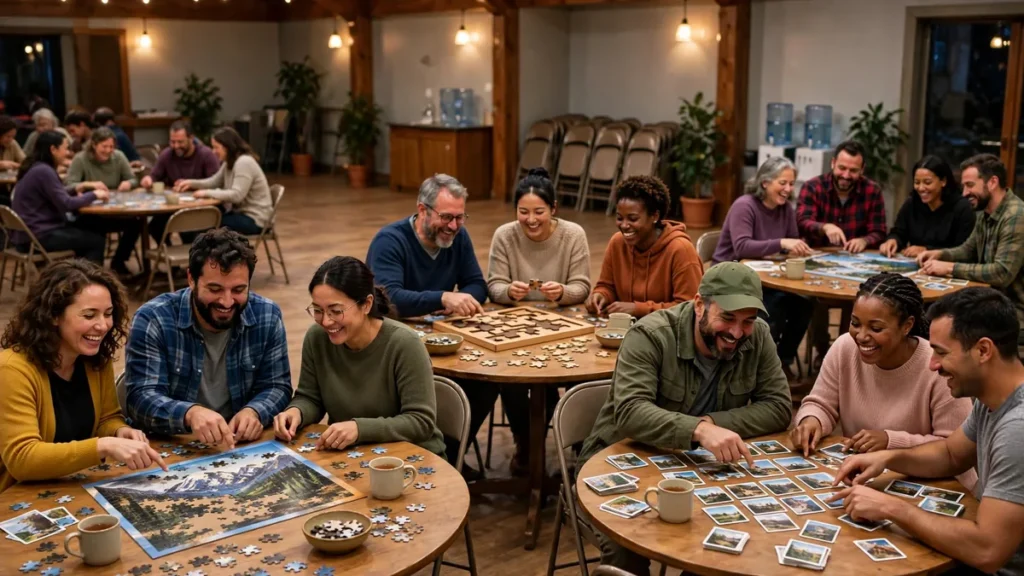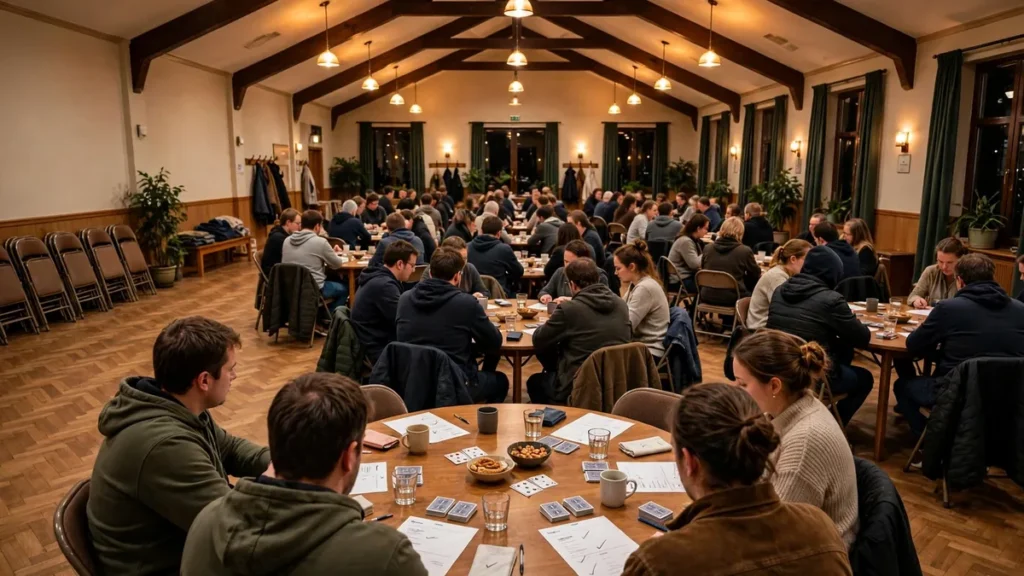
The best card games for 137 players are not the games with the biggest decks or the flashiest rules. They are the formats that survive a very large room: small teams at many tables, clear scoring that still works when twenty-seven teams hand in results at once, and rounds short enough that nobody at the back of the hall checks out. No single card game seats 137 players around one table, and any guide that pretends otherwise is selling a fantasy. What works instead is team play, multiple tables, tournament brackets, and whole-room rounds, and the ten formats below are ranked for exactly that job.
A group of 137 players changes card games in practical ways that have nothing to do with how clever the cards are. Sound has to reach the back of the hall, decks have to be dealt without long delays, and the gap between rounds has to be short enough to keep energy up. A standard deck holds 52 cards, so a single deck cannot even deal a hand to 137 people. The formats below solve those problems first, with several decks, team captains, and a visible scoreboard, and worry about clever card play second.
This guide covers ten proven formats, a comparison table so you can choose in two minutes, and a checklist covering the room, the decks, and the schedule. Whether you are running a company social, a school fundraiser, a community hall night, or a large family reunion, the same rules apply: keep teams small, keep rounds short, and keep the scoreboard visible. The closest sibling to this guide, the best card games for 136 players, uses the same team-and-tables logic, and most of the formats here scale up or down by one or two players without any change to the rules.
Key takeaways
- No single card game seats 137 players; every format in this guide works through teams of four to six, multiple tables, or whole-room play.
- Teams of five give you 27 teams of five plus one team of two, so plan for uneven teams and rotate the smaller team through the tables.
- Use at least one deck per table, plus spare decks, and give every table a printed score sheet so results come in cleanly.
- Short rounds of 10 to 15 minutes keep 137 players engaged, while one long game loses the room after the first half hour.
- One confident host, one microphone, and one visible scoreboard matter more than the choice of game.

Why 137 Players Changes Card Games Completely
A normal card night has four to eight players, one deck, and one table. A night with 137 players has roughly 28 tables, 28 decks, and 137 people who all need to know what is happening at the same time. That is a logistics problem before it is a games problem, and the hosts who succeed treat it that way. They arrive early, label the tables, test the microphone, and print more score sheets than they think they will need.
The cleanest answer is to let team sizes vary by one player and to rotate the smaller teams so nobody feels short-handed all night. A team of two can still play most of the formats below if it gets a small scoring adjustment, and a team of seven can split into a playing group and a scorekeeping group for one round. What matters is that every player has a seat, a hand, and a job in every round.
The Three Formats That Scale
Almost every large-group card format falls into one of three shapes. In team play, each table is one team or two teams facing each other, and the team score is what counts. In tournament play, tables play short matches and winners move up while other teams move down, so the room sorts itself into skill bands over the evening. In whole-room play, everyone plays the same game at the same time, following one host, and the cards are only a prompt for a shared reaction.
Team play is the easiest to run and the hardest to get wrong. Tournament play is the most exciting for competitive groups, but it needs a host who can move people between tables quickly. Whole-room play is the best opener, because it gets all 137 players laughing together before they split into tables. A good evening uses all three: a whole-room warm-up, two or three team rounds, and a short tournament finish.
How to Seat 137 Players
Start with the room, not the game. Count the tables first, then the chairs, then the decks. For 137 players, you need at least 28 tables if teams sit five to a table, or 34 tables if teams sit four to a table. Round tables seat five comfortably and six at a squeeze. Long tables seat eight, which is useful for two teams of four facing each other. Walk the room before the night and sit in the worst seat at the back; if you cannot hear a normal speaking voice from the front, you need a microphone and speakers.
Handling the Uneven Numbers
Do not try to force 137 into equal teams. Accept the remainder and build it into the plan. If you use teams of five, you have 27 teams of five and one team of two. Give that pair a bye in the first round, or pair them with a volunteer host for a friendly game, then rotate them into a full table for the next round. If you use teams of four, you have 34 teams of four and one spare player, who can act as a roaming scorekeeper or a substitute for any table that needs one.
The 10 Best Card Games for 137 Players
The ten formats below are ordered from the easiest to run to the most ambitious. The first three need nothing more than decks, tables, and a host. The middle four need a little more preparation, such as printed brackets or prompt cards. The last three are the ones to save for the second half of the evening, when the room is warm and the teams know each other.
1. Team Rummy Relay
Team rummy is the most reliable large-group card game, because almost everyone already knows the shape of it: collect sets and runs, lay them down, and shed your hand. In the relay version, each table plays a short hand, the team score is the total of its players, and the top two teams at each table move to a higher table for the next round. A round lasts about 15 minutes, which is long enough to feel like a real game and short enough to keep the evening moving.
2. Multi-Table Hearts Tournament
Hearts is a trick-taking game that scales well because each table plays its own self-contained game. In the tournament version, each table plays a short match to a fixed target, such as 50 points, and the lowest scorer at each table moves up a table while the highest scorer moves down. After three rounds, the players at the top tables are the strongest in the room, and everyone has played against a fresh set of opponents.
3. Spades League
Spades is a natural partner game, so it suits a room organised into pairs inside larger teams. Each table hosts two pairs, and the pair score feeds into the team total. Play short matches to 200 points, or set a 15-minute timer and score the match as it stands. The bidding is the part that makes spades fun at scale: a confident bid that succeeds earns a cheer from the whole table, and a failed bid gives the other pair a story to tell.
4. President Ladder
President, also known as Scum, is a climbing game in which players shed cards as fast as they can, and the first player out becomes President for the next hand. In the ladder version, the President at each table moves up a table, the player who finishes last moves down, and everyone else stays put. The movement is simple, the stakes are visible, and the game generates its own energy without any help from the host.
5. Euchre Rotation
Euchre is a fast trick-taking game for four players, which makes it a natural fit for tables of four. In the rotation version, each table plays a short match to five points, then the winning pair stays and the losing pair moves to the next table. Over an evening, every player meets a dozen new opponents, and the room feels sociable rather than locked into fixed groups.
6. Whole-Room Snap
Snap is the best whole-room opener for 137 players, because it needs no tables at all. The host stands at the front with a large deck, or with cards shown on a screen, and the whole room watches for matching pairs. Players call out, raise a hand, or slap a team buzzer when they spot a match, and the fastest correct call wins the point for their team. The game is loud, fast, and funny, and it wakes a room up in five minutes. If you want more whole-room ideas, the best party games for 135 players use the same one-host, whole-room structure with a wider mix of games.
7. Team Concentration Relay
Concentration, also called Memory, is a matching game that works as a relay when the room is large. Each team has a grid of face-down cards on its table, and players take turns turning over two cards to find a pair. In the relay version, a player who finds a pair scores for the team and takes another turn, while a miss passes play to the next teammate. The team with the most pairs when the grid is cleared wins the round.
8. War Bracket Tournament
War is the simplest card game of all, which is exactly why it works as a bracket tournament for 137 players. Two players flip a card each, the higher card wins both, and the winner is the player who ends up with the whole deck. In the bracket version, players face off in one-on-one matches at their tables, winners advance to the next table, and the room narrows from 137 players to a single champion over five or six rounds.
9. Crazy Eights Relay
Crazy Eights is a matching game in which players shed cards by matching the suit or rank of the top discard, with eights acting as wild cards. In the relay version, each team plays a hand together, discussing which card to play, and the team that sheds its hand first scores for the round. The team discussion is the point: it turns a simple game into a social one, and it lets shy players contribute without having to play alone.
10. Prompt Card Game Night
A prompt card game uses one deck of question cards and one deck of answer cards, and the humour comes from the combinations the teams create. In the large-group version, each team writes its best answer on a card, the host reads the best answers aloud, and the room votes for the winner by a show of hands. The game needs no card skill at all, which makes it the most inclusive format on this list, and it produces the most laughter per minute of any game here. For a quieter companion format after the laughter, the best board games for 136 players offer the same team-and-tables structure with longer, calmer games.
Comparison Table
| Game | Best for | Round length | Decks per table | Difficulty |
|---|---|---|---|---|
| Team Rummy Relay | Mixed ages, steady play | 15 minutes | 1 | Easy |
| Multi-Table Hearts | Competitive players | 10 minutes | 1 | Medium |
| Spades League | Pairs, confident bidders | 15 minutes | 1 | Medium |
| President Ladder | Fast movement, high energy | 5 to 8 minutes | 1 | Easy |
| Euchre Rotation | Familiar game, sociable play | 10 minutes | 1 stripped deck | Easy |
| Whole-Room Snap | Opening warm-up | 5 minutes | 1 large deck | Easy |
| Team Concentration Relay | Quiet round, mixed ages | 10 minutes | 1 | Easy |
| War Bracket Tournament | Simple final, clear champion | 3 minutes | 1 | Easy |
| Crazy Eights Relay | Beginners, family groups | 10 minutes | 1 | Easy |
| Prompt Card Game Night | Closing laughter, all abilities | 15 minutes | Prompt decks | Easy |
What You Need for 137 Players
The shopping list for a night like this is short, but the quantities matter. Buy or borrow at least 30 decks of standard playing cards, so every table has one and you have spares for lost or damaged cards. Add two stripped euchre decks if you plan to run euchre, one large-print deck for the whole-room snap, and a prompt deck if you plan to close with the prompt game. Cheap decks are fine for a single night, but plastic-coated cards last longer and survive spilled drinks.
Print the paperwork the day before: 40 score sheets, 40 one-page rules sheets for each game you plan to run, a seating list, and a large scoreboard sheet or a simple spreadsheet projected on a screen. Bring 40 pens, because pens vanish at large events, and bring tape, scissors, and spare table-number cards. A microphone with a speaker is not optional at this size, and a kitchen timer or a phone timer with a loud alarm is the host’s best friend.
Checklist for the Night
- Count tables and chairs for 137 players, label every table, and test the microphone from the back seat before anyone arrives.
- Prepare 30 decks, printed rules sheets, score sheets, pens, and a table kit for every table.
- Decide team sizes and the plan for the uneven remainder before the first round starts.
- Open with a five-minute whole-room game, then run two or three team rounds of 10 to 15 minutes each.
- Update the visible scoreboard after every round, and announce the leading teams by name.
- Finish with a short tournament final or prompt game, announce the winning team, and thank the volunteers by name.
Frequently Asked Questions
Can one card game really seat 137 players?
No. No single card game seats 137 players around one table, because a standard deck has only 52 cards and a table has limited space. Every format in this guide works by splitting 137 players into teams of four to six, spreading them across 28 or more tables, or playing a whole-room game led by one host.
How many teams should 137 players form?
Teams of five give you 27 teams of five plus one team of two, which is a good balance of sociable size and manageable numbers. Teams of four give you 34 teams of four plus one spare player. Choose the size that fits your tables, and plan the remainder in advance rather than improvising on the night.
How many decks do I need for 137 players?
At least one deck per table, which means 28 to 34 decks, plus four or five spares. Fast games such as President wear cards out, and a deck with missing cards slows a table down, so spares are worth the small cost.
How long should a card night for 137 players last?
Two to three hours is the right length, including a break. That allows a five-minute whole-room opener, three or four rounds of 10 to 15 minutes, a short tournament final, and time for results and thanks. Longer than three hours, and the back tables start to drift.
What if some players have never played card games?
Start with the easiest games on this list, such as snap, war, concentration, and crazy eights, and put one experienced player at each table for the first round. Print one-page rules sheets, keep rounds short, and choose team formats so beginners are never playing alone against an expert.
What is the best game to finish the night with?
A war bracket final or a prompt card game makes the best finish. The war final produces a single champion in front of the whole room, while the prompt game produces the most laughter. Either one gives the evening a clear ending, which matters when 137 people need to leave at roughly the same time.
Bottom Line
The best card games for 137 players are the ones that respect the size of the room: small teams, many tables, short rounds, and one host keeping everyone together. Team rummy and hearts give you solid, reliable play, President and snap give you energy, and a war final or prompt game gives you an ending worth staying for. Plan the seating and the scoring before you worry about the games, keep the scoreboard visible, and let the teams do the rest. A room of 137 players does not need a complicated game. It needs a clear plan, enough decks, and a host who keeps the rounds moving.