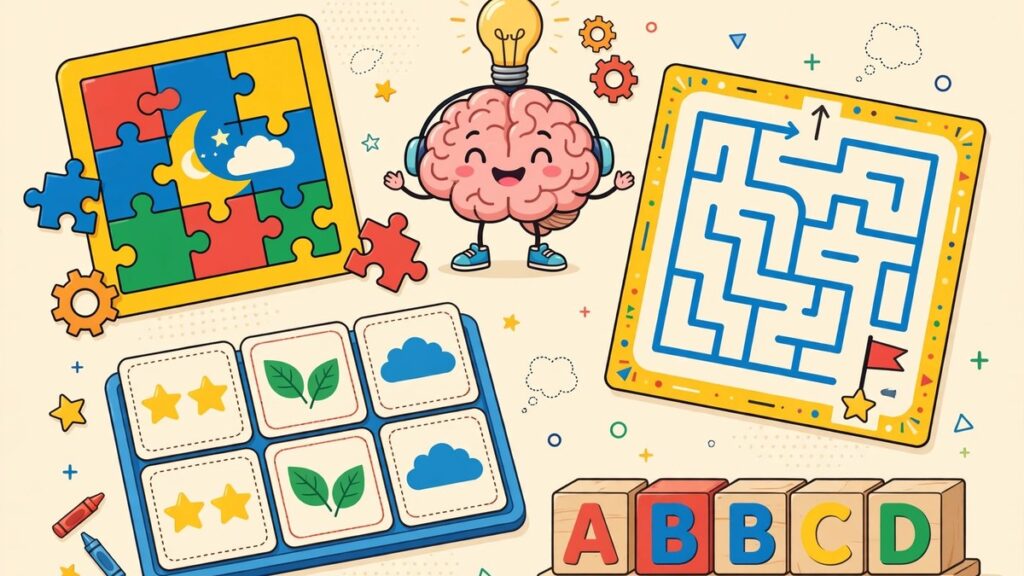
Every parent and teacher knows the same happy problem: kids love games, but not every game helps them grow. The best brain games for kids do both at once. They feel like play — matching cards, solving a maze, outsmarting a friend at chess — while quietly building memory, logic, vocabulary, focus, and patience. A child who plays a good brain game every day is practising the exact skills that make school easier, from remembering instructions to thinking through a tricky maths problem step by step.
What makes a brain game truly great for a child is not how flashy it looks. It is whether the challenge fits the child’s age, whether the rules are simple enough to learn in five minutes, and whether the game can grow harder as the child gets better. A memory game that is too easy bores a ten-year-old, while a strategy game that is too complex frustrates a five-year-old. The sweet spot is a game that makes a child think, smile, and ask to play again tomorrow. That is the list we have built here: games that work at the kitchen table, in the classroom, and on long car journeys, with no screens required for most of them.
In this guide, we cover the best brain games for kids across six kinds of thinking: memory, logic, words, puzzles, focus, and strategy. For each game you will find how it works, the right age range, how hard it is, and who it suits best. We have also added quick games you can play right now with no equipment at all, a comparison table to help you choose, and a simple checklist for picking the perfect game for your child. Whether you are shopping for a birthday, planning a classroom activity, or just looking for a fun way to spend a rainy afternoon, there is a brain game here your child will love.
Key takeaways
- Memory games build recall and concentration, and they work best for ages 4 and up, starting with just a few pairs of cards.
- Logic games teach children to think step by step, spot patterns, and solve problems without guessing.
- Word games grow vocabulary and spelling while keeping reading fun, from simple rhymes to full word searches.
- Puzzle games such as jigsaws, mazes, and tangrams build spatial thinking and patience.
- The best brain game for any child is one that matches their age, stretches them a little, and is fun enough to play again and again.

Memory Games: Training Young Minds to Remember
Memory games are the classic starting point for brain training, and for good reason. They ask children to hold pictures, words, or numbers in their minds and recall them a moment later. That simple act strengthens working memory, which is the mental notepad children use to follow instructions, remember a story, and do mental maths. A child with a strong working memory finds it easier to listen to a teacher, keep track of a multi-step task, and learn new words.
The most famous memory game is the matching pairs game, often called Concentration. Lay a set of cards face down, turn over two at a time, and keep the pair if they match. Start with six pairs for a four-year-old and build up to twenty or more pairs for older children. The game works because children must remember where they saw each picture, and every turn gives them new information to store. You can make your own set with family photos, animal pictures, or flashcards of numbers and letters, which turns the game into a learning tool as well.
Another wonderful memory game needs no cards at all. In the game “I went to the shops and I bought…”, the first player names an item, the next player repeats it and adds one more, and the list grows until someone forgets. It is perfect for car journeys and waiting rooms, and it teaches children to use memory tricks such as picturing the items or grouping them together. Simon Says with a memory twist, where children must remember a growing sequence of actions, builds the same skill while getting them moving. For older children, try the tray game: place ten objects on a tray, let them look for thirty seconds, cover the tray, and ask them to list everything they saw. Swap one object and ask what changed for an extra challenge.
Memory games suit ages 4 to 12, with difficulty that scales easily by adding more items or shorter viewing times. They are best for children who need help with focus and recall, and they are a gentle first brain game for shy children because there is no reading or maths involved. Play for ten to fifteen minutes a day and you will notice the difference within a few weeks: longer lists remembered, fewer forgotten instructions, and a child who is proud of a growing memory.
Logic Games: Learning to Think Step by Step
Logic games teach children the most valuable thinking skill of all: how to work through a problem one step at a time instead of guessing. A logic puzzle gives a child clues and asks them to figure out the answer, which builds reasoning, pattern spotting, and patience. These are the skills behind maths, science, and coding, but children simply experience them as satisfying puzzles to crack.
Sudoku for kids is a brilliant place to start. A 4×4 grid with pictures instead of numbers is perfect for ages 5 to 7, while a 6×6 or easy 9×9 number grid suits ages 8 and up. The rule is simple — each row, column, and box must contain each symbol once — but finding the answer takes careful thinking. Children learn to scan, eliminate options, and check their work, all without realising they are doing maths. Mazes work the same way: a child must plan a route, try a path, backtrack when it fails, and try again, which is exactly how real problem solving works.
For a quick logic game you can play anywhere, try the “20 questions” style guessing game with a twist: think of an animal and let your child ask only yes-or-no questions to work out what it is. Good players learn to ask questions that split the possibilities in half, such as “Does it live in water?” rather than guessing animals one by one. Another favourite is the pattern game: lay out a sequence of coloured blocks or shapes, hide one, and ask your child to spot the missing piece or predict what comes next. If your child enjoys a gentle challenge, our collection of easy brain teasers for kids with answers is a perfect next step, with puzzles that build logic skills one riddle at a time.
Logic games suit ages 5 to 12, and difficulty ranges from simple pattern games for young children to full Sudoku and logic grid puzzles for older ones. They are best for children who love a challenge and for those who rush their schoolwork, because logic games reward slowing down and thinking carefully. Ten minutes of logic play a day builds the habit of checking work and thinking before answering.
Word Games: Building Vocabulary the Fun Way
Word games turn language into play, and they are one of the easiest ways to grow a child’s vocabulary, spelling, and reading confidence. When a child hunts for words in a puzzle or invents a rhyme under pressure, they are practising the same skills they need for reading and writing — but it feels like a game, not homework. Word games also build quick thinking, because many of them are played against the clock or against another player.
Word searches are the classic choice. A grid of letters hides words that children must find by scanning rows, columns, and diagonals. They are wonderful for ages 6 and up, and you can theme them around animals, space, food, or school subjects so children learn new words while they play. For older children, crosswords build spelling and general knowledge at the same time, while word ladder games — changing one letter at a time to turn CAT into DOG, for example — teach children how words are built. Scrabble Junior and simple anagram games, where children rearrange letters to make new words, are excellent for ages 7 to 12 and work brilliantly as family games.
One of the best word games needs nothing but voices: the rhyming chain. One player says a word, the next must say a word that rhymes with it, and the chain continues until someone cannot think of one. It is fast, funny, and perfect for building sound awareness in younger children. For older children, try the categories game: pick a letter and a category, such as animals or foods, and race to name as many as you can in a minute. If your child loves hunting for hidden words, the best word search puzzles for teens offer a bigger challenge for confident readers who are ready to move beyond children’s puzzles.
Word games suit ages 5 to 13, with difficulty from simple rhymes and picture word searches for young children to crosswords and anagrams for older ones. They are best for children who love stories and reading, and for children who need extra spelling practice in a low-pressure way. A daily word game of ten minutes builds vocabulary steadily and makes reading feel like fun rather than work.
Puzzle Games: Jigsaws, Mazes, and Brain Teasers
Puzzle games are the quiet heroes of brain training. A jigsaw puzzle asks a child to study shapes, colours, and edges, rotate pieces in their mind, and keep going when the answer is not obvious. That is spatial reasoning and persistence in action, and it is why puzzles are a favourite in classrooms around the world. Children who do puzzles regularly become better at visualising shapes, following instructions, and sticking with a hard task until it is done.
Start young children with wooden puzzles of 12 to 24 pieces, then move to 48, 100, and 200-piece jigsaws as they grow. By ages 9 to 12, many children can happily tackle 500-piece puzzles, especially with a friend or parent helping. Tangrams are another wonderful puzzle: seven flat shapes that can be rearranged to make hundreds of pictures, from animals to houses. They teach geometry without a single worksheet. Building blocks and construction sets belong here too, because every tower a child builds is a small engineering puzzle about balance, shape, and planning.
Brain teasers and riddles deserve a special place in this category because they train flexible thinking — the ability to look at a problem from a different angle. A riddle such as “What has keys but cannot open a single lock?” (a piano) teaches children that words can have more than one meaning and that the obvious answer is not always the right one. For children ready for a tougher test, our hard riddles for kids will stretch their thinking and give the whole family something to puzzle over together at dinner.
Puzzle games suit ages 3 to 12, with difficulty that grows naturally with piece count and puzzle complexity. They are best for children who like quiet, focused play and for those who need to build patience. Puzzles are also wonderful for winding down before bed, because they calm the mind while still keeping it active.
Focus Games: Building Attention One Round at a Time
Focus is a skill, not a talent, and games are one of the best ways to train it. Focus games ask children to pay close attention, ignore distractions, and stay with a task until it is finished. In a world full of screens and noise, that ability is more valuable than ever, and it directly helps children in school, where listening carefully is half the lesson.
Spot the difference is a perfect focus game for ages 4 and up. Two nearly identical pictures hide small changes, and children must scan carefully to find them all. It trains visual attention and teaches children to slow down and look properly. The “what is missing” game works the same way: look at a set of objects, close your eyes, and spot what has been taken away. For older children, listening games such as “Simon Says” with tricky instructions, or a game where children must clap only when they hear a certain word in a story, build the ability to listen carefully for a long time.
Board games such as Bingo and simple card games also build focus, because children must watch every turn and remember what has already happened. A quick focus game to try today is the counting game: count backwards from 50 by twos, or count the number of red things you can see from the window in one minute. It sounds simple, but it takes real concentration, and children love beating their own best score. Keep focus games short — five to ten minutes is plenty for younger children — and always end on a success so they want to play again.
Focus games suit ages 4 to 12 and are best for children who find it hard to sit still or finish tasks. They are also a gentle way to help children who feel overwhelmed by schoolwork, because the games are short, clear, and winnable. A little daily focus play builds the habit of paying attention, one round at a time.
Strategy Games: Thinking Ahead Like a Champion
Strategy games are where brain training becomes a contest of wits. In a strategy game, children must plan ahead, predict what their opponent will do, and change their plan when things go wrong. That is advanced thinking, but children learn it naturally through play, one move at a time. Strategy games also teach graceful losing, because even the best players lose sometimes, and working out why is part of getting better.
Chess is the king of strategy games, and children can start learning it from age 6 with simplified rules — play with just the pawns first, then add one new piece at a time. Checkers, known as draughts in some countries, is simpler and perfect for ages 5 and up, while Connect Four teaches planning and blocking in a game that lasts five minutes. For older children, games such as Battleships, which build logic and memory together, and simple card games where children must decide when to hold and when to play, are excellent next steps.
A lovely strategy game to try with no board at all is noughts and crosses, or tic-tac-toe, played properly: teach your child to look for two ways to win at once, so their opponent can only block one. Once they master that, they are thinking strategically. Another is the “guess my number” game, where children must use clever questions to find a number between 1 and 100 in as few guesses as possible. Strategy games suit ages 6 to 13, and difficulty ranges from simple two-player board games to full chess. They are best for competitive children and for those who love planning and outsmarting others.
Quick Brain Games You Can Play Right Now
You do not need to buy anything to start training your child’s brain. Here are five quick games that need no equipment and can be played in the car, at the dinner table, or in a waiting room. First, the alphabet game: pick a category such as animals and take turns naming one for each letter of the alphabet, from A to Z. Second, the opposite game: one player says a word and the other must say its opposite as fast as possible — hot, cold; up, down; happy, sad. Third, the story chain: one person starts a story with one sentence, the next adds a sentence, and the story grows stranger and funnier with every turn.
Fourth, the counting challenge: choose a number, such as 7, and count to 50 together, clapping instead of saying any number that contains a 7 or is a multiple of 7. It is surprisingly hard and wonderfully fun. Fifth, the memory shopping list: as described earlier, build a growing list of items and see how long your family can keep it going. These games take five minutes, cost nothing, and build memory, vocabulary, logic, and focus all at once. Keep a few in your back pocket for every journey and queue.
How to Choose the Right Brain Game for Your Child
Choosing a brain game is easier when you match the game to your child, not to what other children are playing. Start with age: check the box, but trust your knowledge of your child more, because children develop at different speeds. A game should be a little bit hard — easy enough to enjoy, hard enough to make them think. If your child wins every time without trying, move up a level. If they lose every time and stop smiling, step down a level and try again later.
Think about what your child needs most. A child who forgets instructions will benefit most from memory games. A child who rushes and guesses will grow from logic and puzzle games. A child who struggles with reading will love word games, and a restless child will benefit from focus games that are short and active. A child who loves competition will thrive on strategy games. And remember that variety matters: rotate games so your child practises different kinds of thinking across the week, rather than playing the same game every day.
Finally, play together. Children learn most from games when a parent, grandparent, or older sibling plays with them, talks through the thinking, and celebrates good moves. Ask questions such as “What do you think will happen if you do that?” and “Is there another way to solve this?” Those conversations turn a simple game into a real lesson in thinking. Keep sessions short for younger children — ten to fifteen minutes is ideal — and let your child choose the game sometimes, so play stays joyful.
Comparison Table: The Best Brain Games for Kids at a Glance
| Game Type | Best Ages | Difficulty | Main Skill | Best For |
|---|---|---|---|---|
| Memory matching games | 4–12 | Easy to medium | Recall and concentration | Remembering instructions |
| Kids Sudoku and mazes | 5–12 | Easy to hard | Logic and reasoning | Step-by-step thinking |
| Word searches and crosswords | 6–13 | Easy to medium | Vocabulary and spelling | Reading confidence |
| Jigsaw puzzles and tangrams | 3–12 | Easy to hard | Spatial thinking and patience | Quiet focused play |
| Spot the difference | 4–12 | Easy to medium | Attention and detail | Building focus |
| Chess and checkers | 6–13 | Medium to hard | Planning and strategy | Thinking ahead |
| Riddles and brain teasers | 6–12 | Medium to hard | Flexible thinking | Creative problem solving |
| Rhyming and category games | 5–10 | Easy | Language and quick thinking | Car journeys and waiting rooms |
Your Brain Game Checklist
- Match the game to your child’s age and stage, and move up a level when it becomes too easy.
- Pick games that stretch one skill at a time, such as memory, logic, words, or strategy.
- Keep play sessions short and regular: ten to fifteen minutes a day beats one long weekly session.
- Rotate different types of games across the week so your child practises many kinds of thinking.
- Play together and talk about the thinking behind each move, not just who wins.
- Celebrate effort and good thinking, not just winning, so your child keeps trying hard games.
Frequently Asked Questions
What age should children start playing brain games?
Children can start with simple brain games from age 3 or 4, such as matching pairs, simple puzzles, and rhyming games. The key is to choose games that fit the child’s stage: picture-based games for young children, and word, logic, and strategy games as they grow. A game that is a little bit challenging is ideal.
How long should a child play brain games each day?
Ten to twenty minutes a day is plenty for most children. Short, regular play builds skills better than one long session once a week. For children under six, keep sessions to about ten minutes, and always stop while the game is still fun so they want to come back tomorrow.
Are brain games better than screen time?
Hands-on brain games have real advantages: they build social skills, patience, and fine motor control, and they do not come with the distractions of a screen. That said, a good educational app played for a short time can also help. The best balance is mostly hands-on games with a little screen play, always with an adult nearby to talk about what the child is learning.
Which brain game is best for a child who struggles with focus?
Start with short focus games such as spot the difference, the tray game, and Simon Says. Keep each round to five minutes, celebrate every success, and build up slowly. Memory matching games are also excellent, because they reward careful attention with a visible win every time a pair is found.
Can brain games help with school work?
Yes. Memory games help children remember instructions and facts, logic games help with maths and problem solving, and word games build vocabulary and spelling. The skills transfer because they are the same thinking skills school asks for, practised in a fun, low-pressure way. Teachers often notice the difference within a few weeks of regular play.
What is the best first strategy game for a child?
Connect Four is a wonderful first strategy game because the rules take one minute to learn and every game lasts about five minutes. Checkers is the next step, and chess can follow from age 6 or 7, starting with just a few pieces. The best first game is the one your child enjoys enough to play again and again.
The Bottom Line
The best brain games for kids are the ones that make thinking feel like play. Memory games build recall, logic games teach step-by-step reasoning, word games grow vocabulary, puzzles build patience and spatial thinking, focus games train attention, and strategy games teach children to plan ahead. You do not need expensive toys or screens: a pack of cards, a puzzle, a pencil, and a willing adult are enough to start. Pick one game from this guide, play it together today, and watch your child’s thinking grow one game at a time.
Note: Every child develops at their own pace, so use the age ranges in this guide as a starting point and trust your knowledge of your own child. If a game feels too hard, step down a level and try again later; if it feels too easy, add a challenge such as a timer or extra pieces. The goal is joyful, regular play that builds a love of thinking for life.


