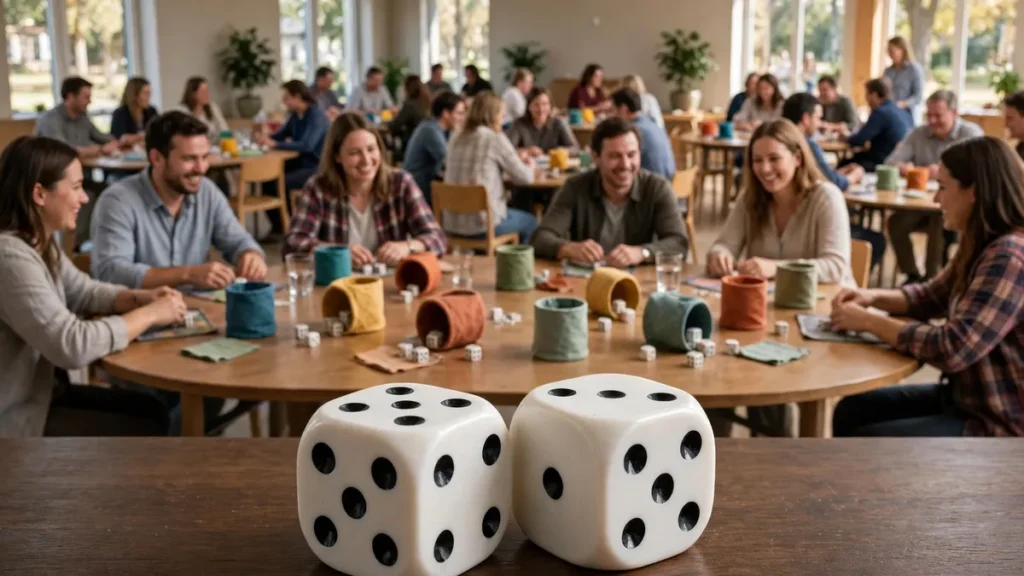
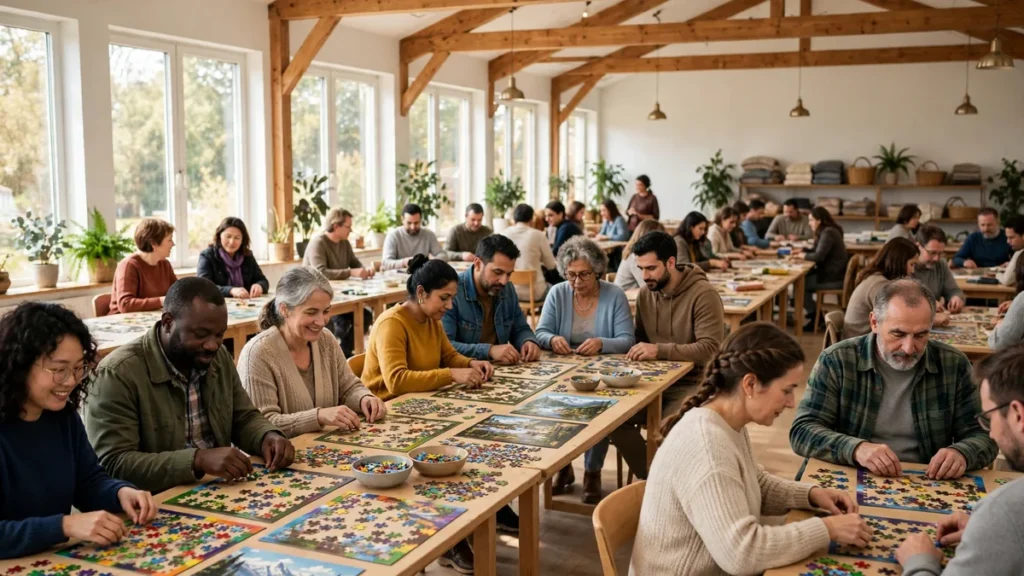
Finding the best word games for 144 players starts with an honest fact: no single word game is designed to seat 144 people around one table. A gathering of 144 players is a whole hall, a school assembly, a company event, or a large family reunion, and the games that work at that scale split the crowd into teams, run across many tables at once, or turn the entire room into one playing field. The best word games for 144 players are therefore not boxed games with a player count on the lid. They are formats and tournaments that keep every one of those 144 people playing at the same time, instead of leaving most of them watching.
That distinction matters because the usual advice for large groups fails at this size. A game that works beautifully for twelve people can collapse with 144, with rounds that drag and half the room checking out. Each format in this guide scales cleanly to 144 players through teams of six, multiple tables, relay rounds, or whole-room play.
In this guide you will find seven word game formats that genuinely work for 144 players, a comparison table to help you pick the right one, a step-by-step setup plan, scoring systems that keep 24 teams honest, and answers to the questions organisers ask most often. Whether you are planning a school literacy day, a corporate team event, or a giant family game night, these are the word games for 144 players that will fill the room with noise, laughter, and friendly competition.
Key takeaways
- No single boxed word game seats 144 players, so the best formats use teams, multiple tables, relays, or whole-room play.
- Split 144 players into 24 teams of six for the fairest balance of participation, noise, and manageable scoring.
- Whole-room games such as word bingo and giant crossword races keep all 144 players active at the same time.
- Parallel-table tournaments let every team play the same game simultaneously and compare scores at the end of each round.
- Prepare printed answer sheets, a master scoreboard, and a clear host script before the event, because 144 players leave no room for improvisation.

Why 144 Players Changes Everything
A word game for 144 players is a logistics challenge before it is a game. One hundred and forty-four people need chairs, tables, answer sheets, pens, and a way to hear the host. They need a scoring system that 24 teams can trust, and rounds short enough that nobody gets bored. The games that survive these demands share three traits: simple rules that can be explained in under two minutes, simultaneous play so nobody waits for a turn, and scoring that volunteers can handle between rounds.
Team size is the first decision, and it shapes everything else. Teams of six work best for 144 players because six people can huddle around one table, debate a word, and reach a decision quickly, while still giving every person a voice. Teams of four would mean 36 tables and 36 sets of materials. Teams of twelve would mean only 12 tables, but half of each team would sit silently while the loudest two players took over. Twenty-four teams of six is the sweet spot, dividing neatly into 24 tables, 24 answer sheets per round, and a scoreboard with 24 rows.
The second decision is whether the whole room plays one game together or whether each table plays its own copy of the same game. Whole-room games are simpler to run and create a shared buzz, because everyone reacts to the same clue at the same moment. Parallel-table games are better for skill-based play, because each team works at its own pace. Most successful 144-player events mix the two, opening with a whole-room warm-up, running two or three parallel-table rounds in the middle, and closing with a whole-room final. If you are choosing games for a smaller adult crowd first, the ideas in our guide to word games for adults adapt well to team play.
The Best Word Games for 144 Players
The seven formats below are ranked by how well they handle a crowd of 144, how easy they are to run, and how much fun they create. Each one includes the setup, the rules in brief, and what makes it work at this scale. Pick two or three for a two-hour event, and use the comparison table to match each format to your audience.
| Game format | How 144 players take part | Best for | Time per round | Materials needed |
|---|---|---|---|---|
| Team tile tournament | 24 teams of six at separate tables | Competitive players | 25 minutes | 24 tile sets, score sheets |
| Whole-room word bingo | Everyone plays at once | Warm-ups, mixed ages | 15 minutes | 144 bingo cards, caller list |
| Relay anagrams | Teams race in relay lines | High energy events | 20 minutes | Letter cards, timers |
| Giant crossword race | Teams solve the same grid | Schools, literacy days | 20 minutes | Printed grids, clue sheets |
| Word chain relay | Teams build chains in turns | Quick rounds, all ages | 10 minutes | Whiteboards or paper |
| Whole-room word quiz | Everyone answers together | Finals, mixed ability | 20 minutes | Answer sheets, quiz slides |
| Team spelling showdown | Teams spell in rotation | Finale, spectators | 25 minutes | Word list, microphones |
1. Team Tile Tournament
The team tile tournament is the closest thing to a classic board word game at the scale of 144 players. Each of the 24 tables gets its own set of letter tiles and a grid sheet, and each team of six plays a full game against the clock rather than against a single opponent. Players take turns within their team, discussing each word before it is placed, so the game becomes a collaboration instead of a duel. At the end of the round, teams report their scores toward an overall total.
This format works because it uses familiar rules most adults already know, so the host spends almost no time explaining, and every team plays at the same time. The main cost is materials: 24 complete tile sets is a serious investment, although many schools and game clubs already own several sets and can borrow the rest. If buying 24 sets is out of reach, use printed letter grids instead of physical tiles.
2. Whole-Room Word Bingo
Word bingo is the best warm-up game for 144 players because it needs almost no explanation and every single person plays from the first minute. Each player receives a bingo card printed with words instead of numbers, and the host calls out definitions, synonyms, or clues rather than the words themselves. Players mark the matching word, and the first players to complete a row, column, or full card call out and win. With 144 cards in play, several people will finish at nearly the same time, so award prizes to the first three finishers.
The trick to fair word bingo at this scale is card design. Print at least 24 different card layouts so no two neighbouring players share the same card, and shuffle the layouts when you hand them out. Use words that suit your audience: everyday vocabulary for a family event, themed words for a holiday party, or subject vocabulary for a school day.
3. Relay Anagrams
Relay anagrams turn word unscrambling into a physical race, which makes them one of the liveliest word games for 144 players. Each team lines up behind a marked line, and a set of jumbled letter cards waits at the far end. One player at a time steps forward, rearranges the letters into a real word, and tags the next teammate. The team that correctly solves the most anagrams in the time limit wins. The relay structure means every player gets several turns instead of watching the fastest speller do all the work.
Running a relay for 24 teams needs space and clear lanes, so this format suits halls, gyms, and outdoor areas better than cramped rooms. Mark each lane with tape or cones, keep the letter cards large enough to read from a step away, and appoint one volunteer per four teams to judge answers. The large-group logic here is similar to the games in our guide to word games for 100 players, where the same team-and-relay structure keeps a very large crowd playing instead of watching.
4. Giant Crossword Race
In a giant crossword race, every team receives the same crossword grid and clue sheet, and the race is on to complete the most correct answers before time runs out. Teams of six divide the clues among themselves, then check each other’s answers where the words cross. The shared grid means results are directly comparable, and the crossing letters create natural teamwork, because a wrong answer in one place blocks the answers around it. This is the most academic of the seven formats, and it shines at school literacy days, library events, and quiz nights.
Design the crossword carefully for a crowd of 144. Aim for a grid of around 20 to 25 words, with a mix of short, confidence-building answers and a few longer, trickier ones. Print the grid large, at least one full page per team, and the clues on a separate sheet so teams can split the work. Award points per correct word rather than a single winner-takes-all prize.
5. Word Chain Relay
Word chain is one of the simplest word games in existence, and that simplicity is exactly why it works for 144 players. Each team builds a chain of words where every new word begins with the last letter of the previous word, such as apple, elephant, tiger, rabbit. In the relay version, teams write their chains on a whiteboard or a long sheet of paper, with players taking turns to add the next word. Teams score a point for every valid word, and the round ends when the timer sounds.
Word chain needs no special equipment and no preparation beyond a timer and something to write on. It also scales perfectly, because the difficulty is self-adjusting: stronger teams produce longer, cleverer chains, while weaker teams can still score with simple words. Set a rule that no word can be repeated within a team’s chain, and have a volunteer check each chain for made-up words before counting points.
6. Whole-Room Word Quiz
A whole-room word quiz is the most flexible format for 144 players, because the host controls the difficulty, the pace, and the topics. Each team receives an answer sheet, and the host reads out rounds of word questions: definitions, anagrams, missing letters, rhyming pairs, and odd-one-out puzzles. Teams discuss each question quietly, write down one answer per team, and hand in their sheets at the end of each round. Teams then swap sheets and mark each other’s answers against the revealed answer key.
The quiz format suits mixed-ability crowds better than any other game on this list, because the host can include easy questions everyone can answer alongside harder ones that separate the top teams. Write five rounds of ten questions, keep each round to about four minutes, and announce the running scores between rounds to build tension.
7. Team Spelling Showdown
The team spelling showdown is the showpiece finale for a 144-player event. After the earlier rounds, the top four or six teams come to the front of the hall, and the remaining teams become the audience, cheering for their favourites. Each team takes turns spelling words aloud, with teammates allowed a short huddle before answering. A correct spelling scores a point, a wrong spelling passes the word to the next team, and the team with the most points wins. The audience stays involved because the words are displayed on a screen and everyone can play along silently.
This format works as a finale rather than a main event because only a few teams are on stage, but that is also its strength: it gives the event a climax, a visible winner, and a moment the whole room remembers. Choose words that are challenging but fair, and give each team a firm time limit of thirty seconds per word. Have a small prize for every finalist team so the showdown feels like a celebration.
How to Set Up Word Games for 144 Players
Good setup is what separates a smooth 144-player event from a chaotic one, and most of the work happens before anyone arrives. Start with the room: 24 tables of six, arranged with clear aisles so volunteers can reach every team and the host can be seen and heard from every seat. Place a table number on each table and a matching number on every answer sheet, so scoring never gets mixed up. Put the scoreboard where everyone can see it and update it after every round.
Prepare materials in team packs rather than loose piles. Each pack should contain everything that team needs for the whole event: answer sheets for each round, pens, a copy of the rules, and any game-specific items such as bingo cards or crossword grids. Hand out one pack per table as teams sit down, and collect used sheets at the end of each round.
Recruit volunteers early and give each one a clear job. You will need a host, a scorekeeper, and at least six floor volunteers for 144 players, with one volunteer responsible for four tables. Floor volunteers hand out and collect sheets, answer rule questions, and check answers during relay rounds. Brief them with a short written guide, and test the microphone in the actual room, because a host who cannot be heard by 144 people cannot run the event. The team structures in our guide to puzzle games for 105 players offer useful ideas for splitting a big crowd into fair, manageable teams.
Scoring and Tournament Formats
Fair scoring is essential when 24 teams compete, because a disputed result can sour the whole event. The simplest system is points per round: each game awards points based on finishing position, with the top team earning 24 points, the second earning 23, and so on down to one point for the last team. Add the points across all rounds, and the team with the highest total wins. This system rewards consistency, so a team that finishes near the top in every round beats a team that wins one round and finishes last in the others.
An alternative is the cumulative system, where teams keep the actual points they score in each game, such as the number of correct words, and the totals are added together. This system rewards big performances and suits events where the games produce countable scores, like crosswords and quizzes. Whichever system you choose, announce it before the first game, display the running totals after every round, and have a written tie-breaker ready.
Checklist for Your 144-Player Word Game Event
- Book a hall with space for 24 tables of six, clear aisles, and a tested microphone and speaker system.
- Divide 144 players into 24 teams of six and label every table and answer sheet with matching team numbers.
- Prepare team packs with all answer sheets, pens, rules, and game materials, plus ten percent extra of everything.
- Recruit a host, a scorekeeper, and at least six floor volunteers, and brief them with a written guide before the event.
- Choose two or three game formats from this guide, prepare a master scoreboard, and decide the tie-breaker in advance.
- Test the sound system, the projector, and the timing of each round with a short practice run before players arrive.
Frequently Asked Questions
Can one word game really handle 144 players?
No single boxed game seats 144 players, but the formats in this guide handle 144 players by splitting them into teams, running the same game at many tables at once, or playing whole-room games where everyone answers together. Choose formats built for simultaneous play rather than turn-taking.
How many teams should 144 players form?
Twenty-four teams of six is the best split for 144 players. Teams of six are small enough that everyone can contribute, and 24 teams keep the number of tables and score sheets manageable.
How long does a word game event for 144 players take?
A good event lasts about two hours, including a short welcome, three or four game rounds of 15 to 25 minutes each, scoring breaks, and a finale. Add thirty minutes for arrival and seating if players are registering at the door.
What equipment do I need for 144 players?
You need 24 tables, 144 chairs, printed answer sheets and pens for every team, a scoreboard, a microphone and speakers, and the materials for your chosen games, such as tile sets, bingo cards, or crossword grids.
Are these word games suitable for mixed ages?
Yes, most of these formats suit mixed ages well, because teams can mix strong and weaker players and the team format lets everyone contribute. Word bingo, word chain, and the whole-room quiz are the most age-friendly, while the tile tournament and crossword race suit older children and adults best.
What is the best finale for a 144-player word game event?
The team spelling showdown is the best finale, because it brings the top teams to the front of the hall and turns the rest of the room into an audience. A whole-room word quiz also works well, because all 144 players take part in deciding the winner at the same time.
The Bottom Line
The best word games for 144 players are not the games with the biggest player counts on their boxes. They are the formats that respect what 144 people actually need: teams of six that give everyone a voice, simultaneous play that leaves nobody waiting, simple rules that can be explained in two minutes, and scoring that the whole room can trust. Start with word bingo to warm the hall up, run a tile tournament and a crossword race in the middle, and finish with a spelling showdown. Prepare your team packs, brief your volunteers, test your microphone, and decide your tie-breaker before the day begins.