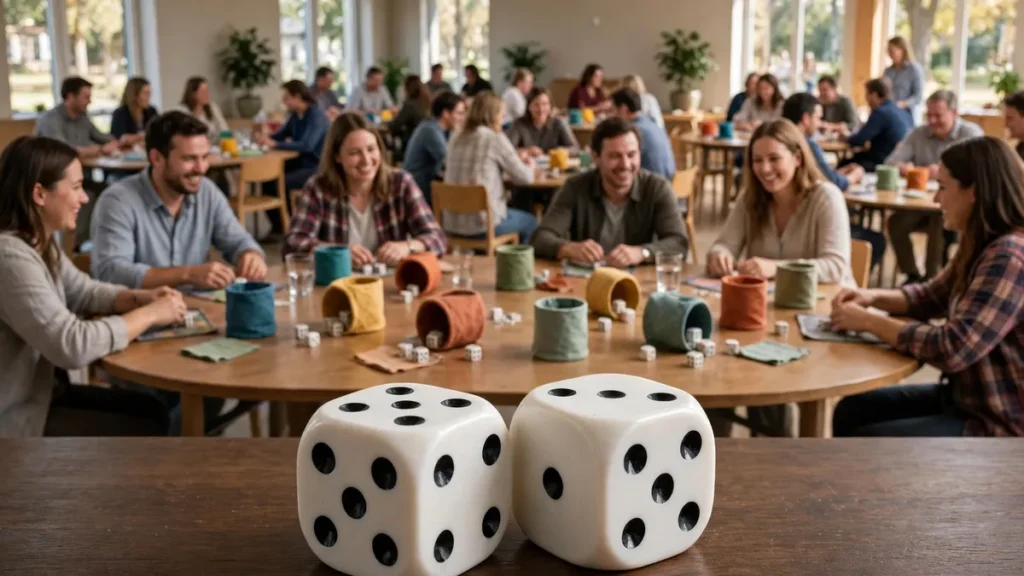
Finding the best board games for 144 players starts with an honest fact: no single board game seats 144 people around one table. The largest party games top out at twenty or thirty players. A gathering of 144 players is not one game night. It is a whole event, and the games that work at that scale split cleanly into teams, run in parallel across many tables, or turn an entire room into a single playing field.
That is good news rather than bad. A 144-player night can be more fun than a standard game night, because the scale itself becomes part of the entertainment. Teams develop rivalries, scores travel from table to table, and a quiet player can shine as the strategist of a twelve-person squad.
This guide covers the board games for 144 players that genuinely work at that scale, the three formats that make them work, and the setup that keeps 144 people playing instead of waiting. Every recommendation below is built for team play, multiple tables, tournament brackets, or whole-room play, and every game can be learned in minutes and run with a small crew of volunteer hosts.
Key takeaways
- No board game seats 144 players at one table, so the best board games for 144 players are team games, multi-table games, and whole-room games.
- Split 144 players into 12 teams of 12, or 18 tables of 8, and run the same game in parallel with a shared scoreboard.
- Word, drawing, guessing, and trivia games scale best because turns are simultaneous and nobody waits long.
- One host per table and one central scorekeeper keep a 144-player night moving on schedule.
- Run a short practice round first so every table learns the rules at the same time.

Why 144 Players Changes Everything About Board Games
Most board games are designed for two to six players sitting close enough to reach the same board. At 144 players, that model breaks in every direction: nobody can see a single board from the back of a hall, a turn order of 144 would take an hour to complete one round, and one set of components cannot be shared by dozens of hands.
The games that scale share three traits. First, they allow simultaneous play, so all 144 people act at the same time instead of waiting for a turn. Second, they work in teams, so one copy can serve a whole table that argues, votes, and decides together. Third, they have simple rules a volunteer host can explain in under three minutes.
That is why word, drawing, guessing, and trivia games dominate every serious list of board games for 144 players. A team of twelve can debate one clue together, a drawing relay can pass sketches down a line, and a trivia round can put the same question in front of every table at once.
How a 144-Player Board Game Night Actually Works
Before choosing games, choose a format. It decides how many copies and hosts you need, and whether the night feels like a festival or a queue. Three formats cover almost every successful 144-player event.
The Multi-Table Model
The multi-table model is the simplest way to run board games for 144 players. Divide the room into tables of six to eight, place one copy of the same game on every table, and run all tables in sync. With 144 players at tables of eight, you need eighteen tables and eighteen copies. A central host calls out round starts and time limits, and each table reports its score to a scoreboard.
This model works best with games that have a fixed number of rounds and a clear winner per table, because every table finishes at roughly the same time. The main cost is copies. Buying eighteen copies of one game is expensive, so many organisers borrow from a game library or ask players to bring copies.
Team Play
Team play is the format that makes the biggest games feel personal. Instead of 144 individuals, you have twelve teams of twelve, each playing as a single unit. One or two players handle the pieces, while the rest debates, suggests moves, and votes. Games built around a single clue, word, or decision per turn are ideal, because the whole team can contribute to that one decision.
Team play also solves the component problem: a game designed for four to eight players can serve a team of twelve without any rule changes, because the team acts as one player. Give each team a name, a colour, and a home table, and let the rivalry build.
Tournament and Relay Formats
Tournament and relay formats turn a 144-player night into a competition with a story. In a tournament, tables play short matches, winners advance, and the field narrows until two teams meet in a final the whole room watches. In a relay, a game passes down a line: one person draws, the next guesses, the next draws the guess, and the result is revealed to laughter.
Relays need almost no equipment and scale without limit: a drawing relay with 144 players runs as twelve lines of twelve. Tournaments need more organisation, with a bracket drawn in advance, but they reward that effort with a final everyone remembers.
Comparison Table: The Best Board Games for 144 Players
| Game style | Best format | Tables needed for 144 | Why it scales |
|---|---|---|---|
| Team word clue game | Team play | 12 team tables | One clue engages a whole team at once |
| Social deduction game | Whole room | 1 large room | Hidden roles work with any group size |
| Party guessing game | Multi-table | 18 tables of 8 | Simultaneous guessing, no waiting |
| Drawing relay game | Relay lines | 12 lines of 12 | Pass-and-play chains need no board |
| Trivia betting game | Multi-table | 18 tables of 8 | Same question reaches every table |
| Cooperative concept game | Team play | 12 team tables | Teams build answers together |
| Escape room board game | Team play | 12 team tables | Teams solve puzzles in parallel |
| Roll-and-write game | Multi-table | 18 tables of 8 | Everyone writes at the same time |
The Best Board Games for 144 Players
The games below are grouped by style rather than ranked, because the right choice depends on your format. A word game is perfect for team play and useless as a relay, while a drawing game is perfect for relays and awkward across eighteen tables. Pick the styles that match your format.
Team Word Clue Games
A team word clue game is the single best starting point for board games for 144 players. One player gives a one-word clue, the rest of the team debates which words on the table it connects to, and the whole table leans in. With twelve teams of twelve, you need twelve copies, one per team. The rules take two minutes to explain, a round takes about fifteen minutes, and the debates are the loudest and happiest noise a game night produces.
The reason this style scales so well is that the clue is the whole game. Nothing changes when the guessing team grows from four players to twelve, because the team is still making one shared decision, and the clue-giver role rotates so everyone gets a turn in the spotlight. For a closer look at team word play, the guide to word games for adults covers the clue-giving and guessing skills that matter most.
Social Deduction Games for the Whole Room
Social deduction games are the only style that can genuinely involve all 144 players in a single game at the same time. Every player gets a secret role, a small number are secretly working against the group, and the group debates, accuses, and votes. One host runs the game from the front, calls for votes, and keeps the pace brisk.
Keep rounds to about twenty minutes, and give eliminated players a side task, such as judging the best accusation, so nobody is ever just waiting.
Party Guessing Games Across Many Tables
Party guessing games are the workhorses of the multi-table model. Every table plays the same game at the same time: one player gives clues while teammates guess, or the whole table guesses a target only one player can see. Because every table runs independently, eighteen tables of eight can finish a full game in twenty minutes with no coordination beyond a start signal and a time limit.
These games are also the easiest to teach at scale: a host demonstrates one round at the front of the room, every table copies it, and play begins. Choose games where the guessing is simultaneous rather than turn-based, so a slow table never holds up the room.
Drawing Relay Games
A drawing relay is the most joyful format in any list of board games for 144 players, and it needs almost nothing to run. Each player gets paper and a pen. Everyone writes a phrase, passes it on, draws what they receive, passes the drawing on, and guesses what the drawing shows. After a dozen passes, the chain is revealed, and the gap between the first phrase and the last guess is usually hilarious.
With 144 players, run twelve relay lines of twelve, each needing only paper, pens, and a timer. The format flattens skill differences beautifully: a bad drawing is often funnier than a good one, and the fun comes from the chain, not from any single player.
Trivia Betting Games
Trivia games with a betting twist are ideal for 144 players because the question reaches everyone at once and the betting adds a decision to every round. The host reads a question, every table discusses it, and each table writes down an answer and a wager. Sure tables bet big, guessing tables bet small, and the scoreboard swings dramatically.
This style works across eighteen tables of eight with a single host and one set of questions, which makes it the cheapest large-group game to run well. Mix question categories widely. A similar team challenge under time pressure drives the guide to escape room board games, where a team solving puzzles together is the whole point.
Cooperative Concept Games
Cooperative concept games ask a team to communicate an idea without words, using only icons, tokens, or a limited set of symbols. One player builds a clue from symbols while the rest of the team guesses the concept. The game rewards creative thinking over trivia knowledge, a good counterweight to a trivia-heavy evening.
At team tables of twelve, the symbol-building becomes a group project: teammates suggest icons, argue about what each means, and celebrate when the guesser lands on the answer. The game is quiet compared with a shouting word game, so it works well as a calm round between louder games.
Escape Room Board Games in Parallel
Escape room board games translate surprisingly well to 144 players when run in parallel. Each team of twelve gets a copy of the same escape room game, a timer starts for the whole room, and every team races the clock and each other. The puzzles are solved by discussion, so a team of twelve has twelve minds on each clue.
The practical challenge is copies: you need one escape room game per team, and these games are often single-use, because the puzzles are spoiled once solved. Borrow from a game library, or choose a reusable escape room game with resettable components.
Roll-and-Write Games for Simultaneous Play
Roll-and-write games are the quiet heroes of very large game nights. One player rolls the dice, calls out the result, and every player in the room writes it on their own sheet at the same time. There is no turn order, no waiting, and no limit on how many people can play from a single roll. One host with a microphone and dice can run the whole room.
The only cost is paper: each player needs a scoresheet, and each table needs pencils. Print the sheets in advance, and use a game where the choices are interesting rather than obvious. For a night that already includes louder team games, a roll-and-write round gives everyone a calm, focused change of pace.
Formats That Make 144 Players Work
Choosing good games is only half the job. The format decides whether 144 people feel like one big party or 144 people waiting for something to happen. The strongest nights follow a simple arc: one whole-room game to warm everyone up, two or three multi-table rounds to build rivalries, and one big finale the whole room shares.
Opening With a Whole-Room Game
Start with a game that involves everyone at once, such as a social deduction round or whole-room trivia. It sets the tone, teaches the room how to listen to the host, and gives strangers a reason to talk. Keep it to twenty minutes and end it while the energy is still high.
Rotating Tables Between Rounds
Between rounds, rotate either the games or the players. Rotating games is simpler: each table keeps its players and gets a new game. Rotating players is livelier: tables mix and new conversations start. For 144 players, rotate games for the first two rounds and players for the last round.
Ending With a Finale the Whole Room Shares
End with a finale that brings all 144 players back together: a tournament final between the two best teams, a drawing relay reveal, or a last trivia round where every table bets everything it has earned. Keep it short, visible, and decisive, and never let an earlier round run long enough to steal it.
Setting Up the Room for 144 Players
Room setup decides whether a 144-player night feels smooth or chaotic, and most of the work happens before anyone arrives. Walk the room in advance, count the tables, and test the sound system from the back of the hall. A host whose voice cannot reach the far tables will lose the room within ten minutes, so a microphone and speaker are not optional.
Place one host at every table, or at least one host per two tables, and give each host a printed rules sheet and a timer. The central host runs the schedule and the scoreboard, while table hosts teach the game and report scores. This division of labour is what makes eighteen simultaneous games possible.
Plan the timing in writing and post it on the wall. A typical two-hour evening runs like this: ten minutes for welcome and the opening game, three twenty-minute rounds with five-minute breaks, and fifteen minutes for the finale and prizes. Build in ten minutes of slack. Put water on every table, keep spare pens, paper, and dice at the front, and label each table.
Checklist: Running Board Games for 144 Players
- Pick a format first: multi-table, team play, or whole-room, and choose games that fit it.
- Count your copies: one game per table or team, plus two spares for damaged or missing pieces.
- Recruit one host per table and give each host a printed rules sheet and a timer.
- Test the microphone and speaker from the back of the room before anyone arrives.
- Print the schedule, the rotation chart, and the scoreboard, and post them where everyone can see them.
- Run a five-minute practice round so every table learns the rules at the same time.
Frequently Asked Questions
Can one board game really seat 144 players?
No. No board game seats 144 players around a single table. The best board games for 144 players work through team play, multiple tables running the same game in parallel, tournament brackets, relay lines, or whole-room formats where everyone plays at once. The structure around the game is what makes 144 possible.
How many copies of a game do I need for 144 players?
It depends on the format. Multi-table play with tables of eight needs eighteen copies, while team play with twelve teams of twelve needs twelve. Whole-room and roll-and-write games may need only one copy plus printed sheets. Always bring two spares.
What is the best game style for a first 144-player night?
Start with a team word clue game. The rules take two minutes to explain, a team of twelve can play it without any changes, and the debates it creates are the most fun a large group can have. Add a trivia round and a drawing relay, and you have a complete evening with only three games to teach. The guide to board games for 143 players uses the same team-first approach for a nearly identical group size.
How long should a 144-player game night last?
Two hours is the sweet spot for most groups, with three hours as the maximum for an enthusiastic crowd. Plan a ten-minute welcome, three twenty-minute rounds, short breaks, and a fifteen-minute finale. Longer nights tire players out, and play quality drops sharply after the second hour.
How do I keep 144 players from waiting around?
Choose games with simultaneous play, where everyone acts at the same time. Keep rounds short and timed, give eliminated players a side role such as scorekeeping, and keep a bonus puzzle at each table for gaps.
Do I need experienced gamers to host a 144-player night?
No. You need organised hosts, not expert gamers. A table host only needs to know one game well enough to teach it in three minutes and keep the table on schedule. Give hosts the rules in advance and let them play a practice round.
The Bottom Line
The best board games for 144 players are not the biggest games, but the games that share best: team word games, whole-room social deduction, party guessing, drawing relays, trivia betting, cooperative concept games, escape room races, and roll-and-write games. Pick a format that fits your room, split 144 players into teams or tables, and recruit a host for every table. A 144-player night done well is not a compromise version of a normal game night. It is a better one, because the room itself becomes the game.