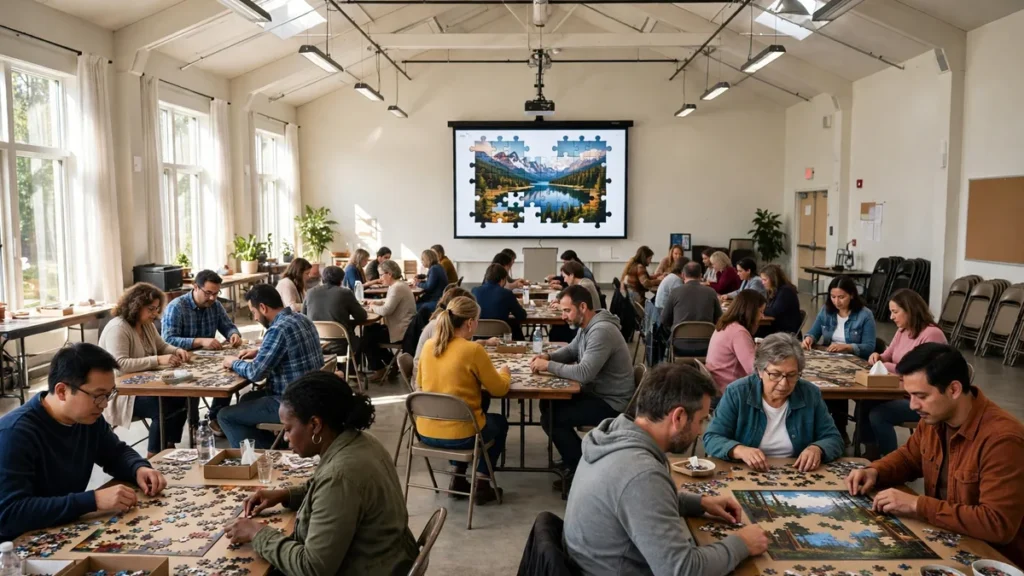
The best board games for 136 players are not games that seat 136 people around one board. No board game does that, and no table, box, or set of pieces is made for a crowd that large. The best board games for 136 players work because they turn one very large group into many small, lively tables, all playing the same game at the same time, with a shared scoreboard and a clear winner at the end. When that structure is in place, 136 players stop being a logistical problem and start being the point of the night.
Planning for 136 players means planning for 17 teams of eight, or 34 teams of four, rather than planning for one giant game. Each team needs its own table, its own copy of the game, and its own scorecard, while the host needs a visible scoreboard, a clear rotation plan, and rounds short enough that no team waits long between turns.
This guide covers the 10 best board games for 136 players, how to set each one up for a crowd this size, what supplies you need, and how to run the whole event without confusion. Every game here scales cleanly to 17 teams of eight or 34 teams of four and keeps all 136 players involved from the first round to the final score.
Key takeaways
- No single board game seats 136 players, so the best format is many tables playing the same game at once, organised into teams.
- Split 136 players into 17 teams of eight or 34 teams of four, and give every team its own table, board, and scorecard.
- Choose games that are easy to teach in five minutes, finish a round in 20 to 40 minutes, and work well with duplicate copies.
- Run the night as a tournament, with the same game at every table, a shared scoreboard, and points that carry into a final round.
- Count every supply before the night starts, including spare copies, pens, scorecards, timers, and a visible clock for every table.

How Board Games for 136 Players Actually Work
The game itself does not change, but the way you organise it changes completely. A game designed for four to eight players still works beautifully when 17 copies of it are running at the same time in one room. The host runs a tournament on top of those tables, collecting scores and moving the top teams into a final round.
The simplest structure is the parallel tournament. Every table plays the same game, at the same time, for the same length of time. When the round ends, each table reports its winner, the host adds the results to a large scoreboard, and the next round begins. After two or three rounds, the top teams move to a final played in front of the whole room.
A second structure is the relay format, which suits games with short turns. Each team sends one player to a central table for a short turn, then that player returns and the next teammate takes over, while the team discusses its move together. A third structure is station rotation, with teams rotating between different games every 30 minutes.
How Many Teams and Tables Do You Need?
For 136 players, 17 teams of eight is the most practical split for party-style and word games, Thirty-four teams of four is the better split for strategy games such as Ticket to Ride, Catan, and Azul, because those games play best with three or four players at a board. Keep the split the same for the whole round, and leave a clear lane down the middle of the room for the host and helpers.
How Long Does a 136-Player Game Night Take?
A well-run night takes between two and three hours. Allow 15 minutes for welcome and team formation, five minutes to teach each game, 20 to 40 minutes per round, and 10 minutes for the final and the winner announcement. Do not try to fit five games into one evening. Use a large visible timer, announce the time remaining every 10 minutes, and call time firmly when a round ends.
What Makes a Board Game Work for 136 Players
A game that works for 136 players has four qualities. First, it must be easy to teach: if the rules take more than five minutes to explain, 17 tables will each learn them slightly differently. Second, it must finish a round in 20 to 40 minutes, or the room will be exhausted before the second round. Third, it must work with duplicate copies, because a game that needs one unique board or one host who knows all the answers cannot be copied 17 times cheaply. Fourth, it must give every player something to do on most turns, because games where one player acts and seven watch will leave most of your 136 players bored.
Word games, drawing games, guessing games, and cooperative games score highly on all four tests, because they are quick, social, and easy to copy. The games that score badly are long, complex strategy games with many rules, games that need a single shared board, and games that depend on one person reading long passages aloud. If your group also enjoys mystery and puzzle-solving, escape room board games make a strong second station in a rotation, because the timed puzzle format gives a team a clear shared goal and a clear finish time.
The 10 Best Board Games for 136 Players
The 10 games below are listed in an order that works as a full evening: quick, social games first to warm the room up, strategy games in the middle when concentration is highest, and a cooperative finale that brings the whole room together. Pick three or four that suit your group and run them as a tournament.
1. Codenames
Codenames is a team word-guessing game in which one player, the spymaster, gives a one-word clue that links several words on a grid, and the rest of the team tries to guess the right words without touching the assassin. It plays in about 15 minutes, teaches in three minutes, and works perfectly in teams of eight. For 136 players, you need 17 copies. Run it as a best-of-three match, with a strict one-minute limit per clue and a fresh grid for each round.
2. Wavelength
Wavelength is a team guessing game in which one player gives a clue to place a hidden target on a scale between two opposite ideas, such as hot and cold, and the team discusses where the target should sit. It plays in 20 to 30 minutes, teaches in two minutes, and works best in teams of six to eight. Every player has an opinion on every clue, so nobody is left out. Run it for 10 clues per team and award points for each correct placement.
3. Telestrations
Telestrations is a drawing and guessing game in which each player draws a word, passes the sketch to the next player, who guesses what it shows, and the chain continues around the table until the final guess is compared with the original word. It plays in 20 to 30 minutes, teaches in two minutes, and works in teams of four to eight. For 136 players, you need one copy per table, plus spare sketch books and pens. Telestrations is one of the funniest games on this list, because the drawings get worse, and therefore funnier, as they pass around the table. Use the same starting words at every table, so the host can read out the best final guesses.
4. Dixit
Dixit is a storytelling and picture-guessing game in which the storyteller gives a short clue for one of the beautiful illustrated cards in their hand, the other players choose a card from their own hands that fits the clue, and everyone votes for the card they think is the storyteller’s. It plays in 30 minutes, teaches in three minutes, and works best with five or six players per table. The skill is imagination, not memory or speed, so a new player can enjoy it in the first round. Use the same set of cards at every table.
5. Ticket to Ride
Ticket to Ride is a route-building game in which players collect coloured train cards and claim railway routes across a map, scoring points for completed routes and for the longest continuous route. It plays in 30 to 40 minutes, teaches in five minutes, and works best with three or four players per board. For 136 players, run it in 34 teams of four, with one board per team. Ticket to Ride is a strong middle-of-the-evening game because it is calm and clear, and a new player can learn it in one round.
6. Catan
Catan is a trading and building game in which players collect resources, trade with each other, and build settlements, cities, and roads on a modular island board. It plays in 45 to 60 minutes at a full table, so run a shortened version: play to seven points instead of 10, with a timer of 40 minutes. It works best with three or four players per board, so plan for 34 teams of four. Trading is at its heart, so a team will spend the whole game talking and negotiating.
7. Azul
Azul is a tile-drafting game in which players take coloured tiles from shared factory displays and place them on their own board in a pattern, scoring points for completed rows and columns. It plays in 30 minutes, teaches in four minutes, and works best with two to four players per board. For 136 players, run it in 34 teams of four. It is quieter than the word games, which makes it a good second or third game. Collect the tiles carefully at the end of the round, because lost tiles are the most common problem with duplicate copies.
8. Carcassonne
Carcassonne is a tile-laying game in which players draw a tile, place it to extend a shared landscape of cities, roads, and fields, and place a follower on the tile to claim points. It plays in 30 to 40 minutes, teaches in four minutes, and works best with two to five players per board. For 136 players, run it in teams of four, with one board per team. Use a timer of 35 minutes per round, and when time is called, let each table finish its current tile and then count points.
9. Pandemic
Pandemic is a cooperative game in which players work together as disease-control specialists, travelling the world, treating infections, and finding cures before four diseases spread out of control. It plays in 45 minutes, teaches in five minutes, and works best with two to four players per team. For 136 players, run it in 34 teams of four, with one copy per team, and set every team the same difficulty level. Run it as a race, with the first teams to find all four cures scoring the most points.
10. Mysterium
Mysterium is a cooperative deduction game in which one player is a ghost who cannot speak, and must guide the other players to the right suspect, location, and weapon using only illustrated vision cards. It plays in 40 minutes, teaches in five minutes, and works best with four to six players per table. For 136 players, run it in teams of six, with one copy per table, and use the same vision cards at every table. The discussion at each table is intense, because every vision card can be read in several ways.
Comparison Table
Use this table to pick the right games for your group. Playing time is for one round at a single table, and the team size is the size that works best for that game when you scale it to 136 players.
| Game | Playing time | Best team size | Copies needed | Best for |
|---|---|---|---|---|
| Codenames | 15 minutes | 8 | 17 | Quick team word play |
| Wavelength | 20 to 30 minutes | 8 | 17 | Lively group discussion |
| Telestrations | 20 to 30 minutes | 8 | 17 | Drawing and laughter |
| Dixit | 30 minutes | 6 | 23 | Creative storytelling |
| Ticket to Ride | 30 to 40 minutes | 4 | 34 | Calm strategy |
| Catan | 40 minutes, shortened | 4 | 34 | Trading and negotiation |
| Azul | 30 minutes | 4 | 34 | Tile drafting |
| Carcassonne | 30 to 40 minutes | 4 | 34 | Tile laying |
| Pandemic | 45 minutes | 4 | 34 | Cooperative play |
| Mysterium | 40 minutes | 6 | 23 | Cooperative deduction |
How to Run a 136-Player Board Game Tournament
Decide the format before the night, and print it on a single sheet for every table. The sheet should list the teams, the table numbers, the game for each round, and how points are awarded: 10 points for first place at a table, seven for second, five for third, and three for fourth.
Appoint one host and at least four helpers for 136 players. The host runs the timer, announces the rounds, and updates the scoreboard. The helpers answer rules questions and collect results at the end of each round. Run a short practice round for the first game, so every table can check its components and its scorecard before the scored rounds begin.
For the final, bring the top four teams to tables at the front of the room. Choose a short, lively game for the final, such as Codenames or Wavelength, keep the final to 20 minutes, and announce the overall winner as soon as the final ends. Players who enjoyed the large-group word games here often want a smaller word game for the next night at home, and the ideas in word games for adults are a good place to start, because they use the same quick, social format at a size that suits a single table.
Checklist for a 136-Player Board Game Night
Work through this checklist the day before the night, and again on the morning of the event. Tick each item off only when it is counted, packed, and ready to carry into the room.
- Count every copy of every game, and pack one spare copy of each game in case a box is incomplete or a component is lost.
- Print 136 scorecards, one per player, plus 34 spares, and pack 150 pens so no table runs out.
- Print the team list, the table plan, and the rules sheet for each round, and place one copy on every table before players arrive.
- Set up the scoreboard where the whole room can see it, and test the timer and the microphone before the first player arrives.
- Walk the room, check every table and chair, leave a clear lane for the host and helpers, and place water within easy reach.
- Pack a small repair kit with spare dice, spare cards, sticky notes, tape, and a first aid kit, and keep it at the host table.
Frequently Asked Questions
Can one board game really seat 136 players?
No. No board game seats 136 players around one board. The games in this guide work for 136 players because they are played in parallel, in teams of four to eight, with one copy per table, and the results are combined into a tournament.
How many copies of each game do I need for 136 players?
It depends on the team size for that game. For a game that plays best with eight players per table, you need 17 copies for 17 teams. For a game that plays best with four players per table, you need 34 copies for 34 teams. If you cannot find that many copies, run the game in a relay format, with teams taking turns at fewer tables.
What is the best game to start with for 136 players?
Codenames is the best game to start with, because it teaches in three minutes, plays in 15 minutes, and gets every table talking within the first minute. If your group prefers drawing to words, start with Telestrations instead, which has the same quick, social energy.
How do I keep 136 players from getting bored between rounds?
Keep rounds short, keep the gaps between rounds short. Announce the scores from the last round, read out the funniest moment from each table, and start the next round within five minutes of the last one ending. If a table finishes early, give it a quick filler puzzle, so it does not sit idle.
Do I need a large hall for 136 players?
Yes. You need a hall with space for 17 to 34 tables, plus chairs, plus a clear lane for the host and helpers. A community hall, a school hall, or a large function room is ideal. If the room is too small, split the night into two sessions of 68 players each.
What if some players have never played a board game before?
That is normal for a group of 136. Seat at least one experienced player at each table, run a five-minute practice round before the scored rounds, and choose a first game that needs no specialist knowledge, such as Codenames, Wavelength, or Telestrations. Keep the teaching short and let the game itself do the teaching.
The structure used for board games for 134 players follows the same team and tournament pattern.
Bottom Line
The best board games for 136 players are the games that are easy to teach, quick to play, and easy to copy across many tables, run as a parallel tournament with a shared scoreboard and a shared final. Split the room into teams of four or eight, give every team its own table and board, keep the rounds short and the timekeeping firm, and choose three or four games from this guide that suit your group. Do that, and 136 players will feel like a celebration, not a crowd.