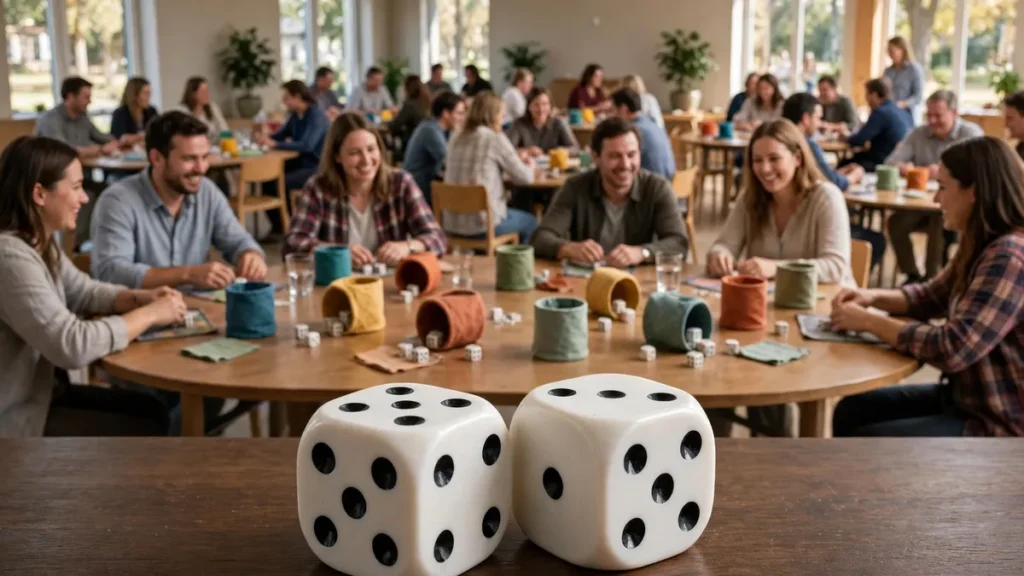
Finding the best dice games for 144 players starts with an honest fact: no single dice game seats 144 people around one table. A group this large is a whole event, not a tabletop session, and the games that work are the ones that scale through teams, multiple tables, and tournament formats. The good news is that dice games are almost perfectly built for this kind of scale, because the rules are simple, the equipment is cheap, and a round takes only a few minutes.
The best dice games for 144 players are the ones every table can learn in under two minutes, play at the same time, and score the same way. Bunco, Farkle, Tenzi, Liar’s Dice, Left Center Right, Dice Bingo, and a Yahtzee-style score chase all fit that description. Each one works as a table game for six to eight players, and each one feeds cleanly into a shared scoreboard that turns 24 separate tables into one big competition.
This guide explains exactly how to run dice games for 144 players, from the three formats that actually work to the equipment list, the scoring system, and a step-by-step checklist.
Key takeaways
- No single dice game seats 144 players, so plan for multiple tables, teams, or a tournament format instead of one giant table.
- Bunco, Tenzi, and Dice Bingo are the easiest games to run at scale because every table learns the rules in under two minutes.
- Use 24 tables of six players, or 18 tables of eight players, with one shared scoreboard to keep the whole room in one competition.
- Budget about five dice per player, plus one dice cup and one score sheet per table, and always bring spares.
- Keep rounds short, rotate players between tables, and finish with a final round so the whole room shares one ending.

Why 144 Players Changes Everything
A dice game for six friends and a dice game for 144 players are two different events that happen to use the same equipment. At a small table, the host explains the rules once and the game starts in a minute. In a room of 144 people, half the room cannot hear the host, and the first round takes twenty minutes unless the plan is built for scale.
The first change is space. A group of 144 needs roughly 24 tables if each table seats six, or 18 tables if each table seats eight. Each table needs room for dice to roll without landing on the floor, space for score sheets, and a clear path for players to move between rounds. A school hall, a community centre, or a large function room works well. A living room does not, no matter how much furniture you move.
The second change is pace and fairness. Dice are loud when 24 tables roll at once, so instructions must be short and visible: print the rules on a card at every table, put the scoreboard where everyone can see it, and use a bell to start and stop rounds.
Three Formats That Actually Work for 144 Players
Every successful large-group dice night uses one of three formats. Choose your format before you choose your games, because the format decides how many tables you need, how players move, and how the winner is found. All three formats work with the games in this guide, and you can combine the first two across an evening.
Format 1: Multiple Tables, One Shared Scoreboard
This is the simplest format and the best choice for a first event. Set up 24 tables of six players, or 18 tables of eight, and every table plays the same game at the same time. Each table records its scores on a sheet, a runner collects the sheets after each round, and a host updates one big scoreboard at the front of the room.
Format 2: Team Tournament With Rotating Tables
In a team tournament, the 144 players form 12 teams of 12, and each team splits across several tables. After every round, players rotate to a new table and meet new opponents, while their points still count toward their team total. This format suits competitive groups because it mixes social time with real rivalry. Number the tables, give every player a coloured wristband for their team, and announce each rotation with a bell.
Format 3: Whole-Room Relay and Call-Out Games
Whole-room games put all 144 players into a single game at the same time, with one host calling the action. Dice Bingo is the classic example: the host rolls dice at the front, calls the result, and every player marks their card. Relay games work the same way, with each table sending one player at a time to roll for the team. Use this format to open and close the night, because nobody needs to find a seat, and a single shared finish gives the evening a clear climax.
The Best Dice Games for 144 Players
The games below are ranked by how well they scale, not by how famous they are. Every one of them is easy to teach, quick to play, cheap to equip, and fair across many tables. If you only have time to prepare three games, pick Bunco, Tenzi, and Dice Bingo, and your night is already covered.
1. Bunco
Bunco is the classic large-group dice game, and it was practically designed for a room of 144 players. Each table seats four players in two pairs, and every table plays the same round number at the same time. Players roll three dice and score points for rolling the target number, with a Bunco, three of a kind on the target number, worth 21 points. When the bell rings, winners move up a table and losers move down, so the room mixes constantly and nobody needs a separate rotation plan.
2. Farkle
Farkle is a push-your-luck dice game in which players roll six dice, bank scoring combinations, and decide whether to risk another roll or stop. A single one is worth 100 points, a single five is worth 50, three of a kind scores from 300 to 1,000, and rolling with no scoring dice is a Farkle that wipes out the turn. For 144 players, run it with six players per table and a fixed target of 10,000 points per round.
3. Tenzi
Tenzi is the fastest game on this list, and speed matters when you have 144 players to keep busy. Each player gets ten dice and one dice cup, and the goal is simple: roll all ten dice to the same number faster than anyone else at your table. Players keep the dice that match their chosen number and re-roll the rest, shouting Tenzi when all ten match. A round takes one to three minutes, and because everyone rolls at the same time, there is no waiting at all.
4. Liar’s Dice
Liar’s Dice is a bluffing game in which each player rolls five dice under a cup, looks at them in secret, and bids on how many of a certain number are showing across the whole table. The next player must raise the bid or challenge it, and the loser of a challenge loses a die. The last player with dice remaining wins the table. Run it with six players per table and a table winner who advances to a final, and schedule it mid-evening, when players are warmed up and ready for a longer, chatty round.
5. Left Center Right
Left Center Right, often called LCR, is the simplest game on this list and the best choice for a mixed-age group. Each player starts with three tokens, rolls up to three special dice marked L, C, R, and dots, and passes tokens left, right, or to the centre according to the roll. The last player still holding tokens wins the table. A round takes about ten minutes, and the rules take thirty seconds to explain. For 144 players, run it as a whole-room game with all tables starting together, then let each table winner move to a championship table for a final. The same pass-and-play spirit appears in the list of party games for 143 players, which uses the same table-and-tournament structure.
6. Dice Bingo
Dice Bingo turns the whole room into one game. Each player gets a bingo card printed with numbers from 2 to 12, and the host rolls two dice at the front of the room and calls the total. Players mark matching numbers, and the first player to complete a row, a column, or a full card wins. Because the host controls the pace, Dice Bingo works for all 144 players at once, with no tables needed at all. This is the best game for opening your night, because late arrivals can join without learning a table game or finding a seat.
7. Yahtzee-Style Score Chase
A Yahtzee-style score chase uses five dice and a score sheet with thirteen categories, from ones through sixes to three of a kind, full house, small straight, large straight, Yahtzee, and chance. Each player gets thirteen turns, and the best total wins the table. For 144 players, run it as a timed tournament round of about 30 minutes, with six players per table. Print a score sheet for every player, collect the sheets at the end, and rank all 144 totals on the shared scoreboard. The same scoring skills transfer to other dice nights, including the dice games for 142 players that many groups play when their crowd is two people smaller.
Best Dice Games for 144 Players Compared
Use this table to pick the right mix for your night. The best events combine one fast game, one social game, and one whole-room game, so the pace changes across the evening and every kind of player finds something they enjoy.
| Game | Players per table | Round length | Best format | Why it scales |
|---|---|---|---|---|
| Bunco | 4 | 15 minutes | Multiple tables | Built-in rotation mixes the room |
| Farkle | 6 | 15 minutes | Tournament | Same scoring at every table |
| Tenzi | 6 to 8 | 2 minutes | Whole room | Everyone rolls at once |
| Liar’s Dice | 6 | 20 minutes | Tournament | Social bluffing, clear table winner |
| Left Center Right | 6 to 8 | 10 minutes | Whole room | Rules take 30 seconds to learn |
| Dice Bingo | All 144 | 15 minutes | Whole room | One host, no tables needed |
| Yahtzee-Style Score Chase | 6 | 30 minutes | Tournament | Score sheets rank all 144 players |
How to Set Up a 144-Player Dice Night
Good setup is what separates a smooth night from a chaotic one, and most of the work happens before anyone arrives. Arrange tables with space to walk between them, put the scoreboard where every table can see it, and set up a central supply table with spare dice, cups, score sheets, pencils, and tokens. Assign one volunteer per four tables as a table captain, so questions get answered without everyone crowding the host.
Equipment for 144 players is simpler than it sounds. Plan on five dice per player as a baseline, which is 720 dice, and buy them in bulk bags rather than boxed sets. Add one dice cup per player for Tenzi and Liar’s Dice, or one cup per table if you are only running Bunco, Farkle, and Dice Bingo. Print score sheets in advance, one per player for score-chase games and one per table for team games, and print the rules on a card for every table.
Timing matters as much as equipment. A two-hour evening fits four rounds comfortably: a whole-room opener, two table rounds, and a whole-room final. Announce each round with a bell, give a two-minute warning before the end of each round, and collect score sheets immediately when a round ends. Label every table with a number, colour-code team wristbands in advance, and test the microphone before the doors open.
Scoring, Prizes, and Keeping 144 People Engaged
Scoring for 144 players must be simple enough to run in real time. Use one points system for the whole night and post it on the wall: table wins are worth ten points, second place is worth six, and every player earns one point per round just for playing. In a team tournament, add up the team members’ points after every round, and update the scoreboard before the next round starts so the standings always feel current.
Prizes should reward more than just winning. Give a prize to the overall winner, a prize to the best team, and fun prizes for the most Bunco rolls, the fastest Tenzi win, and the unluckiest Farkle of the night. Small prizes work best: dice sets, game-night snacks, gift cards, and funny trophies. When prizes cover luck, speed, and team spirit, every player still has something to aim for in the final round.
Engagement comes down to pace and variety. Alternate fast games with slower ones, mix tables between rounds, and never let one round run more than 30 minutes. Recruit helpers early: a scoreboard keeper, two or three runners to collect score sheets, and table captains who know the rules. Brief them an hour before the doors open, and give each one a written job list.
Your 144-Player Dice Night Checklist
Work through this checklist in the week before your event, and the night itself will almost run itself. Print it out, assign each line to a helper, and tick items off as they are done.
- Book a hall with space for 24 tables of six players, plus a supply table and a visible scoreboard area.
- Buy or borrow at least 720 dice, one dice cup per player, score sheets, pencils, tokens, and a bell or whistle.
- Print one rules card per table for each game, plus a one-page schedule to hand out at the entrance.
- Choose your format, assign teams or table numbers in advance, and brief six helpers with written job lists.
- Set up the scoreboard, test the microphone, and run one practice round with your helpers before the doors open.
- Plan prizes for the winner, the best team, the fastest Tenzi, and the funniest moment, and finish with a whole-room final.
Frequently Asked Questions
Can one dice game really seat 144 players?
No, and any plan that claims otherwise is misleading. Dice games for 144 players work through multiple tables, teams, or a whole-room format such as Dice Bingo. A room of 144 players is really 24 tables of six, or 18 tables of eight, playing the same games at the same time under one shared scoreboard. That structure keeps everyone playing at once, which is the real goal.
How many dice do I need for 144 players?
Plan on five dice per player, which is 720 dice in total, and buy them in bulk. Tenzi needs ten dice per player, so if Tenzi is on your schedule, budget 1,440 dice or run Tenzi in heats with shared dice sets.
What is the easiest dice game for a group of 144?
Left Center Right is the easiest, because the rules take thirty seconds to explain and a round needs no score sheet. Dice Bingo is nearly as easy, and it has the advantage of needing no tables at all. If you want a game with a little more depth that is still easy to teach, Bunco is the best next step, and its built-in rotation handles player movement for you.
How long should a 144-player dice night last?
Two to three hours is the right length. A two-hour evening fits a whole-room opener, two table rounds, and a whole-room final, with time for scoring and prizes. A three-hour evening adds a third table round and a longer break. Anything longer than three hours tires the room, and tired players stop playing well, so plan a clear finish and stick to it.
Do I need a special venue for 144 players?
You need a hall, not a house. Look for a school hall, a community centre, a church hall, or a function room with enough tables and chairs for 144 people, plus space to walk between tables. Check the lighting, the sound, and the parking before you book, and visit the room in person if you can.
Can children play dice games at a 144-player event?
Yes, and dice nights work well as family events, because the games in this guide need no reading speed and no special knowledge. Seat children with an adult at their table for the first round, choose Left Center Right, Tenzi, and Dice Bingo for the family rounds, and save Liar’s Dice and Farkle for later, when younger players have warmed up. For more family-friendly game ideas that mix well with a dice night, see this guide to word games for adults, which many hosts pair with dice games for a full evening of play.
Bottom Line
The best dice games for 144 players are Bunco, Tenzi, and Dice Bingo for ease and pace, with Farkle, Liar’s Dice, Left Center Right, and a Yahtzee-style score chase adding depth and variety. No single game seats 144 people, so build your night on 24 tables of six players, one shared scoreboard, and a mix of table rounds and whole-room games. Bring plenty of dice, keep the rules on a card at every table, rotate players between rounds, and finish with a single shared final that the whole room plays together.