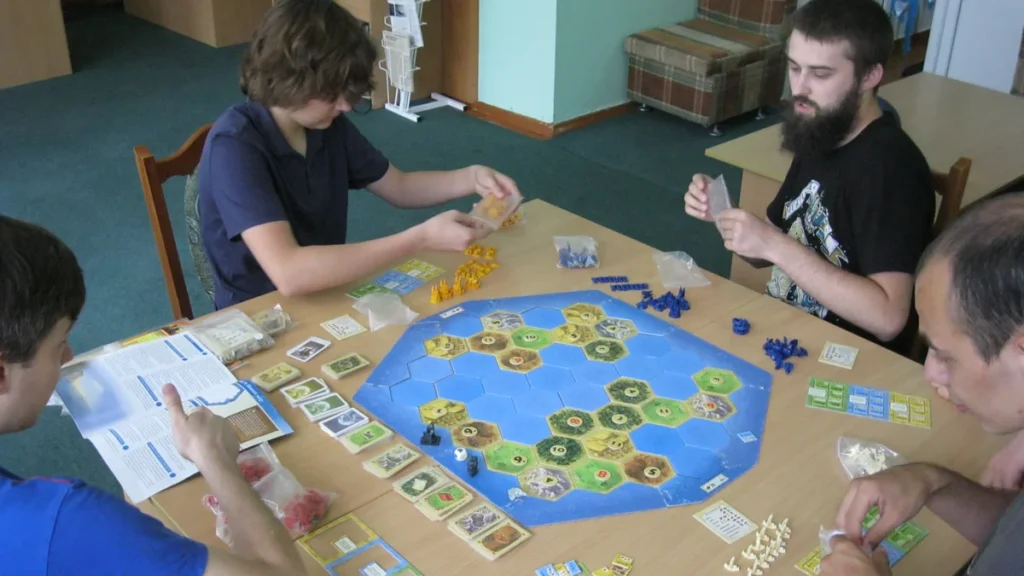
The best card games for 136 players are not found in a single box, because no card game on the shelf is designed to seat 136 people around one table. A gathering of 136 players is a whole event, not a game night, and the honest starting point is that the cards are only one part of the plan. The room, the tables, the format, and the way people move between games matter just as much as which deck you open first.
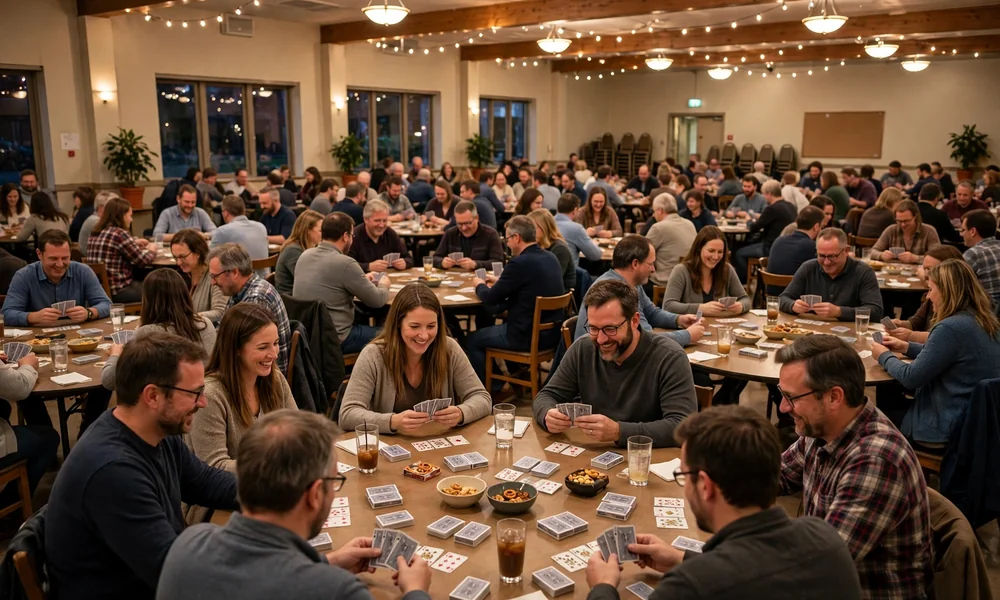
Card games for 136 players work when the crowd is split into small groups that all play at the same time, with a shared scoreboard and a shared schedule tying the tables together. Seventeen tables of eight, thirty-four tables of four, or a mix of both will cover the whole room, and every table can run the same game or a different one. The result feels like one big event rather than thirty-four separate ones, as long as someone is keeping time and posting results where everyone can see them.
This guide covers the formats that actually work at this scale, the card games that suit them best, and the practical details of running a 136-player event without it falling apart. Every game below is a real card game you can buy, learn in minutes, and run across many tables at once. Nothing here needs a casino table, a dealer, or a single rupee of betting, because a big friendly crowd is the whole point.
Key takeaways
- No single card game seats 136 players, so split the crowd into tables of four to eight and run the same game everywhere at once.
- Use a tournament or relay format with a shared scoreboard so thirty-four small games feel like one big event.
- Pick fast, easy-to-teach card games such as Uno, Phase 10, Dutch Blitz, and Taco Cat Goat Cheese Pizza for the main rounds.
- Keep every table on the same clock with a host announcing rounds, breaks, and table changes over a speaker.
- Bring at least one full deck or set per table, plus spares, and appoint one table captain at every table.
Why No Single Card Game Seats 136 Players
Card games are built around a table. Most are designed for two to six players, and even the biggest party card games top out at around ten or twelve before turns become painfully slow. At 136 players, a single shared game would mean waiting twenty minutes between turns, and nobody would stay for the second round. The physics of cards, hands, and turn-taking simply do not stretch that far.
That does not mean a 136-player card event is impossible. It means the event has to be organised in layers. The bottom layer is the table, where four to eight people play a normal card game. The middle layer is the round, where every table plays at the same time and on the same clock. The top layer is the event, where scores from every table feed into one leaderboard, one set of finals, and one winner or winning team.
Think of it like a school sports day. Nobody expects 136 children to play one football match, yet a sports day with 136 children works perfectly because everyone competes in small groups at the same time and the results are added up. Card games for 136 players work on exactly the same principle, and once you accept the table structure, the rest of the planning becomes straightforward.
The Three Formats That Actually Work
There are three proven ways to run card games for 136 players, and the best choice depends on your room, your crowd, and how competitive you want the night to be. All three use the same building blocks, so you can even combine them, running a multi-table session first and a tournament final afterwards.
Multiple Tables, Same Game
The simplest format is also the most reliable. Every table plays the same game at the same time, for example Uno or Phase 10, and a host calls the start and end of each round. With 136 players, you need seventeen tables of eight or thirty-four tables of four, depending on the game. At the end of each round, every table reports its winner or its points, and the host updates a visible scoreboard.
This format is ideal for a first event because everyone learns one set of rules, and the room stays in sync. A warm-up round of quick word games for adults works well before the main game, because it gets strangers talking and laughing before the scoring starts. The main risk is boredom if the game is slow, so pick games that finish a round in fifteen to twenty minutes and keep the rounds moving.
Tournament Bracket Across Tables
A tournament format adds excitement by letting the best players from each table advance. In round one, every table plays its own game and the top one or two players move to a new table for round two. After three or four rounds, the remaining players meet at a final table while the rest of the room watches or plays friendly side games.
Tournaments suit competitive crowds and work brilliantly with games that have clear winners, such as Rummy, Hearts, Spades, and Canasta. The host needs a simple bracket sheet and a way to call table changes, but the players themselves do most of the work. Team-based versions are even better for large groups, because a team of four can share one table and cheer each other on, which is exactly the energy that makes escape-room board games so popular with big groups.
Whole-Room Relay and Rotation
A relay format keeps everyone moving. Each table plays a different short card game for ten minutes, then the players rotate to the next table while the decks stay put. After five or six rotations, every player has tried every game, and the combined scores decide the winners. This is the best format for a mixed crowd, because nobody is stuck at one table with one game they dislike.
Rotation also solves the problem of different skill levels. A fast game such as Dutch Blitz sits happily next to a slower game such as Phase 10, because nobody stays long enough to get bored or overwhelmed. For the gaps between rotations, a few tablets running puzzle apps for adults at a side station give early finishers something fun to do without leaving the room.
Best Card Games for 136 Players
The games below are chosen for three reasons: they are quick to teach, they work at small tables, and they stay fun when played in parallel across a whole room. Classic games and modern party games are mixed together on purpose, because a 136-player event needs variety across its tables even when every table is playing at the same time.
| Game | Players per table | Time per round | Best format | Why it works at scale |
|---|---|---|---|---|
| Uno | 2 to 10 | 15 to 20 minutes | Multi-table | Everyone knows it, and ten-player tables cut the table count |
| Phase 10 | 2 to 6 | 20 to 30 minutes | Tournament | Clear phases make scoring simple across tables |
| Dutch Blitz | 2 to 4 | 10 minutes | Relay | Fast and frantic, perfect for short rotations |
| Skip-Bo | 2 to 6 | 20 minutes | Multi-table | Simple sequencing rules suit mixed ages |
| Rummy | 2 to 6 | 20 to 30 minutes | Tournament | A classic with clear winners for brackets |
| Hearts | 3 to 6 | 20 minutes | Tournament | Low score wins, which is easy to compare |
| Spades | 4 | 30 minutes | Tournament | Partnership play adds team spirit |
| Canasta | 4 | 30 to 45 minutes | Tournament | Deep enough for serious players |
| Taco Cat Goat Cheese Pizza | 2 to 8 | 10 to 15 minutes | Relay | Silly, fast, and great for breaking the ice |
| Exploding Kittens | 2 to 5 | 15 minutes | Multi-table | Short rounds with big laughs |
| Monopoly Deal | 2 to 5 | 15 minutes | Relay | Quick property collecting with real tension |
| The Crew | 2 to 5 | 20 minutes | Multi-table | Cooperative play suits friendly crowds |
Uno and Phase 10: The Reliable Core
Uno is the safest choice for the main game of a 136-player event. Almost every adult has played it, the rules take two minutes to explain, and tables of eight to ten players are comfortable, which means only fourteen to seventeen tables are needed. Buy one deck per table plus at least four spares, because cards will be dropped, bent, or wander off. Run three timed rounds of fifteen minutes, and award points for finishing first, second, and third at each table.
Phase 10 is the better choice if your crowd likes a little more structure. Each player works through ten phases, such as two sets of three or a run of seven, and the player who completes all ten phases first wins. The phase system makes scoring fair across tables, because a host can compare which phase each player reached rather than relying on a single winner. A full game takes longer than Uno, so Phase 10 suits a tournament with fewer, longer rounds.
Dutch Blitz and Taco Cat Goat Cheese Pizza: The Fast Games
Every large event needs at least one game that finishes in ten minutes, and Dutch Blitz is the best of them. Each player has their own small deck and races to play cards onto shared piles, so there is no waiting for turns at all. It is loud, fast, and wonderfully chaotic, which makes it perfect for a relay format where players rotate every ten minutes. The only catch is that each set supports only four players, so a 136-player relay needs thirty-four sets, and you should buy them in bulk.
Taco Cat Goat Cheese Pizza plays a similar role with even simpler rules. Players take turns flipping cards and saying the words taco, cat, goat, cheese, pizza in order, slapping the pile when the word matches the card. It takes thirty seconds to teach and produces the kind of laughter that fills a whole hall. Use it as the opening game while latecomers arrive, or as a tie-breaker between tournament rounds.
Rummy, Hearts, Spades, and Canasta: The Classics
Classic card games are the backbone of any serious 136-player tournament, because they have clear winners, standard rules, and no learning curve for older players. Rummy is the most flexible, working well with two to six players and finishing in about twenty minutes. Deal from a double deck at six-player tables so nobody runs out of cards mid-game.
Hearts is a trick-taking game where the lowest score wins, which makes it easy to compare results across tables. Spades adds partnerships, so four players form two teams and the teamwork gives quieter players a reason to talk. Canasta is the slowest of the four and suits the final rounds, when the room has narrowed to the strongest players and everyone is watching. Keep a printed rules sheet at every classic-game table, because small rule differences between families are the most common cause of arguments at large events.
Exploding Kittens, Monopoly Deal, and The Crew: The Modern Picks
Modern card games bring energy that the classics sometimes lack. Exploding Kittens is a fast elimination game where players draw cards and hope to avoid the exploding kitten, and a round takes about fifteen minutes with five players. Monopoly Deal compresses the property trading of the board game into a fifteen-minute card game, and it works beautifully in a relay because every round feels complete on its own.
The Crew is different from everything else on this list because it is cooperative. Players work together to complete missions by winning tricks in a set order, and the table either succeeds or fails as a team. That makes it ideal for a workplace or community event where the goal is bonding rather than beating each other. Run The Crew at tables where you want conversation and teamwork, and save the competitive games for the tournament tables.
How to Run 136 Players Without Chaos
A 136-player card event fails on logistics far more often than on game choice. The games will take care of themselves if the room is set up properly, the schedule is visible, and every table knows who is in charge. Plan for the event like a small conference, not like a living-room game night, and the evening will run itself after the first round.
Arrive early and lay out the tables before anyone else arrives. Number every table clearly, put one complete game set and one score sheet on each, and leave a spare deck at the host table. A visible clock or countdown timer matters more than decorations, because the single most common problem at large game nights is tables drifting out of sync and finishing rounds at different times.
Event Checklist
- Count the room first: confirm seventeen tables of eight or thirty-four tables of four, with chairs for all 136 players.
- Buy one full game set per table plus at least four spares, and test every deck for missing cards before the day.
- Appoint one table captain per table to explain rules, settle disputes, and report scores to the host.
- Print a one-page rules sheet and a score sheet for every table, and post the full schedule on the wall.
- Set up a speaker and microphone so the host can call round starts, breaks, and table changes for the whole room.
- Prepare a visible scoreboard, final-table seating, and small prizes for the winners before the first card is dealt.
Frequently Asked Questions
Can one card game really seat 136 players?
No. No published card game seats 136 players at one table, and any event claiming otherwise is misunderstanding the game. The correct approach is to split 136 players across many tables of four to eight, run the same game at every table, and combine the results on one scoreboard.
How many tables do you need for 136 players?
It depends on the game. Uno supports up to ten players, so seventeen tables cover 136 people. Most other games seat four to six, so plan for twenty-three to thirty-four tables. Count the chairs before you count the decks, because a missing chair causes more trouble than a missing card.
How many decks should you buy?
Buy one complete set per table, plus at least four spares. For a thirty-four-table event, that means thirty-eight sets of the main game. Buying in bulk is usually cheaper, and the spares cover damaged cards, lost cards, and tables that want a practice round.
What is the best game for a mixed crowd of 136?
Uno is the best single choice for a mixed crowd, because almost everyone already knows it and it handles large tables well. For a relay format, pair it with Dutch Blitz and Taco Cat Goat Cheese Pizza so players get variety as they rotate between tables.
How long does a 136-player card event take?
Plan for two and a half to three hours. That covers a fifteen-minute welcome and warm-up, three rounds of twenty minutes with short breaks, and a twenty-minute final at a single table while the rest of the room watches. Add thirty minutes of setup time before guests arrive.
Do you need a host for 136 players?
Yes, and the host is the most important person in the room. The host keeps every table on the same clock, announces rotations and results, settles disputes, and keeps the energy up. Without a host, thirty-four tables drift apart within the first round and the event falls apart.
The Bottom Line
The best card games for 136 players are the ones that work at small tables and scale across a whole room. Uno and Phase 10 anchor the main rounds, Dutch Blitz and Taco Cat Goat Cheese Pizza keep the energy high between them, and Rummy, Hearts, Spades, and Canasta give serious players a tournament worth winning. Split the crowd into tables of four to eight, keep every table on the same clock, and let one scoreboard turn thirty-four small games into one big event.