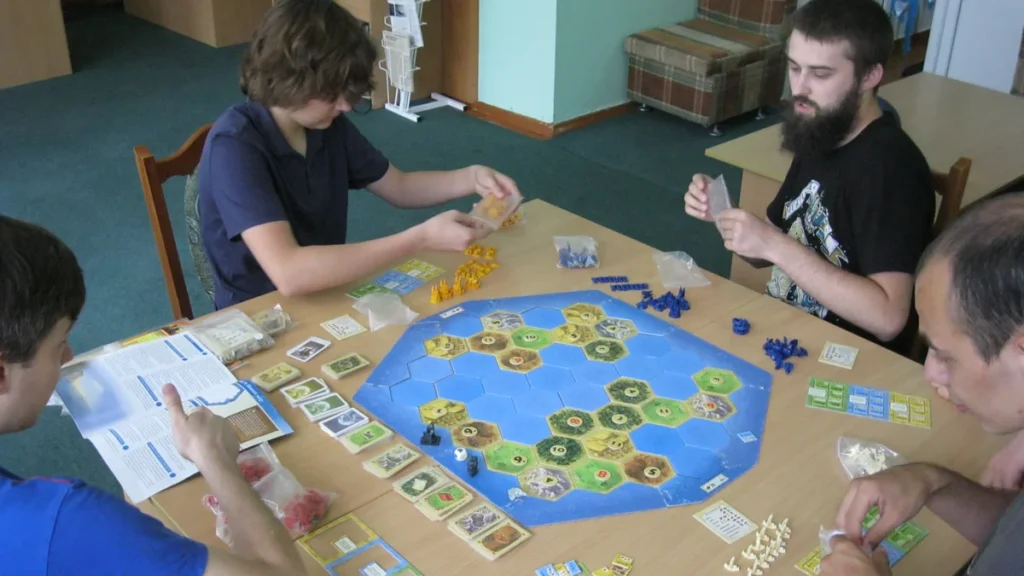
Four hundred and seventy-four players in one room sounds impossible until you stop thinking of it as one giant game. Nobody seats 474 people around a single table, and nobody should try. The night works when it is built from small tables, short teaching sessions, and games that can be repeated across the room at the same time. Each table becomes its own small contest, and the whole room becomes a festival of those contests running side by side.
The nine games in this guide were chosen for weight, clarity, and repeat play rather than for size alone. Every one of them fits on a normal table, teaches quickly to players who already know modern games, and rewards a second and third play. They range from a tense two-player duel about the Cold War to a loud five-player negotiation in mythic Japan, so the room never feels like it is playing the same game ninety times over.
The plan below shows how to run the night in three formats, which nine games to put on the tables, and how to choose the mix that fits your room.
Key Takeaways
- Seat 474 players at many small tables, not at one large table, and let every table play the same short round at the same time.
- Mix quick games with heavier games, so new players have a gentle start and experienced players have a real challenge.
- Run pairs and small groups in rotation, so a finished table can start again while slower tables catch up.
- Keep one central scoreboard and one clear signal for starting and ending each round, so the whole room stays together.
- End with a short final round for the best tables, then let everyone compare stories while the scores are added up.

How 474 Players Actually Play Together
The secret of a 474-player night is that nobody plays with 473 other people. The room is divided into tables of two to five players, and each table plays its own copy of the same game at the same time. A shared clock and a shared scoreboard tie the tables together, so the night feels like one event even though the games are small. With tables of four, you need about 119 tables; with tables of five, about 95.
Helpers make the format work. Plan for about one helper for every ten tables, which means ten to twelve helpers for a full room, plus two people at a central desk for scoring and questions. Helpers hand out rules summaries, answer the same three questions at every table, and collect scoresheets at the end of each round. The approach for how to run board games for 472 players uses the same helper ratio at a nearby scale, so a team that has run one of these nights can run the other with almost no changes.
The Team Format
In the team format, each table is a team, and every player at the table works toward the same table score. Two-player games become duels between tables, and four-player games become small team contests where partners share advice and celebrate together. This format suits the opening round best, because new players can ask their tablemates for help without slowing anyone down. Teams also solve the teaching problem: each table learns together from a one-page summary, and the helper for that zone answers questions as they come up.
The Station Format
In the station format, the room is divided into zones, and each zone plays a different game. Players move from station to station between rounds, so everyone tries three or four games in one night instead of playing the same game all evening. Heavy games go in a quiet corner with longer rounds, quick games go near the entrance where late arrivals can join, and loud negotiation games go in the middle where the noise belongs. Put a large sign above each station with the game name, the player count, and the round length.
The Tournament Format
In the tournament format, tables play short rounds and the winners move up to stronger tables. After two or three rounds, the best players in the room meet at the final tables, while everyone else keeps playing friendly games nearby. Keep the scoring simple: one point for a win, half a point for a draw where the game allows it, and a tiebreak by the margin of victory. Announce the leading tables after each round, and the room will follow the contest without needing a complicated bracket.
The 9 Best Board Games for 474 Players
The nine games below cover every seat at the table. Two-player duels anchor the expert stations, three-to-five-player games fill the main hall, and the whole list moves from quick openers to long showcase games. None of them appears in the recent large-group guides, so a room that has played through the earlier lists will find nine fresh games here.
1. Twilight Struggle
Twilight Struggle is the great two-player duel of modern board games, and it anchors the expert stations. Two players replay the Cold War, placing influence on a world map and playing event cards that can help one side or hurt the other, often both at once. Every card forces a choice between its points and its event. A full game takes about three hours.
At a 474-player night, set up a few tables in a quiet corner, pair experienced players, and let the room watch the map change between rounds. The game teaches patience, because a player who grabs early points often loses the late game.
2. Through the Ages: A New Story of Civilization
Through the Ages builds a whole civilization from cards, with no map and no dice. Players draft leaders, wonders, technologies, and armies, then balance food, resources, and happiness while their neighbours do the same. The new story edition streamlines the classic design, so a game for three or four players finishes in about two hours.
For a large room, Through the Ages is the thinking station. It needs quiet tables and players who are happy to sit still, so place it away from the loud negotiation games and give it the longest round slot. The card drafting means every game tells a different story, from a peaceful farming age to a sudden military rush.
3. War of the Ring
War of the Ring turns the Lord of the Rings into an epic two-player contest, with one player leading the Fellowship toward Mount Doom and the other commanding the Shadow armies across Middle-earth. The Fellowship player wins by destroying the Ring or by holding out in battle, while the Shadow player wins by conquering strongholds or corrupting the Ring-bearers. A game takes two and a half to three hours.
At a big-group night, War of the Ring is the feature table. Put it where people can see the board, because the map and the armies draw a crowd even among players who never sit down. The two-player core keeps the decisions sharp, while the four-player team option lets partners share the command and learn together.
4. Rising Sun
Rising Sun is a loud, bright game of negotiation and area control set in mythic Japan, and it is the natural centrepiece of the main hall. Three to five players lead clans of samurai, monsters, and spirits, forming alliances, betraying them at the worst possible moment, and fighting seasonal battles over provinces. A game takes about ninety minutes to two hours.
For 474 players, Rising Sun does the work that quiet games cannot: it makes noise, it makes stories, and it makes strangers talk. Tables of five suit it best, because five clans create the shifting alliances that the game needs, and the short rounds keep the battles moving.
5. Kemet
Kemet is a fast, sharp game of Egyptian gods and armies, and it is the best combat game on this list for players who hate waiting. Two to five players build pyramids, buy creature tiles, and march their troops across the board, fighting battles that resolve in seconds with cards and power points. A game takes about an hour to ninety minutes.
At a large night, Kemet fills the gap between the quick openers and the long epics. It teaches in five minutes, plays in about an hour, and gives aggressive players a game where attacking is always a good idea. The action pyramids give every player a clear set of choices each turn, and the creature powers keep each game different.
6. Tigris & Euphrates
Tigris & Euphrates is a Reiner Knizia classic, and it has stayed in print for good reason. Two to four players lay tiles to build kingdoms along the rivers, place leaders to claim the colours of those kingdoms, and fight wars and revolts when kingdoms join together. The winner is the player whose weakest colour is strongest, so everyone must build in every colour instead of chasing one.
For a big room, this is the connoisseur table. It looks simple, with plain tiles and wooden leaders, but the decisions are deep, and experienced players will argue about a single tile placement for minutes. Place it near the other classic games, give it a quiet corner, and let the regulars teach it to newcomers with a practice round first.
7. The Castles of Burgundy
The Castles of Burgundy is a Stefan Feld favourite, and it is the most welcoming heavy game in this guide. Two to four players roll dice, take tiles from a central market, and place them on their personal estate boards, building castles, mines, farms, and monasteries for points. A game takes thirty to ninety minutes.
At a 474-player night, Castles of Burgundy is the workhorse. It teaches in ten minutes, finishes in about an hour, and suits players who like a quiet puzzle more than a loud argument. Run it in the main hall in large numbers, because it scales beautifully: twenty tables can play it at once with one helper, and the scores compare neatly across tables.
8. Hansa Teutonica
Hansa Teutonica is a tight trading game set in medieval Germany, and it rewards players who plan their network instead of grabbing points. Two to five players place merchants and traders along routes between cities, claim offices, and unlock new abilities as they build their trading houses. A game takes forty-five to ninety minutes.
For a large group, Hansa Teutonica is the clever filler between the big feature games. It plays in under ninety minutes, teaches in five, and gives experienced players a game with almost no luck and no downtime. Tables of four or five suit it best, because more traders on the board mean more competition for the same routes.
9. Vinhos
Vinhos is a Vital Lacerda game about making wine in Portugal, and it is the richest theme on this list. Two to four players plant vineyards, hire experts, age their wine, and enter it in the national fair, balancing the quality of the wine against the money it earns. A game takes about two hours.
At a big-group night, Vinhos closes the evening beautifully. It is calm after the noise of Rising Sun and Kemet, it looks lovely on the table, and it gives the most patient players a game worth their time. Run it once, in the final long round, and let the winners of the earlier rounds take the seats.
At a Glance: The Nine Games Compared
Use this table to plan the night.
| Game | Players per Table | Typical Time | Best Role at 474 Players |
|---|---|---|---|
| Twilight Struggle | 2 | 180 minutes | Expert showcase duel |
| Through the Ages | 2 to 4 | 120 minutes | Thinking station game |
| War of the Ring | 2 to 4 | 150 to 180 minutes | Feature table epic |
| Rising Sun | 3 to 5 | 90 to 120 minutes | Main hall social game |
| Kemet | 2 to 5 | 60 to 90 minutes | Fast combat station |
| Tigris & Euphrates | 2 to 4 | 60 to 90 minutes | Classic connoisseur table |
| The Castles of Burgundy | 2 to 4 | 30 to 90 minutes | Main hall workhorse |
| Hansa Teutonica | 2 to 5 | 45 to 90 minutes | Second round clever filler |
| Vinhos | 2 to 4 | 120 minutes | Closing expert game |
How to Choose the Right Mix for Your Room
Start with the room, not the games. Count the tables first, then decide how many copies of each game you need. A room with 95 tables of five needs a different mix from a room with 119 tables of four, and the two-player games need far more tables than the five-player games. For 474 players, plan roughly half the tables for the four-player games, a quarter for the five-player games, and the rest for the duels.
Next, match the games to your players. A room full of beginners needs Castles of Burgundy, Kemet, and Rising Sun on most tables, with the heavy games kept to a few expert stations. A room full of regulars can run the whole list at once, with Twilight Struggle and Vinhos taking the quiet corner.
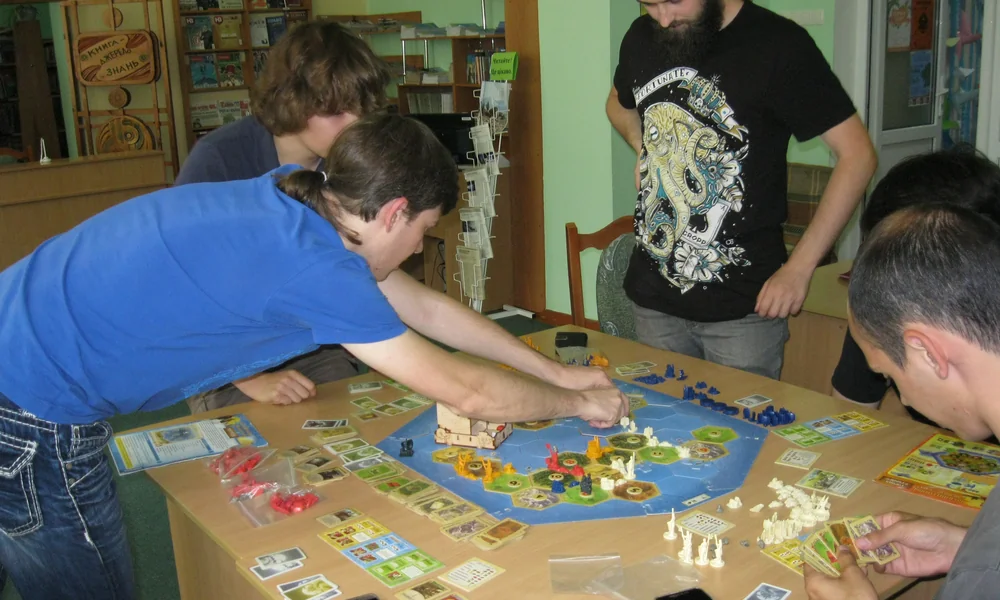
Finally, think about time. Three rounds of ninety minutes fit into about four hours with breaks. Put the long games in the first round, when everyone is fresh, and save the short games for the last round, when energy dips. The mix in the best board games for 470 players follows the same rhythm at a nearby scale, and it works here too: quick games first, heavy games in the middle, and a short final that everyone can finish together.
Checklist for a 474-Player Board Game Night
Use this checklist in the week before the night, and again on the morning of the event.
- Book the hall and the tables. Confirm about 119 tables of four or 95 tables of five, 474 chairs, and enough floor space for a wide central aisle.
- Count the game copies. You need one copy of each game per table, plus five spares for lost pieces and damaged boxes.
- Print the paperwork. Rules summaries, scoresheets, table numbers, and the night’s timetable, one set per table.
- Brief the helpers. Ten to twelve floor helpers and two at the scoring desk, each with a zone and a copy of the schedule.
- Test the sound and the timer. A microphone that reaches the back row and a visible countdown timer are worth more than any game.
- Plan the ending. Decide how winners are announced and how the room clears out, before the first round starts.
Frequently Asked Questions
Can one board game really seat 474 players?
No, and it does not need to. Think of the night as about a hundred small tables playing at the same time rather than one giant game. Each table runs its own copy of the same game, and a shared leaderboard connects the tables.
How many tables do 474 players need?
It depends on the game at each table. Two-player games need 237 tables for everyone at once, four-player games need about 119, and five-player tables need about 95.
How many helpers do we really need?
One helper for every ten tables is a good guide, which means about ten to twelve helpers for a full room, plus two at the central scoring desk. Each helper answers rules questions, checks scores, and reports results.
Which game should we start with?
Start with a game that teaches in ten minutes, such as The Castles of Burgundy or Kemet. A calm, quick opening round lets late arrivals join and gives every table a finished game early.
What if some tables finish much faster than others?
That is normal, and the reserve table is the answer. A pair that finishes early moves to a short game at the reserve table, or plays a rematch, while slower tables finish at their own pace.
How long does a night for 474 players last?
Plan for about four hours, including arrival, three rounds, and a final. Short games take thirty to ninety minutes each, and longer feature games take two to three hours.
The Bottom Line
Four hundred and seventy-four players need small tables, short games, and one clear plan, not one enormous game. Start with The Castles of Burgundy and Kemet, let Rising Sun fill the hall with noise, and close with Vinhos for the players who want a long, thoughtful finish. The board games for 468 players use the same plan at a nearby scale, and the same plan carries the extra six players without a change in spirit.


