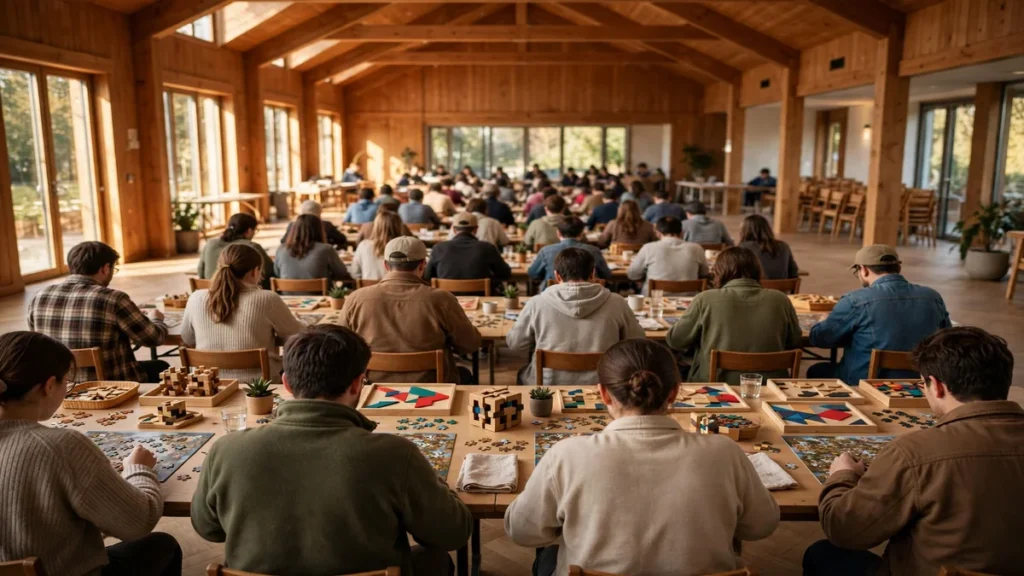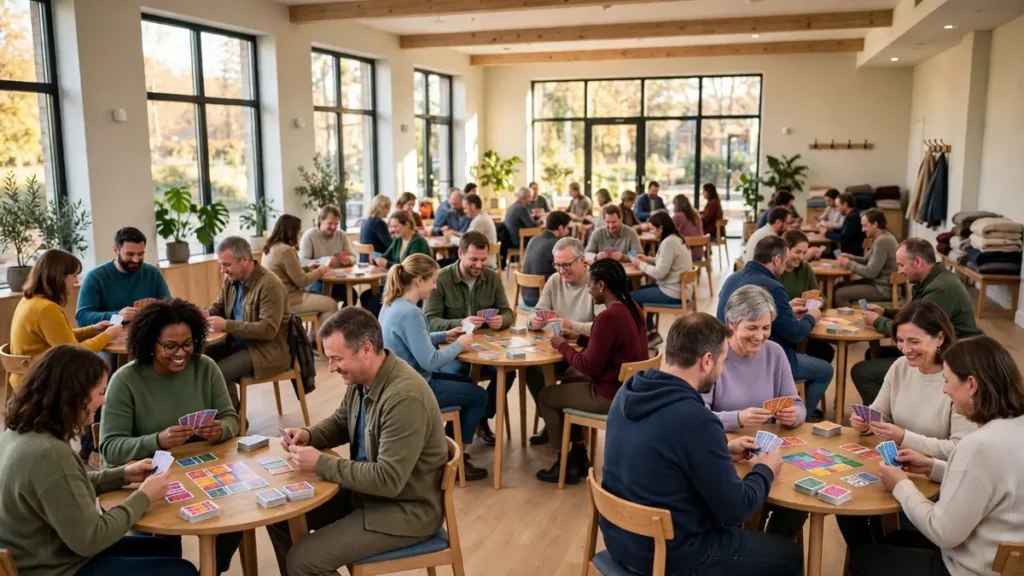
Finding the best card games for 316 players begins with a simple piece of arithmetic that makes the whole evening possible. A group of 316 divides neatly into 79 tables of four, with nobody left over and nobody sitting out. That clean split is the reason a crowd this size can play cards together at all. Instead of one enormous game that nobody can follow, you run 79 small games at the same time, all using the same rules, all finishing their rounds together, and all feeding their scores into one shared leaderboard. When the format is right, the hall feels lively rather than chaotic, and every player gets a full evening of play.
The games that work at this scale share three qualities. First, the rules can be taught in about five minutes, because you cannot spend half an hour explaining a complicated game to 79 tables. Second, a round finishes in twenty-five minutes or less, so the whole room moves to the next round together and nobody waits around. Third, the result at each table is a clear number or ranking that can be compared with every other table, which is what turns dozens of separate games into one tournament. Games that need long negotiations, hidden information spread across a huge group, or a single shared board simply do not survive contact with a crowd of 316.
This guide brings together ten card games that genuinely suit a group of 316, from loud party favourites like Uno and Exploding Kittens to thoughtful cooperative games like The Crew. You will find a comparison table to help you choose, a practical plan for seating and scoring, and answers to the questions every organiser asks before an event this size. If you are planning a school fundraiser, a company social, a community festival, or a charity game night, the ideas in our guide to the best card games for 314 players will also help you shape the evening around the card tables.
Key Takeaways
- Split 316 players into 79 tables of four, all playing the same game under the same rules at the same time.
- Choose games with rules a beginner can learn in five minutes and a round that finishes in twenty-five minutes or less.
- Run the evening as a ladder tournament with a host at every table, rotating seats, and one shared leaderboard.
- Bring at least one full game set per table plus spares, along with printed score sheets, pens, and a visible timer.
- Mix fast, noisy party games with one or two quiet cooperative games so the energy stays high from the first hand to the last.

How the Ten Games Compare
Not every card game scales in the same way. Some reward quick thinking, others reward teamwork and careful planning, and a few are so simple that anyone can join halfway through the evening. The table below compares the ten games in this guide on the things that matter most to an organiser: how many people sit at each table, how long a round lasts, how hard the game is to learn, and what kind of evening it suits best.
| Game | Players per Table | Round Length | Learning Curve | Best For |
|---|---|---|---|---|
| Uno | 4 | 20 minutes | Easy | A loud, friendly opener |
| Exploding Kittens | 4 | 20 minutes | Easy | Party atmosphere |
| Sushi Go! Party | 4 | 20 minutes | Easy | Light drafting fun |
| Dutch Blitz | 4 | 15 minutes | Easy | Fast, energetic play |
| Phase 10 | 4 | 25 minutes | Moderate | A steady tournament game |
| Skip-Bo | 4 | 25 minutes | Easy | Relaxed, all-ages play |
| Monopoly Deal | 4 | 20 minutes | Easy | Quick deals and rivalries |
| Love Letter | 4 | 15 minutes | Easy | Quick deduction rounds |
| Coup | 4 | 15 minutes | Moderate | Bluffing and nerve |
| The Crew | 4 | 25 minutes | Moderate | Teamwork and planning |
The 10 Best Card Games for 316 Players
Every game below works at a table of four, which is the key to the whole evening. With 316 players you need exactly 79 tables, so ordering is simple: 79 copies of the game in play, plus a handful of spares for damaged decks and late arrivals. Each section explains how the game works, why it suits a crowd of this size, and how to score it fairly across all 79 tables.
1. Uno
Uno is the safest opening game for a crowd of 316 because almost everyone already knows it. Players match cards by colour or number, play action cards that skip, reverse, or force opponents to draw, and shout Uno when they are down to a single card. A table of four usually finishes a hand in about twenty minutes, which fits the tournament rhythm perfectly. The rules need almost no explanation, so table hosts can spend their time keeping score instead of teaching.
2. Exploding Kittens
Exploding Kittens turns a simple draw-a-card mechanic into a party game that whole tables laugh through. Players take turns drawing from the deck, hoping to avoid the Exploding Kitten card, and use action cards like See the Future, Attack, and Skip to dodge danger or push it onto someone else. A defuse card saves a player who draws a kitten, and the last player still in the game wins the round. The humour on the cards gives strangers at a table something to laugh about together within minutes.
At a tournament scale, Exploding Kittens works because elimination is quick and nobody sits out for long. A round lasts about twenty minutes, and players who are knocked out early can watch the finish or help the table host with scoring. Award four points to the winner and one point to each eliminated player in reverse order of elimination, so survival time matters. Buy the standard edition for every table and keep the rules sheet short, since the game teaches itself after the first two turns.
3. Sushi Go! Party
Sushi Go! Party is a drafting game where players pick one card from their hand, pass the rest along, and build a menu of sushi dishes that score points in different ways. Some dishes score on their own, others score better in sets, and a few reward players who collect the most of a type. The party edition includes a large menu board and many extra card types, so organisers can change the menu between rounds and keep the game fresh across the evening.
4. Dutch Blitz
Dutch Blitz is the fastest game in this guide, and it brings a burst of energy that wakes a whole hall up. Each player has a small deck in their own colour and races to play cards onto shared piles in number order, shouting and grabbing as the piles grow. There are no turns, so all four players at a table act at once, and a round is usually over in fifteen minutes. The speed makes it thrilling, but it also means table hosts need to watch for mistakes, since excited players sometimes play out of order.
Score Dutch Blitz by counting the cards each player successfully placed, minus two points for every card left in their blitz pile. That gives a clear number for the leaderboard and rewards both speed and accuracy. Because the game is so quick, it works well as a short round between longer games, or as a warm-up while late arrivals find their tables. Warn players that it is a loud game and that tables should keep their decks tidy, since four colours of cards spread across a table can become a mess in seconds.
5. Phase 10
Phase 10 gives a tournament evening its steady backbone. Each player works through ten phases, such as collecting two sets of three or a run of seven, and must complete the current phase before moving to the next. Players draw and discard each turn, and the first to finish all ten phases wins. The game rewards patience and planning rather than speed, which suits players who prefer thinking over shouting, and the phase structure gives every round a clear sense of progress.
6. Skip-Bo
Skip-Bo is a gentle sequencing game that suits mixed-age tables and players who want a calm round. Each player has a personal stock pile and must play its top card onto shared building piles in number order from one to twelve, using hand cards and wild Skip-Bo cards to keep the sequence moving. The first player to clear their stock pile wins. The rules take about two minutes to explain, and the game is forgiving enough that a beginner can compete with an experienced player.
For a crowd of 316, Skip-Bo works as a mid-evening breather after faster games. A round lasts about twenty-five minutes, and scoring is simple: the winner takes four points, and the rest score by how few cards remain in their stock piles. The calm pace also helps table hosts, who can check scores and reset tables without rushing. Skip-Bo decks are inexpensive, so buying 79 copies plus spares is one of the cheapest ways to fill a hall, and the game is a good choice for tables that include younger players or grandparents.
7. Monopoly Deal
Monopoly Deal squeezes the property-trading heart of Monopoly into a fast card game that fits a twenty-minute round. Players collect property sets, charge rent, and use action cards like Deal Breaker and Just Say No to steal sets or block attacks. The first player to complete three full property sets wins the round. Deals and betrayals happen constantly, so tables stay talkative and competitive from the first hand to the last.
8. Love Letter
Love Letter is a tiny game with a big personality, and it is perfect for short rounds between longer games. Each player holds one card, draws a second each turn, plays one, and uses its effect to guess, eliminate, or protect. The deck has only sixteen cards, so a round lasts about fifteen minutes, and the deduction is sharp enough to keep experienced players interested. The small size also means it is cheap to buy in bulk and easy to replace when cards go missing.
Score Love Letter by awarding four points to the round winner and one point to each player who survived to the final showdown. Because rounds are so short, run two Love Letter rounds back to back and combine the scores, which gives the game a fair weight on the leaderboard. The game also works well as a filler while the hosts tally scores from a longer round, since a table can start and finish a game in the time it takes to collect score sheets. New players learn it in a single demonstration hand.
9. Coup
Coup is a bluffing game where each player holds two hidden character cards and claims powers they may or may not actually have. Players take coins, launch assassinations, and call out bluffs, and a player who is caught lying loses a card. The last player with a card remaining wins. The game rewards nerve and reading people, so it produces the most dramatic moments of the evening, with tables erupting when a bold bluff is exposed.
10. The Crew
The Crew is a cooperative trick-taking game that gives the evening a thoughtful finish. Players work together to complete missions, such as winning a trick that contains a particular card, and they may only communicate through a limited set of signals. The game rewards planning and trust, and a table that works well together feels a real sense of achievement when a mission succeeds. The quiet concentration it needs also calms the hall after a noisy evening.
Score The Crew by mission rather than by individual winner: award every player at a table the same points for each mission completed, with a bonus for finishing ahead of schedule. That keeps the cooperative spirit intact and lets the leaderboard reward teamwork rather than rivalry. A round takes about twenty-five minutes, and the game is a strong closing choice because it ends the night with tables working together instead of competing. Bring the mission logbook for each table so progress is recorded clearly, and remind hosts that table talk is limited by design, not by rudeness.
Your 316-Player Game Night Checklist
A crowd of 316 leaves no room for improvisation, so work through this checklist in the week before the event. The planning approach in our guide to the best card games for 312 players uses the same ladder format, and most of its setup steps transfer directly to a group of 316.
- Book a hall with 79 tables of four plus space for a registration desk, a leaderboard wall, and walkways wide enough for hosts to move between tables.
- Buy 79 copies of each game on the schedule, plus at least eight spares of each title for damaged decks and late arrivals.
- Recruit and brief 79 table hosts, one per table, with a one-page rules sheet and a clear ruling for the most common disputes in each game.
- Print score sheets for every table and every round, with the table number and game name already filled in so nothing is mislabelled.
- Set up one visible leaderboard, updated after every round, and a loud timer that the whole hall can hear when a round ends.
- Plan the rotation in advance, so winners move up toward the top tables and everyone meets new opponents after each round.
Frequently Asked Questions
Organisers planning a card night for 316 players tend to ask the same questions. The answers below cover the numbers, the timing, and the practical details that decide whether the evening runs smoothly.
How many tables do you need for 316 players?
You need exactly 79 tables of four, which is one of the cleanest splits in this whole series. Nobody sits out and nobody plays at a short table, so every round is fair and every score is comparable. Keep two or three spare tables ready in case a table is damaged or a group needs to move, but the plan itself needs no reserves or byes.
How long does a 316-player card game night last?
Plan for about three hours, including registration, five rounds of twenty to twenty-five minutes, short breaks for scoring, and a closing ceremony. Add thirty minutes at the start for seating and a welcome briefing, and ten minutes at the end for prizes and photos. A tighter schedule is possible with four rounds, but five rounds gives the ladder time to separate the strongest players fairly.
What is the best game to start the evening with?
Uno is the best opener because almost everyone knows it, the rules need no teaching, and the first round finishes quickly. A familiar game calms nervous players and lets the hosts learn their tables before the more competitive games begin. Save Coup and The Crew for later rounds, when players are comfortable with each other and the hall has found its rhythm.
How do you keep scores fair across 79 tables?
Use the same scoring rule at every table, collect the score sheets after each round, and update one central leaderboard that everyone can see. Give four points to each table winner and fewer points down the ranking, so every table contributes the same total. Brief every host on the same rulings before the evening starts, and have two scorers double-check the leaderboard after each round.
Can beginners enjoy a card night with 316 players?
Yes, because every game on this list can be learned in about five minutes, and every table has a host to help. Beginners usually do best at tables playing Uno, Skip-Bo, or Love Letter, so ask about experience at registration and seat new players at friendly tables for the first round. The rotation system then lets them meet stronger players gradually as the evening goes on.
What should you bring besides the card games?
Bring printed score sheets, pens, a visible timer, spare decks, a first aid kit, and a simple prize table with small awards for the winners and a few fun prizes for the best table spirit. Water and light snacks keep energy up, and a clear sign at the entrance showing the table layout saves the hosts from answering the same seating question 79 times. The seating ideas in our guide to the best card games for 310 players also work well for arranging a hall of this size.
The Bottom Line
The best card games for 316 players are the ones that stay simple when they are played at 79 tables at the same time. Uno opens the evening, Dutch Blitz and Love Letter keep the pace quick, Phase 10 and Skip-Bo give the tournament its steady middle, and The Crew closes the night with teamwork instead of rivalry. With a host at every table, a shared leaderboard, and rounds that finish on time, a crowd that sounds unmanageable becomes one of the most enjoyable evenings a community can run.
Start with the checklist, order your 79 sets early, and brief your hosts before anyone arrives. The games themselves are the easy part. The planning is what makes 316 players feel like one big card night instead of 79 separate ones, and when the planning is done well, the only thing left to do is shuffle, deal, and enjoy the evening.