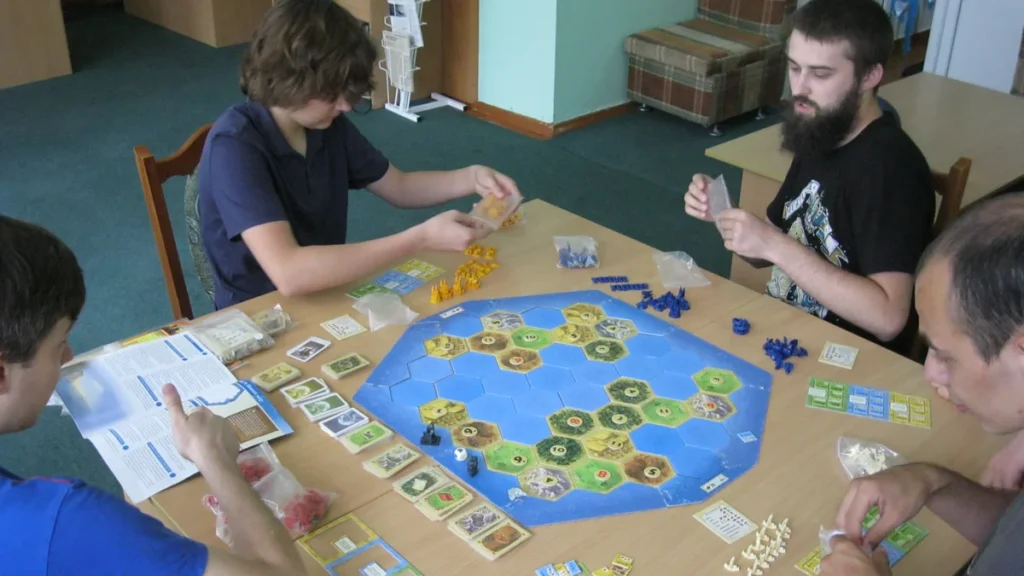
Four hundred and sixty-eight people in one room, all playing board games at the same time, sounds like a logistical nightmare. No single board game seats 468 players, and no single table ever will. The games in this guide work because they repeat cleanly across dozens of tables, teach in minutes, and keep every table finishing at roughly the same time.
The secret is not finding one magic game. It is picking games that survive being played at 78 tables at once The nine games below were chosen for exactly that: short teach times, almost no downtime, and simple scoring that a helper can check at a glance.
This guide gives you three formats that work for 468 players, the nine games with setup notes for a huge group, the table counts and copy counts you need, and a checklist to run on the night. Follow it in order, and the evening runs itself. Skip the planning, and 468 people will spend the first hour standing around waiting for someone to explain the rules.
Key takeaways
- No one game seats 468 players. Run 78 tables of six, and repeat the same game across the room.
- Pick games that teach in under five minutes and finish in under an hour.
- Teams of two or three stretch every copy further and keep shy players involved.
- Stations beat one giant tournament when players have mixed experience.
- One helper per six to eight tables keeps scoring fair and questions answered fast.
How 468 players actually play at once
Start with the room, not the games. Four hundred and sixty-eight players at six per table means 78 tables, and 78 tables need clear lanes between them, a central scoring desk, and a sound system that reaches the back row. The team format below is the same approach used in our guide to board games for 466 players, and it holds up at this size too.
The team format
In the team format, every seat at the table belongs to a team of two or three, not to one person. A five player game suddenly seats ten or fifteen people, and nobody sits out a round. Teams talk through every move together, which means new players learn the game from their own team instead of waiting for a volunteer to reach their table.
The station format
In the station format, the room is split into zones, and each zone runs a different game. With 468 players, six stations of 78 players work well, and every station runs the same game at thirteen tables. Players rotate to a new station every forty-five minutes, so nobody is stuck with a game they dislike all night.
The tournament format
In the tournament format, every table plays the same game at the same time, and winners move up while the rest stay put. Use it for a single headline round in the middle of the evening, not for the whole night. Run it with one of the flip and write games below, because everyone plays at the same time, everyone finishes together, and scoring is a simple number a helper can check in seconds.
The 9 best board games for 468 players
Every game below was picked for the same four reasons: it teaches in five minutes or less, it plays in under an hour, it works in teams, and you can buy or borrow enough copies without a miracle. The copy counts assume teams of two or three sharing a seat.
1. Tokaido
Tokaido is a calm walk along the old East Sea road in Japan, where players collect meals, souvenirs, hot springs, and encounters on the way to Edo. Each turn, the player furthest behind moves forward, so nobody waits long, and the whole table stays involved even when it is not their move. A copy seats two to five players and plays in about forty-five minutes
For 468 players, run Tokaido in pairs, with two people sharing each seat and deciding every move together. That puts ten players on every copy, so 47 copies cover the whole room It scales because the rules fit on one page, the pieces are chunky and easy to handle, and a helper can teach a full table in four minutes.
2. Santorini
Santorini is a pure abstract game of building towers on a small Greek island board, where you win by getting your builder to the third level. The base rules take about three minutes to teach: move, then build, and the first to the top wins.
For 468 players, play Santorini as two against two, with each pair sharing a builder and arguing every move as a team. Four seats per copy means eight players per table, so 59 copies cover the room It scales because the board is tiny, the rules never change mid game, and a twenty minute game means nobody is stuck losing for long.
3. Calico
Calico is a cosy tile laying game about sewing a quilt for cats, where players draft fabric tiles and place them to match colour and pattern goals. It looks gentle, and the first few turns are, but the scoring puzzle is genuinely thinky, which makes it a favourite with players who want a quiet challenge. A copy seats one to four players, plays in thirty to forty-five minutes
For 468 players, run Calico in pairs at four seats per copy, which puts eight players on every table and means 59 copies cover the room. It scales because every player works on their own quilt, so there is no direct conflict to slow the game down.
4. Cartographers
Cartographers is a flip and write game where everyone draws on their own map at the same time, following a card flipped for the whole room. There is no turn order, no waiting, and no player limit that matters: one copy includes a hundred map sheets, so a single copy covers a hundred players. A game takes thirty to forty-five minutes
For 468 players, Cartographers is the star of the night, because five copies give you five hundred map sheets, and every single player can play at the same time. It scales because simultaneous play removes the waiting entirely, the rules take five minutes to teach to a hall full of people at once, and the shared flip means every table is always in step.
5. Welcome To…
Welcome To is another flip and write game, this time about building the perfect 1950s neighbourhood, with house numbers, fences, parks, and pools. Three cards are flipped for everyone each turn, and every player picks a combination and writes it on their own street. It plays in about twenty-five minutes, seats any number of players
For 468 players, Welcome To works exactly like Cartographers: five copies give you five hundred score sheets, and the whole room plays together in one giant round. Run it as the opening game of the night, because it teaches the entire room at once, finishes in under half an hour, and everyone leaves the first round with a finished sheet. It scales because the game has no player limit, no downtime, and a score that any player can add up on their own sheet.

6. Tiny Towns
Tiny Towns is a clever little city builder where every player builds on their own four by four grid, using the same resource called out each turn. One player names a resource, and everyone places it on their board, so the whole table builds at the same time A copy seats one to six players and plays in about forty-five minutes.
For 468 players, run Tiny Towns in pairs at six seats per copy, which puts twelve players on every table and means 39 copies cover the room. The shared resource call is the key: one player at each table calls the resource, so the table never waits on a slow turn It scales because simultaneous building removes downtime, the grid is small enough to see at a glance, and the game ends the moment the boards fill up.
7. Wits and Wagers
Wits and Wagers is a trivia betting game where nobody needs to know the answer, only to guess closest to it. Every question has a number for an answer, like the year something happened or the weight of an animal, and players write a guess, then bet on which guess is nearest. It plays in about twenty-five minutes, seats three to seven players or teams per copy
For 468 players, run Wits and Wagers with teams of three, seven teams per copy, which puts twenty-one players on every table and means 23 copies cover the room. Lighter party games like the ones in our board games for 464 players round up work the same way, but Wits and Wagers earns its place here because the betting keeps every team invested even when they know nothing about the question.
8. Herd Mentality
Herd Mentality is a party game with one rule that matters: give the same answer as everyone else. Each round, one player asks a question, everyone writes an answer, and the players who match the majority score, while anyone who gives a unique answer gets the dreaded pink cow. It seats four to twenty players per copy, plays in about twenty minutes
For 468 players, Herd Mentality is the easiest game to run at scale, because a single copy seats twenty people, so 24 copies cover the whole room with no teams needed. It scales because the player count per copy is the highest here, the rules fit in two minutes, and the pink cow gives every table something to laugh about.
9. Throw Throw Burrito
Throw Throw Burrito is a fast card game mixed with dodgeball, where players collect matching sets of cards and then throw soft foam burritos at each other to score. It is loud, silly, and physical A copy seats two to six players, plays in about fifteen minutes, and the foam burritos are soft enough that nobody gets hurt.
For 468 players, run Throw Throw Burrito in pairs at six seats per copy, which puts twelve players on every table and means 39 copies cover the room. Keep it at the far end of the hall, well away from the quiet stations It scales because the rounds are so short that a station can run three games in one rotation, and the rules take two minutes to teach.
At a glance: the nine games compared
Use this table when you are buying or borrowing copies. The copy counts assume teams of two or three sharing a seat
| Game | Players per copy | Minutes | Teach time | Copies for 468 |
|---|---|---|---|---|
| Tokaido | 2 to 5 | 45 | 5 minutes | 47 |
| Santorini | 2 to 4 | 20 | 3 minutes | 59 |
| Calico | 1 to 4 | 30 to 45 | 5 minutes | 59 |
| Cartographers | 1 to 100 | 30 to 45 | 5 minutes | 5 |
| Welcome To | 1 to 100 | 25 | 5 minutes | 5 |
| Tiny Towns | 1 to 6 | 45 | 5 minutes | 39 |
| Wits and Wagers | 3 to 7 teams | 25 | 3 minutes | 23 |
| Herd Mentality | 4 to 20 | 20 | 2 minutes | 24 |
| Throw Throw Burrito | 2 to 6 | 15 | 2 minutes | 39 |
Your 468 player night checklist
Run through this list the week before, and again on the morning of the event.
- Count the copies first. Check every copy against the table above, and borrow spares of the two flip and write games, because spare score sheets are the cheapest insurance you will ever buy.
- Number every table. Put a big numbered card on each of the 78 tables, and print the same number on every player wristband or ticket, so nobody wanders the room looking for their seat.
- Brief the helpers together. Gather every helper an hour before the doors open, teach them one game each, and give them a printed rules sheet so they never have to guess.
- Test the sound system. Stand at the back table and have someone speak from the stage, because the flip and write rounds fall apart if the back rows cannot hear the cards.
- Plan the rotation. Print a rotation card for every team showing which station comes next and at what time, and ring a bell when it is time to move.
- Pack a spares box. Bring extra pencils, score sheets, dice, timers, and batteries, plus tape and markers, because something always goes missing in the first hour.
Frequently asked questions
Can one board game really seat 468 players?
No single board game seats 468 players around one table, and that is fine. Two games on this list, Cartographers and Welcome To, let all 468 players play at the same time, because everyone plays on their own sheet while the host flips cards for the whole room.
How many tables do 468 players need?
At six players per table, you need 78 tables, and you should plan for 80 so you have spares for helpers and late arrivals. Teams of two or three change the maths in your favour, because a table of six seats can hold twelve to eighteen players when every seat is a team.
How many helpers do we really need?
Plan for one helper per six to eight tables, which means ten to thirteen helpers for the full room, plus a host on the stage and two people on the scoring desk. If your crowd leans heavier, the board games for 462 players guide uses the same helper ratio, and it holds up just as well here.
Which game should we start with?
Start with Welcome To, because it teaches the whole room at once, finishes in twenty-five minutes, and gives every player a finished sheet to compare. Welcome To sits in the middle: lively enough to wake the hall up, calm enough that nobody misses a turn.
What if some tables finish much faster than others?
Fast tables are a feature, not a problem, if you plan for them. Keep a filler game at every station, like a deck of cards or a quick guessing game, and let finished tables play it while they wait.
How long does a night for 468 players last?
Plan for three to four hours, including arrival, three rotations of forty-five minutes, and a closing round. Anything shorter feels rushed at this size, and anything longer leaves the last tables tired and ready to go home.
The bottom line
Four hundred and sixty-eight players is not a bigger game night. It is a small festival that happens to be about board games, and it works when you stop hunting for one game that seats everyone and start building a room where every table is playing something good at the same time. Do that, and 468 strangers will leave talking about the night they played board games with a whole crowd.