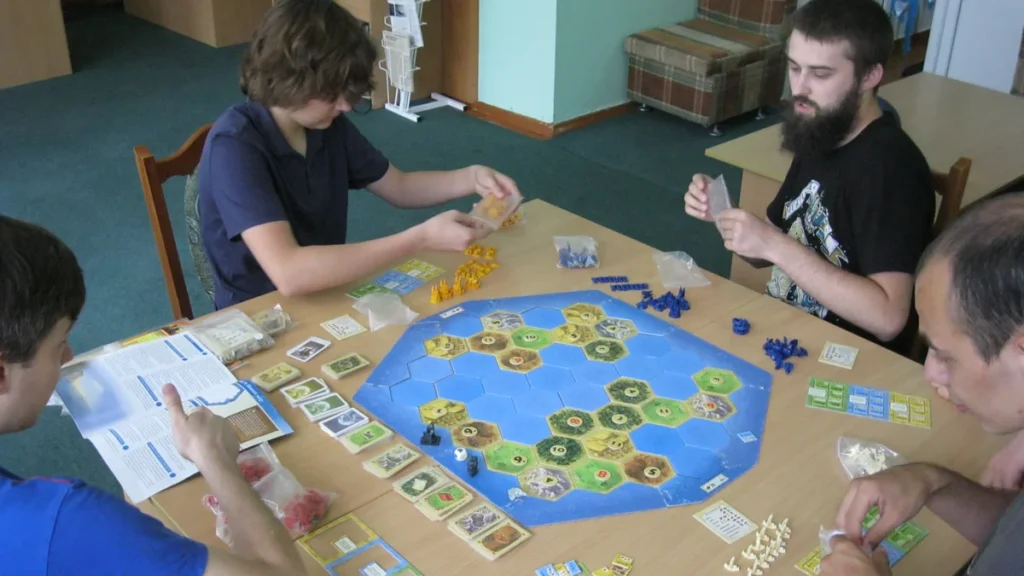
Four hundred and seventy-four players fill a hall fast. A single puzzle handed to that many people at once would vanish into noise. The trick is not to shrink the games but to split the crowd: small teams, short rounds, and stations that keep every player busy at the same time. When the format fits the room, a crowd this size stops feeling crowded and starts feeling like a festival.
This guide builds a full day around nine puzzle games that work for very large groups. Each game runs in parallel across many tables, so no team waits long for a turn and no single table decides the whole event. Some games reward quiet planning, others reward fast hands or loud teamwork, and the mix keeps energy up from the first round to the last. Every game below scales cleanly, needs only ordinary tabletop supplies, and can be explained in under two minutes.
The plan suits school halls, company off-sites, community days, and family gatherings where ages and experience levels vary widely. Teams of six to eight players work best, stations rotate on a fixed clock, and points carry forward into a short final. Print one rules sheet per station and appoint a scorekeeper for every table before play begins.
Key takeaways
- Split 474 players into teams of six to eight and run nine stations in parallel so nobody queues.
- Rotate stations every 20 minutes on a fixed clock, with points carrying forward to a short final.
- Mix quiet planning games with fast, hands-on games so every kind of player has a round to shine in.
- Print one rules sheet per station and give every table its own scorekeeper before play begins.
- Keep rounds short, score simply, and announce the standings after every rotation to hold the energy.

The Nine Games at a Glance
The table below gives the whole day in one view. Use it to plan table space, buy supplies, and brief your station leaders. Round lengths include setup and scoring, so a 20-minute rotation never overruns.
| Game | Players per team | Round length | Best for |
|---|---|---|---|
| Carcassonne Tile Laying Challenge | 4 to 6 | 20 minutes | Quiet planners |
| Qwirkle Pattern Match Challenge | 4 to 6 | 20 minutes | Quick pattern spotting |
| Splendor Gem Claim Challenge | 4 | 20 minutes | Careful traders |
| Dixit Story Clue Challenge | 6 to 8 | 20 minutes | Creative storytellers |
| Zendo Rule Discovery Challenge | 6 to 8 | 20 minutes | Logical detectives |
| Santorini Build Challenge | 4 | 20 minutes | Tactical builders |
| Sushi Go Pick and Pass Challenge | 6 to 8 | 15 minutes | Fast drafters |
| Pick Up Sticks Challenge | 4 to 6 | 15 minutes | Steady hands |
| Forbidden Island Tile Rescue Challenge | 6 to 8 | 20 minutes | Team cooperation |
How 474 Players Break Into Teams
Divide 474 players into 72 teams of six or seven, with a few teams of eight to absorb the remainder. Six is the sweet spot: everyone can reach the table, everyone gets a say, and no one hides at the back. Teams of eight still work for the louder, story-driven games, but keep them away from the small-board games where elbow room matters. Give every team a number, a colour, and a printed rotation card that lists its nine stations in order.
Run the nine games as nine stations around the hall, with eight teams at each station at any one time. That puts about 50 players at every station, spread across eight tables, which is a comfortable density for a school hall or a hotel ballroom. A central bell or whistle marks each rotation, and teams move clockwise to the next station. The format borrows its shape from the puzzle games for 473 players event, where the same station layout kept a nearly identical crowd moving without bottlenecks.
Score every round out of ten points, and let the lowest-scoring team at each table still bank two points for finishing. That small floor keeps weaker teams in the contest. Announce the top ten teams after every rotation, post a printed leaderboard near the entrance, and keep the final simple: the top eight teams meet in a short playoff while everyone else plays a relaxed closing round.
The Nine Games
Each game below includes what the team actually does, how it is scored, and one practical tip from running it with large groups. Play them in any order; the rotation card decides the sequence, not the difficulty.
1. Carcassonne Tile Laying Challenge
Teams draw landscape tiles one at a time and build a shared map of roads, cities, and fields, placing a follower on a feature they hope to complete. The twist for a big group is that each team plays on its own copy of the game, so eight tables run eight separate maps at once. Points come from finished roads and cities, and the team with the highest map score when the tile stack runs out wins the round.
Keep the pace honest with a sand timer: each tile placement gets 30 seconds, and a team that stalls loses the tile to the box. Station leaders should pre-count the tiles so every table starts with the same stack, and score the maps with a simple printed sheet rather than arguing over half-finished cities.
2. Qwirkle Pattern Match Challenge
Teams lay coloured shape tiles in lines where every tile in a line shares either its colour or its shape, scoring a point for each tile in the line and six bonus points for completing a line of six. The rules take one minute to teach, which makes this the best warm-up station for teams that have never played a modern board game. Because every turn is visible on the table, even quiet players can point at a good move without speaking over anyone.
Score by counting tiles, not by debating cleverness: each team records its total after a fixed number of turns, and the highest total wins. A station leader who watches for one common mistake, tiles that match neither colour nor shape, will save every table a scoring dispute later.
3. Splendor Gem Claim Challenge
Teams collect coloured gem tokens and spend them on development cards, building a small engine that earns points and permanent gem discounts. The game rewards patience: the team that grabs the first shiny card usually loses to the team that builds a steady income of gems. With only four players per team in this round, split larger teams into two pairs and add their scores together, so everyone still has a hand in the result.
Set a firm turn limit of 15 turns per team so the round fits the rotation clock. When the limit hits, count points from cards and noble tiles and record the total. Lay out the market cards in the same order at every table so scores stay comparable across the hall.
4. Dixit Story Clue Challenge
One player gives a short spoken clue for a dreamlike picture card, the other teams pick the card they think matches, and points go to clues that are suggestive but not obvious. This is the loudest station in the hall, and that is the point: after two quiet tile games, teams need a round where talking, laughing, and wild guessing are the whole game. The surreal art does the heavy lifting, so no one needs to be an artist or a poet to play well.
Score with voting tokens rather than raised hands, because secret votes stop confident players from swaying the room. Each team writes its guess on a slip, the station leader reveals them together, and points are tallied in the open. Rotate the clue-giver every round and keep clues to five words or fewer.
5. Zendo Rule Discovery Challenge
A station leader, called the Master, holds a secret rule about arrangements of small pieces, such as a structure containing a red piece touching a blue one. Teams build test arrangements, the Master marks each one as following or breaking the rule, and the first team to state the rule correctly wins the round. It is pure inductive logic, and it produces the best arguments of the whole day as teams defend their theories.
Give every team the same set of pieces and a printed sheet to record its guesses, because written records stop teams from repeating failed tests. Limit each team to one formal guess per rotation block, with unlimited informal test builds in between, so the round stays tense without ending in five minutes. The Master should prepare three rules of rising difficulty in advance and use the easiest one for the first rotation of the day.
6. Santorini Build Challenge
Teams move worker figures across a small grid board, building towers level by level, and win by stepping onto the third level of a tower. The board is tiny, the rules fit on one card, and every move is visible, which makes it a strong spectator game for the teams waiting at neighbouring tables. Because the game is quick, run it as a mini-league: each team plays three short matches against different opponents and banks points from all three.
Keep matches to ten minutes by using a chess clock or a phone timer, and call a draw at two points each if time runs out. Teach the win condition first and the building rules second. Spare boards matter here too: the small building blocks are the easiest pieces in the hall to lose.
7. Sushi Go Pick and Pass Challenge
Teams draft cards of sushi dishes from a hand, pass the rest to the next player, and score sets such as pairs of tempura or runs of sashimi. The pick-and-pass rhythm is fast, the cards are cheerful, and a whole round fits inside 15 minutes, which makes this the perfect palate cleanser between two longer thinking games. It also scales beautifully: six to eight players around one table is exactly how the game was designed to be played.
Play three short hands and add the scores together, with pudding cards scored only at the end, so teams that chase quick points early can still be caught. The station leader should demonstrate one full pass before starting, because the first pass is where new players get confused.
8. Pick Up Sticks Challenge
A bundle of thin sticks is dropped onto a table, and players take turns lifting one stick at a time without moving any other stick. It sounds simple until the pile settles into a woven knot and every hand in the room goes still. This is the quietest, tensest station in the hall, and it gives players with steady hands and sharp eyes a genuine edge over the fast talkers. The complete guide to puzzle games for 472 players uses the same idea of a short dexterity round to break up long thinking games, and it works just as well here.
Score each stick by its colour value, play two drops per team, and take the better total of the two. The station leader drops the bundle from the same height every time, about 30 centimetres, so no table gets a kinder scatter than another. Warn teams in advance that a moved stick ends the turn immediately, and appoint one player per table as the judge for that call.
9. Forbidden Island Tile Rescue Challenge
Teams play as adventurers on a sinking island, flipping and moving across tiles to collect four treasures and reach the helicopter before the island floods. It is fully cooperative, so the whole team wins or loses together, and it is the ideal closing game for groups that have spent the day competing against each other. The rising water mechanic creates real tension in the last five minutes, and the shared win feels earned.
Run it on the standard difficulty for most rotations and raise the water level by one step for the final rotation of the day. Score by treasures collected, with a bonus for escaping, so a team that rescues three treasures and escapes still beats a team that grabs four and sinks. Station leaders should keep the flood deck shuffled between rotations, because a memorised deck would hand later teams an unfair advantage.
Running the Day: Stations, Scoring and Timing
Open the hall 45 minutes before the first round. Lay out nine stations in a wide loop, put the quiet games on one side and the loud games on the other, and leave a clear walking lane between them. Each station needs its own table set, a printed rules sheet, a score sheet, and a leader wearing a coloured badge that matches the station colour on the rotation cards. A short briefing for station leaders, ten minutes the evening before or 20 minutes on the morning, prevents most problems before they start.

Run nine rotations of 20 minutes with five-minute moves between them, which fills about four hours including a midday break after rotation five. Keep the break long, at least 30 minutes, because 474 players need time for food, fresh air, and a rest from thinking. During the break, post the standings and reset every station to its starting layout.
Close with a short final for the top eight teams: one round of Dixit Story Clue followed by one round of Forbidden Island Tile Rescue, scored together, while the remaining teams play a relaxed free-choice round at any station. The structure mirrors the step-by-step approach in the guide to running puzzle games for 471 players, and it gives the day a clear ending without making 466 players sit and watch. Hand out small prizes for the winners, plus one prize for the best team name and one for the fairest play, and the hall will empty happy.
Setup Checklist
Work through this list the day before the event, and tick each item off with the station leaders present.
- Count 474 player badges and print 72 team rotation cards, one per team, with station order and colours.
- Pack nine station kits, each with its game sets, printed rules, score sheets, timers, and spare pieces.
- Brief nine station leaders on scoring, timing, and the two-point finishing floor for every round.
- Test the bell or whistle from the far corner of the hall and print the leaderboard sheets in advance.
- Arrange tables in a wide loop with a clear walking lane, quiet games on one side and loud games on the other.
- Prepare small prizes for the winning team, the best team name, and the fairest play of the day.
Frequently Asked Questions
How do 474 players fit into teams?
Split the crowd into 72 teams of six or seven, with a few teams of eight to absorb the remainder. Teams of six work best because everyone can reach the table and join the discussion, while the station format means eight teams play each game at once across eight tables.
How long does the whole day take?
Nine rotations of 20 minutes, plus five-minute moves and a 30-minute midday break, fill about four hours. Add 45 minutes for setup before the first round and 30 minutes for the final and prizes, and the day runs close to five hours from doors open to finish.
Do we need a big hall?
You need one large hall or two medium rooms joined by a clear route, with nine station areas of about eight tables each. A school hall, a hotel ballroom, or a community sports hall all work, as long as the walking lane between stations stays clear throughout the day.
What if a team has never played one of the formats?
Every game in this guide can be explained in under two minutes, and each station leader demonstrates the first move before play starts. Teams learn fastest by playing, so keep the first rotation gentle and let station leaders answer questions during the round rather than before it.
Can younger or older players take part?
Yes. The mix of games means no single skill decides the day: younger players often shine at fast drafting and pattern spotting, while older players tend to lead at planning and rule discovery. Teams with a spread of ages usually score more evenly across all nine stations.
What should we do if a puzzle set breaks during a round?
Every station kit carries spare pieces and, where possible, a spare copy of the game. If a set cannot be fixed in two minutes, the station leader swaps in the spare, awards the affected team the average score for that station, and notes the incident for the organisers to fix after the event.
The Bottom Line
Nine games, nine stations, and a fixed clock turn 474 players from a crowd into 72 teams that all play at once. The mix of quiet planning, fast drafting, storytelling, logic, and steady hands means every player finds a round where they matter, and the simple scoring keeps the contest alive until the final.
Print the rotation cards, brief the station leaders, and trust the format. The games do the work once the hall is set, and the day ends the way every good puzzle event should end: with a close finish, a room full of talking teams, and a winner decided on the last round.