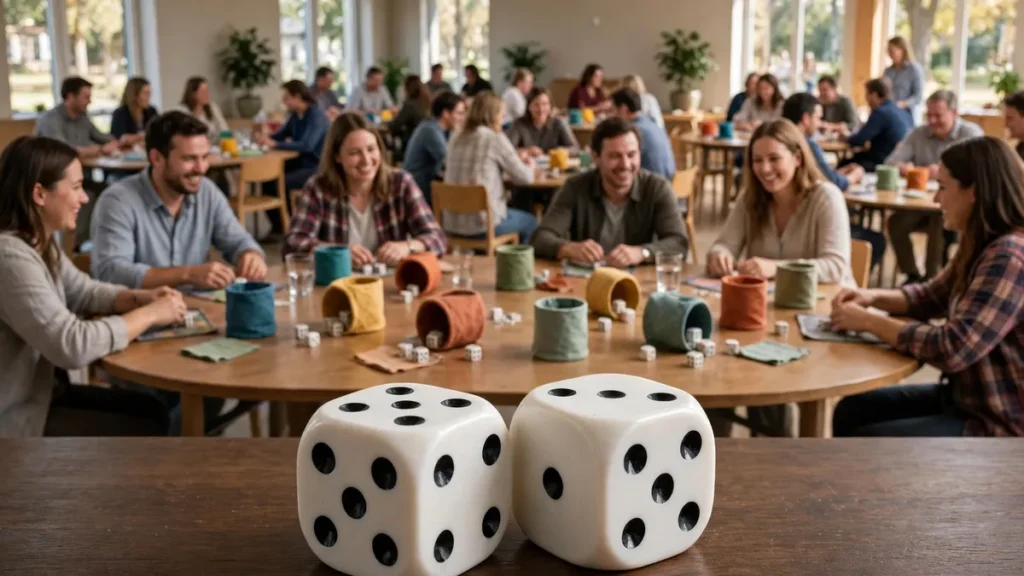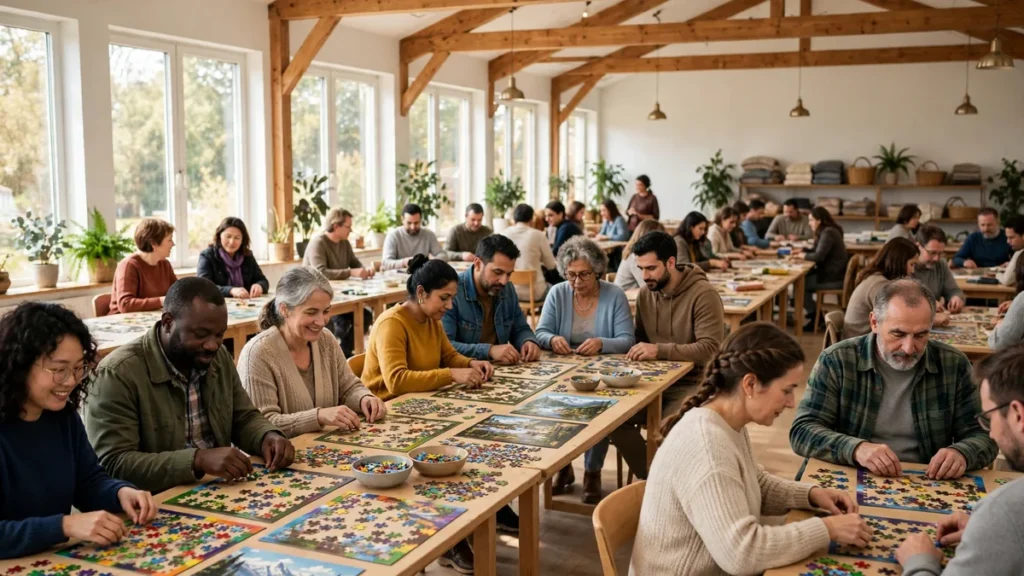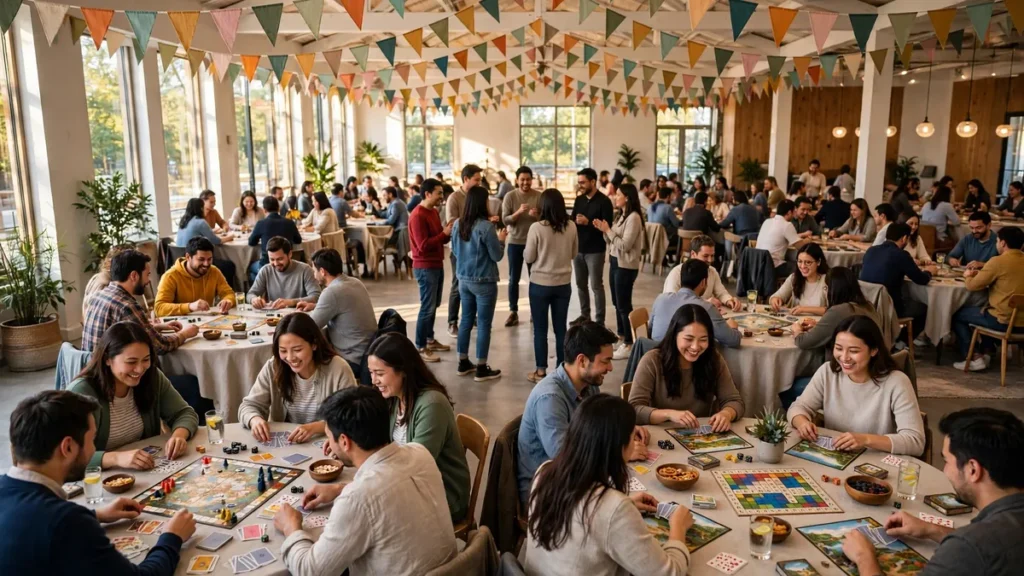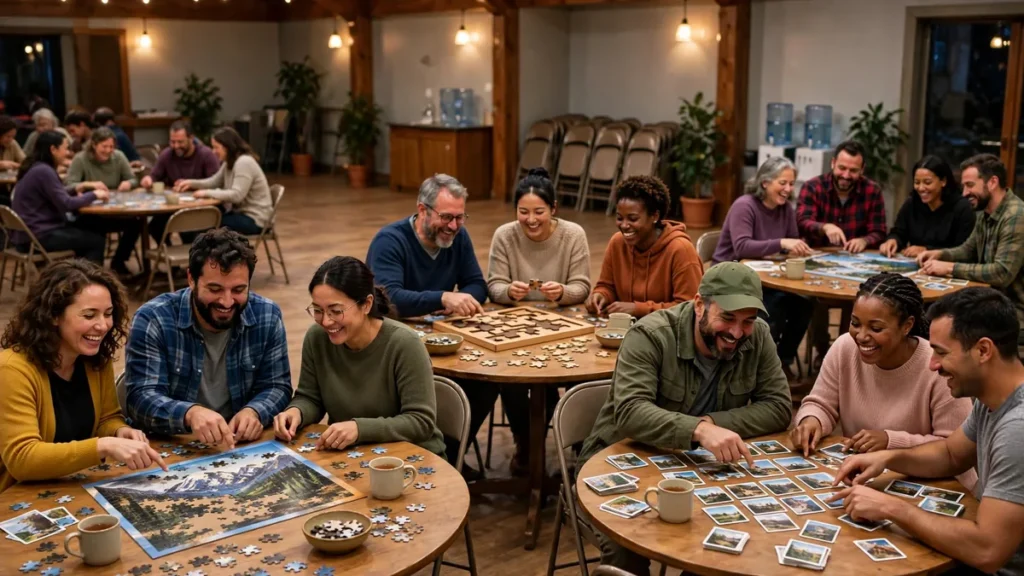
Finding the best puzzle games for 143 players starts with an honest fact: no single puzzle game seats 143 people around one table. A jigsaw puzzle, a logic grid, or an escape-room board game is built for a small group, not a crowd the size of a wedding reception. That does not mean a puzzle night for 143 players is impossible. It means the game has to change shape, and the best puzzle games for 143 players are the ones that scale through teams, tables, relays, and tournaments rather than through one oversized box.
Think of 143 players as twenty or more teams working at once. Split the room into teams of five, six, or seven, and you get roughly twenty-one to twenty-eight teams, each solving the same puzzle challenge at its own table. A central host keeps the clock, hands out identical puzzle sets, and scores every table on the same rules. Everyone plays the same game at the same time, even though nobody is crowded around the same pieces. That structure is what turns an ordinary puzzle into a genuine large-group event.
This guide covers the formats that actually work at this scale, the space and equipment you need, fair scoring, and a step-by-step plan for running the night. Every format below was chosen because it survives contact with a real room of 143 people: it is easy to explain in under two minutes, it keeps every team busy, it produces a clear winner, and it does not collapse when one table finishes early or one team gets stuck. Whether you are planning a school event, a company social, a community fundraiser, or a family reunion, these puzzle games for 143 players will give every guest something to solve.
Key takeaways
- No single puzzle game seats 143 players, so the best events use teams of five to seven, multiple tables, and identical puzzle sets played at the same time.
- Jigsaw relays, escape-room tournaments, and puzzle hunts scale best because every team works in parallel and finishes can be timed fairly.
- Give every team the same puzzle, the same number of pieces, and the same time limit, or the results will not be fair.
- Plan one table per team, one puzzle set per table, plus at least two spare sets, and a host with a microphone and a visible timer.
- Score on a mix of speed and accuracy, not speed alone, so careful teams are rewarded and guessing is not.

Why 143 Players Changes Everything
A puzzle game designed for four players assumes a quiet table, shared pieces, and constant conversation. Multiply that table by twenty-five and every assumption breaks. Pieces get lost, instructions get misheard, one loud table drowns out the host, and a single puzzle set cannot be shared by a hundred people. The puzzle itself is rarely the problem. The logistics around it are.
The first decision is team size. Teams of five to seven work best for 143 players. Smaller teams mean more teams to manage, more tables, and more puzzle sets to buy or print. Larger teams mean some players stand around watching while two or three keen solvers do all the work. A team of six gives everyone a job: one person sorts edge pieces, one sorts by colour, one reads the clues, one tracks the time, and two work the middle of the puzzle. With 143 players, teams of six give you twenty-three teams of six and one team of five, which is a tidy, manageable number.
How to Organise 143 Players Into Teams
Good organisation is what separates a memorable puzzle night from a noisy mess. Start with registration. Ask players to arrive in pre-formed teams where possible, and assign the rest on the night using coloured wristbands or numbered badges. Pre-formed teams arrive faster and settle quicker, while assigned teams mix strangers together, which suits community and workplace events. Either way, publish the team list before the event so nobody queues at the door asking where to sit.
Choose Your Team Size and Table Count
For 143 players, plan for twenty-four tables. Twenty-three tables hold six players and one table holds five, or you can run twenty teams of seven with three spare players joining as helpers. Seven-player teams reduce the number of puzzle sets you need, but they also increase the chance that quieter players get sidelined. Six-player teams are the safer choice for a mixed crowd that includes children, older players, and first-time puzzlers.
Run Parallel Rounds, Not One Long Game
One long puzzle that lasts ninety minutes sounds dramatic, but it punishes slow teams and bores fast ones. Short parallel rounds work better. Run three or four rounds of twenty to thirty minutes each, with a different puzzle type in every round. Teams earn points in each round, and the overall winner is the team with the most points across the night. A team that struggles with jigsaws can still win the logic round, and nobody is eliminated early.
The Best Puzzle Games for 143 Players
The formats below are ranked by how well they scale, how easy they are to run, and how much fun they create for a large mixed group. Each one uses the same principle: identical challenges, parallel play, and a clear finish line. If you usually play with a smaller group, the best puzzle games for adults are a good place to practise these formats before you scale them up. Mix three or four of the formats below across your rounds for a varied night.
1. Jigsaw Relay Race
The jigsaw relay is the simplest large-group puzzle game and the easiest to run fairly. Every team receives the same 500-piece jigsaw puzzle, still sealed, at the same moment. The host starts the timer, and teams race to finish. The first team to complete the puzzle and raise its flag wins the round, with bonus points for the next three finishers. Because every team has the same image and the same piece count, the result is genuinely comparable.
Choose a puzzle image with clear colour regions, such as a landscape with a blue sky, green fields, and a red building. Avoid images that are mostly one colour, because they frustrate beginners and slow everyone down without adding fun. A 500-piece puzzle takes a team of six about twenty-five to forty minutes, which fits a single round well. Buy one puzzle per team plus two spares, and check that every box contains the same piece count by buying them as a single batch from the same supplier. For a relay twist, swap players every five minutes on the host’s whistle, so one fast solver cannot do the whole puzzle alone.
2. Escape-Room Tournament
An escape-room tournament adapts the popular escape-room format to a whole hall. Instead of one locked room, every table becomes a mini escape room with the same set of puzzle envelopes. Each envelope contains a clue, a code, or a small puzzle, and solving it unlocks the next envelope. Teams work through five or six envelopes in sequence, and the first team to open the final envelope and call out its code wins.
Design the puzzles so they need different skills: one code hidden in a word puzzle, one in a number sequence, one in a picture clue, one in a logic grid, and one in a simple sorting task. That variety means every team member can contribute, and no single puzzle type decides the whole round. The best escape-room board games give you ready-made puzzle ideas to adapt, and borrowing their structure saves hours of design time. Test the full sequence with a small group before the event, and time them, because escape-room tournaments take more preparation than a jigsaw race.
3. Whole-Room Puzzle Hunt
A puzzle hunt sends teams around the room, or around a building, following a trail of clues. Each clue leads to a station where a puzzle waits, and solving it reveals the location of the next station. Teams move at their own pace, so fast teams are not held back by slow ones, and the hunt suits venues with several rooms, a garden, or a hall with distinct corners.
Keep the hunt to six or eight stations so it fits inside an hour. At each station, place a table with a puzzle, a helper, and a stamp or token. Teams collect a token for every station they complete and return to the finish table with their full set. The winning team is the first back with all tokens, or the team with the most tokens when the time limit expires. Make at least two stations physical, such as a tangram challenge or a shape-sorting task, so the hunt is not only pen and paper, and spread the stations out so teams do not queue.
4. Logic Puzzle League
A logic puzzle league is the quietest format on this list and the fairest for mixed ages. Every team receives the same printed logic puzzles: grid puzzles, Sudoku-style challenges, sequence problems, and deduction riddles. Teams have thirty minutes to solve as many as they can, and each correct answer earns points based on difficulty. Easy puzzles earn one point, medium puzzles earn three, and hard puzzles earn five, so teams must choose between safe points and risky ones.
Print the puzzles as a booklet with a clear answer sheet at the back. Teams write their answers on the sheet and hand it in when the time expires, which makes scoring fast and objective. A single scorer with an answer key can mark twenty-four sheets in about fifteen minutes, especially if answers are short numbers or words. Logic leagues suit corporate events and older audiences, because they reward careful thinking over speed and noise, and they need the least equipment: printed booklets, pens, and a timer.
5. Live Puzzle App Showdown
A live puzzle app showdown uses phones or tablets to run the same puzzle challenge for every team at once. The host projects a puzzle on a large screen, teams solve it on their devices, and the fastest correct answers earn points. This format works well when the venue has reliable Wi-Fi and a projector, and it adds a modern, fast-paced round to a night that might otherwise be all paper and cardboard.
Choose puzzle apps that support multiplayer or timed challenges, and test the connection before the event with as many devices as you can gather. A single team phone per table is enough, with one player entering answers while the rest of the team calls out suggestions. That keeps the round social instead of turning it into twenty-four people staring silently at their own screens. The best puzzle apps for adults include timed modes and daily challenges that adapt neatly to a live showdown format. Keep the round to fifteen minutes, and set a strict rule that teams may only use the designated app.
6. Word Puzzle Rounds
Word puzzle rounds bring anagrams, crosswords, word ladders, and code words to a large group. The host reads a clue aloud or projects it on screen, teams write their answer on a small whiteboard, and all teams reveal their boards at the same time. Correct answers earn points, and a bonus point goes to the fastest team to raise its board. Because every team answers the same clue at the same moment, the round feels like a game show, and the whole room reacts together.
7. Tangram and Building Challenge
A tangram and building challenge gives every team the same set of seven tangram pieces, or the same set of building blocks, and a series of silhouette cards to complete. Teams race to match each silhouette, and each completed card earns points. The challenge is visual, hands-on, and quiet enough to run alongside conversation, which makes it a good opening round while late arrivals are still finding their tables.
8. Cryptic Crossword Race
A cryptic crossword race is the hardest format here, so save it for groups that enjoy wordplay. Every team receives the same crossword grid and clue sheet, and the team that completes the most correct answers in thirty minutes wins. Provide a short guide to cryptic clue types on the back of the sheet, because many players will never have tried one before, and a little guidance turns frustration into fun.
Comparison Table: Puzzle Games for 143 Players
| Format | Best for | Round length | Equipment needed | Preparation |
|---|---|---|---|---|
| Jigsaw relay race | All ages, first-timers | 25 to 40 minutes | One identical puzzle per team | Low |
| Escape-room tournament | Teams that love a story | 30 to 45 minutes | Sealed clue envelopes per team | High |
| Whole-room puzzle hunt | Families and school groups | 45 to 60 minutes | Station puzzles and tokens | Medium |
| Logic puzzle league | Careful thinkers, tight budgets | 30 minutes | Printed booklets and pens | Low |
| Live puzzle app showdown | Tech-friendly groups | 15 minutes | One phone per team, projector | Medium |
| Word puzzle rounds | Mixed groups, game-show feel | 20 minutes | Whiteboards or paper, pens | Low |
| Tangram and building challenge | Younger players, visual thinkers | 20 minutes | Identical tangram sets, cards | Low |
| Cryptic crossword race | Experienced word players | 30 minutes | Printed grids and clue sheets | Medium |
Scoring That Keeps 143 Players Happy
Fair scoring is the difference between a friendly competition and an argument. The simplest fair system is points per round: ten points for first place, eight for second, six for third, four for fourth, two for fifth, and one point for every other team that finishes the round. Add accuracy bonuses where they make sense, such as two extra points for a jigsaw completed with no missing pieces. Publish the scoring system on the back of every scorecard so teams know exactly how they can win.
Checklist: Running Puzzle Games for 143 Players
- Split 143 players into teams of five to seven, label every table with a number and colour, and publish the team list before the event.
- Buy identical puzzle sets for every team, plus at least two spares, and check piece counts before the night begins.
- Print a one-page rules card for every table, with the scoring system on the back, so no team has to rely on hearing the host.
- Book a host with a microphone, two or three floor helpers, and a separate scorer, and brief them all before the doors open.
- Run three or four short parallel rounds of different puzzle types, with a visible timer and a leaderboard update between rounds.
- Decide tiebreakers in advance, prepare a sudden-death clue, and have prizes ready for the top three teams.
Frequently Asked Questions
Can one puzzle game really seat 143 players?
No, and any product that claims to is misleading you. No jigsaw, board game, or card game is designed for 143 people around one table. The honest solution is teams of five to seven, each with its own identical puzzle set, playing in parallel. Everyone plays the same game at the same time, and the team structure is what makes 143 players possible.
How many tables do I need for 143 players?
Plan for twenty-four tables. Twenty-three tables seat six players each and one table seats five, which covers all 143 players exactly. If you prefer teams of seven, you need twenty-one tables, with three players joining as helpers or forming a small floating team. Always confirm the table size with the venue, because a table that seats six for dinner may only seat four comfortably for a puzzle.
What is the best puzzle game for a large group of beginners?
The jigsaw relay race is the best starting point for beginners. Everyone understands how a jigsaw works, no rules need explaining beyond the time limit, and the whole room can see progress happening. Follow it with a word puzzle round, which is equally easy to join, and save the escape-room tournament and cryptic crossword for later rounds once players are warmed up.
How long should a puzzle night for 143 players last?
Allow two and a half to three hours in total. That gives you thirty minutes for arrival and seating, three or four rounds of twenty to forty minutes, short breaks and leaderboard updates between rounds, and fifteen minutes for the final results and prizes. A shorter night feels rushed at this scale, and a longer one loses the attention of casual players.
How do I keep the results fair across twenty-four teams?
Give every team the same puzzle, the same piece count, the same time limit, and the same scoring rules. Start every team at the same signal, collect answer sheets at the same moment, and mark them against one answer key. Never let one team start early or use a different puzzle, because even a small difference makes the results meaningless.
What prizes work best for a puzzle night?
Choose prizes that the whole winning team can share or enjoy together, such as a puzzle bundle, a board game, or vouchers for a local café. Offer a small prize for the top three teams and a fun prize for the best team name or the most enthusiastic team, so more than one team leaves happy. Keep prizes modest and announce them at the start, because a clear prize gives every round a purpose.
The Bottom Line
The best puzzle games for 143 players are not single games at all. They are team formats that let twenty-four tables play the same challenge at the same time: a jigsaw relay to open the night, an escape-room tournament or puzzle hunt for the main event, a logic league or word round for variety, and a clear scoring system that rewards both speed and accuracy. Split the room into teams of six, give every team identical equipment, keep the rules on one printed card, and let a host with a microphone run the clock. Do that, and 143 players will not feel like a crowd. They will feel like a room full of teams, each convinced it is about to win.