Puzzle games for 382 players sound impossible until you stop picturing one table and start picturing a system. Nobody expects 382 people to crowd around a single jigsaw or share one crossword grid. The trick is to treat the number as a range, not a headcount at one table: the same formats that work for a family of three scale up to a hall of 382 when you split players into teams, rotate them through stations, and run the whole thing as a tournament. Once you make that shift, puzzles become one of the best large-group games there is, because they need no athletic ability, no stage, and almost no equipment beyond paper, pieces, and a timer.
A puzzle game works at this scale because the challenge is in the head, not in the room. A crossword does not care whether five people or five hundred are solving it. A jigsaw relay only cares that each team has a table and a box. That is why schools, companies, and camps keep coming back to puzzles when the guest list grows past a hundred.
This guide covers the formats that actually work for very large groups, the exact team and station maths for 382 players, and the practical details of space, timing, equipment, and scoring.
Key takeaways
- Puzzle games for 382 players work as a 3-to-382 range: small teams of 4 to 8 players, rotated through stations, with a tournament or points league deciding the winner.
- Jigsaw relays, crossword races, Sudoku tournaments, escape-room hunts, and cube-solving relays are the five formats that scale best to hundreds of players.
- Plan one station per 30 to 40 players, one volunteer per station, and about 90 minutes for a full session including a final round.
- Score on accuracy first and speed second, so fast teams cannot win by guessing and careful teams stay in the race.
- Print everything in advance, test every puzzle yourself, and always keep one spare station ready in case a format runs short.

What Puzzle Games for 382 Players Actually Means
When a school, a company, or a camp asks for puzzle games for 382 players, the number usually comes from a real headcount: a year group, a conference, or a whole organisation. It does not mean 382 people doing the same puzzle at the same moment. It means an event that can include 382 people, keep them all busy, and produce a fair result. The moment you accept that definition, the planning becomes straightforward, because you are designing a system of small games rather than one giant game.
Think of it like a sports day: you run heats, rotate groups through events, and bring the winners together at the end.
The 3-to-382 Range
The same puzzle formats in this guide work for three players on a kitchen table and for 382 players in a hall, because the unit of play is the team, not the crowd. A team of four to eight people can solve a crossword together, race a 500-piece jigsaw, or work through a logic grid. If you have three players, you have one team. If you have 382, you have roughly 55 to 95 teams, depending on team size, and the event is simply more teams doing the same thing in parallel.
Team size matters more than most organisers expect. Teams of six to eight are the sweet spot for large events: big enough that everyone can contribute, small enough that nobody hides. For 382 players, teams of six give you 63 teams with four players left over, which you can fold in as four teams of seven.
Why Puzzles Scale Better Than Most Party Games
Most party games break at scale: charades needs a visible audience, and trivia leaves half the room waiting. Puzzles avoid all of this because they are parallel by nature: every team works at the same time, on its own copy of the same challenge, with no waiting and no audience needed.
The Best Puzzle Games for Huge Groups
Not every puzzle survives contact with 382 players. A single 5,000-piece jigsaw is a spectacle, not a game, and a cryptic crossword will lose half the room in five minutes.
Jigsaw Puzzle Relays
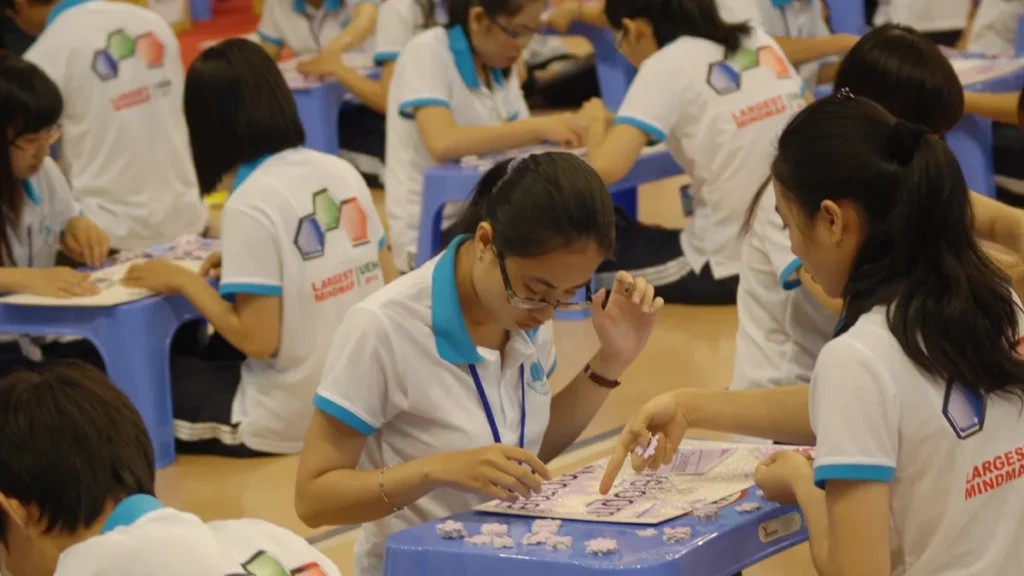
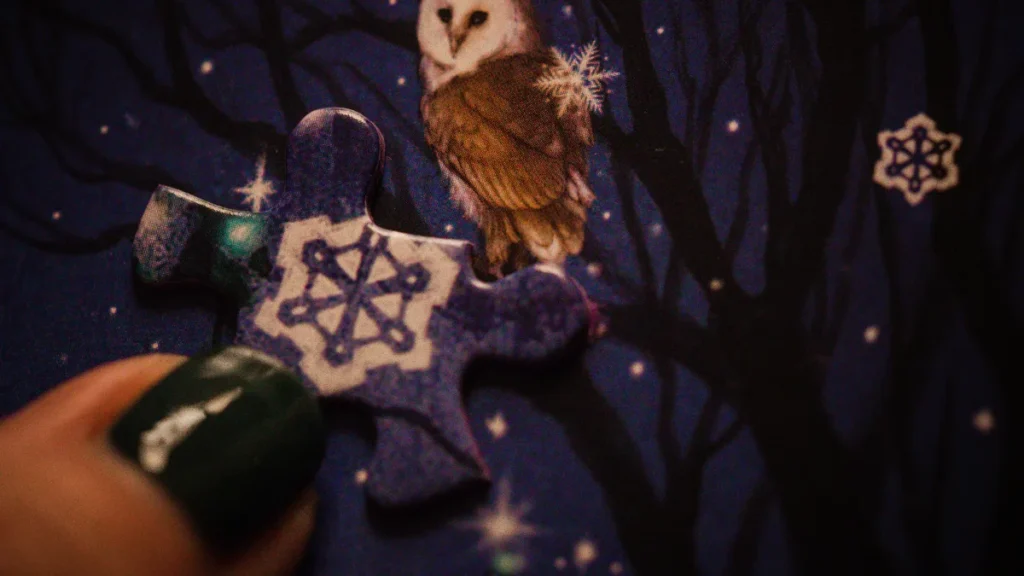
The jigsaw relay is the most visual large-group puzzle there is. Each team gets the same puzzle, usually 300 to 500 pieces, and races to finish it. For a relay twist, only two team members may touch the pieces at any time, and they swap out every three minutes, so the whole team stays involved and the fastest pair cannot do everything alone. A 500-piece puzzle takes a team of six about 25 to 35 minutes, which makes it a perfect main event rather than a quick station.
For a hall of 382 players, run jigsaws as one station among several rather than the only game. Buy identical puzzles, not similar ones: even a small difference in cut or image makes the race unfair. The step-by-step plan for running puzzle games for 381 players uses the same relay logic at almost the same scale, and its station counts and timing transfer directly to 382 players.
Crossword and Word-Grid Races
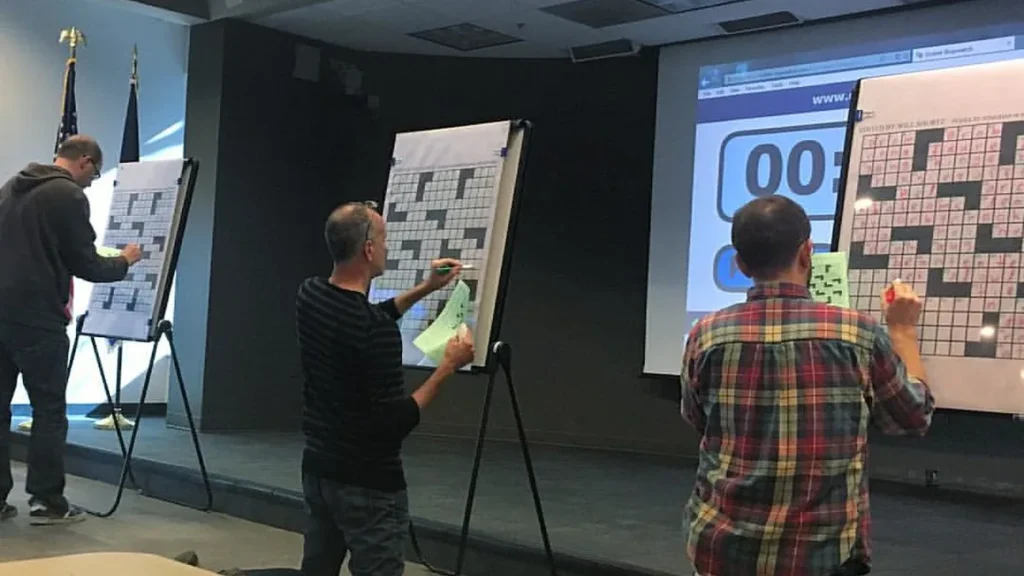
Crossword races are the cheapest large-group puzzle to run and one of the fairest. Print the same grid for every team, give each team one pencil, and award points per correct answer, with a bonus for a fully completed grid. A 15-by-15 grid with 30 clues takes a team of six about 20 minutes, and the scoring is simple enough for a volunteer to mark in two minutes per sheet.
The key is writing clues for your audience. A general-knowledge crossword works for a mixed adult group, while a themed crossword, built around your school, company, or event, works better for a group that shares a context. Avoid cryptic clues unless everyone knows the conventions, and avoid obscure trivia that turns the race into a guessing game. Word searches and word ladders make good warm-up stations: they are fast, need no explanation, and let nervous players score early points.
Sudoku and Logic-Grid Tournaments
Sudoku is the most scalable puzzle ever printed. One grid per player, one pencil, no talking needed during the solving, and a finish time that is easy to measure. Run it as a tournament: three rounds of increasing difficulty, with the fastest correct finishers in each round advancing. A round of easy Sudoku takes most adults 8 to 12 minutes, medium takes 12 to 18, and hard separates the field quickly.
Logic grids, the kind where you work out who owns which pet from a set of clues, make an excellent partner for Sudoku because they use a different kind of thinking. A team that is slow at numbers may be fast at deduction, which keeps the overall standings close. Award full points for a correct grid, half points for a grid with one or two errors, and nothing for more mistakes than that, so teams cannot win by rushing and guessing.
Escape-Room Style Puzzle Hunts
An escape-room hunt turns a whole building into a puzzle. Teams follow a chain of clues: a riddle leads to a location, the location hides a code, the code opens a box, and the box contains the next riddle. For 382 players, run the same hunt on a loop, with teams starting at different points in the chain so they never queue at the same clue. A hunt with eight clue stations and a 45-minute limit gives every team a genuine chance to finish.
Design the clues so each one needs a different skill: one is a word puzzle, one is a maths puzzle, one is a pattern, one is a physical search, and one is a code to crack. That variety stops one strong solver from carrying the team and gives every member a moment to lead. Keep the clues self-contained, so a team that misses one can still continue, and put a volunteer or a hint card at every station so no team is stuck for more than five minutes.
Rubik’s Cube and Speed-Solving Relays
Cube-solving relays add spectacle to a puzzle event. Each team gets a scrambled cube, and members take turns making moves, with a time limit per turn, until the cube is solved or the time runs out. You do not need 382 expert cubers: a 2-by-2 cube or a simple pattern challenge, such as making one face a single colour, works for beginners, while experienced solvers can race full 3-by-3 solves.
For a fair race, scramble every cube with the same sequence of moves and check that each cube turns smoothly before the event starts.
How to Run Puzzle Games for 382 Players
Build the Teams First
Decide team size before anything else, because it determines your table count, your printing, and your scoring sheets. Six per team is the default for 382 players: 63 teams of six, with four players to place. Put the four extra players on four different teams to make four teams of seven, and nobody will notice the difference. Mix the teams deliberately: ask each player to rate their puzzle confidence from one to five on arrival, then deal the fives, fours, and threes evenly across the teams.
Set Up Stations, Not One Big Game
A station is one puzzle type at one table, run by one volunteer, for a fixed time, usually 10 to 15 minutes. Teams rotate from station to station on a whistle or a bell, and each station awards points. Ten stations of 12 minutes, plus rotation time, fill a two-hour session comfortably, and every team tries every puzzle. For 382 players, plan one station per 30 to 40 players, which means 10 to 12 stations.
Space the stations around the edges of the hall and keep the centre clear for movement. Put the noisy stations, such as the jigsaw relay, at opposite ends from the quiet stations, such as Sudoku, so concentration and celebration do not fight each other.
Run a Tournament, Not a Single Race
A single race with 382 players produces one winner and 381 people who stopped caring after ten minutes. A tournament keeps everyone playing to the end, because points accumulate across stations and the leaderboard changes after every round. Award points at each station, add them up, and take the top eight teams to a final.
The scoring system should reward accuracy first and speed second. A common scheme is 10 points for a correct solution, 7 for a nearly correct one, 4 for a genuine attempt, and a speed bonus of 1 to 3 points for the fastest three teams at each station. Puzzle games for 380 players use the same tournament structure, with teams, stations, and a final, and the lesson from both scales is the same: the format that keeps the most teams in contention for the longest is the format people remember fondly.
Comparing the Best Formats
| Format | Players per station | Setup time | Cost per 382 players | Best for |
|---|---|---|---|---|
| Jigsaw relay | 6 to 12 per table | 30 minutes | Medium: one puzzle box per table | Visual drama and teamwork |
| Crossword race | Unlimited with printing | 15 minutes | Low: printed sheets only | Large halls and mixed ages |
| Sudoku tournament | Unlimited with printing | 10 minutes | Low: printed sheets only | Fair, quiet, timed competition |
| Escape-room hunt | 6 to 8 per team | 2 to 3 hours | Medium: locks, boxes, printed clues | Whole-building events |
| Cube-solving relay | 6 per team | 15 minutes | Medium: cubes for each station | Spectacle and the final round |
| Tangram challenge | 6 per team | 10 minutes | Low: reusable piece sets | Young players and calm stations |
Equipment, Space and Timing
Equipment for 382 players is less than most organisers fear, but it must be counted exactly. Print 400 copies of every paper puzzle, buy one puzzle box per jigsaw table, and pack one pencil per player plus a box of spares. Bring 10 stopwatches or use phone timers, one per station, and a whistle or bell loud enough to be heard across the hall.
Space is the real constraint. A team of six needs a table of about 1.8 metres by 0.75 metres, and 63 teams need 63 tables if they all sit at once, which no ordinary hall holds. That is why stations matter: with ten stations and rotating teams, you need only ten to twelve tables in play at a time, plus a seating area for teams between rounds. A school hall of about 400 square metres handles this comfortably, with stations around the edges and waiting teams in the middle.
Timing needs a written schedule, not a rough idea. Allow 15 minutes for arrival and team formation, 10 minutes for the briefing and a practice puzzle, 90 minutes for the stations, 20 minutes for the final, and 15 minutes for results and prizes. That is two and a half hours in total, which fits a morning or an afternoon session. Build in 15 minutes of slack, because the first rotation always runs long while teams learn the system. The same volunteer maths covers large board-game nights for 380 players, so if you have already staffed one of those, the same roster will cover a puzzle event with almost no changes.
Checklist for Puzzle Games for 382 Players
Run through this checklist the day before the event, and again on the morning itself. Each item is small on its own, but together they are the difference between a smooth session and a day spent improvising.
- Teams formed in advance, with names, colours, and home tables assigned, and the team list posted at the entrance.
- Every puzzle printed in 400 copies, tested by solving it yourself, with the answer key held by the station volunteer only.
- Identical jigsaw boxes, one per table, still sealed, plus spare puzzles in case a box is damaged or a piece is missing.
- Ten to twelve stations laid out around the hall edges, each with a numbered sign, written instructions, and a timer.
- Volunteers briefed with written rules, answer keys, scoring sheets, and the one-point hint policy.
- Leaderboard ready to update after every third station, plus prizes for the winning team and a small prize for the best team name.
Frequently Asked Questions
Can puzzle games really work for 382 players?
Yes, if you use teams, stations, and a tournament. No single puzzle can hold 382 people at once, but 63 teams of six, rotating through ten stations, can all play at the same time, and a points league keeps everyone in contention until the final.
How many teams should 382 players make?
Teams of six give you 63 teams with four players to place, and teams of seven give you 54 teams with four spare players. Six is the best default, because it is large enough for mixed abilities and small enough that everyone contributes. Avoid teams larger than eight, because quieter players stop participating, and avoid teams smaller than four, because you will need too many tables and volunteers.
How long does a puzzle event for 382 players take?
Plan two and a half hours: 15 minutes for arrival and team formation, 10 minutes for briefing, 90 minutes for stations, 20 minutes for the final, and 15 minutes for results. If you have less time, cut the number of stations rather than the time per station, because a rushed puzzle is a frustrating puzzle.
What is the cheapest puzzle format for a huge group?
Crosswords and Sudoku are the cheapest by far, because they need only printed sheets and pencils. A full event for 382 players can be run on paper puzzles alone for the cost of printing, which is why schools and charities use them so often. Add one jigsaw station as a showpiece if the budget allows, because it gives the event its visual centrepiece.
Do I need expert puzzlers to run the event?
No. You need one organiser who has solved every puzzle in advance, and one volunteer per station who can follow an answer key. The puzzles should be tested by someone who is not a puzzle expert, because if a keen amateur cannot finish a station puzzle in the time allowed, your players will not finish it either. Test everything, and replace anything that takes longer than the station allows.
What prizes work best for puzzle games?
Small, shareable prizes work best: a puzzle book per team member, a box of chocolates for the table, or a trophy the winning team keeps for a year. Avoid one large prize for one person, because puzzle games are team games and the prize should reflect that.
Bottom Line
Puzzle games for 382 players work when you stop thinking of 382 as a crowd and start thinking of it as 63 teams of six, moving through ten stations, with a tournament deciding the winner. Jigsaw relays give the event its spectacle, crosswords and Sudoku give it fairness and low cost, escape hunts give it adventure, and cube relays give it a finale worth watching. Print everything in advance, test every puzzle yourself, brief your volunteers properly, and keep the scoring simple enough to explain in one minute.