Puzzle games for 384 players sound impossible at first. Most puzzle games are built for a table of four or six, not a hall full of people, and the idea of keeping hundreds of players busy at the same time can feel like a planning nightmare. Yet the number itself is the clue to the solution, because 384 divides neatly into teams, stations and tournament rounds, and once the crowd is split into small working groups the game becomes a normal puzzle night repeated many times over.
The trick is to stop thinking of 384 players as one giant game and start thinking of it as 96 teams of four, 64 teams of six, or 48 teams of eight, all playing at once. Each team works on its own puzzle, each station runs its own clock, and a simple scoreboard turns dozens of small contests into one big event. The same approach works for a school hall, a company offsite, a community festival or a fundraiser, and it works for players from age eight to eighty.
This guide shows exactly how to run puzzle games for 384 players from start to finish. You will learn the team sizes that divide 384 cleanly, the station layouts that stop queues from forming, the puzzle formats that suit huge groups, a fair scoring system, a minute-by-minute schedule, and the mistakes that sink large events. Everything here has been planned around real rooms, real clocks and real people, so you can use it as a checklist on the day.
Key takeaways
- Split 384 players into teams of four, six, eight or twelve, because 384 divides cleanly into 96, 64, 48 and 32 teams.
- Use stations so every team plays at the same time, with eight stations of 48 players or twelve stations of 32 players.
- Mix jigsaw races, logic puzzles, word puzzles and riddle relays so different strengths all matter.
- Score with points per station plus time bonuses, and post a live scoreboard everyone can see.
- Plan ninety minutes of play, fifteen minutes of setup per station, and a ten minute final round.

How Puzzle Games Scale From 3 to 384 Players
Puzzle games scale by division, not by making one puzzle bigger. A three player game is one team around one puzzle, and a 384 player game is the same idea repeated across a hall. The host does not need a bigger puzzle, a louder voice or a longer day. The host needs a clean way to split the crowd, a set of identical puzzle kits, and a schedule that moves every team at the same time. When those three things are in place, the size of the crowd stops mattering.
The first decision is team size, and the maths is friendly. With 384 players you can form 96 teams of four, 64 teams of six, 48 teams of eight, 32 teams of twelve, or 24 teams of sixteen. Teams of four suit jigsaw races, because four pairs of hands can sort pieces without getting in each other’s way. Teams of six suit mixed puzzle rounds, because the team can split into pairs for different tasks. Teams of eight suit quiz style rounds, because more heads mean more answers. Pick one size for the whole event and keep it, because mixed team sizes make scoring unfair and confuse the rotation.
Teams of Four, Six and Eight
Teams of four are the safest choice for a first large event. Four people can sit around one table, share one puzzle, and hear each other without shouting, and a team of four finishes a 500 piece jigsaw in about forty minutes, which fits a standard station slot. If your crowd is mostly families, teams of four also let each family play together, which keeps children with their parents and removes the need for separate age groups. The only cost is the number of tables, because 96 teams need 96 tables or table shares, so check the room before you commit.
Stations That Keep Everyone Busy
Stations are the heart of a 384 player event. Instead of one game for everyone, you run six to sixteen stations at the same time, and every team visits every station in turn. Eight stations of 48 players work well, because each station holds six teams of eight or twelve teams of four, and a ten minute slot per station gives a full rotation in eighty minutes. Twelve stations of 32 players suit a wider mix of puzzle types, because you can offer jigsaw, logic, word, riddle, memory and code breaking stations without repeating a format.
Tournaments That Crown a Winner
Keep the tournament short. Two semi finals of ten minutes and a final of fifteen minutes add forty minutes to the day, and the audience stays engaged because the puzzles are visible and the clock is ticking. Give the finalists the same puzzle and the same number of pieces, start them together, and let a commentator explain what is happening. Small prizes for the top three teams, plus a prize for the best team name and the best comeback, give more teams a reason to celebrate. If you want ideas for a slightly smaller crowd first, the format used in puzzle games for 383 players shows how the same station and tournament system works with one fewer player.
The Best Puzzle Formats for Huge Groups
Not every puzzle format survives contact with 384 players. The best formats share three traits: they need no special equipment, they can be scored in seconds, and they work when many teams play the same puzzle at the same time. Jigsaw races, logic puzzles, word puzzles, riddle relays and memory games all pass that test. Escape room style puzzles and long mystery games do not, because they need a dedicated room per team and an hour each, which no schedule can afford at this scale.
| Format | Team size | Time per round | Best for | Scoring |
|---|---|---|---|---|
| Jigsaw race | 4 to 6 | 20 to 40 minutes | Hands on speed | Pieces placed |
| Logic puzzles | 6 to 8 | 10 minutes | Careful thinking | Correct answers |
| Word puzzles | 4 to 8 | 10 minutes | Vocabulary | Words found |
| Riddle relay | 6 to 8 | 10 minutes | Quick wit | Riddles solved |
| Memory game | 4 to 6 | 10 minutes | Focus | Pairs matched |
| Code breaking | 6 to 8 | 15 minutes | Teamwork | Codes cracked |
Jigsaw Races
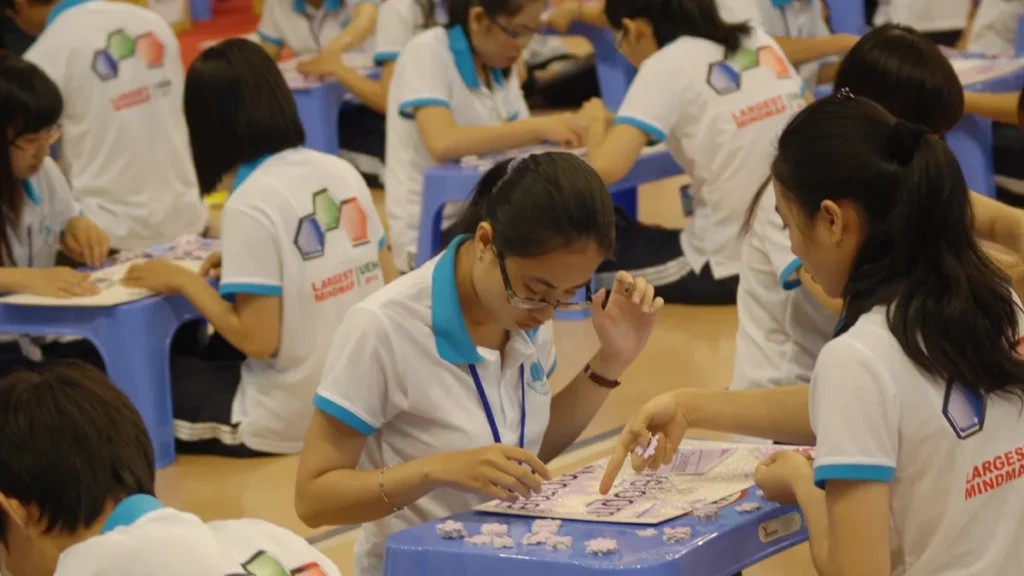
Jigsaw races are the most visual format for a huge group, and they photograph well, which matters if the event is a fundraiser or a school celebration. Give every team the same 300 or 500 piece puzzle, start the clock together, and score by the number of pieces placed when time runs out, with a bonus for a finished puzzle. Identical puzzles are essential, because a harder picture would punish the team that drew it, so buy in bulk from one supplier and test one puzzle yourself before the day.
Logic and Deduction Rounds
Logic rounds reward the quiet thinkers in the room, and they balance the speed of a jigsaw race with careful reasoning. Print a set of ten logic puzzles per team, with grid puzzles, sequence puzzles, and simple deduction problems that take about a minute each. Teams work through the set together, write their answers on one sheet, and hand it in when the whistle blows. Marking is fast, because each answer is right or wrong, and a tie break question settles teams that finish level on points.
Deduction puzzles work especially well when the clues are read aloud, because the whole team hears the same information at the same time. A classic format is the who did it puzzle, where five suspects, five places and five objects are narrowed down by a list of clues. Teams that talk through the clues together beat teams where one person works alone, which is exactly the teamwork the event is meant to encourage. You can warm up with a set of deduction puzzles with answers so your station captains know how the puzzles work before they explain them to a team.
Word and Riddle Relays
Word puzzles and riddle relays add pace and laughter to the day. In a word round, teams get a grid of letters and ten minutes to find as many hidden words as they can, with longer words worth more points. In a riddle relay, the captain reads a riddle, the team has thirty seconds to answer, and a correct answer earns the next riddle, so fast teams can work through a long chain while slower teams still enjoy the ones they solve. Both formats need nothing but paper and a pen, which makes them cheap to run at every station.
Keep the difficulty mixed. A round that is all easy riddles bores the strong teams, and a round that is all hard riddles silences the rest, so include three easy, four medium and three hard items in every set of ten. Read the riddles clearly and repeat each one once, because a team that mishears a word cannot solve the puzzle and will blame the host. A similar mixed format appears in puzzle games for 382 players, where word and riddle rounds sit alongside jigsaw stations in the same rotation.
Setting Up 384 Players Without Chaos
The Room Layout That Works
Use a hall, a gym or a marquee, and lay the stations around the edges with an open space in the middle. Teams rotate clockwise around the room, which stops two teams from trying to swap places at the same time, and the open middle holds the scoreboard, the prize table and the first aid point. Leave a wide aisle of at least two metres between stations, because 384 people moving at once need room, and narrow gaps cause bottlenecks that eat into playing time.
Timing and Rotation
A simple schedule works best. Allow thirty minutes for arrival and team registration, ten minutes for the welcome and rules, eighty minutes for station rounds, twenty minutes for the semi finals, fifteen minutes for the final, and fifteen minutes for prizes and photos. That is a three hour event, which is long enough to feel substantial and short enough to hold the attention of younger players. Print the schedule on the back of every team sheet so nobody needs to ask what happens next.
Run the station rounds as eight slots of ten minutes, with two minutes of travel time between slots. The travel time matters, because 384 people need time to stand up, pack their puzzle, and walk to the next table, and a schedule with no travel time falls behind within the first rotation. Use a whistle for the end of each slot and a bell for the start of the next, so teams learn the two sounds quickly and move without being chased. Keep a master clock on the scoreboard so captains and teams always agree on the time.
Scoring That Feels Fair
Fair scoring is simple scoring. Give each station a maximum of ten points, so a team that visits eight stations can earn eighty points, and add a time bonus of one point per minute saved on a timed station, up to five points. Publish the scoring rules on every team sheet, and have the station captain sign the score sheet before the team leaves, because a signed sheet ends arguments before they start. Post the running totals on a large board after every second rotation, so teams can see where they stand.
Puzzle Games for 384 Players at School, Work and Community Events
School Puzzle Days
School puzzle days work best with teams of four to six and puzzles that match the age of the players. Use 300 piece jigsaws for younger children and 500 piece jigsaws for older students, and keep logic puzzles to one step of reasoning so that a ten year old can solve them with a little thought. Mix the year groups in each team, so older students help younger ones, and give house points instead of cash prizes, because house points keep the competition friendly and cost nothing.
Office and Team Building Days
Office puzzle days are about mixing people who do not normally work together. Build teams across departments, so marketing sits with engineering and finance sits with sales, and use puzzles that reward different skills, so the quiet analyst and the loud salesperson both have a moment to shine. Code breaking and logic rounds suit office teams well, because they reward careful thinking under time pressure, which is a skill every workplace values.
Festivals and Fundraisers
Festivals and fundraisers can charge a small entry fee per team, which turns 384 players into real income for a good cause. Ninety six teams of four paying a modest fee each adds up quickly, and a raffle or a cake stall on the side adds more, so a puzzle day can raise a useful sum without feeling like a sales event. Keep the puzzles family friendly, put the event in a park or a community hall, and invite local businesses to sponsor a station, with their name on the station sign.
Common Mistakes to Avoid
The most common mistake is buying too few puzzles. Every station needs a full set of puzzle kits, plus one spare per station, because a lost piece, a torn card or a spilled drink can take a station out of the game. Count the kits twice the night before, and pack them in labelled boxes per station, so the captain of station four opens the box marked four and finds everything inside. A missing kit discovered after the players arrive cannot be fixed in time.
Your 384 Player Puzzle Day Checklist
Use this checklist in the week before the event, and tick each item off as it is done. A checked list is the difference between a relaxed host and a host who is still counting puzzle pieces while the players are arriving.
- Confirm the venue, the tables, the chairs and the power supply for the scoreboard, and walk the rotation route yourself.
- Buy identical puzzle kits for every station, plus one spare kit per station, and test one puzzle from each batch.
- Print team sheets, score sheets, instruction cards and answer sheets, with the scoring rules on every sheet.
- Recruit one captain per station, brief them on their puzzle, and give each one a timer and a whistle.
- Prepare the scoreboard, the tie break rules, the prizes, and the team wristbands in matching station colours.
- Send every team its start time, its station number and its team colour the day before the event.
Frequently Asked Questions
How long does a puzzle event for 384 players take?
Plan for about three hours. That covers thirty minutes for arrival, ten minutes for the welcome, eighty minutes of station rounds, forty minutes for the semi finals and final, and fifteen minutes for prizes and photos. Shorter events feel rushed, and longer events lose the attention of younger players.
How many tables do 384 players need?
It depends on team size. Ninety six teams of four need about 96 table places, while 48 teams of eight need about 48 larger tables. Two teams of four can share one large table if space is tight, so count table places rather than tables when you book the venue.
What is the best team size for 384 players?
Teams of six are the best all round choice, because 64 teams of six need fewer tables than teams of four and still let everyone handle the puzzle. Teams of four suit jigsaw races, and teams of eight suit logic and word rounds, so match the size to your main format.
Can children and adults play together?
Yes, and mixed age teams often do well, because children are fast at spotting jigsaw pieces and adults are strong at logic and word puzzles. Keep the puzzles age friendly, give every team a mix of ages where possible, and use a 300 piece jigsaw for family events.
How do you stop 384 players from getting bored while they wait?
There is no waiting if the stations run at the same time, because every team plays in every slot. The only queue is at registration, so open registration thirty minutes early, put the welcome desk near the entrance, and start the first round on time even if a few teams are still arriving.
What prizes work for a 384 player puzzle event?
Small prizes work best. A trophy for the winning team, medals for the top three teams, and fun prizes for the best team name and the best comeback give many teams something to celebrate. Avoid one large cash prize, because it makes the event feel serious and puts pressure on the finalists.
Bottom Line
Puzzle games for 384 players work because the number divides so cleanly. Ninety six teams of four, 64 teams of six, or 48 teams of eight, playing across eight to twelve stations, turn a crowd that looks unmanageable into a hall full of small, focused teams. Pick one team size, run identical puzzles at every station, rotate on a whistle, score simply, and finish with a short tournament that everyone can watch. Do that, and 384 players will feel less like a logistical problem and more like the best puzzle night you have ever run.