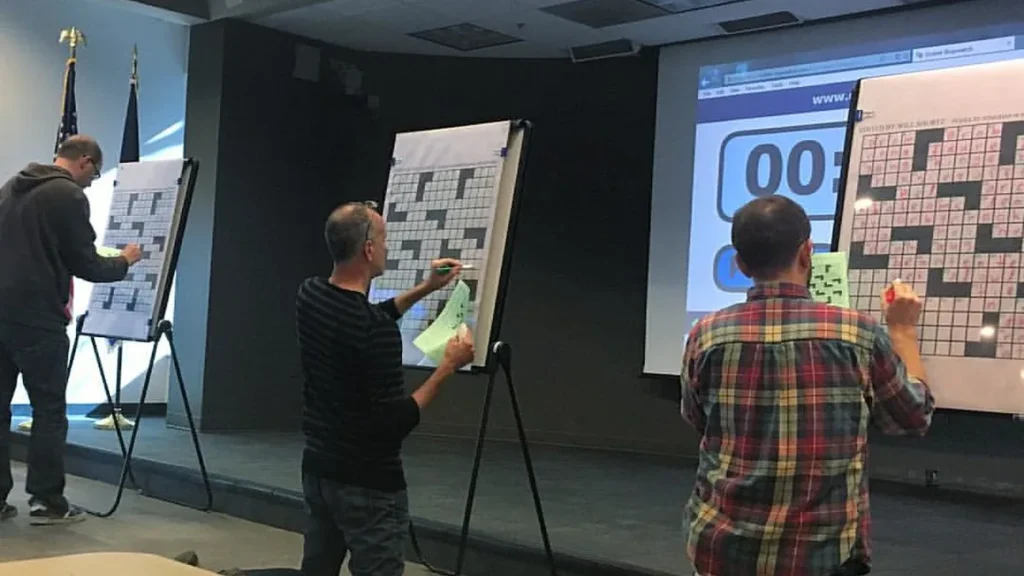
Word games for 383 players sound impossible until you stop picturing one board and one table. No single game of Scrabble, Boggle, or hangman seats 383 people at once, and nobody should try to force it. The trick is to treat 383 as the top of a range, not a seating plan: the same word games that work for 3 players work for 383 when you split the crowd into teams, run several stations at once, and let a tournament bracket carry the winners forward.
The reason word games scale so well is that they need almost nothing. A word list, a timer, a whiteboard, and a way to keep score will carry an entire evening. There are no expensive boards to buy in bulk, no complicated rules to teach a hall full of strangers, and no equipment that breaks when 383 hands touch it. Most formats in this guide run on paper, a projector, or one shared board per team, so the cost stays low even when the headcount climbs into the hundreds.
This guide covers the full range, from a living-room trio up to a 383-player event, with twelve game formats, a comparison table, a setup plan, a checklist, and answers to the questions organisers ask most. Every format below lists a team size, a round length, and the materials it needs, so you can pick the ones that fit your room, your clock, and your crowd.
Key takeaways
- Word games for 383 players work by splitting the crowd into teams of 4 to 8, not by seating everyone at one board.
- Stations and tournament brackets are the two scaling methods that matter: stations let everyone play at once, brackets create a finish everyone can watch.
- Giant crossword races, team Scrabble, anagram sprints, and word relays are the most reliable formats for very large groups.
- A single host with a microphone, a visible timer, and a simple scoring sheet can run a 383-player event without extra staff.
- Keep rounds short, rotate roles inside each team, and score by points per round so late joiners and early leaders both stay in the game.

How Word Games Scale From 3 to 383 Players
The first decision is team size, and the answer is almost always between 4 and 8 players per team. Four is the smallest team that still feels like a team, and eight is the largest that still lets everyone speak. At 383 players, teams of 6 give you roughly 64 teams, teams of 7 give you about 55, and teams of 8 give you around 48. Any of those splits works, and the exact number matters less than keeping every team close to the same size.
The Team Model: Everyone Plays, Nobody Waits
In the team model, each team gets a name, a table, and one answer sheet per round. The host reads a prompt, starts a timer, and every team works on the same challenge at the same time. A full round takes about five minutes, so an hour holds ten to twelve rounds. Inside each team, roles should rotate every few rounds: the writer passes the pen, the caller becomes the checker, and the quietest player gets a turn as captain. A simple rule helps: nobody writes two rounds in a row.
The Station Model: Many Games, One Room
Stations work best when the room is large and the crowd is mixed in age or ability. Set up six to ten stations around the edges of the room, put a different word game at each one, and let teams rotate every ten minutes. Each station has a volunteer or a printed instruction card, and each team carries a scorecard from station to station. Stations absorb uneven numbers gracefully: if 383 players arrive but only 370 were expected, you add one player to a few teams and nothing else changes.
Tournaments give the evening a climax. The simplest bracket for word games is a points bracket rather than an elimination bracket: every team plays every round, points accumulate, and the top four teams play a short final on stage. This keeps all 383 players involved until the end while still producing a final the whole room can watch. Many of the best large events use both shapes: stations for the first hour so nobody sits idle, then a bracket for the last half hour.
The 12 Best Word Games for 383 Players
1. Team Scrabble Sprints
Each team gets a board, a rack of tiles, and five minutes to play as many high-scoring words as they can, with every team playing at the same time. Points come from the board as usual, with a bonus for the longest word and a bonus for using all seven rack tiles in one play. For 383 players, run Scrabble as a station, and if you do not have 50 Scrabble sets, use printed board grids and letter tiles cut from card.
2. Giant Crossword Races
Giant crossword races are the best spectacle format for a huge room. Project a large crossword grid on a screen and let every team solve the same puzzle at the same time. A 15-by-15 grid with 30 clues takes most teams about eight minutes, and scoring is unambiguous, since a completed square is either right or wrong. For a stage final, put the top two teams on easels with giant grids and let the room watch them race.
3. Anagram Sprints
Anagram sprints are the fastest game on this list and the easiest to run. The host shows a jumbled set of letters, such as A E I L N R S T, and teams have sixty seconds to write down as many real words as they can. Three-letter words earn one point, four-letter words earn two, and words of five letters or more earn three. Run three sprints back to back with different letter sets and you have a ten-minute block that resets the room’s energy.
4. Word Relay Races
Word relays add movement to an evening that might otherwise be all sitting. Each team lines up, the first player runs to the front, writes a word that starts with the last letter of the previous word, and runs back to tag the next player. A relay of ten words per team takes about three minutes. The rules are simple: every word must be real, no proper names, no repeats, and a word that breaks the chain costs the team five seconds.
5. Codenames-Style Clue Games
Clue games in the style of Codenames turn word association into a team sport. The host lays out a grid of twenty-five words on a screen, and each team’s clue-giver gives a one-word clue that connects two or more of their team’s words. The team tries to find them all without touching the other team’s words or the forbidden word that ends the round. For a large room, run it as a whole-room round with every team writing guesses on answer sheets instead of shouting, which keeps 64 teams from talking over each other.
6. Word Bingo
Word bingo is the calmest game on this list, which makes it the ideal opener or closer. Each player gets a bingo card filled with words instead of numbers, the host calls out definitions or synonyms, and players mark the matching word. The first team to complete a row, column, or full card shouts bingo and wins the round.
7. Hangman Arena
Hangman works at scale when the whole room plays against the host instead of against each other. The host picks a word, draws the gallows on a screen, and each team submits one letter per turn. Correct letters are filled in for everyone, wrong letters add a body part, and the team that guesses the full word first wins the points.
8. Word Search Races
Word search races are the quiet counterpart to the relay. Every team gets the same printed grid and the same list of twenty hidden words, and the first team to find all twenty wins. A 15-by-15 grid with twenty words takes most teams six to eight minutes, and the scoring is simple: one point per word, with a five-point bonus for the first finished team. Word searches are genuinely fair across ages, since a nine-year-old can find CAT and DOG as fast as an adult, and the longer words reward the adults without shutting the children out.
9. Chain Word Challenges
Chain words are the written cousin of the relay, and they suit rooms where running is not practical. The host gives a starting word, such as STONE, and each team builds a chain where every word starts with the last letter of the previous word: STONE, EAGLE, ELEPHANT, TIGER, RAIN. Teams have five minutes to build the longest valid chain they can, with one point per word and a bonus for chains longer than fifteen words.
10. Spelling Bee Teams
A spelling bee sounds like a solo event, but it adapts to teams with one small change: the team huddles, agrees on a spelling, and one player delivers it to the judges. The host reads a word, the team has thirty seconds to confer, and the speaker spells it aloud. A correct spelling earns a point, a wrong spelling passes the word to the next team, and a team that spells three words wrong in a row sits out one round.
11. Taboo-Style Word Guessing
Taboo-style guessing is the loudest game in this guide. One player describes a word without using any of the five forbidden words listed on the card, and the rest of the team shouts guesses until they get it right or the timer ends. Each team gets two minutes and as many cards as it can clear, with one point per correct guess and a lost turn if a forbidden word slips out.
12. Group Wordle-Style Guessing
Group Wordle takes the daily word puzzle everyone knows and turns it into a team race. The host picks a five-letter word, teams guess by writing a five-letter word on their answer sheet, and the host reports how many letters are correct and in the right place, and how many are correct but in the wrong place. Teams have six guesses to find the word, and the team that finds it in the fewest guesses wins the round.
Word Games for 383 Players: Comparison Table
| Format | Best team size | Round length | Materials needed | Energy level | Best for |
|---|---|---|---|---|---|
| Giant crossword race | 4 to 8 | 8 minutes | Projector, printed grids | Medium | Stage finals, mixed ages |
| Team Scrabble sprint | 4 to 6 | 10 minutes | Boards or printed grids | Medium | Stations, word lovers |
| Anagram sprint | 4 to 8 | 1 minute | Screen, pens | High | Energy resets, fillers |
| Word relay race | 5 to 8 | 3 minutes | Boards, floor space | Very high | Children, outdoor events |
| Codenames-style clues | 4 to 7 | 10 minutes | Projector, word grid | High | Adults, party nights |
| Word bingo | Any size | 10 minutes | Printed cards | Low | Openers, calm closers |
Setting Up a 383-Player Word Game Event
Scoring, Judging, and Prizes
Scoring should be simple enough for a volunteer to do in under a minute per round. Award one point per correct answer, with small bonuses for speed or length where the game calls for them, and record totals on a single scoreboard. Publish the running totals after every third round so the room can see the race taking shape. Disputes are rare when the rules are printed on each team’s envelope, but the host’s decision is final, so say so at the start. The same approach works whether the crowd is 38 or 383, and the earlier guide to word games for 381 players uses the same team and station method for a room just two players smaller.
Checklist: Running Word Games for 383 Players
- Confirm the headcount and the team split: count confirmed players, divide into teams of 4 to 8, and prepare one envelope per team with answer sheets, a pen, a scorecard, and a name card.
- Book the room and test the equipment: check that the hall seats 383, the microphone reaches the back row, the projector is readable with the lights on, and the timer is visible from every table.
- Choose six formats and prepare the materials: pick a mix of quiet and loud games from this guide, print the grids, cards, and word lists, and prepare one spare set of everything.
- Write the rules and the scoreboard: print the rules on each team’s envelope, decide the points per round, and set up a whiteboard or projected sheet for running totals.
- Brief the host and the judges: walk the host through the schedule, the timer, and the dispute rule, and give each judge a station or a set of rows to watch.
- Plan the final and the prizes: decide whether the final is a crossword race, a spelling bee, or a Wordle-style showdown, and have the prizes ready before the first round starts.
Frequently Asked Questions About Word Games for 383 Players
Can 383 people really play a word game at the same time?
Yes, if they play in teams. No word game seats 383 people at one table, but every format in this guide seats 383 people in teams of 4 to 8, all playing the same round at the same time. Stations let teams rotate through different games, while whole-room rounds let the host run one game for everyone at once. The key is that every team plays every round, so nobody waits on the sidelines.
How many teams should 383 players form?
Divide 383 by your chosen team size. Teams of 6 give you 63 teams of 6 and one team of 5, teams of 7 give you 54 teams of 7 and one team of 5, and teams of 8 give you 47 teams of 8 and one team of 7. Any of these splits works, so choose the size that fits your tables and your games. If you have children in the room, lean toward teams of 6 so younger players get more turns.
What is the cheapest way to run word games for 383 players?
Use games that need only paper and a projector: anagram sprints, chain words, hangman arena, group Wordle, and word search races. Print one answer sheet per team per round, roughly 60 sheets per round, and project the prompts on a screen. The whole evening can cost less than a ream of paper and a box of pens. The formats that need boards, such as Scrabble stations, are the only ones that add real cost, and printed grids replace bought boards at almost no expense.
How long should a 383-player word game event last?
About two hours is the right length for most crowds: fifteen minutes for arrival, ten minutes for rules and a practice round, sixty minutes for the main games, fifteen minutes for the final, and ten minutes for prizes. For younger children, shorten the main games to forty-five minutes and add a second break. Events longer than two and a half hours lose energy no matter how good the games are, so protect the clock and end on time.
Do word games work for mixed ages at this scale?
Yes, and mixed-age teams are often the strongest. Children are fast at relays and word searches, teenagers are quick at anagram sprints and Wordle-style guessing, and adults bring the deep vocabulary that wins crosswords and Scrabble rounds. The formats in this guide all award points for short words as well as long ones, so younger players contribute from the first round. If the age range is very wide, add a bonus point for the youngest player on each team answering a round.
What do I need to host 383 players with no extra staff?
One host with a microphone, a visible timer, and printed rules can run the whole evening alone if the games are whole-room rounds. Stations need one volunteer per station, but a host working alone can run anagram sprints, hangman arena, chain words, group Wordle, and giant crosswords back to back with no help. Choose games where the host controls the pace from the front and teams score their own sheets, with the host spot-checking the top three teams per round. The guide to word games for 379 players covers the same solo-host setup for a crowd of almost the same size.
Bottom Line
Word games for 383 players are not a different kind of game; they are the same games you already know, played in teams, in stations, and in brackets. Split the crowd into teams of 4 to 8, keep the rounds short, rotate the roles, and let a simple points system carry the evening from the first anagram sprint to the final crossword race on stage. Do that, and 383 players will feel less like a crowd to manage and more like a room that is already playing. If you are comparing nearby group sizes before you commit, the guide to word games for 377 players shows how the same plan adapts when a few teams drop out.


