Most trivia nights host twenty or thirty people. The best trivia games for 385 players work on a completely different scale, and they need a plan that a small pub quiz never requires. Three hundred and eighty five players fill a hall, a school gym, or a company campus, and every round has to keep all of them playing at the same time. A single slow round can lose the room, while a well run format turns a huge crowd into the loudest, most competitive night of the year.
The secret is simple: nobody plays alone at this size. The best trivia games for 385 players split the crowd into teams of five to seven, run several games side by side, and use stations or tournament brackets to keep every team in the action. Fifty five teams of seven equals 385 players exactly, and seventy seven teams of five reaches the same total. Pick the team size that fits your room, then build the night around it.
This guide covers the formats that actually work for a crowd of 385, from classic buzzer rounds to picture quizzes and music rounds. You will find eight complete games, a comparison table, a planning checklist, and answers to the questions every large event organiser asks first. Every game here has been chosen because it scales cleanly, needs little special equipment, and keeps hundreds of players engaged from the first question to the final score.
Key takeaways
- Split 385 players into 55 teams of seven or 77 teams of five so every person has a role and a voice.
- Buzzer rounds, picture quizzes, and music rounds scale best because whole teams can answer at once.
- Run stations or a tournament bracket so no team waits more than a few minutes between rounds.
- One host with a microphone and a projected scoreboard can run a 385 player night with three or four helpers.
- Keep rounds short, score in public, and finish with a final round that every team can still win.

Why 385 Players Changes Trivia Night
A trivia night for 385 players is not a bigger version of a small quiz. It is a different event with different rules. With thirty players, a host can hear every answer, settle every dispute, and keep the pace by feel. With 385 players, the host cannot hear the room at all. The format has to do the work: clear team sizes, written answers, visible scores, and rounds that end on a clock instead of on a feeling.
Sound is the first problem to solve. One voice cannot reach 385 people in a hall without help, so a microphone and speakers are not optional extras. A projected screen matters just as much. When every team can see the question, the picture, or the scoreboard, the host stops repeating questions and the game moves twice as fast. A second screen at the back of the room helps the teams seated furthest away.
How to Scale Trivia Games to 385 Players
Three methods carry almost every large trivia event: teams, stations, and tournaments. Most successful nights use all three at different points in the evening. Teams make the crowd manageable, stations keep everyone busy at the same time, and a tournament bracket gives the night a clear ending that the whole room can follow. Choose the mix that fits your venue, your helpers, and your schedule.
Build Teams of Five to Seven
Teams of five to seven are the sweet spot for a crowd of 385. Five players give every person a real chance to contribute, while seven players cover more knowledge areas without the team becoming a crowd of its own. Fifty five teams of seven is the cleanest split, and seventy seven teams of five works when you want more teams and faster play. Teams smaller than five leave too many players sitting out, and teams larger than eight turn into audiences instead of teams.
Give every team a name, a table, and a number. Numbered tables let runners collect answer sheets without confusion, and team names give the scoreboard personality. Hand out a simple answer sheet with the team number printed at the top, and collect it the same way every round. Consistency matters more than cleverness here: when 55 teams follow the same routine, the night runs itself. The same team structure works in the smaller sibling event covered by our guide to trivia games for 383 players, where teams of seven also carry the night.
Run Stations in Rotation
Stations are the best way to keep 385 players active at the same time. Set up eleven stations with thirty five players at each one, or seven stations with fifty five players each, and rotate teams every ten to fifteen minutes. Each station runs a different game: a picture quiz at one table, a music round at the next, a buzzer challenge at another. Nobody waits, nobody watches from the sidelines, and the energy stays high because every station feels like a fresh start.
Stations need a clear rotation plan posted where every team can see it. A simple chart on the wall, plus a bell or a whistle to signal the change, is enough. Give each station a volunteer host with a printed question set and an answer key, so the main host is free to manage the room.
Use a Tournament Bracket
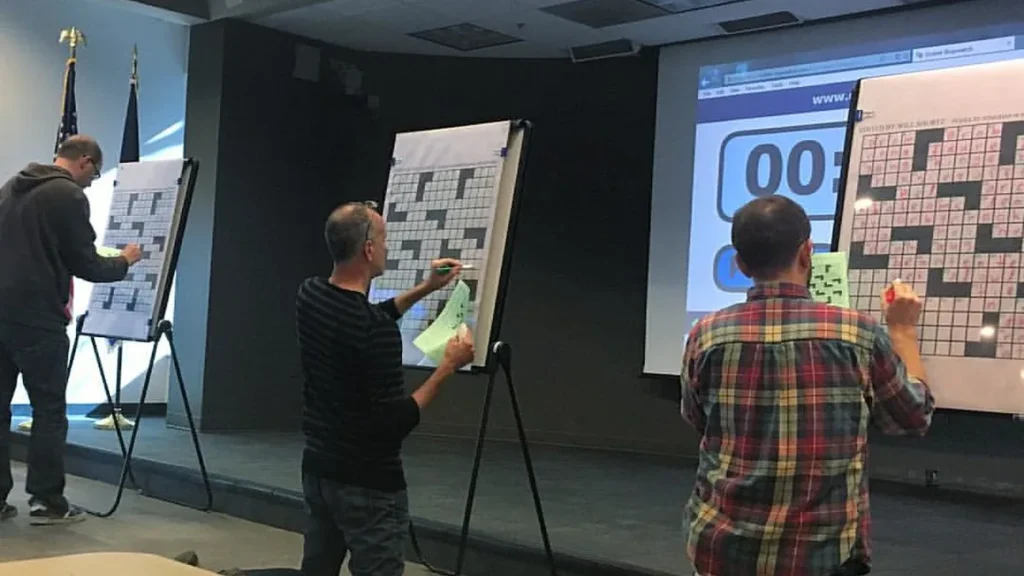
A tournament bracket turns the final hour into a show. After the station rounds, take the top sixteen teams into a single elimination bracket, and play head to head buzzer matches on a stage while the rest of the room watches and cheers. Sixteen teams become eight, then four, then two, and the whole hall follows the same match. The teams that did not qualify still have a part to play: they form the audience, they vote on bonus questions, and they cheer for their friends.
The Best Trivia Games for 385 Players
These eight games were chosen because they work with teams of five to seven, need little special equipment, and keep hundreds of players involved at the same time. Mix three or four of them into one evening, and the night will feel varied instead of repetitive. Each game includes the setup, the rules, and the reason it scales well.
1. Classic Buzzer Quiz Bowl
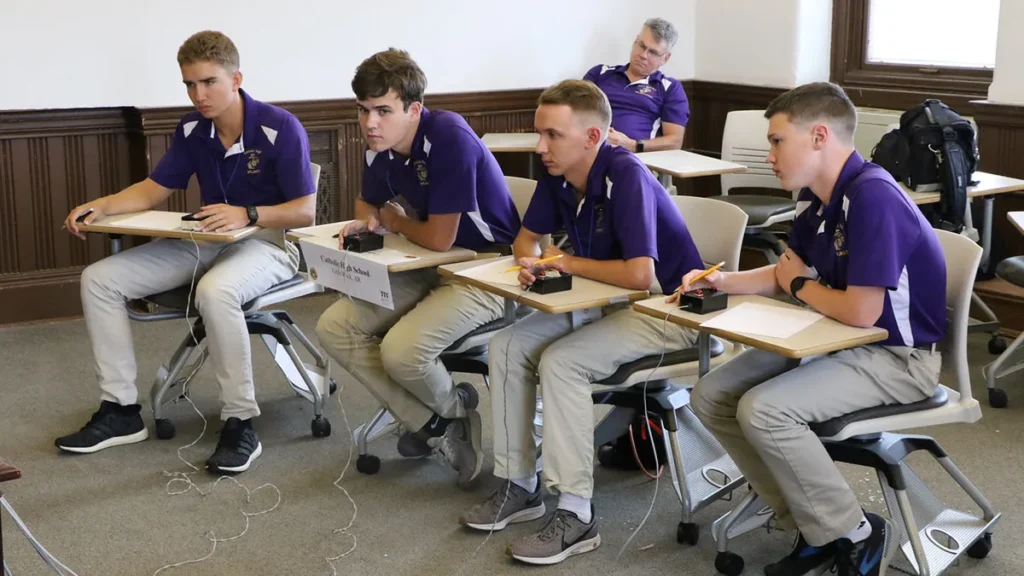
The buzzer quiz bowl is the gold standard for large trivia events. Two teams face each other, a moderator reads a question, and the first player to press the buzzer answers. With 385 players, run several buzzer tables at once during the early rounds, then move the best teams to a stage for the finals. A single buzzer set serves one table, so four or five sets cover the whole room when matches run in rotation.
2. Picture Quiz Relay
A picture quiz is one of the easiest games to run for 385 players, because a single projected image reaches the whole room at once. Show a photo of a famous place, a film still, a historical event, or a close up of an everyday object, and ask every team to write down the answer. Ten pictures per round, one point each, and a strict time limit per picture keep the pace brisk.
3. Music Round Madness
Music rounds bring energy that no other format matches. Play ten short clips of songs from different decades and genres, and ask teams to name the song, the artist, or both. Thirty seconds per clip is enough, and the room will sing along before the host has to ask for quiet. Music rounds work for 385 players because the sound system does the heavy lifting and every team hears the same clip at the same time.
4. General Knowledge Written Rounds
Written rounds are the backbone of any large trivia night. The host reads or projects ten questions, every team writes its answers on a sheet, and runners collect the sheets for marking. Written rounds suit 385 players because all 55 teams play at the same time, nobody needs a buzzer, and the host controls the pace completely. A good written round mixes history, science, sport, geography, food, and popular culture.
Keep written rounds to ten questions each and run three or four across the night, with a different theme for each one. Score one point per correct answer and announce the running totals after every round, so teams can see the leaderboard move. The written format also makes marking easy: one answer key, one mark per question, and a simple spreadsheet to add the totals. For ready made material, a strong bank of 100 best trivia questions and answers gives you a full evening of questions to draw from.
5. Trivia Bingo
Trivia bingo turns answering into a race across a card. Each team gets a bingo card filled with answers instead of numbers, and the host reads clues one at a time. When a team hears a clue that matches an answer on its card, it marks the square. The first team to complete a row, a column, or a full card wins the round. Print different cards for every team so no two teams share the same layout.
Bingo scales beautifully to 385 players because every team plays the same game at the same time, and the format needs nothing more than printed cards and a clear voice. Run three short bingo games across the evening, with a small prize for each winner. The format also suits mixed age groups and mixed knowledge levels, since a lucky card can beat a clever team. Keep the clues short and the pace steady, and call out the winning card number so the room can verify it.
6. Team Feud Style Showdown
A feud style game asks teams to guess the most popular answers to survey questions, such as naming the most common thing people keep in a fridge, or the most popular holiday destination. The host reveals the top answers one by one, and teams score points for each answer they predicted. With 385 players, run the feud as a stage show: two teams face off while the rest of the room plays along on paper and compares scores.
Feud games create laughter because the answers are often surprising, and they reward common sense as much as knowledge. Prepare twenty survey questions in advance, with five top answers for each one, and keep the questions light and family friendly. Rotate the stage teams every two questions so more of the 385 get a turn under the lights, and let the audience teams score the same questions on their sheets so everyone stays in the game.
7. Speed Round Lightning Quiz
A lightning round asks twenty quick questions in five minutes, with one point each and no time to overthink. The host fires questions at a rapid pace, teams scribble answers, and the sheets are collected the moment the last question lands. Lightning rounds work for 385 players because they compress a lot of play into a short window, and the speed creates a buzz that slower rounds cannot match.
Use lightning rounds as a change of pace between longer games, or as the final round before the scores are announced. Keep the questions short, with single word answers, and mix very easy questions with a few hard ones so the scores spread out. Read each question twice, then move on without waiting: the pace is the point. A lightning round at the end of the night can shake up the leaderboard and give a mid table team a real shot at the win.
8. Themed Trivia Tournament
A themed tournament builds the whole evening around one subject, such as films, sport, music, or science. Every round draws from the same theme, teams can prepare in advance, and the night feels like a proper championship instead of a random quiz. Themed nights suit 385 players because a shared theme gives the crowd something to talk about between rounds, and it lets the organiser build a stronger set of questions.
Announce the theme two weeks ahead so teams can study, and mix question types inside the theme: picture rounds, music rounds, buzzer matches, and written rounds, all on the same subject. A film night might include movie stills, soundtrack clips, quote rounds, and a buzzer final. Themed tournaments also make great repeat events: run a new theme every month, and the same 385 players will come back to defend their title. The team format in our guide to trivia games for 382 players shows how a similar themed night scales to a crowd of this size.
Trivia Games for 385 Players Compared
Use this table to pick the right mix for your night. Buzzer games give the best show, written rounds give the best coverage, and station games give the best pace. Most large events combine at least three formats.
| Game | Players at once | Equipment needed | Best for | Round length |
|---|---|---|---|---|
| Classic buzzer quiz bowl | 8 to 16 per table | Buzzer sets, microphone | Finals and showpiece matches | 10 to 15 minutes |
| Picture quiz relay | All 385 | Projector and screen | Whole room rounds | 10 to 15 minutes |
| Music round madness | All 385 | Speakers and playlist | Energy and singalongs | 10 minutes |
| General knowledge written rounds | All 385 | Answer sheets and pens | Fair scoring for everyone | 15 minutes |
| Trivia bingo | All 385 | Printed bingo cards | Mixed ages and abilities | 10 minutes |
| Team feud style showdown | 2 teams on stage, rest on paper | Microphone and survey answers | Laughter and stage drama | 15 minutes |
| Speed round lightning quiz | All 385 | Answer sheets and a timer | Shaking up the leaderboard | 5 minutes |
| Themed trivia tournament | All 385 | Theme question sets | Repeat events and rivalries | Full evening |
Planning Checklist for 385 Players
Run through this checklist in the week before your event, and again on the day itself. Each item is small on its own, but together they decide whether the night feels smooth or chaotic.
- Book a venue that seats 385 with tables for 55 teams of seven, plus space for a stage, a scoreboard screen, and a sound desk.
- Test the microphone, speakers, and projector in the empty hall, and check the wifi with 55 devices submitting at the same time.
- Print answer sheets, bingo cards, and station rotation charts, and pack spare pens, paper, and batteries.
- Recruit at least four helpers: one for scores, one for the station rotation, and two runners to collect answer sheets.
- Prepare 20 percent more questions than you plan to use, so a disputed or repeated question never stops the game.
- Set the prizes, the rules for ties, and the tiebreaker question before the first team arrives.
Frequently Asked Questions
How many teams should 385 players form?
Fifty five teams of seven is the cleanest split, and seventy seven teams of five works when you want more teams and faster games. Avoid teams larger than eight, because quieter players stop contributing and the team turns into an audience. If your numbers are uneven, a few teams of six are fine.
What equipment do I need for 385 players?
You need a microphone and speakers, a projector and a screen, printed answer sheets and pens, and a laptop for scoring. Buzzer sets are useful for the finals but not essential for the whole night. Rent the sound system if the venue does not provide one, and always test it in the empty hall.
How long does a trivia night for 385 players last?
Plan for two and a half to three hours, including seating and prize giving. Four written rounds, two station rotations, and a short final fit comfortably inside that window. Add thirty minutes of buffer for the first event, and trim a round rather than rushing the final.
Can one host run a 385 player trivia night alone?
One host can run the show, but not alone in practice. You need at least three or four helpers: one to keep score, one to manage stations, and two runners to collect answer sheets. The host reads questions and works the room, while the helpers keep the logistics moving behind the scenes.
What is the best game format for a mixed age crowd?
Picture quizzes and trivia bingo suit mixed ages best, because they reward visual memory and luck as much as book knowledge. Music rounds with songs from several decades also level the field. Mix in one buzzer final for drama, but keep the main rounds open to everyone.
How do I handle ties with 385 players?
Decide the tiebreaker before the night starts and print it in the rules. A single sudden death buzzer question works well for a tie at the top, and a countback of the highest single round score settles ties lower down the table. Never improvise a tiebreaker in front of 385 people.
Bottom Line
The best trivia games for 385 players share three traits: every team plays at the same time, the scoring is visible, and the night ends with a final that the whole room can follow. Build teams of five to seven, mix written rounds with picture quizzes, music rounds, and a buzzer final, and keep the pace brisk with short rounds and fast scoring. Do that, and 385 players will feel like one big room full of friends instead of a crowd that is hard to manage. Pick your games, print your sheets, test your sound, and enjoy the night.