A quiz night for twelve friends in a living room and a quiz night for three hundred and eighty-four players are not the same event with more chairs. The questions can be identical, the host can be the same person, and the room can even feel similar at the start, yet everything between the first question and the final score behaves differently. Trivia games for 384 players work only when the format is built for that scale from the beginning, with teams, stations, and tournaments doing the heavy lifting that a single microphone never could.
The number itself is the clue. Three hundred and eighty-four divides neatly into teams of four, six, and eight, which means it fits the way real quiz nights already organise people. Sixty-four teams of six, forty-eight teams of eight, or ninety-six teams of four all add up to the same full house, and each of those shapes suggests a different way to run the night. The organisers who succeed at this size do not try to quiz 384 individuals at once. They quiz 48 to 96 teams, and they design every round, every answer sheet, and every break around that smaller, manageable number.
This guide explains exactly how that works. It covers the formats that hold up when the room is full, the scoring systems that stay fair when dozens of teams tie, the staffing and timing that keep a mega quiz moving, and the mistakes that turn a promising big night into a slow, noisy muddle. Whether you are planning a school fundraiser, a company social, a charity tournament, or a community festival, the same principles apply: plan in teams, run in parallel, and keep every round short enough that nobody is ever waiting long for something to happen.
Key takeaways
- Trivia games for 384 players work as a team event: 48 teams of eight, 64 teams of six, or 96 teams of four, never as 384 solo players.
- Scale with parallel play — table rounds, station rotations, and heats — so every team is answering at the same time instead of waiting for a turn.
- Cap rounds at ten questions and keep the whole night under two hours of play, with scoring done between rounds, not after them.
- Use one scoring crew per twelve to sixteen teams, and publish a live leaderboard so the room can follow the race.
- Plan the room first and the questions second: sightlines, sound, answer-sheet collection, and toilet queues decide whether a mega quiz feels smooth or chaotic.

Why 384 Players Is a Different Game
Most trivia advice assumes a room of twenty to forty people. At that size, one host with a microphone can read questions, collect sheets, mark them, and announce scores without breaking a sweat. Double the room to eighty and the same system still works, just more slowly. Double it again to 160, and the cracks start to show: marking takes twenty minutes, the back tables cannot hear the host, and the queue for the answer-sheet box stretches across the room. At 384, those cracks become the event itself unless the format changes.
The difference is not the questions. A good general-knowledge round works just as well for eight people as for eight hundred, because the question does not care how many people hear it. The difference is logistics: sound, sightlines, scoring, movement, and time. Each of those is a small problem at thirty players and a serious one at 384. The organisers who get this right treat the quiz as a production, with a run sheet, a crew, and a plan for every transition, rather than as a casual night that happens to have a lot of guests.
The maths of a mega quiz
Start with the team maths, because it decides everything else. Teams of six are the sweet spot for a large event: big enough that a table feels lively, small enough that everyone can contribute, and a size that divides 384 into exactly 64 teams. Teams of eight give you 48 teams and a louder room, but they need bigger tables and the quieter players can disappear. Teams of four give you 96 teams, which spreads the field wide and makes marking a much bigger job. Pick your team size first, then design the room, the rounds, and the scoring around the number of teams, not the number of players.
Next, work out the timing honestly. Ten questions read aloud take about eight minutes if the host reads at a steady pace and allows thinking time. Marking 64 answer sheets takes a crew of four about ten minutes if the answers are short and the sheets are well designed. Collecting those sheets from 64 tables takes another five. That means a single ten-question round costs roughly twenty-five minutes from first question to announced scores, and six rounds cost two and a half hours before you add breaks, a picture round, or a final. That is too long, which is why large quizzes must overlap their jobs: one crew marks while the next round is already being played.
What breaks first at scale
Sound breaks first. A single speaker at the front of a hall reaches the first ten tables clearly and turns to mush by table thirty. The fix is distributed sound: speakers down the sides of the room, or a second host with a microphone in the far half, repeating the questions. Some large events put the questions on screens as well as reading them aloud, which helps the back tables and the players who process text better than speech. Whatever the setup, test it with the room full of people, not empty, because a crowd absorbs sound in a way an empty hall never does.
Marking breaks second. One person with a red pen cannot mark 64 sheets between rounds, and the delay kills the energy in the room. The answer is parallel marking: a crew of scorers, each responsible for a block of tables, working from a single answer key and swapping sheets between tables so no team marks its own. Digital answer sheets, where teams submit through a form on their phones, remove the paper entirely and give you a live leaderboard, but they need reliable Wi-Fi and a backup plan for the teams whose phones die mid-round.
How Trivia Games Scale from 3 to 384 Players
The range from three players to 384 is not a straight line. It is a series of steps, and each step changes what works. A three-player game is a conversation. A twelve-player game is a party. A forty-eight-player game is a pub night. A 384-player game is a tournament, and it needs tournament thinking: brackets, heats, parallel play, and a final that the whole room can watch. The table below shows how the format should shift as the numbers grow.
| Players | Best format | Teams | What changes |
|---|---|---|---|
| 3–12 | Single table, host reads aloud | 1–3 | Everyone hears everything; no crew needed |
| 13–48 | Pub night, table rounds | 4–8 | Answer sheets and a scorekeeper appear |
| 49–120 | Hall event, marked rounds | 10–20 | Sound system, marking crew, printed sheets |
| 121–240 | Multi-room or zoned hall | 20–40 | Zone hosts, live leaderboard, staggered breaks |
| 241–384 | Tournament: heats and a final | 40–96 | Parallel heats, finals stage, full production crew |
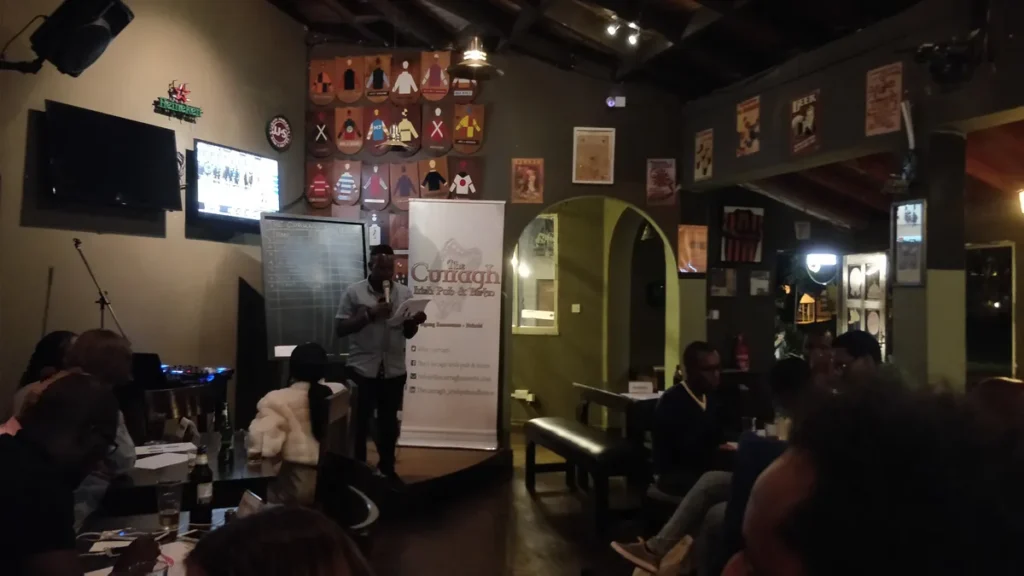
The classic pub-quiz shape still works at the top of the range, but only in a stretched form. A normal pub-quiz night runs five or six rounds for eight teams; a 384-player version runs the same rounds for 64 teams, with the rounds shortened, the marking parallelised, and the scores announced from a leaderboard rather than read out one team at a time. The soul of the event is unchanged — friends around a table, arguing cheerfully over an answer — but the machinery behind it is far more deliberate.
The Formats That Work at 384 Players
Four formats carry a 384-player night. Most successful mega quizzes use at least two of them in combination: table rounds for the bulk of the night, plus one showpiece format — a buzzer final, a station rotation, or a digital speed round — to give the evening a climax. The formats below are the ones that survive contact with a full room.
Team table rounds
Table rounds are the backbone. Every team sits together, the host reads the questions, and each team writes its answers on one sheet. Ten questions per round is the right length: long enough to feel substantial, short enough that marking never becomes a bottleneck. Mix the subjects inside each round rather than running a whole round on one topic, because a single-topic round can sink a team that happens to know nothing about it, while a mixed round lets every table find something to contribute.
Station rotation rounds
Station rounds turn the room into a circuit. Instead of every team doing the same thing at the same time, teams rotate between stations: a music station with headphones, a picture station with a wall of images, a puzzle station with a physical challenge, and a speed station with quick-fire questions. Each station runs for eight to ten minutes, then a bell moves everyone on. Stations are ideal for the middle of a big night because they solve the waiting problem completely — nobody is ever idle, and the room is always moving.
Heats and a grand final
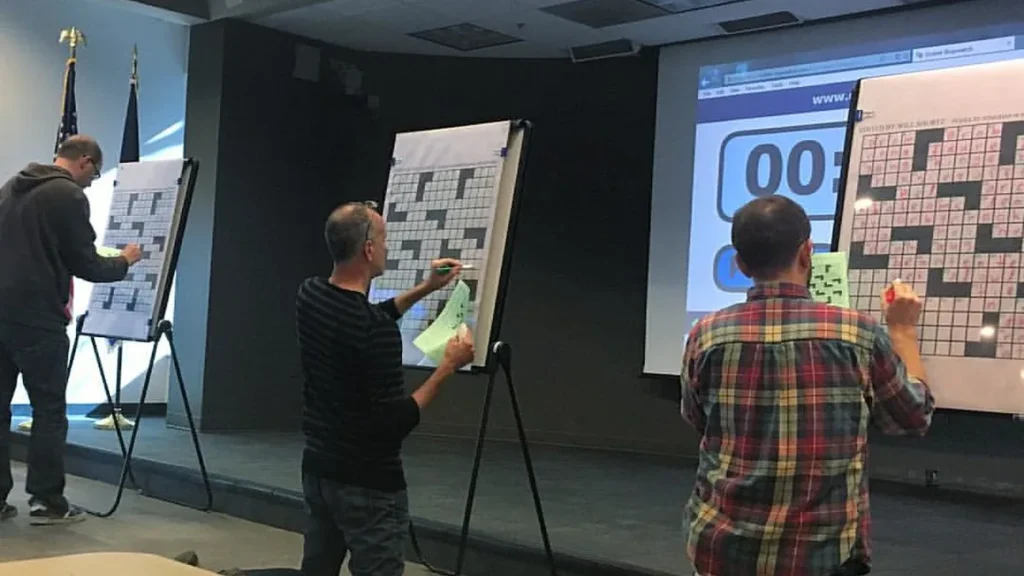
Heats are how a 384-player field becomes a contest. Split the room into four zones of 96 players, or six zones of 64, and run the first three rounds as heats inside each zone. The top two teams from each zone advance to a final on stage, while the rest of the room watches, plays along for fun, and cheers. The final should feel different from the heats: brighter lights, a bigger screen, a faster pace, and rounds that reward quick thinking as well as deep knowledge.
The final is also where buzzer rounds belong. A quiz-show style round with buzzers is electric on a stage in front of a crowd, and it is unworkable as a main format for 64 teams. Keep the final short — twenty to thirty minutes — and make sure the audience has something to do while it runs, such as an audience-only bonus round with a small prize, so the ninety per cent of the room that did not reach the final stays engaged to the end.
Hybrid digital answer sheets
Digital answer sheets are the quiet revolution in large trivia. Each team opens a form on one phone, types its answers, and submits at the end of the round. Scoring becomes automatic, the leaderboard updates in real time, and the marking crew shrinks to one person watching the results come in. For a 384-player event, that is a serious saving in time and labour, and the live leaderboard adds a competitive buzz that paper sheets cannot match.
Running the Night Without Chaos
A 384-player quiz is a production, and productions run on checklists. The list below is the minimum a host should confirm before the doors open. Every item on it has caused a real mega quiz to stumble when it was skipped, and none of them is expensive or difficult to fix in advance. Walk the room, test the sound, brief the crew, and then trust the plan.
- Sound tested with a full room in mind: speakers down both sides, a spare microphone, and the questions also shown on screens.
- One scorer per twelve to sixteen teams: a crew of four to six, each with a block of tables, an answer key, and a pencil.
- Team registration done before the first question: table numbers assigned, team names collected, and answer sheets already on the tables.
- A run sheet with clock times: every round, break, and announcement given a start time, shared with the whole crew.
- Breaks staggered by zone: no more than a third of the room moving at once, with drinks available at the tables.
- A dispute rule announced up front: the host’s answer key is final, challenges go to one named judge, and no round is ever re-marked mid-game.
Finally, brief the room before the first question. Two minutes of housekeeping — how answers are submitted, how ties are broken, where the toilets are, and when the final will happen — prevents an evening of interruptions. Players who know the rules relax into the game, and a relaxed room is a fun room. The guide to how to run a pub quiz covers the same basics for a smaller night, and every one of them matters more when the room is ten times bigger.
Scoring, Ties and Fair Play
Scoring at scale is a design problem, not an arithmetic problem. With 64 teams, ties are not a rare event; they are a certainty. Three rounds in, half a dozen teams will be locked on the same score, and if the rules do not say what happens next, the host will be inventing policy in front of a restless crowd. Decide the tie-break before the night begins, print it on the answer sheet, and announce it in the opening briefing.
The cleanest tie-break is a single sudden-death question: the tied teams write one answer, the closest wins, and the game moves on. For ties at the top of the table, a short five-question play-off round between the tied teams works well and gives the room a dramatic moment. Avoid tie-breaks that depend on the host’s judgement, such as awarding points for the best team name, because judgement calls in front of 384 people invite arguments that no host wants.
Fair play needs the same forethought. Phone use is the obvious issue: a team of six with six phones can look up any answer in seconds. Most large quizzes solve this with a simple rule — phones face down during rounds, one phone allowed for digital answer submission — and a visible enforcement policy, such as a first warning followed by disqualification from the round. Announce the rule, enforce it evenly, and pick the battles that matter: a team photographing the answer sheet is cheating, while a team checking the time is not.
Frequently Asked Questions
How many teams should 384 players be split into?
Sixty-four teams of six is the best default: it keeps every table lively, divides neatly, and gives the scoring crew a manageable 64 sheets per round. Forty-eight teams of eight works if your tables are large and your crowd is sociable, while ninety-six teams of four suits competitive events where every player wants to contribute. Avoid teams larger than eight, because the quieter players stop participating and the table becomes an audience.
How long does a 384-player trivia night take?
Plan for three hours from doors to prizes, with about two hours of actual play. Six rounds of ten questions, a picture round, and a short final fit comfortably in that window if marking happens in parallel with play. The most common timing mistake is marking after each round instead of during the next one, which adds ten minutes per round and pushes the night past midnight.
Do you need buzzers for a quiz this big?
No, and for the main rounds buzzers are a bad idea, because only two teams can play at once while the other sixty-two wait. Use written answer sheets for the heats, where every team plays at the same time, and save buzzers for the grand final, where eight or fewer teams on stage can use them properly in front of the crowd.
What is the best way to score 64 teams quickly?
A crew of four to six scorers, each handling twelve to sixteen teams, marking from a single key while the next round is played. Digital answer sheets are faster still, because scoring is automatic and the leaderboard updates live, but keep paper sheets as a backup. Either way, never let the whole room wait for marking — overlap it with play.
Can a 384-player quiz work outdoors?
Yes, with the right setup: a covered stage, a sound system that carries across an open space, printed answer sheets that will not blow away, and lighting that lets every table read its questions after dark. Wind and rain are the real risks, so have a marquee or an indoor fallback, and choose rounds that do not depend on hearing a quiet audio clip across a field.
What prizes work for a crowd this size?
One strong first prize, two smaller runner-up prizes, and a handful of spot prizes keep the whole room interested. A cash prize or a bar tab suits the winning team, while spot prizes — best team name, best-dressed table, or a prize drawn from the middle of the leaderboard — give the teams at the bottom a reason to stay until the end. Announce the spot prizes early so every team knows it still has something to play for.
Bottom Line
Trivia games for 384 players work when the event is designed as a tournament of teams, not as a big version of a small quiz. Split the crowd into 48 to 96 teams, run table rounds and stations in parallel, mark while the next round is playing, and finish with a short final the whole room can enjoy. Get the sound, the scoring, and the schedule right, and 384 strangers become 64 teams having the same argument over the same question — which is exactly what a great quiz night is supposed to feel like.