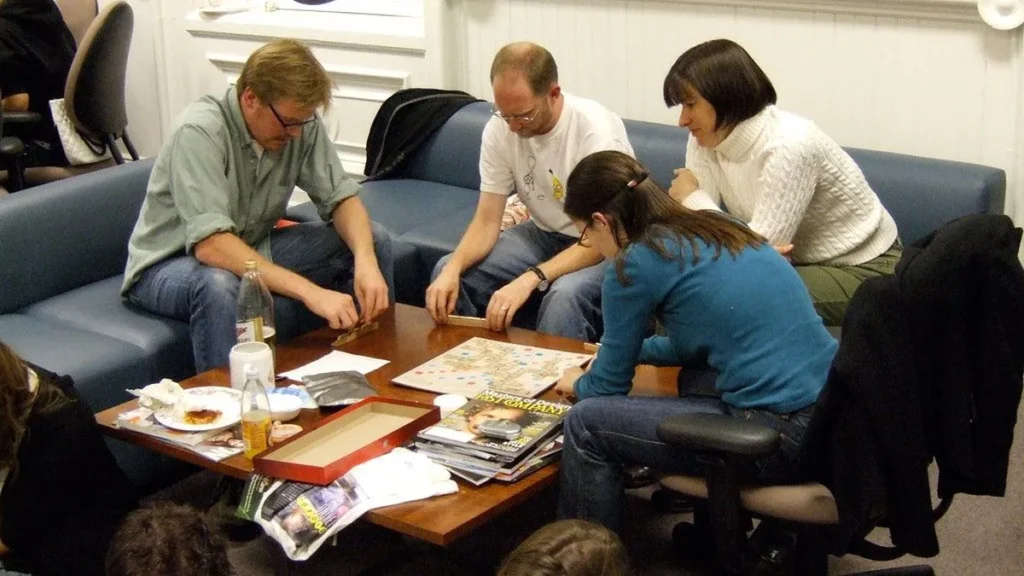
Puzzle games for 380 players sound impossible until you change the shape of the game. Nobody can sit 380 people around one table, hand them one jigsaw, and expect a fair contest. The puzzle itself is not the problem. The format is. When the group grows past a dozen players, the game has to stop being a single table and start being a system: many small teams, many identical stations, and one clear clock that everyone shares.
That is the idea behind this guide. It treats 380 as the top of a range, not as a fixed crowd. The same plan works for three friends on a rainy afternoon, for 40 colleagues at a team day, and for 380 players at a school festival, a company event, or a community tournament. The number of teams changes. The number of stations changes. The rules, the scoring, and the way a winner is found stay the same, so organisers can practise small and scale up without rewriting the event.
Below you will find the formats that actually survive at this size, a side-by-side comparison to help you choose, a running order for the day, and a checklist for the morning of the event. Every suggestion has been chosen for one reason: it keeps every player busy, it can be judged fairly, and it finishes on time.
Key takeaways
- Think in teams of four to six players, not in 380 individuals. Sixty to ninety-five teams is the real unit of organisation.
- Use identical stations so every team faces the same puzzle, the same pieces, and the same time limit.
- Pick formats with a clear finish line, such as a completed puzzle, a solved code, or a checked answer sheet.
- Run heats and a final instead of one long round, so the day stays on schedule and the best teams meet at the end.
- Score with time plus accuracy, and publish the rules before play starts, so no result feels like a surprise.

Why 380 Players Changes Puzzle Games
A puzzle game for four people is a conversation. A puzzle game for 380 people is logistics. A single jigsaw with a thousand pieces gives each player in a group of four about 250 pieces to consider. Give the same puzzle to 380 players and most of them will stand and watch. Watching is not playing, and a room full of watchers gets bored and restless within minutes.
Scale also changes fairness. If one team gets a puzzle with a clear picture and another gets one with a plain sky, the contest is decided before it starts. If one team starts five minutes late because its table was not ready, its time is not comparable with anyone else’s. Large events fail quietly in these small details, and the teams who lose on a technicality remember it for a long time.
The 3-to-380 Range
Think of 380 as the ceiling of a sliding scale. At the bottom, three players share one puzzle. At 30 players, you have five or six teams of five, each with its own table. At 120 players, you need two rooms or a hall with rows of tables. At 380 players, you have 63 teams of six, or 76 teams of five, and you need a hall or gym, plus volunteers who do nothing but reset stations between rounds.
The range matters because most organisers do not know their final number until late. People drop out, extra classes sign up, and a sponsor brings a whole department. A plan built for exactly 380 breaks if 312 turn up. A plan built for a range survives. Prepare stations in multiples, print extra answer sheets, and set a team size with a little flex, such as four to six players, so a team of five is never turned away.
The Team Format That Works
The team is the heart of the whole event. A good team is small enough that everyone can reach the puzzle, large enough that jobs can be shared, and mixed enough in skill that one strong player cannot do everything alone. Four to six players hits that balance for most puzzle formats. Three can work for a fast relay. Seven starts to leave someone out at the edge of the table.
Teams of Four to Six
Four gives each person a corner of a table puzzle. Five adds a reader or a checker without crowding the table. Six lets a team split into two pairs for a relay. More than six, and the table edge runs out. Players at the ends cannot reach the middle, and the puzzle becomes a spectator event for them.
Stations Instead of One Table
A station is a self-contained puzzle post: a table, a puzzle, a timer, an answer sheet, and a volunteer or a clear instruction card. A team visits a station, plays for a set time, records a result, and moves on. With enough stations, every team plays at once. Nobody queues. Nobody watches. That is the whole point.
Seven Puzzle Games for 380 Players
Not every puzzle survives at this size. The seven formats below do, because each one has a clear task, a clear finish, and a way to run many copies at once. They can be mixed across stations, or one format can fill the whole event. Mixing is better for a festival, where variety keeps energy up. A single format is better for a serious tournament, where the winner should be the best at one thing.
1. Jigsaw Relay
Each team gets the same jigsaw, usually 100 to 300 pieces for a 20-minute round, and works together to finish as much as possible. The score is the number of pieces correctly placed when time ends, or the time taken if a team finishes early. Sort the pieces into trays before the event, keep the box picture visible, and count the pieces for each set so a missing piece does not ruin a team’s score. Large, sturdy pieces are better than small ones: a floor puzzle or a large-piece map puzzle lets the whole team see the picture and reach the pieces.
2. Puzzle Hunt
A puzzle hunt sends teams around a building, a campus, or a hall to find and solve a chain of clues. Each clue leads to the next location, and each location holds the next puzzle. This format suits 380 players because the crowd spreads out naturally instead of gathering at one table. Stagger the start, giving each team a different first clue or starting teams in waves five minutes apart, so they do not bunch up. Keep each puzzle short, two or three minutes at most, and use wordplay, picture puzzles, simple codes, and observation tasks that need no phone and no specialist knowledge.
3. Escape-Room Stations
Each station is a small set of linked puzzles: a code to crack, a lock to open, a hidden message to find. Teams have ten or fifteen minutes to escape the station, and the score is the number of puzzles solved or the time to escape. Keep each station to three or four puzzles, and make the link between them obvious once the first one is solved. Each station needs a volunteer who can give a hint when a team is stuck and reset the station quickly. Train volunteers on hints, not just answers: a good hint points the team in the right direction without giving the answer away.
4. Crossword Relay
Each team gets the same large crossword, printed big enough for the whole team to read, and works through the clues together. The score is the number of correct answers when time ends, or the time to complete the grid. Big print is essential: a normal newspaper crossword is too small for six people to share. Split the clues by type, so one player takes the wordplay clues, another takes the general knowledge clues, and another checks the crossing letters. Write the crossword for your audience, using school-friendly words for a school event or company history for a company event.
5. Logic Grid Tournament
Logic grids, where you work out who lives where and who owns what from a set of clues, are ideal for tournaments. They have one right answer, they can be marked in seconds, and they do not depend on speed of hands. A team that thinks carefully beats a team that rushes. Run them as a written round: every team gets the same grid and clues, works for 15 minutes, and hands in an answer sheet. Mark one point per correct cell, or give a bonus for a fully correct grid. Because the round is quiet, it gives the hall a calm middle section after a noisy jigsaw round.
6. Tile and Pattern Race
Each team gets a set of tiles, tangram pieces, or pattern blocks, and a picture to copy. The team must recreate the picture as quickly as possible, with every piece in the right place. It is fast, visual, and easy for spectators to follow, which makes it a good final-round game. The result is visible from across the room, so a judge can see at a glance whether a picture is complete and check it against a printed answer card in seconds. Keep the pieces large enough to handle quickly, and have spare sets ready, because pieces will go missing.
7. Code-Breaking Relay
Each team gets a series of coded messages to decode. Each message, once decoded, gives the key to the next one. The first team to decode the final message wins the round. Use simple codes that can be learned in two minutes: a Caesar shift, a reversed alphabet, a number code, or a picture code. Give each team a code sheet they can keep, so the game tests decoding rather than memory. Run it as a station game with written answer sheets, not as a race to shout out the answer. A written answer, checked against a key, is fair and easy to score.
Which Format Should You Choose?
The right format depends on your players, your space, and your helpers. A school with a big hall and many parent volunteers can run escape-room stations. A company with one meeting room and no volunteers should run a written logic-grid round and a crossword relay. A community festival with families of all ages should run a jigsaw relay and a tile race, because both are easy to join and easy to watch.
| Format | Best team size | Space needed | Preparation | Scoring |
|---|---|---|---|---|
| Jigsaw relay | 4 to 6 | One table per team | Medium: sort and count pieces | Pieces placed or time to finish |
| Puzzle hunt | 4 to 6 | Building, campus, or hall | High: route and clue design | Clues solved or time to finish |
| Escape-room stations | 4 to 5 | One station per team | High: linked puzzles and props | Puzzles solved or escape time |
| Crossword relay | 4 to 6 | One table per team | Medium: large-print grid | Correct answers or completion time |
| Logic grid tournament | 4 to 6 | One table per team | Low: print grids and keys | Correct cells or full grid bonus |
| Tile and pattern race | 4 to 5 | One table per team | Low: tile sets and pictures | Time to copy the picture |
| Code-breaking relay | 4 to 6 | One table per team | Medium: codes and answer key | Messages decoded or final time |
For ideas on the smaller-scale versions of these games, the guide to puzzle games for 379 players shows how the same team and station ideas work with one fewer player in the top count, and it is a useful check when you are scaling a plan down for a smaller hall.
Running the Day: Heats, Finals, and Scoring
A 380-player day needs a running order that everyone can follow. Print it, project it, and announce it at the start. Begin with registration, then a short welcome and a demonstration round: show one team playing for two minutes while everyone watches. People learn a puzzle game by seeing it, not by hearing the rules read aloud. Then run the first heat, a short break, the second heat, lunch, the semi-final, and the final.
A Schedule That Finishes on Time
Time is the scarcest resource at a large event. Every round that runs ten minutes over pushes lunch, the final, and the prize-giving later. Build slack into the schedule: a 20-minute round with a 10-minute changeover is realistic, because 380 people cannot reset, move, and settle in two minutes. Use a visible clock. A projected countdown that everyone can see does more for timekeeping than a dozen announcements. When the clock hits zero, play stops, even if a team is one piece away from finishing.
Fair Scoring Without Arguments
Good scoring is simple, written down, and shared before play starts. Time plus accuracy is the best combination for most puzzle formats. Decide before the event whether a fast team with three mistakes beats a slower team with none, and write the answer on the instruction card. Tie-breaks need a rule too: a single extra puzzle, played by the tied teams while the audience watches, is quick, exciting, and decisive. Keep a master scoresheet in one place, with one person in charge of it, so two volunteers never record the same result differently.
Checklist for the Morning of the Event
- Count every puzzle set and check that each one is complete, with the same number of pieces at every station.
- Put a numbered card, an answer sheet, a pen, and a timer at each station, and test the projected countdown.
- Brief every volunteer on their station, their hints, and the exact words to use when time is up.
- Walk the hall as a player would, checking that every station is reachable, visible, and far enough from the next one.
- Print the running order, the scoring rules, and the tie-break rule, and put a copy at every station.
- Prepare the prizes, the master scoresheet, and a spare set of puzzles for the final before the first team arrives.
Common Mistakes at 380 Players
The most common mistake is choosing a puzzle that is too hard. Organisers want a challenge, so they pick a 1,000-piece jigsaw or a fiendish logic grid, and most teams make almost no progress in the time allowed. A puzzle that nobody finishes is not a challenge. It is a discouragement. Choose a puzzle that a good team can finish, or nearly finish, in the time given.
For a closer look at how a similar large-group puzzle day is structured, the guide to puzzle games for 378 players sets out the same station and heat system for a slightly smaller crowd, which is handy when your final number lands between the two counts. And if your teams enjoy story-driven puzzles, murder mystery puzzles offer a ready-made way to add a narrative thread to an escape-room station or a puzzle hunt.
Frequently Asked Questions
Can 380 players really play puzzle games together?
Yes, if the game is organised in teams and stations. No single puzzle can hold 380 players, but 63 to 76 teams of four to six players can all play at once across stations, or in heats if space is limited. The key is to stop thinking of 380 individuals and start thinking of 70 teams.
How many teams will 380 players make?
It depends on team size. Teams of five give 76 teams. Teams of six give 63 teams, with two players left to join another team or form a small team. Teams of four give 95 teams, which is a lot to manage, so five or six is usually the better choice for a crowd this large.
What is the best puzzle game for a very large group?
The jigsaw relay is the best starting point, because it is easy to understand, easy to judge, and easy to run at many stations at once. A logic grid round is the best second game, because it is quiet, fair, and simple to mark. Together they make a balanced half-day event.
How long should each round last?
Most rounds work best at 15 to 20 minutes, with a 10-minute changeover between rounds. Shorter rounds feel rushed, and longer rounds leave fast teams waiting. A final round can be shorter, 10 minutes, because the audience wants a quick, clear result.
How do you stop teams from copying each other?
Use identical puzzles but seat teams far enough apart that they cannot see each other’s tables, and collect answer sheets at the end of each round. For a puzzle hunt, stagger the routes so teams are not following each other. For written rounds, a quiet hall and a clear rule about talking to other teams is usually enough.
What do you need most on the day?
Volunteers, spare puzzles, and a visible clock. Volunteers reset stations and give hints. Spare puzzles cover losses and damage. A visible clock keeps every round honest. If you have those three things, most other problems can be fixed as they come up.
Bottom Line
Puzzle games for 380 players work when the event is built around teams, stations, and tournaments. Divide the crowd into teams of four to six, give every team the same puzzle at its own station, and use heats and a final to find a winner. Choose formats with a clear finish line, score with time plus accuracy, and publish the rules before play starts. Do that, and 380 players will not feel like a crowd to manage. They will feel like a tournament worth playing.