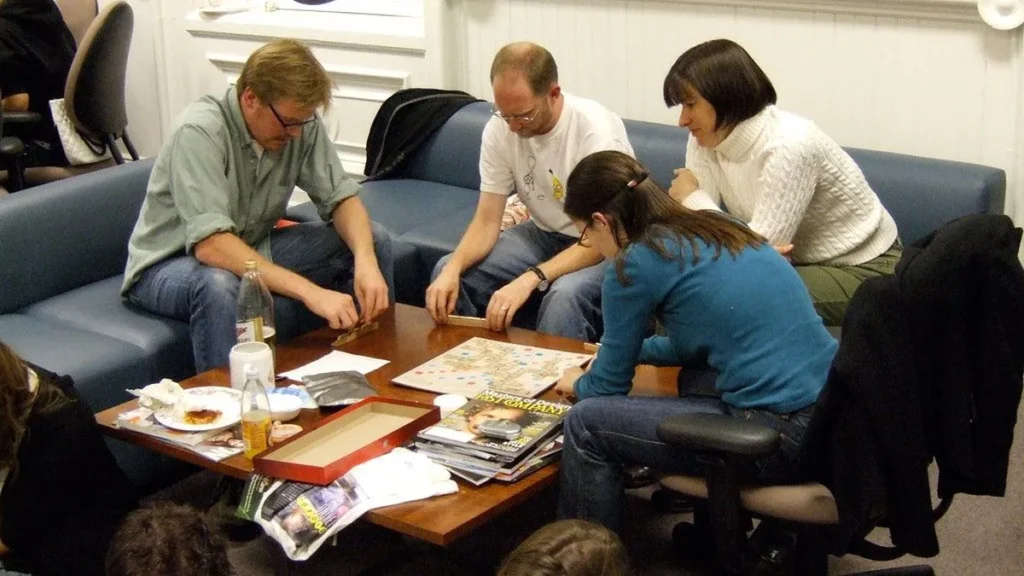
Card games for 538 players work when the evening is arranged around many small tables instead of 1 big one. With 538 people in a riverside boathouse, nobody can hear a host from the far side or watch a single pack of cards. The answer is about 100 tables of 4, 5 or 6, each playing its own short contest, with points carried forward to a closing final. This guide gives you 9 card games that fit that shape, and each one is easy to teach, quick to finish, and built around small groups that never need to wait for anyone else.
A crowd this large needs a plan that a host can run from the middle of the room. Every table gets the same start signal, the same round length, and the same simple scoring sheet, so the whole boathouse moves together even though no 2 tables play the same hand. The 9 titles below teach in under 5 minutes, finish a round in about half an hour, and keep every player busy from the opening deal to the closing count.
The boathouse setting helps more than it sounds. Long rows of tables face the same way, the host stands where every table can see the raised hand, and coloured cards held high tell each table when to start, when to finish, and when to move to the closing final. The plan, the 9 games, a checklist, and answers to the usual questions follow below.
Key takeaways
- Card games for 538 players work when about 100 small tables play at the same time, with every table following the same timing and the same simple scoring sheet.
- Pick titles that teach in under 5 minutes and finish a round in about 30 to 45 minutes, so the whole room moves together and nobody waits long.
- Tables of 4, 5 or 6 suit every title below, and the two 4-player titles take more tables than the 6-player ones.
- A host with coloured cards held high beats a shouted announcement: every table can see the start, the finish, and the move to the closing final.
- Points carried forward from each table decide the champion, so the closing final is short, fair, and easy for a crowd of 538 to follow.

The 9 games at a glance
| Game | Players per table | One round | Why it scales to 538 |
|---|---|---|---|
| Glory to Rome | 2 to 5 | 30 minutes | Every table uses the same short role list, so rounds end together. |
| Uchronia | 2 to 6 | 30 minutes | One shared timer per table keeps the building phase even. |
| Valeria: Card Kingdoms | 1 to 5 | 45 minutes | Dice and cards mix in a way newcomers learn in minutes. |
| Villages of Valeria | 2 to 5 | 30 minutes | Everyone chooses at the same time, so no table stalls. |
| Quest of Valeria | 2 to 5 | 30 minutes | A shared dice pool per table makes each round easy to run. |
| Eminent Domain | 2 to 5 | 45 minutes | Role cards give every player a clear job each round. |
| Core Worlds | 2 to 5 | 45 minutes | A central row of cards per table keeps choices visible. |
| Jump Drive | 2 to 4 | 30 minutes | A fast tableau builder that tables of 4 finish together. |
| Sorcerer | 2 to 4 | 30 minutes | Two duels per table finish fast and feed a clear champion. |
How 538 players fit into one evening
Split the crowd evenly and each of the 9 titles takes about 60 players. That means 12 tables for a 5-player title, 10 tables for the 6-player title, and 15 tables for each 4-player title, which comes to 112 tables if the split is perfectly even. In practice, plan for about 100 tables and let the host move a few players between tables as the night goes on.
Each table plays its own copy of its title, and the host runs the evening in 2 halves. In the opening half, every table learns its title and plays 1 full round. In the later half, every table plays a 2nd round with the same title, and the best score from each table moves forward. The closing final brings the 9 table champions together at 1 table for a short deciding round while the rest of the room watches and cheers. The whole evening runs about 3 hours, including the welcome, the 2 halves, and the final.
The same many-tables idea already works for a slightly smaller crowd: the card games for 536 players run on the same pattern of small tables, short rounds, and points carried forward to a closing final. Borrow the shape, keep the timing tight, and a crowd of 538 plays just as smoothly as a crowd of 536.
The 9 games
1. Glory to Rome
Glory to Rome is a role-choosing card game in which every player builds a Roman town from the cards in hand. On each turn, the player whose turn it is names a role, and everyone at the table may follow that role or take a different action with their own cards. Buildings rise from the cards laid down, and the player with the most impressive town when the deck runs out takes the table.
At a huge gathering, Glory to Rome earns its place because the role list is short and every table learns it in minutes. The host reads the 6 roles aloud once, each table pins the list where every player can see it, and rounds move at the same pace across the room. Tables of 5 work best, and a 30-minute round leaves time for a 2nd round in the later half. It rewards clever use of the cards in hand rather than long speeches, so soft-spoken players do as well as loud ones.
2. Uchronia
Uchronia is a tableau-building card game in which every card can be a resource or a building. Players lay cards down to raise the value of their town, then use those cards to put new buildings into play. The puzzle is choosing which cards to spend and which to keep, because every card spent is a building that will never rise.
For 538 players, Uchronia works because the building phase is calm and every table runs on the same timer. A table of 6 finishes a round in about 30 minutes, and the host holds up a coloured card when 5 minutes remain so no table overruns. The scoring is visible on the table in front of every player, which makes the closing count honest and quick, and the best tableau at each table moves forward to the final.
3. Valeria: Card Kingdoms
Valeria: Card Kingdoms mixes dice and cards in a small kingdom-building game. On each turn, dice are rolled for the whole table, and every player gains from the roll according to the citizens in front of them. Players then spend what they gained to hire new citizens, raise buildings, and win the favour of the realm. The mix of dice and cards keeps every player involved even when it is not their turn, because every roll matters to everyone.
A crowd of 538 suits this title because the dice roll is a shared moment at each table. The host can even roll for the room: when the coloured card goes up, every table rolls at once, and the room fills with the sound of dice and laughter. A smaller crowd can borrow the same rotation from the card games for 534 players, where 89 tables of 6 keep the same pace and the same shared-roll energy.
4. Villages of Valeria
Villages of Valeria is a card-choosing game in which every player builds a settlement from the cards passed around the table. Each round, players take 1 card from the hand offered to them and pass the rest along, so the settlement grows 1 card at a time. The skill lies in watching what the nearby tables want and taking the card that fits your own settlement best before someone else takes it.
The choosing happens at the same time at every seat, which is exactly what a huge evening needs: no table ever waits for 1 slow player, because everyone chooses together and the host moves the room on with a raised card. The settlement on the table tells its own story at the closing count, and the strongest settlement at each table moves forward.
5. Quest of Valeria
Quest of Valeria is a dice-choosing adventure in which players hire heroes and send them out on quests. A pool of dice sits in the middle of each table, and on each turn a player takes dice from the pool to power a hero or complete a quest. The heroes grow stronger with each turn, and the player whose party finishes the most quests takes the table.
For a crowd of 538, Quest of Valeria works because the dice pool is shared and visible. Every player at a table can see the same dice, plan the same way, and follow along without asking the host for help. The host keeps the pace with coloured cards, and the closing count is a simple addition of finished quests, so the table champion is clear before the final begins.

6. Eminent Domain
Eminent Domain is a deck-building game of growing empires among the stars. Players begin with the same small pile of cards and add better cards to it as play goes on, shaping the pile into an engine that explores, trades, and settles new worlds. On each turn, the player names a role, and every player at the table may follow that role with a card from hand.
At 538 players, Eminent Domain earns its place because the role cards do the teaching. Each role is printed on a card that every player can read, so the host never needs to explain the same rule 100 times. The closing count adds up settled worlds and trade goods, and the best empire at each table moves forward to the final.
7. Core Worlds
Core Worlds is a deck-building game in which players build galactic empires from a central row of cards. Each table has its own central row, and on each turn a player buys from that row or deploys units to win new worlds. The row changes as cards are taken, so every table tells a different story even though every table plays the same game.
The central row is what makes Core Worlds scale to a huge evening. Every choice is visible to the whole table, so newcomers learn by watching the row change, and the host can walk the room and see at a glance how every table is doing. The card games for 532 players show the 4-to-a-table version of the same evening in the card games for 532 players, where smaller tables keep the central row easy to read for every player.
8. Jump Drive
Jump Drive is a fast tableau-building card game in which every player builds a small space empire from the cards in hand. On each turn, players lay down cards to win new worlds, raise income, and add powers to the tableau in front of them. The player who reaches 50 points ends the round, and the highest total takes the table.
For a crowd of 538, Jump Drive works because a round takes about 30 minutes and every table finishes together. Tables of 4 suit it best, and the rules teach in minutes because the flow never changes: lay a card down, pay for it, take the benefit. The tableau in front of each player shows the whole story, so the host can see at a glance how every table is doing, and the closing count is a simple addition of points. The best tableau at each table moves forward to the final.
9. Sorcerer
Sorcerer is a duelling card game in which 2 players face each other across 3 lines of play. Each player commands a sorcerer and an army of creatures, laying cards into the lines and casting spells to break through. The duel ends when 1 sorcerer falls, and the whole contest fits into about half an hour.
At a table of 4, Sorcerer runs as 2 duels side by side, and the 2 duel winners meet in a deciding duel to take the table. That shape is perfect for a huge evening: every player gets a duel, nobody waits, and the table champion is decided by play rather than by a vote. The 9 table champions from the Sorcerer tables join the champions from the other 8 titles in the closing final.
Checklist for the night
- Count the crowd before the night and arrange about 100 tables, with extra tables ready for the 4-player titles.
- Put 1 copy of the title, the scoring sheet, and the short role list on every table before anyone sits down.
- Give the host 3 coloured cards: green to start, amber for 5 minutes left, red to finish and move to the closing count.
- Place a clear walkway down the middle of the room so the host can reach every table without squeezing past chairs.
- Keep the closing final short: 1 table, the 9 table champions, and a single deciding round the whole room can watch.
- Pack extra packs, extra scoring sheets, and extra pencils in a box by the door, so a damaged pack never holds a table up.
Frequently asked questions
How many tables do 538 players need?
Plan for about 100 tables. Tables of 6 suit the 6-player title, tables of 5 suit most titles, and tables of 4 suit the two 4-player titles. If the crowd splits evenly across the 9 titles, the count comes to 112 tables, so having a few extra tables ready is wise.
How long does a 538-player card night take?
About 3 hours. Allow 15 minutes for the welcome and seating, 45 minutes for the opening half, 45 minutes for the later half, and 30 minutes for the closing final and the announcement of the champion. The coloured-card signals keep every table on the same timing.
What if half the players have never played a card game before?
That is normal for a crowd this large, and these 9 titles were picked for it. Every title teaches in under 5 minutes, every choice is visible on the table, and nearby players can help newcomers without slowing anything down. Put 1 experienced player at each table if you can, and let the host walk the room during the opening half.
Can children join a 538-player card evening?
Yes, with a guardian at their table. The titles use reading and simple addition, so children of about 10 and older usually follow along well. Keep children with their own group at a table of 4 or 5, and let the host know which tables have younger players so the pace stays gentle there.
Do we need special packs for these 9 titles?
Yes. Each title has its own pack, and each table needs 1 copy of its title. Borrow or hire extra copies well before the night, and label every pack with its table number so the packs find their way home.
How do we decide the champion across about 100 tables?
Every table keeps a scoring sheet, and the best score at each table moves forward. The 9 champions from the most-played titles meet at 1 table for a short deciding round, and the host announces the overall champion from there. Points, not applause, decide the result, so the final is fair even in a room of 538.
The Bottom Line
Card games for 538 players work when the evening is built around small tables, short rounds, and one shared pace. The 9 titles above give every table a game that teaches in minutes, finishes in under an hour, and ends with a clear champion. Arrange about 100 tables, give the host coloured cards for the start, the warning, and the finish, and let the points decide the final.
Start with the checklist, lay the tables out the day before if you can, and trust the shape: small tables, short rounds, and a closing final the whole room can follow. A crowd of 538 sounds impossible until the tables are laid out, and then it plays like any other card night, only larger, louder, and more fun.