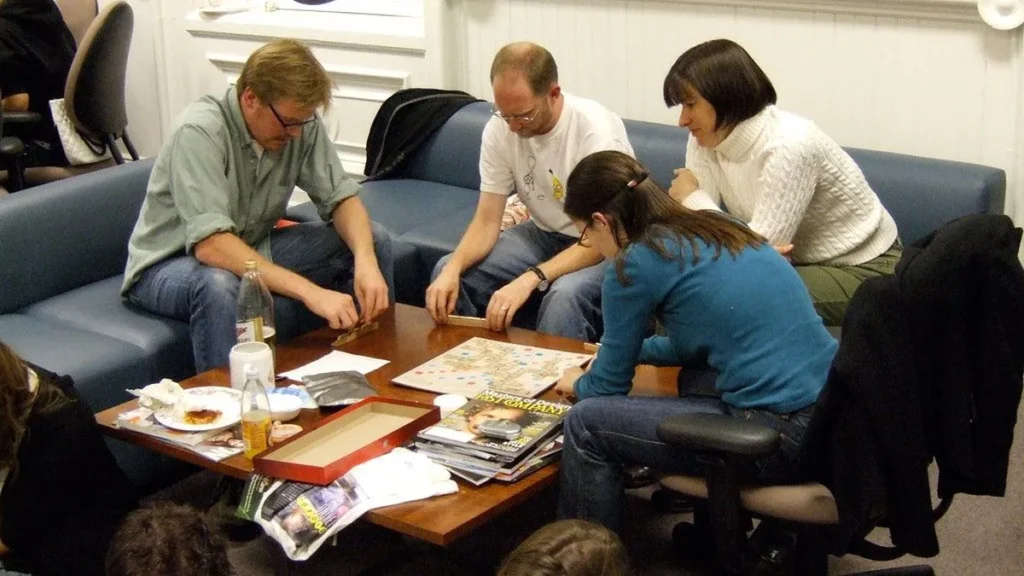
Word games for 537 players work best when every team plays at the same moment, with the same words, and nobody has to wait for a chance that never comes. This collection of nine games does exactly that. One caller runs the hall, sixty teams of nine sit with paper and pens, and each game asks the whole room to listen, look, and answer together. The games play with how words sound and how they are spelled: look-alike words that refuse to rhyme, two letters that make one sound, extra sounds that sneak into everyday speech, and first sounds that fall away when people talk quickly.
Nothing here needs fancy kit. Each team needs an answer sheet, a pen, and a clear view of the caller. The caller needs nine printed word lists, one for each game, and a firm voice that carries to the back of the hall. The team with the most correct answers earns the points, with a small bonus for the earliest correct answer sheet in each game.
What makes this collection different from a spelling contest is that nobody has to be a strong speller to enjoy it. Eye rhymes reward looking, not spelling. Digraphs reward listening. Aphaeresis rewards anyone who has ever heard someone say ‘cause instead of because. The games below are written so that a mixed-age team, with grandparents and teenagers side by side, can all add something.
Key takeaways
- Nine sound-and-spelling games run hall-wide, so all 537 players play at once with no waiting.
- Teams of nine sit together, answer on paper, and hand in one answer sheet per game.
- Every game uses ordinary words, so mixed-age teams can all add answers.
- One caller, nine printed lists, and a points tally are the only kit the day needs.
- Points reward correct answers first, with a small bonus for the earliest correct answer sheet.

The nine games at a glance
| Game | What teams do | Minutes |
|---|---|---|
| 1. Eye Rhyme Word Match | Match words that look like rhymes but sound different | 15 |
| 2. Digraph Word Hunt | Locate words holding a named two-letter sound | 15 |
| 3. Epenthesis Word Tuck | Spot the extra sound tucked inside a spoken word | 15 |
| 4. Aphaeresis Word Chop | Work out the full word behind a chopped opening | 15 |
| 5. Asyndeton Word Rush | Build three-beat lists with no joining words | 15 |
| 6. Auxesis Word Climb | Arrange three words from mildest to strongest | 15 |
| 7. Augmentative Word Boost | Make ordinary things bigger with mega-, super-, and -zilla | 15 |
| 8. Hyponym Word Narrow | Name narrower kinds of a broad word | 15 |
| 9. Synecdoche Word Call | Name the whole thing from one of its parts | 15 |
The nine games
1. Eye Rhyme Word Match
Some words look like perfect rhymes and then refuse to rhyme at all when you say them aloud. Cough and bough share their ending on paper, yet one ends with an off sound and the other with an ow sound. Dove and move look like a neat couple until you hear them. Said and paid, come and home, bread and bead, rough and through, pint and hint, great and treat, pear and fear, blood and food, tough and though: every one of these couples tricks the eye and rewards the ear.
The caller reads out twelve couples, one at a time, and teams write down whether each couple truly rhymes or only looks as if it does. Each correct verdict earns two points, and a bonus point is added for any team that writes down the two different ending sounds. The trick is to say each word aloud before deciding, because silent reading is what makes eye rhymes work.
For the remaining three couples, the caller gives only the first word and asks teams to invent an eye rhyme for it. A good invented couple earns three points if the spelling matches closely and the sounds differ.
2. Digraph Word Hunt
A digraph is two letters that join up to make a single sound. Sharp starts with sh, chip starts with ch, thin starts with th, phantom starts with ph, when starts with wh, back ends with ck, young ends with ng, and queen starts with qu. The letters sit side by side, but the ear hears only one sound. Teams who enjoyed the sound-change games in our word games for 513 players will feel at home here, because those games play the same trick of listening past the spelling to the sound underneath.
The caller names one digraph, and teams have ninety seconds to write down as many words holding it as they can. Each real word earns a point, and a word that holds the digraph twice earns two. The caller then names a second digraph, and a third, until five have been hunted. The gh digraph steals the show: it sounds like f in enough, laugh, and cough, stays silent in eight and though, and sounds like g in ghastly.
3. Epenthesis Word Tuck
Epenthesis is the habit of tucking an extra sound into the middle of a word. Nobody means to do it, yet whole halls do it every day. Athlete comes out as ath-e-lete, with a vowel tucked between the th and the l. Realtor comes out as real-a-tor. Hamster comes out as hampster, with a p tucked in after the m. Mischievous comes out as mischievious, nuclear as nucular, and escape as excape, with an x tucked in at the front.
The caller reads out ten words, each one spoken the tucked-in way, and teams write down the plain spelling of each word. Each correct plain spelling earns three points, and a bonus point is added for any team that writes down exactly which sound was tucked in and where it sits. The caller then reads out five plain words and asks teams to say them aloud the tucked-in way.
4. Aphaeresis Word Chop
Aphaeresis is the habit of chopping the first sound off a word. Because becomes ‘cause, until becomes ‘til, about becomes ‘bout, except becomes ‘cept, beneath becomes ‘neath, afraid becomes ‘fraid, and alone becomes ‘lone. Older words show the same chop: esquire lost its first sound and became squire, and example lost its first sound and became sample. The chopped word still carries the full meaning, just with a shorter front.
The caller reads out ten chopped words, and teams write down the full word each one came from. Each correct full word earns three points. For the remaining five, the caller gives the full word and asks teams to write down the chopped version people actually say, which earns two points each. The squire and sample examples earn a bonus point each, because they catch out teams who think chopping is only something people do in rapid speech.
5. Asyndeton Word Rush
Asyndeton is the trick of leaving out every joining word and letting short beats stand side by side. I came, I saw, I conquered has no and, no but, no or, and it hits harder for it. Eat, drink, laugh works the same way. Cold, raincoats, laughter tells a whole afternoon in three words. The wordcraft games in our word games for 525 players play a similar trick with figures of speech, and teams who liked that collection will take to this one at once, because both games ask players to feel how a sentence lands, not only what it says.
The caller gives each team a plain sentence with its joining words in place, and teams rewrite it with every joining word taken out. Each rewrite that keeps the meaning and drops every joining word earns three points. The caller then gives a topic, such as a wet afternoon, a birthday, or a long ramble, and teams build a three-beat list with no joining words at all. The best lists earn up to five points, judged on punch and on keeping the meaning clear.

6. Auxesis Word Climb
Auxesis is the climb from a mild word to a strong one, word by word: cold, colder, freezing; fond, keen, devoted; large, huge, enormous; amble, stride, march; good, great, superb. Each word means a little more than the one before it, and the third word lands with real force because the first two paved the way for it.
The caller gives each team three words in a jumbled order, and teams arrange them from mildest to strongest. Each correct arrangement earns three points. The caller then gives a single mild word, such as glad, tired, or pleased, and teams build a three-word climb from it. Cold, colder, freezing earns full points, and so do glad, delighted, overjoyed and tired, weary, exhausted. A climb that jumps too far in one jump, such as cold, freezing, blazing, earns only two points, because the middle word has to earn its place.
7. Augmentative Word Boost
An augmentative makes a word bigger, grander, or more extreme. Mega-, super-, ultra-, hyper-, and -zilla all do the job. A reader becomes a super-reader, rapid becomes ultra-rapid, busy becomes hyper-busy, a bride with strong opinions becomes a bridezilla. A bargain becomes a mega-bargain, a sneeze becomes a super-sneeze, and an ordinary sandwich becomes a godzilla-sized sandwich, which is a fine thing to order when the whole hall is hungry.
The caller gives each team ten ordinary words, and teams write down the biggest version of each one they can build. Each version that uses a real augmentative ending or beginning and still makes sense earns three points. A megamug earns points, and so does a super-mug, but a zilla-mug earns only one point, because -zilla has to fit the thing it describes, and a mug is too small a thing for it. The caller then asks teams to invent the biggest version of five everyday things: a mug, a wait, a yawn, a nap, and a sandwich. The best invention for each earns five points.
A mega-wait is good, but a super-mega-wait is better, and a wait-zilla is best of all, because it makes the whole hall picture a wait so long it needs its own county. The caller reads the best five aloud, and the hall chooses the single biggest invention of the day with a show of hands, which earns its team five extra points.
8. Hyponym Word Narrow
A hyponym is a narrower kind of a broader word. Plum, pear, and melon are all narrower kinds of fruit. Wren, finch, and robin are all narrower kinds of bird. Lorry, taxi, and jeep are all narrower kinds of vehicle. Bungalow, villa, and manor are all narrower kinds of house. Birch, elm, and beech are all narrower kinds of tree.
The caller gives each team five broad words, and teams have two minutes to write down as many narrower kinds of each one as they can. Each real narrower kind earns a point, and a narrower kind that no other team wrote down earns two. The caller then gives a single broad word and asks teams to write down the narrowest kind they can think of
9. Synecdoche Word Call
Synecdoche is the trick of naming a whole thing by one of its parts. Wheels means a motor, suits means the bosses, boots means soldiers, threads means what someone is wearing, roof means a home, strings means the string players, throne means a monarchy, and pen means the people who write for a living. One small part stands in for the whole, and everyone in the hall knows exactly what is meant, even though the words never say it outright.
The caller reads out ten parts, one at a time, and teams write down the whole thing each part stands for. Each correct whole earns three points. The caller then reads out five whole things and asks teams to write down a part that could stand for each one. A motor could be wheels, a home could be a roof, and the string players could be strings. The best answers earn three points each, and an answer that makes the whole hall nod earns a bonus point.
Teams leave the hall saying wheels and suits and boots all day long, and the caller will hear those words again at the next meeting. It is a gentle finish to a loud day, and it leaves every team feeling clever, which is exactly how a day of word games should end.
How 537 players all play at once
Five hundred and thirty-seven players sounds like too many for one hall, until you count it out in teams. Sixty teams of nine make five hundred and forty places, so fifty-nine teams have nine players and one team has six. Every team sits at its own table with paper and pens, and one caller runs each game for the whole hall at the same moment. No team waits for another team to finish, because every team answers on paper and hands in one answer sheet per game. The old coaching-inn set in our word games for 535 players runs on the same hall-wide call-and-response, and it works because the caller sets the pace and the paper does the work.
Give each team a table number and a points tally where everyone can see it. After each game, two helpers collect the answer sheets, the caller reads out the answers, and the points rise on the tally while the next game is being explained. Nine games at fifteen minutes each come to two hours and a quarter, and two short breathers bring the day to about two and a half hours. Teams that finish early can look over their answers, but no team may hand in a second answer sheet, because one answer sheet per team per game keeps the points honest.
Seat mixed-age teams together on purpose, because every game in this collection rewards a different kind of knowledge. Grandparents know the chopped words and the old sayings, teenagers know the augmentatives, and children hear the tucked-in sounds most clearly.
Checklist for the day
- Sixty answer sheets per game, one per team, with the team number written at the top.
- Pens for every player, plus a few extra.
- Nine printed word lists, one per game, for the caller and for the two helpers.
- A points tally where everyone can see it, updated after each game.
- A timekeeper with a stopwatch, so every game gets its full fifteen minutes.
- Drinks and nibbles for the two breathers.
Questions teams ask
How long do the nine games take?
Nine games at fifteen minutes each come to two hours and a quarter, and two short breathers bring the day to about two and a half hours.
Do we need any special kit?
No. Paper, pens, nine printed word lists, and a points tally are the whole list. The caller needs a loud voice that carries to the back of the hall.
How do we keep 537 people together?
One caller runs each game for the whole hall at the same moment, and every team answers on paper.
What if some players are shy?
Nobody has to answer alone. Every answer lands on the team answer sheet, so a shy player can write down an idea without saying it aloud.
Can younger players join in?
Yes. Mixed-age teams do best here, because the games reward different kinds of knowledge.
How do we pick the top team?
Points decide it. Correct answers earn points, the earliest correct answer sheet earns a small bonus, and the team with the most points at the end of the day takes the top place. If two teams end level, the caller reads out one more eye rhyme couple, and the first team to answer it correctly takes the top place.
The Bottom Line
Word games for 537 players work when the whole hall plays together, and this collection of nine sound-and-spelling games does exactly that. Eye rhymes, digraphs, tucked-in sounds, chopped openings, bare lists, climbing words, boosted words, narrower kinds, and parts that stand for wholes give every team something to add, whatever their age. Print the lists, gather the teams, and let the caller lead the day: the words will do the work.


