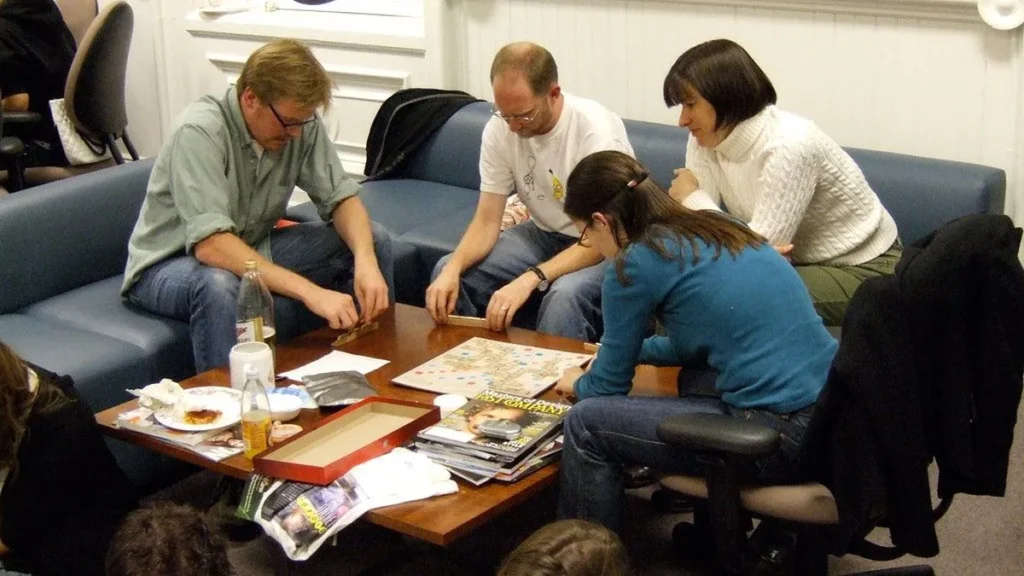
These word games for 535 players make one old coaching inn a place where a crowd of 535 can play together. The inn gives you everything a huge group needs: a hanging board by the door, a yard out back, a taproom full of tables, a fireplace to gather around, and a pantry, a courtyard and a hayloft. Nobody needs to travel anywhere, nobody needs to buy anything, and nobody sits out for long. Each crew of eight to twelve players moves from place to place, plays nine short word games, and gives in a points sheet at the end of the night.
A coaching inn works well because it was built for crowds. Travellers once stopped here in large numbers, ate together, slept under one roof, and passed the time with talk. The nine games below use that same shape. They use the places and objects of the inn as prompts, and the building itself does half the work of keeping 535 players interested. A creaking board becomes a letter-by-letter game. A lantern becomes a follow-on word game. A fireplace becomes a hearing game. The theme holds the night together without any extra decoration.
This guide gives you the full plan: nine games for crews of eight to twelve, a rotation that keeps every crew busy, a points sheet that any crew head can run, and answers to the questions groups ask most. Look it over once, copy the word handouts, and you can run the whole night with two hosts and a handful of helpers.
Key takeaways
- Nine short word games use the places and objects of one old coaching inn, so 535 players play in one place.
- Crews of eight to twelve move between nine places, which keeps idle time short.
- Each game takes about ten minutes, and the whole night runs for about two hours including short gaps.
- You need only paper, pens, a hanging board, a lantern and a tumbler: no electronics, no hired kit, no bought extras.
- Points sit on one sheet per crew, and a single extra word round settles any crews that end level.

How 535 players fit into one night at the inn
Divide 535 players into crews of eight to twelve, which gives you roughly fifty crews. Give each crew a name from the inn itself, such as the Sign crew, the Lantern crew or the Hayloft crew, and a named crew head who carries the points sheet. Two hosts run the night from the taproom: one host announces the moves and keeps the time, while the other walks the places and settles any disputes about words.
Each crew visits nine places one after another: the door, the yard, the lantern post, the taproom, the fireplace, the guest book table, the courtyard, the pantry and the hayloft. A crew spends ten minutes at each place, then moves on when the host raises the lantern in the taproom. That seems like a lot of movement, but the places sit close together inside one building, so a crew is never more than a short walk from its next game. The village-hall set in our word games for 531 players runs on the same rotation idea, with crews moving between places in a fixed order so that no place ever has two crews at once.
Points are simple. A crew earns one point for each correct word, with a bonus point for the best answer in a round when the host names one. The crew head writes the points on the sheet after each game, and the host adds up the sheets at the end of the night. Keep the points visible: put the current totals up in the taproom after the fifth game so that every crew can see them.
The nine games at a glance
| Game | What it asks for | Crews | Minutes |
|---|---|---|---|
| Inn Sign Word Creak | Sharp thinking | 8 to 12 | 10 |
| Stable Yard Word Groom | Neat letter order | 8 to 12 | 10 |
| Lantern Post Word Shimmer | Snappy answers | 8 to 12 | 10 |
| Taproom Word Clink | Close attention | 8 to 12 | 10 |
| Fireplace Word Crackle | Sharp eyes | 8 to 12 | 10 |
| Guest Book Word Scribble | Sharp thinking | 8 to 12 | 10 |
| Courtyard Word Wander | Good talk | 8 to 12 | 10 |
| Pantry Word Chill | Neat letter order | 8 to 12 | 10 |
| Hayloft Word Doze | Calm focus | 8 to 12 | 10 |
The 9 coaching-inn word games
Each game below uses one place in the inn and one simple rule. The host at each place says the rule aloud, gives one worked example, and starts the ten-minute count. If your group likes outdoor wordplay as well, the rockpool set in our word games for 533 players offers a daylight round by the sea that fits well with this indoor night.
1. Inn Sign Word Creak
The host hangs a board at the front of the inn with a long word written on it, covered except for its opening letter. The board moves gently on its hook, and the host lifts the cover a little at a time, showing one more letter after each creak of the hook. Crews write down their answer as soon as they know the word. A crew that answers with only three letters showing earns three points, with two letters showing earns two points, and with the full word showing earns one point.
Use long, familiar words for this game, such as “lantern”, “courtyard”, “hayloft” or “taproom”, so that every crew has a fair chance. Avoid words that two crews might spell in different ways, and avoid words with letters you cannot hear. The host should practise the gradual reveal: too hasty and the game ends in seconds, too drawn out and crews lose interest. Three words per crew visit is about right for ten minutes.
2. Stable Yard Word Groom
Each crew gets a grooming kit of six words with their letters mixed up: brush, comb, sponge, cloth, halter and manger. The crew works together to put the letters back in order, writing each word on its points sheet. A crew earns one point for each word it puts right, and a bonus point if it completes all six before the host raises the lantern.
The trick here is that the mixed-up letters look harder than they are. “Shurb” becomes “brush” once a crew spots the “br” at the start, and “regman” becomes “manger” once a crew tries the “man” opening. Let crews work it out aloud, because the player who spots the opening letters is often not the one who puts the word together. If a crew completes its kit early, the host gives it another kit with harder words, such as “groom”, “curry” and “hoof”, which are short and sharp.
3. Lantern Post Word Shimmer
The host stands by the lantern post and says a word, such as “shimmer”. The crew must answer with a word that starts with the ending letter of the word before it, so “shimmer” gives “roof”, and “roof” gives “fig”. Each word must be new, and no word may be repeated. A crew earns one point for each good word, and the run ends when a crew repeats a word or waits more than five beats.
This game suits crews with mixed ages, because it rewards snappy answers. The host should keep the pace brisk and say the ending letter clearly each time, because crews lose their place when the letter is mumbled. If a crew gets stuck, the host gives it a fresh starting word. Three runs per visit fill ten minutes nicely, and the best run of the night often comes from a crew that starts at an even pace and then finds its stride.
4. Taproom Word Clink
The host holds up fingers showing a number, and that number tells the crew how many letters its word must have. Three fingers means a three-letter word, five fingers means a five-letter word, and so on. The crew has ten beats to say a word of the right length, and it earns one point for each word that fits. Words must be real words the host knows, and made-up words earn nothing.
Short words are easy, so the host should mix short and long counts. A run of three, seven and then four keeps crews from settling into one length. The taproom suits this game because the clink carries well across a crowded taproom, and crews can hear it even when the taproom is full of talk. Look to the host for the end of the round, and make sure the host holds the fingers up high so every crew can see it.
5. Fireplace Word Crackle
The host sits by the fireplace with a handful of words on slips of paper. The host says a word aloud one letter at a time, with a short gap between letters, like the crackle of logs. Crews write down the word they think they hear, and they earn one point for each word they get in the right letter order. The host uses words of five to eight letters, such as “grate”, “mantel”, “smoky” and “sooty”.
Hearing is the skill here, not haste, so the host should speak at an even pace and repeat the letters once if a crew asks. Crews that write together do better than crews where one player writes alone. If the inn is noisy, the host moves closer to the fireplace and speaks more quietly, which brings the crew in and quiets the crowd. Four words per visit is plenty, with a short gap between each one for crews to compare answers.

6. Guest Book Word Scribble
The host shows the crew a word in messy handwriting, as if a tired traveller had scribbled it in the guest book late at night. The crew has twenty beats to say the word aloud and write it on its points sheet. A crew earns one point for each word it says correctly, and a bonus point if it says all five words in its round without a mistake.
Messy handwriting is harder to make out than typed words, so the host should use a thick pen and uneven letters, but keep them legible. Words with tall letters, such as “eight”, “weight”, “bright” and “night”, work well because their letters are easy to see even when the writing is rough. The guest book table suits this game because crews can lean in close and study the words together, and the host can give the paper to the next crew without any fuss.
7. Courtyard Word Wander
The host names a topic, such as inn work, supper dishes or months of the year, and the crew wanders the courtyard naming words on that topic, one each, with no repeats. A player who repeats a word, names a word off topic, or waits more than five beats sits out for the rest of that round. The crew earns one point for each good word, and the round ends when only one player is left naming words.
This game is the most social of the nine, because it gets crews talking as they move. The host should choose topics that every player knows something about, so that nobody is left out in the opening minute. Inn work gives words such as host, innkeeper, porter and maid. Supper dishes give words such as pie, stew and tart. Months give twelve easy words that every crew can start with. If a crew is large, divide it into two halves so that every player gets a chance.
8. Pantry Word Chill
The host gives the crew a short pantry word, such as “plum”, and the crew builds a growing word by adding one letter at a time: plum, plumb, plumbs. Each new word must be real, and it adds exactly one letter. A crew earns one point for each good addition, and the growing word ends when a crew cannot add a letter to make a real word.
The pantry suits this game because its words are short and plain, which makes the growing easy to start and hard to end. “Plum” grows to “plumb” and then to “plumbs”, while “pea” grows to “pear” and then to “pears”. The host should keep a small book of words nearby, because crews will argue about whether an addition is a real word. Three growing words per visit fill ten minutes, and the longest growing word usually comes from a crew that takes its time over the early words.
9. Hayloft Word Doze
The hayloft is the quiet round, and it comes at the end of the rotation. The host speaks a word low, and the crew answers low with a word that starts with its ending letter, keeping voices low all the way. Anyone who breaks the hush loses a point for the crew. A crew earns one point for each good low word, and the round ends after ten words or when the host raises the lantern.
Speaking low changes the whole feel of the game. Crews lean in close, pay close attention, and laugh quietly. The host should choose soft words that are easy to say low, such as “hush”, “dew”, “soft” and “low”, and avoid words with hard letters that carry across the loft. This is a good round to place after the noisy taproom game, because it calms the crews down before the points count at the end and the walk back to the taproom.
A simple plan for the night
Run the night in this order. Copy this plan and give it to the two hosts before the crews arrive.
- Divide 535 players into crews of eight to twelve, and name a crew head for each crew who carries the points sheet.
- Give out one word handout per crew at the door, with a pen and a points sheet for each crew head.
- Fix a clear start time, and raise the lantern every ten minutes to move crews to their next place.
- Walk the nine places in the same order for every crew, so that no place ever has two crews at once.
- Put the current totals up in the taproom after the fifth game, so every crew can see them.
- End with the quiet hayloft round, then bring every crew back to the taproom for the points count at the end.
Questions groups ask
How do 535 players all play at once?
They play in crews of eight to twelve, and each crew plays at a different place at the same time. With roughly fifty crews and nine places, the rotation spreads the crowd so thinly that no place feels crowded. The two hosts keep the moves on time, and the crew heads keep their crews together. If your group travels together often, the night-sleeper-train set in our word games for 529 players keeps the same crew sizes while the journey moves along with you.
How long does the night take?
About two hours: nine games at ten minutes each, plus the short gaps, the walk back to the taproom and the points count at the end. If you are short on time, shorten the games to eight minutes each and leave out the current totals. If you have a full night, add a tenth game of your own at the taproom while the hosts add up the sheets.
What if a crew has fewer than eight players?
Let it play anyway. A crew of five or six can play every game here, though it will earn a little less than a full crew. If you have several small crews, merge them into crews of eight to twelve before the night starts. Mixed crews often do better than crews of old friends, because they bring more words to the table.
Do we need any special kit?
No. You need paper, pens, a hanging board, a lantern, a tumbler and a pen. Everything else comes from the inn itself: the fireplace, the guest book table, the courtyard, the pantry, the hayloft. Copy the word handouts the day before, and make sure each place has its slips of paper ready before the crews arrive.
Can children play too?
Yes, and they often do well. The hearing games and the growing-word game suit younger players, because they reward care rather than plenty of words. Put at least two adults in each crew with children, and let each host give a simpler starting word when a crew asks for one. Mixed-age crews are some of the best crews here.
What if two crews end level on points?
Play one extra word round in the taproom. The host gives a starting word, and the level crews name words one after another, starting with the ending letter of the word before, with no repeats. The crew that names the most words before a repeat or a long wait comes out ahead. It takes five minutes, fills the taproom with noise, and gives the night a proper end.
The Bottom Line
Word games for 535 players work when the plan is simple, the crews are small, and the theme does the hard work. One old coaching inn gives you nine places, nine games and a night that 535 players can enjoy without fuss. Divide the crowd into crews, fix a clear start time, keep the points on one sheet per crew, and let the inn itself carry the night. The crews will remember the creaking board, the lantern, the fireplace and the low-voiced round long after they forget the points.