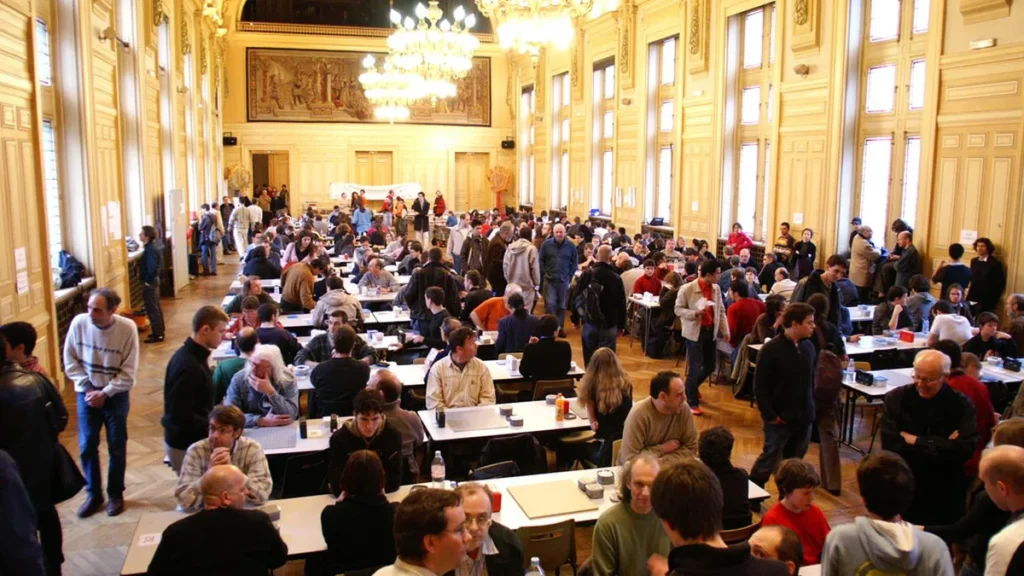
Dice games for 401 players sound impossible until you change the shape of the game. No single table holds 401 people, and no single roll can include everyone at once, so the trick is to stop thinking of one game and start thinking of one event built from many small games running at the same time. Dice games for 401 players work when teams, stations, and a shared clock carry the size, while the dice themselves stay simple, fast, and fair for every person in the room.
The nine games in this guide were chosen for three reasons. Each one uses ordinary dice or a small set of specialty dice, each round lasts only a few minutes, and each result is easy to record on a single score sheet. A game that needs ten minutes of explanation will stall when dozens of tables are waiting for the next round to start.
You do not need 401 dice sets or a stadium to make this work. A school hall, a community center, or a large office floor with enough tables will do, and most of the games below run well with one dice set shared by each table of five players. Read the scaling plan first, pick three or four games from the table, and build the evening around those choices.
Key takeaways
- 401 players means 80 teams of five plus one head host, not one giant table.
- Short rounds and simple scoring keep dozens of tables moving together.
- Pig, Farkle, and Zombie Dice are the fastest games for huge groups.
- One shared score sheet per team prevents most disputes before they start.
- A short practice round before scoring begins is worth more than a long rule speech.

How Dice Games Scale to 401 Players
The number 401 is a range, not a table size. The games below work for groups of three players at a kitchen table and for 401 players in a hall, because the same rules run at every table and the event adds the structure around them. Split the crowd into 80 teams of five, add one head host who floats between zones, and you have 401 people playing the same game at the same time without anyone waiting for a turn that never comes.
Stations turn that split into a schedule. Set up eight zones with ten tables in each zone, give every zone a captain with a whistle and a timer, and run the same game at every table for a fixed round length. When the whistle sounds, teams record their scores, and the next game begins. Nobody needs to move tables between rounds. The layout is close to the one in our guide to dice games for 399 players, which uses the same zone and captain system for a crowd of almost the same size.
Tournaments add the finish. After three scored rounds, the top two teams from each zone move to a final round at eight tables, and the winners of those tables meet for one last game on a stage or a central table where everyone can watch. The other teams keep playing a friendly round at their own tables, so nobody sits out the ending. That gives 401 people a shared result and a clear winner while keeping every table busy.
Dice Games for 401 Players at a Glance
| Game | Players per table | Round length | Best for |
|---|---|---|---|
| Pig | 2 to 6 | 10 minutes | Simple push your luck play |
| Farkle | 2 to 6 | 20 minutes | Risk and reward scoring |
| Zombie Dice | 2 to 6 | 15 minutes | Fast themed fun |
| Cee-lo | 3 to 6 | 10 minutes | Quick head to head rounds |
| Kismet | 2 to 5 | 25 minutes | Colourful scoring combinations |
| Dice Baseball | 2 to 6 | 20 minutes | Team rivalry and innings |
| Going to Boston | 2 to 6 | 10 minutes | Simple adding for all ages |
| Beat That! | 2 to 6 | 15 minutes | Physical party challenges |
| Drop Dead | 2 to 6 | 10 minutes | Quiet number play |
The Best Dice Games for Huge Groups
Pig
Pig is the simplest push your luck game in this guide, and it is the best opener when 401 people need to learn the rules at once. Each player rolls a single die and adds the result to a running turn total, then chooses to bank the points or roll again. Roll a one and the whole turn total is lost, so every extra roll is a small gamble. The first player to reach 100 points wins the table, and a round takes about ten minutes.
For a crowd of 401, run Pig as a team game with one shared score per table. Each team of five takes turns rolling for the team, and the group votes on whether to bank or roll again, which turns a quiet solo choice into a team debate. Give each table one die and one score sheet, and keep a spare die at every zone captain station.
Farkle
Farkle is the classic six dice scoring game, and it gives a large event a result that feels earned. On a turn, a player rolls six dice and scores for ones, fives, and three of a kind, then sets the scoring dice aside and rolls the rest again or banks the points. Roll with no scoring dice and the whole turn is lost, a result players call a Farkle. The first player to reach 10,000 points wins.
At scale, Farkle works best in the middle of the evening, once the room has settled and players want a game with real decisions. Give each table a printed scoring card, because the combinations are the one thing players forget under pressure, and the card stops arguments before they start. Run it as a team event with one shared score sheet, and let players take turns rolling for the team.
Zombie Dice
Zombie Dice is the quickest themed game in this guide, and it is the best choice when the crowd includes children or players who want a story without complex rules. Players draw three dice from a cup of thirteen, roll them, and keep the brains they collect while setting aside the shotguns that hurt them. Three shotguns ends the turn with nothing banked, so players must decide when to stop eating brains and pass the cup. The first player to collect thirteen brains wins.
At a table of five or six, Zombie Dice works as a fast round between longer games, and it needs only one cup of thirteen dice per table, which makes it easy to supply for 80 tables. Use it as the second game of the night, when teams are still learning the whistle and the score sheet.
Cee-lo
Cee-lo is a fast three dice game with a street corner history, and it is the best choice for quick head to head rounds at a big event. Each player rolls three dice, and the best rolls win in order: a 4, 5, and 6 beats everything, three of a kind beats a pair, and a pair beats a single high number. A roll of 1, 2, and 3 loses at once, so every roll has a clear result and nobody needs a score sheet to know who won.
For 401 players, Cee-lo fits neatly into a tournament bracket, because each table can settle a round in a few minutes and report a single winner. Give each table three dice and a small printed ranking card, and let the table winner move on to a zone playoff. Keep the stakes friendly and the forfeits harmless, so every player is comfortable taking part.
Kismet
Kismet is a colourful cousin of Yahtzee that rewards players who spot scoring patterns quickly. Each player rolls five dice with coloured pips, up to three times per turn, trying to fill fifteen boxes on a score sheet with straights, full houses, three of a kind, and the famous five of a kind.
For a crowd of 401, run Kismet as a team event rather than a solo contest. Each team of five plays one shared score sheet, and players take turns rolling for the team, discussing each choice out loud before the dice are set aside. That shared sheet turns a quiet solo game into a team discussion. A full game takes about twenty five minutes, so it works best once the room has warmed up.

Dice Baseball
Dice Baseball turns a whole ball game into a dice game, and it is the best choice when the evening needs team rivalry. Each player rolls dice to decide what happens at the plate: a single, a double, a triple, a home run, a walk, or an out, depending on the roll. Teams bat through nine innings, tracking runners on a simple printed diamond, and the team with the most runs wins the game.
At scale, Dice Baseball works because the printed diamond does the record keeping and the dice do the drama. Give each table two dice, one diamond sheet, and one pencil, and let the two teams at the table play each other. A game takes about twenty minutes, and the inning by inning structure keeps every player watching every roll.
Going to Boston
Going to Boston is the simplest adding game in this guide, and simple is a strength when 401 people need to learn the rules at once. Each player rolls three dice, keeps the highest die, rolls the other two, keeps the highest of those, and rolls the last die, then adds the three kept dice together. The player with the highest total wins the round, and the first player to win a set number of rounds wins the table.
The game also makes a fair tiebreaker. When two teams finish a tournament round level on points, a single round of Going to Boston at the central table settles it in front of the whole room. Use a large dice tray so the dice stay visible, and let the crowd call out the totals as they land. There is no scoring card to memorise, which makes it the best game for tables with children or players who have never touched dice before.
Beat That!
Beat That! is the loudest party game on this list, and it is the best choice when the evening needs energy rather than strategy. Players draw a challenge card and roll dice to complete a physical task, such as stacking dice into a tower, balancing a die on a finger, or rolling a pair before a timer runs out. Each completed challenge earns points, and the player with the most points after ten challenges wins the table.
For a crowd of 401, run Beat That! as a short party round rather than a full game, and keep it at the tables with players who enjoy a noisy, silly format. Set a timer of fifteen minutes per table, then rotate the game out for something calmer. The challenges should always be harmless, so every player is comfortable taking part.
Drop Dead
Drop Dead is the quietest game on this list, and it is the best choice when a table needs a breather between loud rounds. Each player rolls five dice and scores the total of the dice shown, except that any twos and fives are dead and drop out of the game. The player rolls the remaining dice again, and keeps rolling until no dice are left, then adds the running total to the score sheet. Five rounds are played, and the highest total wins.
For a crowd of 401, Drop Dead works best as a side station rather than a main round. Set up a quiet corner with a few tables, let teams send one player at a time to post a score, and add the best score to the team total. Keep a printed scoring example beside each table, since new players often forget that a two or five removes that die for the rest of the round.
Setting Up 401 Players Without Chaos
Setup decides whether the night feels smooth or crowded, and most of the work happens before anyone arrives. Lay out eight zones with ten tables each, label every table with a number and a zone letter, and place one dice set, one score sheet, one pen, and one rule card on each table before the doors open. Zone captains should walk their zone before the first whistle to check that every table is ready.
Dice sets are the main supply question. Pig needs only one die per table, while Farkle needs six dice per table, so the total depends on which games you choose. A practical kit is eighty cups of six dice for the scoring games, eighty single dice for Pig, and eighty cups of thirteen dice for Zombie Dice, plus spares at each zone captain station. Buy dice in bulk packs of matching colours per table, so a stray die can be returned to the right table at a glance. If you want ideas for running the same kind of evening with a nearby group size, these dice games for 397 players cover the same station and zone setup in detail.
Sound and timing need the same care as the dice. A single whistle or bell that every zone can hear is better than eight separate timers, because tables stay in step and the room shares the same rhythm. Print the schedule on the back of every score sheet, so nobody needs to ask what happens next.
Scoring and Tie Breaks That Stay Fair
Fair scoring at this size depends on simple points and a visible record. Award three points for a table win, two points for second place, and one point for taking part in a full round, then add the points across three rounds to find the zone leaders. That scale rewards winning without punishing a team that loses a close game.
Ties will happen, so decide the tie break before the first roll and print it on the score sheet. The cleanest method is a single roll off: each tied team rolls one die, the highest roll wins, and a second roll settles any further tie. Keep the roll off public, at the zone captain table, so everyone can see the result. For games with exact scores, such as Farkle and Kismet, use the printed score sheet total as the tie break before any roll off. These dice games for 395 players show how a similar crowd size handles points and tie breaks.
Checklist Before the First Roll
- Count the dice kits per zone and place a spare set at every zone captain station.
- Print one score sheet per team, with the schedule and the tie break rule on the back.
- Label every table with a zone letter and a number, and post a zone map at the door.
- Brief the head host and eight zone captains on the whistle signals before guests arrive.
- Run one practice round of Pig so every team learns the rhythm before scoring starts.
- Set out the prize table early, so teams can see what they are playing for.
Frequently Asked Questions
Can 401 people really play dice games at the same time?
Yes, if the crowd is split into teams of five playing the same game at 80 tables. No single table holds 401 people, but eight zones of ten tables let everyone roll at the same time, and the whistle keeps every table in step.
How many dice do we need for 401 players?
It depends on the games you pick. Pig needs one die per table, while Farkle needs six dice per table, so a mixed kit of eighty cups of six dice, eighty single dice, and eighty cups for Zombie Dice covers the whole night. Keep spares with the zone captains.
What is the best game to start with?
Pig is the best opener, because every player rolls one die, a round takes ten minutes, and the push your luck choice builds a shared mood across the hall. Follow it with a themed game such as Zombie Dice, then a scoring game such as Farkle or Kismet.
How long does a 401 player dice night last?
Plan for about two and a half hours, including setup and the final. Three scored rounds of fifteen to twenty minutes each, plus a practice round and a ten minute final, fill the evening without rushing anyone.
Do we need a referee at every table?
No. One zone captain for every ten tables is enough, as long as each table has a printed rule card and one shared score sheet. The zone captain only steps in when a table calls for help.
What if some players have never played dice games before?
Start with the simplest games first. Pig, Going to Boston, and Drop Dead each take less than a minute to explain, and the practice round lets new players learn by rolling instead of listening.
Bottom Line
Dice games for 401 players work when the event does the heavy lifting and the games stay simple. Split the crowd into teams of five, run the same short games at every table, keep one score sheet per team, and let the whistle and the zones carry the schedule. Pick three or four games from this guide, run one practice round before scoring starts, and 401 people will be rolling and cheering together before the first hour is over.