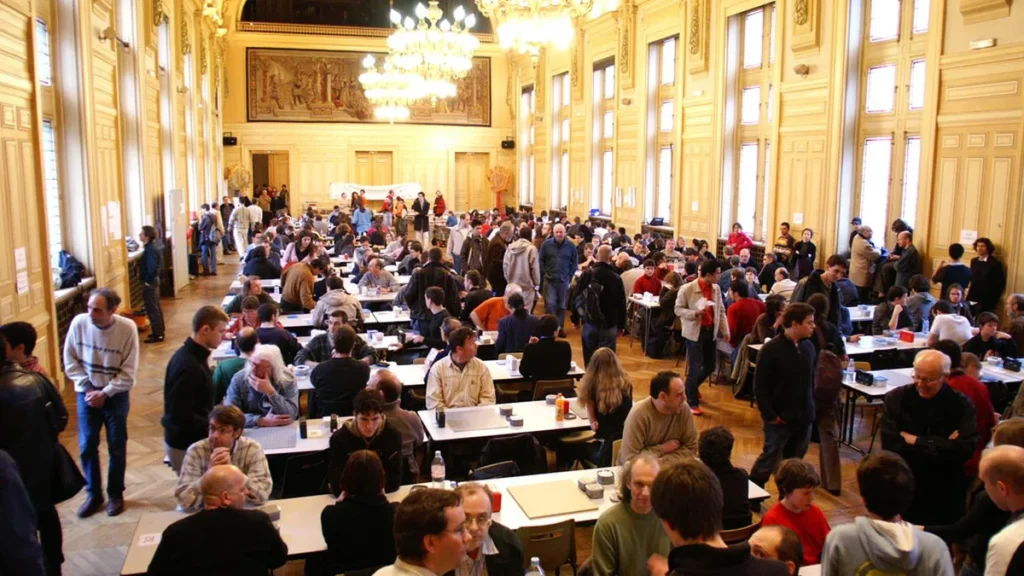
Four hundred and seventy-seven players sounds like a crowd that no dice game could ever hold together, yet the trick is not to play one giant game at all. You split the room into small tables, give every table the same simple rules, and let the dice do the talking. The whole hall fills with the sound of dice rolling at the same time. That is what makes a night like this work, and it is why a school theme fits it so well.
A school day is easy to picture, easy to explain, and easy to cheer for. Everyone in the room knows what a backpack, a lunchbox, a school bus, and a chalkboard look like, even if they left school years ago. When a roll of the dice becomes a race at recess or a trip on the school bus, players understand the game in seconds and start shouting for their table before the first round is over. The school theme gives every game a clear picture, so the host needs no long speeches.
This guide gives you nine dice games built around the school day, each one made for a table of four to six players and quick to learn. You will find a setup plan, a table that sums up all nine games, full rules for every game, a scoring system for 477 players, a checklist, and answers to the questions every host asks first. Set the tables, hand out the dice, and let the games begin.
Key Takeaways
- Split 477 players into tables of four to six, with every table playing the same nine school games in the same order.
- Use the school day as the theme because every player can picture a backpack, a lunchbox, a school bus, or a chalkboard without a long explanation.
- Give every table the same kit of dice, score cards, and pencils so no table has an unfair edge.
- Keep every round short, with a clear winner at each table, and move the whole room on together with a bell or a whistle.
- Score by table points, not by single rolls, so the night stays fair and the final result stays close until the end.

The 9 Games at a Glance
The table below sums up all nine school games. Every game takes about ten minutes at a table, so a full round of nine games fits into an evening with time left for a break in the middle.
| Game | Players at a table | You need | Round length |
|---|---|---|---|
| Dice Backpack Pack | 4 to 6 | Two dice and a score card | About 10 minutes |
| Dice Recess Race | 4 to 6 | Three dice and a score card | About 10 minutes |
| Dice Lunchbox Trade | 4 to 6 | Two dice and a score card | About 12 minutes |
| Dice School Bus Ride | 4 to 6 | Two dice and a score card | About 10 minutes |
| Dice Homework Dash | 4 to 6 | Three dice and a score card | About 10 minutes |
| Dice Field Trip | 4 to 6 | Two dice and a score card | About 10 minutes |
| Dice Morning Assembly | 4 to 6 | Three dice and a score card | About 12 minutes |
| Dice Report Card | 4 to 6 | Two dice and a score card | About 10 minutes |
| Dice Chalkboard Draw | 4 to 6 | Two dice and a score card | About 10 minutes |
How to Set Up the Night for 477 Players
Start by counting tables, not players. With 477 players and tables of five, you need about 96 tables, and a few tables will seat four or six so that nobody is left out. Lay the tables out in rows with a clear aisle down the middle, so the host can walk the room and every table can hear the bell. Put a small school sign on each table, so players can find it fast.
Give every table the same kit before anyone sits down. Each kit holds two or three dice, a stack of score cards, pencils, and a one-page sheet with the nine games in order. With the same kit everywhere, the host can start all nine games with one short announcement. Keep a spare box of dice and pencils at the front of the room, because dice roll off tables and pencils go missing in every large game night.
Run the night in rounds, and keep the whole room together. The host calls the start of each game, walks the room while tables play, and then rings a bell to end the round. Tables write down their winner, pass the score card to the next game, and wait for the next call. This shared rhythm is what turns 477 separate players into one room playing together, and it is the same rhythm that works in the dice games for 475 players built around animals, where the same table plan keeps a huge crowd in step.
The 9 School Dice Games
Dice Backpack Pack
Dice Backpack Pack opens the night, and it is the simplest game on the list. Each player rolls two dice and adds the total, and the backpack is said to be packed when the total is seven or higher. A player who rolls seven or more scores one point and rolls again, while a player who rolls six or less passes the dice to the next player. The round ends after five rolls each, and the most points wins the table.
The fun of this game is the way a low roll can end a hot streak in a single throw. A player who has scored four points in a row can roll a three and a two and lose the dice at once, and the whole table groans together. A high roll packs the bag, a low roll leaves it half empty.
Dice Recess Race
Dice Recess Race turns three dice into a dash across the playground at break time. Each player rolls three dice and looks for a pair, because a pair means the player has found a shortcut across the yard. A pair scores two points, three of a kind scores five points, and a roll with no match scores nothing and ends the turn. Six rolls each, and the highest score wins.
This game rewards patience, because a player who rolls badly early can still catch up with one strong roll late in the round. The recess theme works well here because everyone remembers the rush to get outside when the bell rang, and the game turns that rush into a roll of the dice.
Dice Lunchbox Trade
Dice Lunchbox Trade is a short trading game, and it is the longest game in the set at about twelve minutes. Each player rolls three dice and uses the three numbers to trade snacks at lunch: a one trades an apple, a two trades a sandwich, a three trades a biscuit, a four trades a juice box, a five trades a yoghurt, and a six trades a chocolate bar. A full set of three different snacks scores five points, while three of the same snack scores only two.
Players must decide whether to keep what they rolled or to reroll one die and risk losing a snack they already have. That choice is the heart of the game, and it gives careful players a real edge over players who reroll everything. Play five turns per player, add up the trading points, and the player with the highest total wins the table. The lunchbox theme is easy to explain because everyone has swapped food at lunch, and the snacks give every roll a small story.
Dice School Bus Ride
Dice School Bus Ride is the loudest game of the night, and it suits tables that like a little noise. Each player rolls two dice, and a total of nine or more means the player has caught the bus and scores one point. A total of four or less means the bus drove off, the player scores nothing, and the next player rolls at once. Any total in between means the bus is still at the stop, and the player rolls one die again.
The second roll is where the ride gets tense, because a roll of four or more on that single die catches the bus, while a lower roll lets it drive away for good. Play six rounds per player, add up the points, and the player with the most caught buses wins the table.

Dice Homework Dash
Dice Homework Dash asks players to finish their homework with three dice, and it is a calm game after the noise of the bus ride. Each player rolls three dice and adds the total, and that total is the number of questions finished in that turn. A roll of three ones is a blank page and wipes out the questions finished in that turn, while a roll with all three dice showing four or more is a perfect evening and doubles the turn total.
Players keep a running total of questions across five turns, and the player with the most questions at the end wins the table. The score card has one column per turn, so players can watch their homework pile shrink. The homework theme also gives the host a natural way to talk about the round: a blank page hurts, a perfect evening helps, and steady work wins more often than lucky guessing.
Dice Field Trip
Dice Field Trip is a game of timing, and it works best when the whole table plays along. Each player rolls two dice, and a total of exactly eight reaches the museum and scores three points. Any other total scores nothing, but doubles earn another roll. The round ends when every player has rolled eight times, and the player with the most points wins.
The low chance of hitting exactly eight keeps the scores close and the tension high, because one lucky trip can change the table in a single roll. Ask players to tap the table when they hit eight, so the room hears the wins happening around them.
Dice Morning Assembly
Dice Morning Assembly is the singing game of the set, and it takes about twelve minutes because players have choices to make on every turn. Each player rolls three dice and uses the three numbers to pick songs for assembly: a one picks a marching song, a two picks a quiet song, a three picks a clapping song, a four picks a round, a five picks a hymn, and a six picks a farewell song. Three different songs score five points, while three of the same song score only two.
Players must decide whether to keep what they rolled or to reroll one die and risk losing a song they already have. That choice is the heart of the game, and it gives careful players a real edge. Play five turns per player, add up the assembly points, and the player with the highest total wins the table. The assembly theme is easy to explain because everyone has stood in a school hall in the morning, and the songs give every roll a small story.
Dice Report Card
Dice Report Card is a game of standing firm while the dice try to knock your grades down. Each player rolls two dice, and a total of six or less means the grades hold and the player scores one point. A total of nine or more means the grades have slipped, the player scores nothing, and the turn passes on. Seven or eight means the grades wobble, and one more die decides it: three or more steadies them for one point, less knocks them down.
The wobble roll is what makes this game fun, because a player who is one point behind can catch up with a steady report card at the last moment. Play seven rounds per player, with the scores where everyone can see them. The report card theme is a good fit for a school night because the report card is the quiet record of the term, and this game asks players to keep it steady just as a good student does.
Dice Chalkboard Draw
Dice Chalkboard Draw closes the set with a simple race to fill the board. Each player rolls two dice and adds the total to their drawing, and the first player to reach fifty wins the table. A roll of doubles adds a bonus of five to the drawing, which can turn a close race into a sudden win, while a roll of two ones wipes the board and takes ten away from the total. The game ends as soon as one player reaches fifty.
Keep the total on the score card, so players can see how full their board is. A player on forty-five who rolls doubles will win on the spot, and the table will cheer the finish even if they were losing a moment before. The chalkboard theme rounds off the school night nicely, because it takes the players from the backpack at the start to a full board at the end, and it leaves the room in a good mood for the final scores.
How to Score 477 Players
Score by table points, not by single rolls. The winner of each game at a table earns five table points, the second player earns three, and the third earns one, while the rest earn none for that game. After nine games, each table adds up its points and sends its top two players to the room leaderboard, which the host reads out at the end of the night. This keeps the night fair: one lucky win cannot decide the evening, and a steady player can still reach the top.
Tiebreaks are simple and quick. If two players finish level on table points, the player who won more individual games goes ahead, and if they are still level, they roll one die each and the higher roll wins. The host should settle ties at the table, not at the front of the room, so the final leaderboard can be read out without delay. A similar points system keeps the sports-themed dice games for 474 players fair for a crowd of almost the same size, and it works just as well here with a school theme.
Your Checklist for the Night
- Count the tables first, then seat four to six players at each one, with a school sign on every table.
- Pack a kit for each table with dice, score cards, pencils, and the nine games in order.
- Keep spare dice, pencils, and score cards at the front of the room for the whole night.
- Ring a bell or blow a whistle to start and end every round, so all tables move together.
- Write down each table winner before the next game starts, and check the scores twice.
- Read out the room leaderboard at the end, and thank every table for playing.
Frequently Asked Questions
How long does the whole night take?
The nine games take about ninety minutes of play, with a short break in the middle and time for the final scores at the end. Plan for two hours from the first roll to the last announcement.
What if a table has only three players?
A table of three works fine, because every game in this set is built for four to six players and plays just as well with three. The rounds move faster, so the host should let small tables play an extra round of their favourite game while they wait for the bell, and the scoring stays the same.
Do we need a lot of dice?
You need two or three dice per table, which means about two hundred dice for 96 tables, plus spares. Buy the dice in bulk and count them into small bags before the night, one bag per table, so setup takes minutes instead of half an hour.
Can children play these school games?
Yes, the school games suit children aged eight and up, because the rules are short and the theme is familiar. Seat younger players with an adult at first, and let them keep their own score card, because children enjoy the school pictures and the simple adding as much as the game itself.
What happens if a die rolls off the table?
A die that rolls off the table does not count, and the player rolls again. Put a tray or a shallow box on each table if you can, because it catches stray dice and keeps the game moving without players crawling under tables all night.
Can we play only some of the nine games?
Yes, you can play any five or six of the nine games and still have a full evening, but keep the order the same and skip whole games rather than cutting rounds short. The nine games are built to work as a set, and the circus-themed dice games for 473 players use the same idea, with a full set of nine games that a host can shorten by dropping games, not rounds.
The Bottom Line
Nine school games, ninety minutes, and 477 players who all roll at the same time: that is the whole plan. Split the room into small tables, give every table the same kit, keep the rounds short, and score by table points so the night stays fair to the end. The school theme does the rest, because a backpack, a lunchbox, and a school bus need no long explanation, and every roll has a picture behind it. Set the tables, ring the bell, and let the dice do the work.