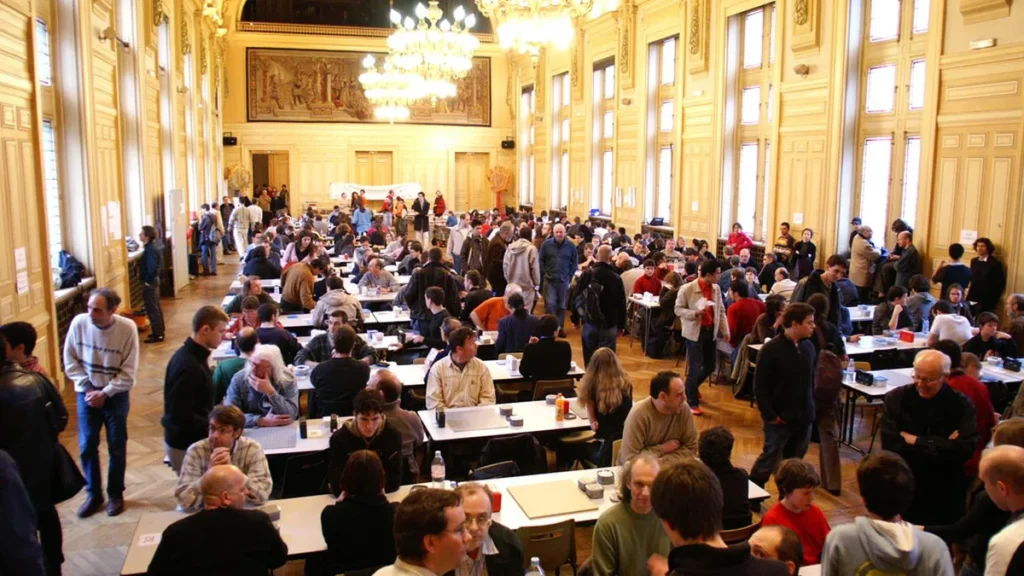
Four hundred and seventy-seven players is not a crowd you can wing. It is a small town hall, a school gym full to the rafters, or a company away day that has swallowed the whole building. When that many people sit down to play trivia at once, the quiz itself has to do the heavy lifting: the rounds must be clear, the questions must land for everyone from teenagers to grandparents, and the scoring has to survive contact with nearly five hundred answer sheets.
This guide builds a full trivia night for 477 players around nine rounds, and every round is built on one idea: famous people who made things with their hands. Famous taxidermists, famous cobblers, famous dyers, famous tanners, famous potters, famous silversmiths, famous thatchers, famous farriers and famous wheelwrights. The theme is narrow enough to feel clever and wide enough that every table will know at least a few answers. Nobody needs a degree in craft history to play.
Below you will find the format that keeps a room this size moving, a table of all nine rounds, a full write-up of each round with sample questions you can use as they stand, a short checklist for the night itself, and answers to the questions hosts ask most often. If you want a slightly smaller night first, the Best Trivia Games for 475 Players set is a good warm-up, because it uses the same team sizes and the same scoring rhythm. Run the rounds in order and keep the pace brisk.
Key Takeaways
- Nine rounds, one theme: every round celebrates famous makers, from taxidermists to wheelwrights, so the night feels connected rather than random.
- Split 477 players into teams of six, about eighty teams, and score by round so a slow start never ends a team’s night.
- Ask ten questions per round, worth one point each, with one bonus question per round for the teams that know their craft history.
- Read every question twice, keep each round under twelve minutes, and use a picture round in the middle.
- Print one answer sheet per team per round, and announce the running scores after rounds three, six and nine.
The Nine Rounds at a Glance
The table below is the whole night on one page. Each round has ten questions and one bonus, so the maximum score for the night is ninety-nine points, and ties are broken by the bonus answers.
| Round | Category | What the Round Covers |
|---|---|---|
| Round 1 | Famous Taxidermists | The artists who preserved animals for museums |
| Round 2 | Famous Cobblers | The shoemakers who dressed the world |
| Round 3 | Famous Dyers | The colour makers, from purple to mauve |
| Round 4 | Famous Tanners | The leather workers behind every saddle and shoe |
| Round 5 | Famous Potters | The clay artists, from Wedgwood to modern studios |
| Round 6 | Famous Silversmiths | The silver workers, from Paul Revere onwards |
| Round 7 | Famous Thatchers | The roofers who kept the rain out with straw |
| Round 8 | Famous Farriers | The smiths who shod the horses |
| Round 9 | Famous Wheelwrights | The wheel makers who kept the carts rolling |
How to Run a Trivia Night for 477 Players
With 477 players, the room is the challenge, not the questions. Put eighty teams of six at long tables, with six players to a team and three spare seats held back for late arrivals and for the teams that turn up with five. Give every team a number, write it large on a card at the end of their table, and use that number on every answer sheet. Numbers are faster than team names when eighty sheets come in at once.
Sound matters more than decoration. One speaker at the front will not reach the back of a hall this size, so add a second set of speakers for the far end and test the microphone from the last row before anyone arrives. Print the questions on a screen as well as reading them aloud, because a room of 477 always has people who missed a word. The Best Trivia Games for 472 Players guide uses the same hall layout and the same team numbering, and it is worth reading if this is your first night at this scale. Keep the breaks short, and never let the gap between rounds stretch past five minutes.
Round 1: Famous Taxidermists
Taxidermy is the art of making a dead animal look alive again, and the great taxidermists were artists first and scientists second. Carl Akeley, often called the father of modern taxidermy, built the lifelike animal groups that still fill the American Museum of Natural History in New York. Martha Maxwell, working in Colorado in the 1870s, was one of the first women to make a living from taxidermy, and her lifelike displays drew crowds at exhibitions in Philadelphia. Rowland Ward, the London taxidermist, supplied the great houses of Britain and published the record books that big game hunters treated as bibles.
Good questions for this round ask teams to name the museum, the animal, or the maker. Ask which museum holds Akeley’s African Hall, or which London firm published the Records of Big Game. Mix one easy question with one hard one, such as the year Akeley’s hall opened, and the room will want the next question as soon as the last one lands.
Round 2: Famous Cobblers
Cobblers repair shoes, but the famous names in this round are the shoemakers who turned a trade into an art. Salvatore Ferragamo began by making shoes for film stars in Hollywood and ended up dressing the feet of half the famous women in the world. Manolo Blahnik, the Spanish designer, made the high heel a fashion statement in its own right. Jimmy Choo, who learned his trade from his father in Malaysia, built a brand that red carpet regulars now treat as a first choice rather than a luxury.
Ask teams to match the designer to the famous wearer, or to name the country where each maker learned the trade. A good bonus question asks which saint is the patron saint of shoemakers and cobblers, and the answer, Saint Crispin, surprises almost every room. Keep the questions about shoes people can picture, because a room remembers a famous pair of shoes far longer than it remembers a date.
Round 3: Famous Dyers
Before chemistry, colour was a trade secret, and dyers guarded their recipes like gold. The most famous dye in the ancient world was Tyrian purple, made from sea snails by the dyers of Phoenicia, and it was so costly that only emperors and kings could afford it. Indigo, the deep blue dye, was traded across continents for centuries. Then, in 1856, an eighteen-year-old student named William Henry Perkin tried to make a medicine from coal tar and made a purple dye instead, and mauve became the first synthetic colour.
This round works well as a mix of history and science. Ask which sea creature gave Tyrian purple its colour, ask which country supplied most of the world’s indigo, or ask how old Perkin was when he discovered mauveine. The bonus question can ask teams to name the colour that Perkin’s dye made fashionable, and the answer, mauve, is one of those words that everyone has heard and almost nobody can spell under pressure.
Round 4: Famous Tanners
Tanners turn animal hides into leather, and without them there would be no saddles, no belts, no shoes and no book bindings. The tanneries of Fez in Morocco are among the oldest working tanneries in the world, and the great stone vats of dye and lime there have been photographed so often that most players will recognise them from a picture alone. In America, the Horween Leather Company of Chicago, founded by Isadore Horween in 1905, still makes the leather used for American footballs.
Questions here can be about the process as much as the people. Ask what oak bark was used for in traditional tanning, ask which Moroccan city is famous for its leather vats, or ask which company makes the leather for the American football used in the professional game. Vegetable tanning, which uses tannin from bark and leaves, is the oldest method in the trade, and a picture of the Fez vats makes a strong picture round question too.
Round 5: Famous Potters
Pottery is one of the oldest crafts in the world, and its famous names stretch from factories to village studios. Josiah Wedgwood, working in Staffordshire in the eighteenth century, turned pottery into an industry and made his jasperware famous across Europe. Bernard Leach, who studied pottery in Japan and settled in St Ives in Cornwall, brought Eastern ideas about simple, honest pots to British studios. Lucie Rie, who fled Vienna for London, made thin, elegant pots that collectors prize, and Maria Martinez of San Ildefonso Pueblo in New Mexico revived the black-on-black pottery of her people.
Ask teams to match the potter to the place, or to name the material that Wedgwood made famous. A strong bonus question asks which modern potter, Grayson Perry, won the Turner Prize in 2003 with his decorated vases, a fact that links this old craft to living artists. Pottery questions also work well with pictures, because a Wedgwood vase and a Martinez blackware pot look nothing alike, and teams that cannot name the maker can often name the style.
Round 6: Famous Silversmiths
Paul Revere is remembered for a midnight ride, but his day job was silversmithing, and his silverware is among the most famous American silver ever made. Hester Bateman, working in London in the late eighteenth century, ran one of the most successful silver workshops of her time at a moment when very few women ran businesses at all. Georg Jensen, the Danish silversmith, turned silver into modern design, and his Copenhagen workshop made clean silverware that is still collected today.
This round suits questions about objects as well as people. Ask what Paul Revere did for a living before his famous ride, ask which Danish designer gave his name to a silver company, or ask what metal, besides silver, a silversmith usually works with. The bonus question can ask teams to name the famous American silversmith whose name is also on a brand of silverware sold in shops today, and the answer, Tiffany, opens a discussion about Charles Lewis Tiffany, who founded the firm in 1837.
Round 7: Famous Thatchers
Thatching is the craft of roofing a building with straw, reed or heather, and it is one of the oldest building trades in Britain. A good thatched roof can last fifty years. The Globe Theatre in London, rebuilt in the 1990s, has the only thatched roof allowed in the city since the Great Fire of London in 1666, and it needed special permission because thatch had been banned as a fire risk. That single fact makes a wonderful quiz question, because almost everyone has seen the Globe and almost nobody knows about its roof.
Ask teams to name the three main materials used for thatching, ask which London theatre has a thatched roof, or ask how long a well-made thatched roof can last. The bonus question can ask what a thatcher uses to fix the straw in place, and the answer, a hazel spar, is a lovely piece of craft vocabulary that most players will never have heard.
Round 8: Famous Farriers
Farriers are the smiths who shoe horses, and their work sits exactly where blacksmithing meets animal care. A farrier trims the hoof, shapes a horseshoe on the anvil, and nails it in place. The Worshipful Company of Farriers in London, one of the city’s old trade guilds, still sets the standards for the trade and runs the examinations that working farriers must pass. The farriers of the Royal Mews, who shoe the horses that pull the royal carriages, are among the most famous working farriers in Britain.
Questions for this round can ask what tool a farrier uses to trim a hoof, ask which London guild governs the trade, or ask how many shoes a horse normally wears. The bonus question can ask teams to name the metal that horseshoes are usually made from, and the answer, steel, is easy enough to keep the round friendly.
Round 9: Famous Wheelwrights
Wheelwrights made the wheels that carried the world before the motor car, and their craft was a trade in its own right. A cart wheel is not one piece of wood but many: the spokes, the felloes that form the rim, and the iron tyre that is heated, fitted over the rim and shrunk tight as it cools. George Sturt recorded the trade in his 1923 book The Wheelwright’s Shop, a classic account of a village wheelwright’s yard. The last traditional wheelwrights worked in villages where a broken wheel could stop a farm for a week.
Ask teams to name the parts of a wheel, ask who wrote The Wheelwright’s Shop, or ask what happens to an iron tyre when it cools after being fitted. The bonus question can ask teams to name the trade that made wheels for coaches and carts, and the answer, wheelwright, is a word that many players will know without ever having used it.

Hosting Checklist for the Night
Use this list on the day itself, and do not leave the sound check until the doors open.
- Count the answer sheets: eighty team sheets per round, plus ten spares, with the team number printed at the top of each one.
- Test the microphone and the speakers from the back row, and put the questions on a screen so nobody has to rely on hearing alone.
- Brief the scorers before the first round, and give them a worked example of a marked sheet so every round is scored the same way.
- Put the running scores on display after rounds three and six, because a room that can see the table plays harder in the second half.
- Keep a spare set of pens, a spare microphone battery and a printed copy of the answers in a sealed envelope with the host.
- Plan the tie-break before the night starts, and write it on the host’s card so a tie at the top never turns into an argument.
Frequently Asked Questions
How long does a trivia night for 477 players take?
Plan for about two and a half hours, including breaks. Nine rounds of ten questions take roughly twelve minutes each when the host reads every question twice, and three short breaks of five minutes keep the room fresh. Add fifteen minutes at the start for seating and team numbers, and ten minutes at the end for the final scores and the prize.
How many teams should 477 players form?
Teams of six work best, which gives about eighty teams and leaves three players to place as spares or to join a team of five. Six is small enough that everyone gets a say and large enough that every table has a spread of knowledge. If a team arrives with seven, let them play as seven rather than splitting friends apart.
What happens if two teams tie at the top?
Use the bonus answers first, because every round has one bonus question and the team with the most bonus points wins the tie. If the bonus answers are also level, ask a single sudden-death question, and the first team to write the correct answer on a card wins.
Can children play in a trivia night this size?
Yes, and they often do well, because the craft rounds reward curiosity rather than age. Seat family teams near the front so the younger players can hear clearly. The Best Trivia Games for 471 Players night is run the same way and works well for family teams too.
Do we need a picture round for 477 players?
A picture round helps a great deal at this size, because it gives the host’s voice a rest and gives the scorers time to catch up. Hand out one picture sheet per team in the middle of the night, with ten pictures of famous workshops, tools and finished pieces, and collect it with the next round. Ten points are at stake, which is enough to matter without deciding the night on its own. Print the pictures large, because a small image at the back of a hall is no use to anyone.
What prizes work best for a night this big?
Keep the prizes simple and shared, because eighty teams cannot all win something. A small trophy or a hamper for the winning team, a bottle or a book token for the runners-up, and a small prize for the team in last place, which is the traditional wooden spoon, will cover the night. Announce the last-place prize early, because teams at the bottom play harder when there is something to win for coming last. Avoid cash prizes, because they change the mood of the room.
The Bottom Line
A trivia night for 477 players works when the format is simple, the rounds are connected, and the questions reward curiosity. Nine rounds of famous makers give the night a shape that players can follow. Keep the teams small, keep the scoring visible, and keep the host’s voice reaching the back row.
Run the rounds in order, use the sample questions as they stand or swap in your own, and finish with the wheelwrights, the makers who kept the world rolling. If the room is still talking about the thatchers and the silversmiths on the way home, the night has done its job.