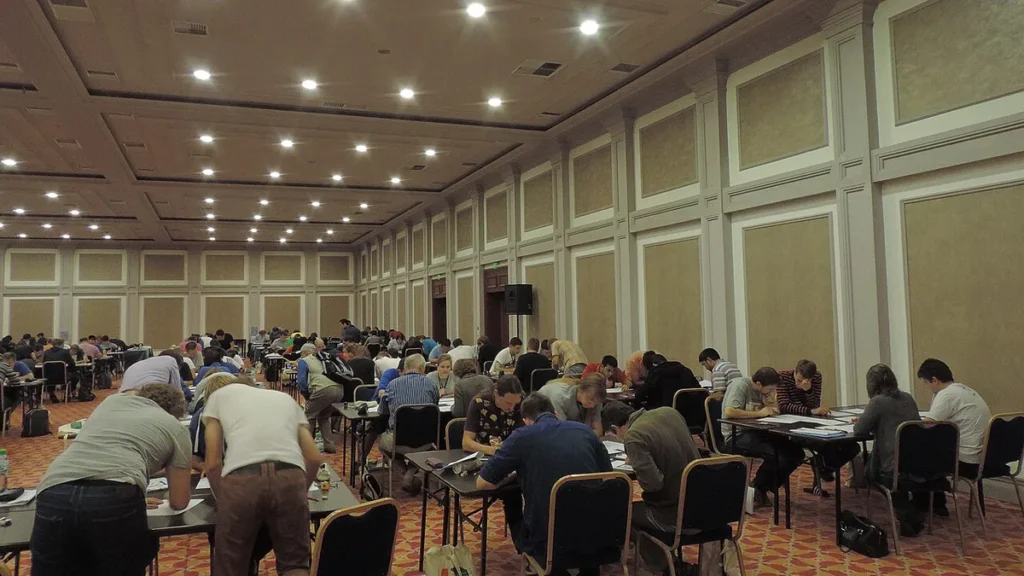
Finding word games for 199 players sounds impossible at first. Most word games are built for a table of four or six people, not for a hall full of nearly two hundred players. The good news is that word games scale better than almost any other party game, because words cost nothing, need no special equipment, and can be played by whole teams at once.
The secret is to stop thinking of 199 individuals and start thinking in teams. Split the crowd into ten teams of about twenty, or twenty teams of about ten, and suddenly every classic word game becomes playable again. Each team works together on the same puzzle, while a host keeps the pace moving and a scoreboard keeps the competition alive. These games suit large halls, school assemblies, company events, church gatherings, and community parties where the guest list is huge and the fun still has to feel personal.
This guide covers twelve word games that suit a crowd of 199, with clear rules, the supplies you will need, and tips for running them without chaos. You will also find a comparison table, a setup checklist, and answers to the questions organisers ask most often.
Key takeaways
- Word games for 199 players work best in teams of ten to twenty, with a host and a visible scoreboard.
- Choose games with simultaneous play, such as word bingo, anagram hunts, and crossword races, so nobody waits long.
- Prepare printed answer sheets, pens, and a microphone in advance, because a crowd this size needs clear instructions.
- Mix quick rounds with longer team challenges to keep energy high and give every team a chance to win.
- Keep scoring simple, with points for correct answers and small bonuses for speed and creativity.

Why Word Games Work So Well for 199 Players
Word games have three advantages for very large groups. First, they need almost no equipment: printed sheets, pens, and letter cards can serve an entire hall, which keeps costs low. Second, they suit mixed ages and abilities. A ten-year-old and a seventy-year-old can both contribute to a team anagram, because different people are good at different kinds of words.
The main challenge is attention. In a hall of 199, players at the back can drift away if nothing involves them for several minutes. That is why the best large-group word games use simultaneous rounds, where every team works on the same task at the same time. When all twenty teams race to solve the same crossword clue, the whole room buzzes.
How to Run Word Games for 199 Players
Divide the crowd before the games begin. Ten teams of twenty work well for team challenges, while twenty teams of ten suit faster games. Give every team a name, a colour, or a number, and hand each captain a pack with answer sheets, pens, and a scorecard. Ask teams to sit together so they can talk quietly, and leave a clear aisle down the middle so the host and helpers can move around and collect sheets.
Keep rounds short and the pace brisk. A round of five to eight minutes holds attention far better than one long forty-minute game, and short rounds let you fit several games into one session. Explain each game in under a minute, show one example on the screen, and start the timer straight away. Many organisers find that a similar format works just as well with a slightly smaller crowd, and the ideas in our roundup of word games for 197 players show how the same team structure adapts when two fewer players are in the room.
Scoring should be simple enough for helpers to mark quickly. Award one point per correct answer, with a small speed bonus for the first three teams to finish correctly. Avoid complicated systems that need a calculator, because marking 199 answer sheets already takes time. A microphone and speakers are essential, and a projector helps everyone see clues and scores.
Team Formats That Work Best
The relay format suits active groups: players take turns running to the front, writing one word on the board, and tagging the next player. The tournament format suits calmer events: teams play in heats, the winners advance, and the final is played on stage. The simultaneous format suits the biggest halls, because every team plays at once and no time is lost waiting.
Best Word Games for 199 Players
The twelve games below start with the easiest to run and move toward games that need a little more preparation. Every game can be played by 199 players in teams, needs only simple supplies, and keeps the whole room involved.
| Game | Best for | Time per round | Supplies needed |
|---|---|---|---|
| Word Relay Race | Energetic groups | 10 minutes | Whiteboard, markers |
| Giant Anagram Hunt | All ages | 8 minutes | Printed letter sets |
| Word Bingo | Quiet warm-up | 15 minutes | Bingo cards, pens |
| Spelling Bee Tournament | Competitive players | 20 minutes | Word list, microphone |
| Crossword Race | Team thinking | 12 minutes | Printed crosswords |
| Word Chain Challenge | Quick rounds | 6 minutes | Answer sheets |
| Guess the Word | Mixed ages | 10 minutes | Clue cards |
| Team Scrabble Boards | Word lovers | 15 minutes | Letter tiles, boards |
| Word Search Race | Calm play | 10 minutes | Printed word searches |
| Hangman Tournament | Stage finals | 12 minutes | Whiteboard, word list |
| Taboo Team Game | Laughs and energy | 10 minutes | Word cards, timer |
| Categories Challenge | Creative thinking | 8 minutes | Answer sheets, timer |
1. Word Relay Race
Each team lines up behind a starting line, and the host calls out a category such as animals, food, or countries. The first player from each team runs to the board, writes a word from that category, and runs back to tag the next player. Teams score one point for every correct, unique word, and lose a point for a repeated or off-category word. Set up one board per five teams, keep each relay to about ten minutes with two categories, and rotate the running order so the same fast players do not always go first.
2. Giant Anagram Hunt
Every team receives the same long word, such as CELEBRATION or FRIENDSHIP, and has eight minutes to find as many smaller words hidden inside it as possible. Teams score one point per valid word, with a bonus point for the longest word found. Younger players can find short words such as cat, pin, and fun, while older players hunt for longer words such as brace, talent, and creation. Print the letters large on each table, collect the sheets when the timer ends, and let teams swap sheets and mark each other while the host reads out the answers.
3. Word Bingo
Each bingo card shows words from a theme such as nature, food, or travel. The host reads out definitions or clues, and teams mark the matching word on their card. The first team to complete a row, column, or full card shouts bingo and wins the round. Because every team plays at the same time, nobody waits, and even players who arrive late can join in straight away. Print at least two different card designs per team so teammates can help each other without copying, and read each clue twice so players at the back can hear.
4. Spelling Bee Tournament
Teams take turns sending one speller to the microphone, the host reads a word and uses it in a sentence, and the speller must spell it correctly to earn a point. If a speller makes a mistake, the next team gets a chance at the same word. Run the early rounds in heats so every team gets several turns, then bring the top teams to the stage for a grand final. Prepare a word list with three levels of difficulty, from common words such as friend and garden, through medium words such as rhythm and separate, to hard words such as onomatopoeia and conscientious.
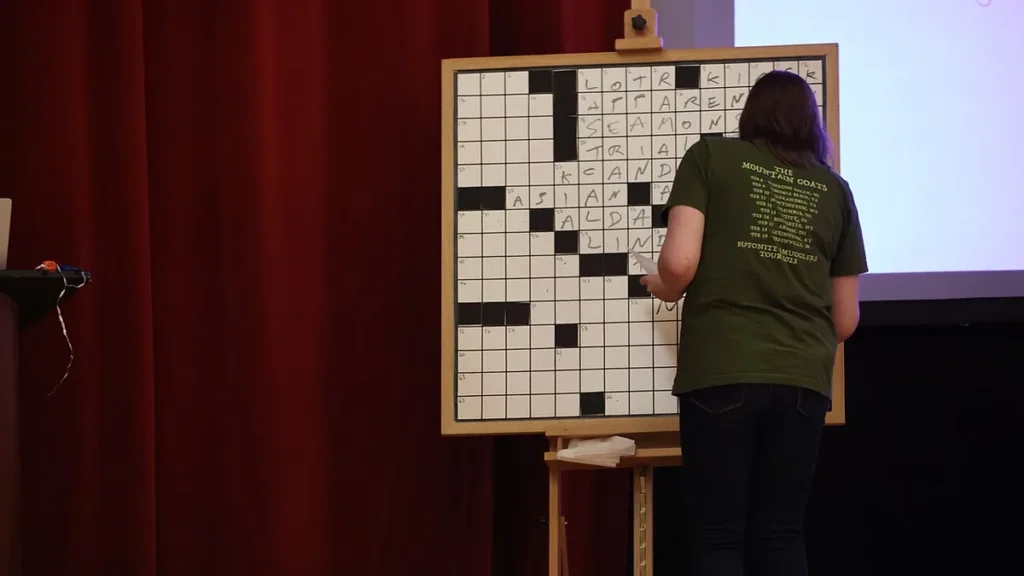
5. Crossword Race
Every team receives the same printed crossword and works together to finish it before the other teams. Award one point per correct answer, with a bonus for the first three teams to hand in a fully correct grid. A crossword with twenty to thirty clues takes most teams about twelve minutes. Choose a themed crossword that matches your event, print it large enough for several people to read at once, and print the clues on a separate sheet so teams can pass them around while one person writes in the answers.
6. Word Chain Challenge
The host gives a starting word, such as apple, and each team must write a chain where every word starts with the last letter of the previous word: apple, elephant, tiger, rabbit, and so on. Teams have six minutes to build the longest correct chain they can, scoring one point per word, with a bonus for chains that use no repeated words. The game is easy to explain and surprisingly hard to master, because teams must think ahead and avoid words that end in difficult letters such as x or q.
7. Guess the Word
Each team chooses a describer, who draws a card, reads the secret word silently, and gives clues while the team shouts guesses. The team scores a point for every word guessed correctly within a minute, then passes the cards to a new describer. Prepare clue cards in advance, with easy words such as bicycle and rainbow for younger players, and harder words such as telescope and avalanche for older ones. Organisers who enjoy this style often find that a similar team guessing format also works in a trivia game for 199 players, where teams answer questions together under the same time pressure.
8. Team Scrabble Boards
Each team shares a large board or a printed grid, and takes turns placing words from a shared pool of letter tiles. Teams score points for each word they place, with double points for words that use all seven tiles or cross an existing word. You do not need 199 Scrabble sets: print large blank grids, cut letter tiles from card, and give each team a bag of tiles to share. A simpler version drops the official rules and simply asks teams to build the longest connected word grid they can, which is easier for younger players and faster to score.
9. Word Search Race
Every team receives the same printed word search, with twenty hidden words to find, and races to circle them all. The first teams to finish with every word found correctly win bonus points, while every team scores one point per word found. Word searches suit all ages, need no talking, and give tired players a restful round after energetic games such as the relay race. Choose a word search with a clear theme and a generous grid, so players can share the sheet and search different corners at the same time.
10. Hangman Tournament
The host draws the gallows on a whiteboard or screen, chooses a secret word, and teams take turns calling out letters. A correct letter is written in its place, a wrong letter adds a body part to the drawing, and the team that guesses the whole word wins the point. Run the early rounds at the tables with printed hangman sheets, then invite the top teams to the stage for a final in front of everyone. The format adapts neatly to other group sizes, and the structure here mirrors the team play in our guide to word games for 195 players, where the same stage final brings a big event to a close.
11. Taboo Team Game
Each card shows a target word and a list of forbidden words that the describer may not say. The describer must get the team to guess the target word without using any of the forbidden words, which leads to creative clues, wild gestures, and plenty of laughter. Teams score a point per correct guess, and lose a point if the describer slips and says a forbidden word. Make your own cards with words your audience knows well, such as birthday, with cake, candles, and party forbidden, or beach, with sand, sea, and sun forbidden.
12. Categories Challenge
The host announces a letter, such as M, and teams have eight minutes to write a word for each category: an animal, a food, a place, a job, a sport, and a film, all starting with M. Teams score one point per valid answer, with a bonus point for any answer no other team wrote, which rewards creative thinking over obvious answers. Prepare a fresh category sheet for each round, with six to eight categories and a different letter each time.
Scoring and Running a Tournament for 199 Players
Begin with three simultaneous games, such as word bingo, the anagram hunt, and the word search race, and award points to every team in each game. Add the scores after each round and display the running total on a screen, so teams can see where they stand. Then play two louder games, such as the relay race and the taboo game, before finishing with a stage final of hangman or the spelling bee, featuring the top four teams.
Checklist for Your 199-Player Word Game Event
Use this checklist in the week before your event, and tick off each item as you complete it, so nothing important is forgotten on the day.
- Divide 199 players into teams of ten or twenty, and prepare a team list with captains named in advance.
- Print answer sheets, bingo cards, crosswords, and word searches, with at least ten percent extra copies for spares.
- Test the microphone, speakers, and projector in the hall, and prepare a large visible scoreboard.
- Prepare a word list, answer keys, and a timer for every game, and brief your helpers on the rules.
- Pack pens, letter tiles, cards, prizes, and a whistle or bell, and set out tables with space for teams to talk.
- Plan the running order, with calm games between energetic ones, and a stage final to close the event.
Frequently Asked Questions
Can 199 players really play a word game at the same time?
Yes, when the game is played in teams. Split 199 players into ten teams of about twenty, or twenty teams of about ten, and give every team the same task at the same time. Games such as word bingo, anagram hunts, crossword races, and word searches work especially well, because every team plays simultaneously and nobody waits for a turn.
What is the best word game for a group of 199?
The word relay race is the best opener, because it gets everyone moving and laughing within minutes. For a calmer main game, the giant anagram hunt or the crossword race works best, since both reward teamwork and suit mixed ages.
How long should a word game session for 199 players last?
A session of ninety minutes to two hours works well, with four to six short games of eight to fifteen minutes each, plus time for introductions, scoring, and breaks. Shorter sessions of one hour can fit three games comfortably. Avoid a single game that lasts longer than twenty minutes, because attention fades in a large hall.
Do I need special equipment for 199 players?
No special equipment is needed beyond the basics: printed answer sheets, pens, a microphone and speakers, a timer, and a scoreboard or screen that everyone can see. Letter tiles, bingo cards, and word cards can be printed or made from card at low cost.
How do I keep scoring fair with so many teams?
Keep scoring simple: one point per correct answer, with a small bonus for the first teams to finish correctly. Prepare answer keys in advance, give each helper a set of teams to mark, and display the running totals after every round. Asking teams to swap sheets and mark each other while the host reads the answers is fast, transparent, and keeps everyone involved.
Can children and adults play these word games together?
Yes, and mixed-age teams often do best, because children are quick with short words and adults know longer and rarer words. Choose games with a range of difficulty, such as the anagram hunt and the categories challenge, where both short and long answers score. Mix ages within each team so every team has a balance of strengths.
The Bottom Line
Word games for 199 players work when you think in teams, keep rounds short, and choose games where everyone plays at the same time. Start with a lively relay to warm up the hall, follow with thinking games such as anagrams, crosswords, and categories, and finish with a stage final that the whole room can watch and cheer. Do that, and 199 players will not just play a word game together, they will remember it as one of the best parts of the day.