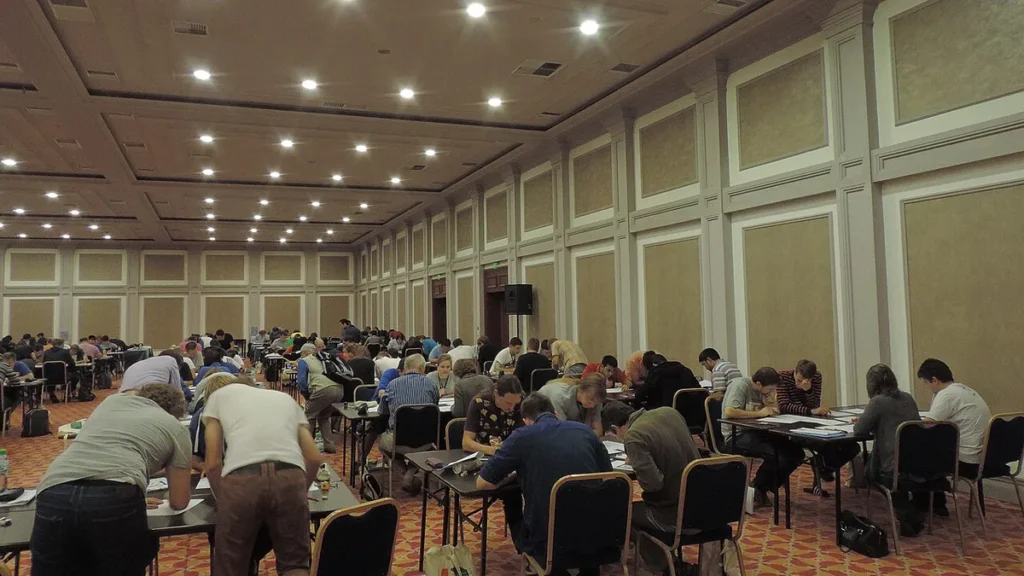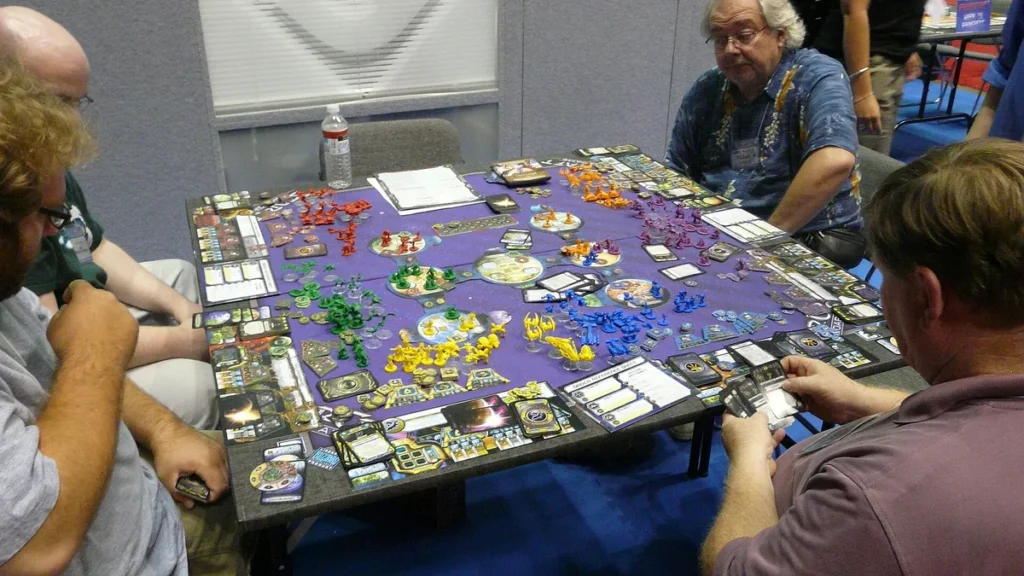
Four hundred and ninety-six players is not a game night. It is a small town, gathered in one hall, all expecting to play at the same time. One table cannot hold them, and one copy of one game cannot serve them. The only way it works is to stop thinking of a single game and start thinking of a system: many tables, many copies, and a short list of games that can run again and again without wearing out their welcome.
The good news is that board games are built for exactly this kind of problem. A game that seats four to six people becomes a building block. Put a hundred of those blocks side by side, give every table the same start time, and 496 people are all playing within ten minutes of the doors opening.
This guide gives you a complete setup plan for 496 players. You will find nine games that suit huge groups, a table plan that shows how many copies you need, a step-by-step setup routine, a short checklist, and answers to the questions every organiser asks first. Follow the plan, and your 496 players will spend the night playing, not waiting.
Key Takeaways
- 496 players need about 83 to 124 tables, depending on whether each game seats four, five, or six people.
- Pick games that teach in five minutes or less, so every table can start on time without a long lesson.
- Run three formats through the night: teams, stations, and a short tournament round.
- Buy or borrow many copies of a few games, rather than one copy of many games.
- Give every table a printed rules sheet and a named table host, so questions never have to travel across the hall.

How 496 Players Play Board Games Together
No single board game seats 496 people, and nobody should try to invent one. The working answer is always the same: split the crowd into tables of four to six, run the same game at many tables at once, and link the tables together with a shared scoreboard. A player only ever needs to know the five people at their own table. The organiser only ever needs to know how many tables are running and which game each one is playing.
Start every table at the same moment. A single start time is the one decision that keeps a hall of 496 people calm. If tables start whenever they feel ready, half the hall is still learning the rules while the other half is already asking what comes next. Pick a start time, announce it twice, and have the table hosts begin teaching five minutes before it. Late arrivals join the next round instead of holding up a table that has already begun. The plan in the 494-player board game guide uses the same three formats, and it works just as well at this size.
The Team Format
The team format is the simplest way to make 496 players feel like one event. Every table plays the same game, and the table’s total score counts as a team score. At the end of the round, the host reads out the top ten table scores, and the hall gets a shared result to cheer. Nobody needs to know the details of another table’s game. They only need to know whether their table beat the table next door.
Use the team format for the first round of the night. It is forgiving, because a table that plays badly still contributes a score, and nobody is knocked out. Keep the round to about forty-five minutes.
The Station Format
The station format keeps the night moving. Each table is a station with one game set up on it, and the players move while the games stay put. After forty minutes, a bell rings, players stand up, and each group walks to the next station. Nobody packs a game away, nobody carries a box across the hall, and the next round starts within two minutes.
Stations work best in the middle of the night, once everyone has played one full game and knows how the hall works. Set up nine stations, one for each game in this guide, and let groups rotate through three or four of them.
The Tournament Format
The tournament format gives the night a finish worth staying for. After two rounds, take the top two tables from each game and invite them to a short final round at the front tables. Everyone else keeps playing at their own tables, so nobody sits out and watches. The final is a spectacle, not a wait, and the rest of the hall can follow it on the scoreboard while their own games continue.
Keep the final short, no more than thirty minutes, and pick a game that is easy to follow from a distance. Announce the finalists by table number, not by name.
The 9 Games at a Glance
The table below gives the quick facts for all nine games. Use it to plan how many copies to buy and which games to teach first.
| Game | Players per table | Teach time | Why it works for 496 players |
|---|---|---|---|
| Flamecraft | 1 to 5 | 5 minutes | Warm, friendly theme and a gentle first round that welcomes new players |
| Earth | 1 to 5 | 5 minutes | Everyone acts on every turn, so nobody waits long between moves |
| Meadow | 1 to 4 | 5 minutes | Calm, pretty tableau building that suits mixed-age tables |
| Canvas | 1 to 5 | 3 minutes | Fast to teach and every finished painting feels like a small win |
| Apiary | 1 to 5 | 5 minutes | Clear worker placement with a lively theme that sparks table talk |
| Forest Shuffle | 2 to 5 | 4 minutes | Quick card combos and a short playing time that fits the station format |
| Harmonies | 1 to 4 | 4 minutes | Quiet, thoughtful tile laying that balances the louder games |
| Paleo | 2 to 4 | 5 minutes | A cooperative game where the whole table wins or loses together |
| Creature Comforts | 1 to 5 | 5 minutes | Dice, trading, and a cosy story that first-time players love |
Notice how short the teach times are. A game that needs twenty minutes of explanation cannot work at this scale, because a hundred tables would need a hundred teachers and a hundred patient audiences.
The 9 Best Board Games for 496 Players
Each game below earns its place for a different reason. Some are fast, some are calm, some are cooperative, and some are loud. Together they cover every kind of player in the hall, from the first-timer who has never held a playing piece to the regular who wants a real puzzle to solve.
1. Flamecraft
Flamecraft is a warm, welcoming game about artisan dragons working in a small town. Players gather goods, invite dragons into their shops, and enchant the town one street at a time. The theme does a lot of the teaching for you: everyone understands at once that a dragon who loves bread belongs in a bakery, and a dragon who loves iron belongs at the forge.
For a hall of 496, Flamecraft is the perfect first game. Its first round is gentle, its choices are clear, and its art makes new players smile before they have learned a single rule. Tables finish in about an hour, which fits the team format neatly. Put Flamecraft on the tables nearest the entrance.
2. Earth
Earth is a tableau-building game in which every player grows a small island of plants, animals, and landscapes. The clever part is that when one player takes an action, everyone else gets a smaller version of the same action, so the whole table stays involved on every turn. Nobody sits and waits while one person thinks.
That shared rhythm is gold at this scale. In a hall with a hundred tables, the games that stall are the ones where three people watch one person take a long turn. Earth keeps all five players touching the game at all times. The selection in the 492-player board game guide follows the same rule, favouring games where every player stays busy.
3. Meadow
Meadow is a calm, beautiful game about observing nature. Players collect cards showing plants and animals, build a little meadow in front of them, and score for the connections between the things they have found. The pace is unhurried, the choices are satisfying, and the finished tableau looks lovely on the table.
Every big night needs a quiet corner, and Meadow provides it. Put Meadow tables together in one area and they become the calm zone of the hall, where players who want a slower game can settle in. It suits mixed-age tables well.
4. Canvas
Canvas is a game about painting pictures by layering clear cards. Each card adds a shape, a colour, or a texture, and the finished painting scores for the elements it contains. The rules take three minutes to explain, the game takes about half an hour to play, and every player ends the game holding a small piece of art they made themselves.
Canvas is the fastest game in this guide to teach, which makes it ideal for the station format. A table can learn it, play it, and be ready to move on inside a single forty-minute slot, with time to spare.
5. Apiary
Apiary is a worker-placement game about spacefaring bees building a hive among the stars. Players send their bees out to gather resources, grow their hive, and develop new abilities, all while the hive itself slowly changes around them. The theme is unusual enough to start conversations, and the rules are clear enough that those conversations never slow the game down.
For a large hall, Apiary earns its place because it gives every table a game with real decisions in it. Experienced players will enjoy planning their hive, while new players can follow the simple rhythm of placing a bee, taking a resource, and building something with it.
6. Forest Shuffle
Forest Shuffle is a quick card game about building a woodland. Players draw cards, play trees, and tuck animals, plants, and fungi into the forest they are growing. The combinations are the joy of the game: a deer is worth more near a clearing, a mushroom is worth more near a tree, and the best forests are the ones where everything fits together.
This is the shortest full game in the guide, and that speed is exactly what the station format needs. A table can finish a game of Forest Shuffle in about forty minutes, including the teach, which means the rotation never slips behind schedule.
7. Harmonies
Harmonies is a thoughtful abstract game about building landscapes from coloured tokens. Players place tokens to form mountains, rivers, fields, and forests, then place animals into the habitats they have created. There is almost no luck in it, and every move is visible on the table, so players can watch a landscape grow and plan three moves ahead.
Harmonies balances the louder, busier games in this guide. It gives the hall a game for players who like to think quietly, and it plays beautifully at three or four players. The rules fit on one page, so a table host can teach it from the printed sheet.
8. Paleo
Paleo is a cooperative game about a Stone Age tribe trying to survive. Players explore, gather food, craft tools, and face dangers together, and the tribe either survives the night or it does not. Nobody competes with the person next to them. The whole table wins together or loses together, and that shared fate changes the feeling of the game completely.
A cooperative game is essential at this scale. In a hall of 496, some tables will have players who are nervous about competing, and some will have a wide gap in experience between the strongest and weakest player. Paleo removes that pressure entirely: the experienced player becomes a coach, and the new player becomes a valued teammate.
9. Creature Comforts
Creature Comforts is a cosy dice game about woodland animals preparing for winter. Players roll dice, send family members out to gather goods, trade at the market, and build comforts for their burrows before the snow arrives. The theme is gentle, the dice give every turn a little surprise, and the game is full of small, friendly decisions.
Creature Comforts closes the list because it is the game most likely to win over someone who thinks board games are not for them. The animals are charming, the rules are friendly, and the game is forgiving of mistakes, because a bad dice roll can usually be fixed with a good trade.
Setting Up 496 Players: The Practical Plan
Start with the tables. With 496 players and four to six players per table, you need between 83 and 124 tables. Plan for 100 tables of five, and you will have room for the tables that run short and the tables that run long. Lay the tables out in rows of ten, with a wide aisle down the middle, so helpers can reach any table in under a minute.
Next, count the copies. Nine games across 100 tables means about eleven copies of each game if you split the hall evenly. In practice, buy more of the quick games and fewer of the slow ones: fourteen copies of Canvas and Forest Shuffle, eleven of Flamecraft, Earth, and Creature Comforts, and eight each of Meadow, Apiary, Harmonies, and Paleo. That gives you roughly a hundred copies in total, and it matches how players actually move through the night. The setup advice in the 490-player board game guide uses the same uneven split, and it keeps the popular stations from running dry.
Then recruit the helpers. You need about twelve table hosts, one for every eight or nine tables, plus four floaters who carry spare copies, answer rules questions, and cover breaks. Give every host a printed rules sheet for their game and a bell for the round change. Brief the hosts together, thirty minutes before the doors open.
Finally, plan the clock. Open the doors thirty minutes before the first game, so players can find their tables without rushing. Play the team round for forty-five minutes, take a ten-minute break, run two station rounds of forty minutes each, and finish with a thirty-minute tournament final. The whole evening runs about three hours, and every player gets at least three full games.
Checklist: Your 496-Player Game Night
Work through this list in the week before the night, and again on the morning of the event.
- Book a hall with room for 100 tables, chairs for 496 players, and a wide central aisle.
- Buy or borrow about 100 copies across the nine games, weighted toward the quickest titles.
- Print a rules sheet and a score sheet for every table, plus spares for the tables that lose theirs.
- Recruit twelve table hosts and four floaters, and brief them together before the doors open.
- Set up a visible scoreboard and a bell or whistle for starting and ending each round.
- Pack spare dice, pens, and a small prize for each game’s winning table.
Frequently Asked Questions
Can one board game really seat 496 players?
No, and it does not need to. The crowd splits into tables of four to six players, each table plays its own copy of a game, and the tables are linked by a shared scoreboard. Every player only ever plays with the people at their own table, and the organiser only has to keep the rounds running on time.
How many tables do 496 players need?
Between 83 and 124 tables, depending on the game. At five players per table, the usual plan, you need 100 tables. Leave a few tables spare, because some games play better with four players and some tables will want an extra seat for a late arrival.
How many helpers do we really need?
About sixteen people in total: twelve table hosts, one for every eight or nine tables, and four floaters who carry spare copies and answer rules questions. The hosts do the teaching, the floaters do the running, and the organiser keeps the clock and the scoreboard.
Which game should we start with?
Start with Flamecraft. It is warm, friendly, and easy to teach, and it turns nervous arrivals into players within ten minutes. Save the deeper games, like Apiary and Earth, for the second round, once everyone has played one full game and knows how the hall works.
What if some tables finish much faster than others?
Give fast tables a short filler activity: a quick round of Canvas, a second game of Forest Shuffle, or a simple scoring challenge while they wait. Never start the next round early for one table, because the hall only works when every table moves together.
How long does a night for 496 players last?
About three hours, including the doors opening thirty minutes before the first game. That covers a forty-five-minute team round, two forty-minute station rounds, a short break, and a thirty-minute tournament final. Players who want more can stay for a casual game after the prizes.
The Bottom Line
Running board games for 496 players is a logistics job with a joyful payoff. Split the crowd into tables of five, give every table a game that teaches in five minutes, and keep the rounds moving together with one clock and one scoreboard. The nine games in this guide cover every kind of player in the hall, from the quiet thinker to the first-timer who just wants a friendly table. Set the hall up the way this plan describes, brief your hosts, and ring the bell on time.