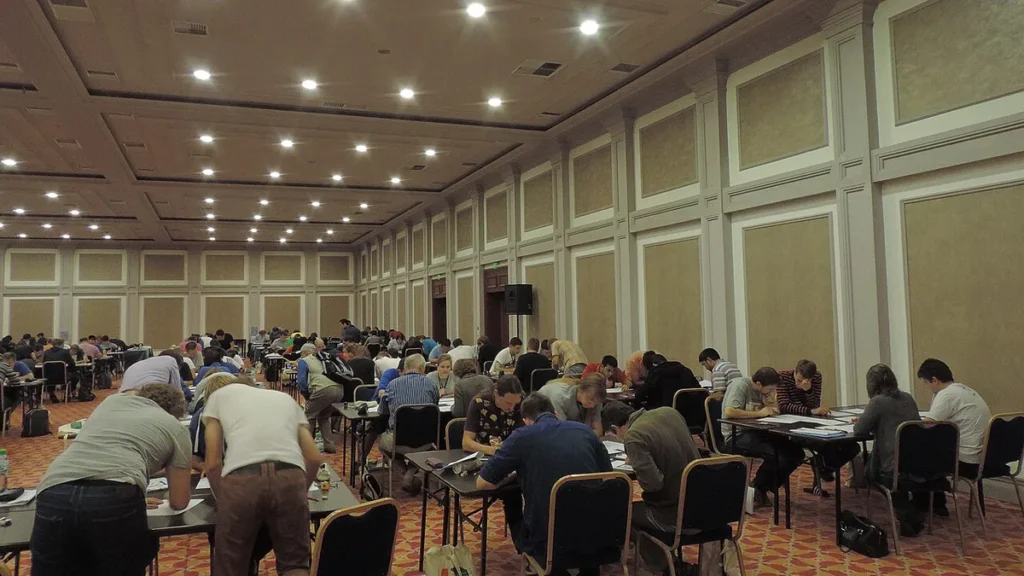
Four hundred and ninety-six people in one hall, all playing cards at the same time, sounds like a plan that will fall apart in the first ten minutes. One table cannot hold that many players, one host cannot teach that many people, and one pack of cards will not go far. The picture changes completely when you stop thinking about one big table and start thinking about many small ones running side by side.
The answer is parallel play. With 124 tables of four, every player has a seat, a hand of cards, and a game that starts at the same moment as all the others. A host walks the room, a clear start signal opens the first round, and winners move to a new table while everyone else keeps playing. Nobody waits long, nobody watches from the side, and the hall feels like one event rather than a hundred separate games.
The nine games below were picked for exactly that kind of night. Each one can be taught in about two minutes, each one works with ordinary packs or simple prompt cards, and each one keeps a full table busy without long pauses. If you are planning a night that is only a little smaller, our guide to card games for 494 players uses the same table plan with two fewer players, so the layout, timing, and hosting notes all carry over.
Key Takeaways
- Plan for 124 tables of four, with a host for every eight to ten tables and one clear start signal.
- Pick games with rules you can teach in two minutes, so no table waits for a long explanation.
- Run short rounds of about twenty minutes, then move winners to a new table.
- Bring far more packs and prompt cards than you think you need, plus spares.
- Keep the whole evening to about two hours of play, with a short break in the middle.

How 496 Players Fit Into One Evening
A hall with 496 players needs a simple layout before it needs anything else. Arrange the tables in rows with wide aisles, put a number card on every table, and give each row a host who knows the games for that row. Players find their table by number and learn from a short printed card. When the start signal sounds, all 124 tables begin together, which stops early tables from drifting off on their own.
Timing matters more than any single title on this list. A round of twenty minutes is long enough for a full game at most tables and short enough that a slow table does not hold up the hall. Between rounds, allow five minutes for players to stand, stretch, and find their next table. Four rounds, a short break, and a final winners’ table fill about two hours.
| Game | Players at one table | What you need | Why it works for 496 |
|---|---|---|---|
| Mafia | 10 to 20 in a circle | Role cards or paper slips and a host | Big circles mean fewer tables |
| Fishbowl | 6 to 10 in a team | Paper slips, pens, and a bowl per table | Every table writes its own slips |
| Taboo | 4 to 6 in a team | Word cards and a timer | Fast turns keep every team talking |
| Big Two | 4 | One standard pack per table | One pack per table is easy to supply |
| Heads Up! | 4 to 6 in a team | Prompt cards or a phone per table | Short, noisy rounds that finish on time |
| Never Have I Ever | 8 to 12 in a circle | Prompt cards and a host | Circles of ten need about fifty tables |
| Once Upon a Time | 4 to 6 | Story cards, one pack per table | Quiet play for a calmer corner |
| We’re Not Really Strangers | 4 to 6 in a circle | Question cards, one pack per table | Small circles help strangers talk quickly |
| Poetry for Neanderthals | 4 to 6 in a team | Word cards and a timer | One-syllable clues make rounds funny |
The table above shows why the mix works. Some games use a standard pack, some use prompt cards, and some use only paper slips, so the hall never depends on one kind of supply. The same table plan works at other sizes, and our guide to card games for 492 players shows how a four-player night scales down by one table while keeping the same rows, hosts, and round length.
The 9 Games
Each entry below works at a single table, and each one scales by running the same title at many tables at once. Read the notes on players and supplies before you buy anything, because the numbers change with the title. A title for circles of twenty needs far fewer tables than one for four.
1. Mafia
Mafia is a hidden-role game where most players are townsfolk and a small hidden group are the mafia. A host, called the narrator, guides the group through a night phase, when the mafia quietly pick one player, and a day phase, when everyone talks and votes on who belongs to the hidden group. The talk is what makes it work. Players watch faces and listen to stories, trying to work out who is hiding something, while the hidden players try to blend in.
At 496 players, Mafia shines because a circle can hold twelve to twenty people, so the hall needs far fewer circles than tables for a four-player title. Give each circle a host, role cards or paper slips with roles written on them, and a corner where the circle can talk without shouting over the next group. After each round, move winners into a fresh circle.
2. Fishbowl
Fishbowl starts with everyone writing a few names or short phrases on paper slips, folding them, and dropping them into a bowl. The group splits into two teams, and play runs in three rounds with the same slips. In the first round, a player describes a slip in any words they like. In the second, they may use only one word. In the third, they act it out without speaking. The same slip gets funnier each time it comes out.
For a hall of 496, Fishbowl works because every table makes its own slips, so no two tables play the same way. A table of eight to ten needs one bowl, a stack of slips, and pens, which costs almost nothing. Run three rounds in twenty minutes, count the slips each team guessed, and send the winners to a new table.
3. Taboo
Taboo is a team word game where one player describes a word on a card while their team guesses it, without using any of the forbidden words listed on the same card. The clue giver talks fast, the team shouts guesses, and a timer keeps the turn short. A wrong word costs the team points, so players learn to describe things in a fresh way instead of reaching for the obvious word first.
With 496 players, Taboo fits neatly into teams of four to six at 124 tables, with one pack of word cards and one timer per table. The table can watch one turn and then play without help. Keep the rounds short, change the clue giver every turn, and let the host call time for the whole hall at once.
4. Big Two
Big Two is a shedding game played with a standard pack, where four players take turns playing cards in combinations that rise in rank, and the first player to shed every card wins the hand. The player with the lowest card starts, the next player must beat the combination on the table or pass, and the hand ends when one player has no cards left. New players pick it up quickly: get rid of your cards first.
For 496 players, Big Two is the easiest title on this list to supply. One pack per table covers 124 tables, and every table plays at the same pace. A hand takes a few minutes, so a round holds several hands, and the top player at each table moves on. Bring spare packs, because a pack handled by many players wears out fast.
5. Heads Up!
Heads Up! is a guessing game where one player holds a card to their forehead without looking at it, while their teammates give clues until the player guesses the word or the timer runs out. Clues can be words, sounds, or actions, and the best ones are short. A team scores a point for every card guessed before time ends, then the card passes to the next player.
At a hall this size, Heads Up! works in teams of four to six, with one pack of prompt cards or one phone per table. The rounds are loud and fast, which suits a big room, and a turn lasts about a minute, so nobody sits idle for long. Keep the prompt cards simple, so new players can give good clues at once, and let the host call the end of each round for the whole hall.

6. Never Have I Ever
Never Have I Ever is a prompt game where a host reads a light, friendly statement, such as never having tried a food or never having stayed up all night, and players put a finger down if the statement is true for them. It is really a way to start conversations, because every statement leads to a short story and a laugh. Keep the prompts gentle and clean, so every player feels welcome to join in.
With 496 players, this title runs in circles of eight to twelve, which means the hall needs only about fifty circles instead of 124 tables. A host reads the prompts at each circle, and one pack per circle is enough. After twenty minutes, mix the circles so players meet new faces, and let any player pass on a prompt without explaining why.
7. Once Upon a Time
Once Upon a Time is a storytelling card game where one player tells a story using the cards in their hand, and the other players try to take over by playing a matching card when the tale turns toward their own card. The story can wander anywhere, from a quiet village to a distant castle, and the player who plays their last card and brings the tale to a neat ending wins the hand. The fun comes from the twists, not from winning.
For a hall of 496, this title suits the calmer corners, where tables of four to six can hear each other without shouting. One pack of story cards per table is enough, and a hand lasts about fifteen minutes, which fits a twenty-minute round. Put these tables away from the loudest games, and let the storytellers take over after the first round.
8. We’re Not Really Strangers
We’re Not Really Strangers is a question card game where players take turns answering honest questions, from light favourites to deeper memories, while the rest of the circle listens. The questions start easy and grow more open as the pack goes on, so strangers can warm up slowly instead of jumping into deep talk at once. Players answer in their own words, and nobody is forced to share more than they want to.
At 496 players, this title runs in small circles of four to six, with one pack of question cards per table. It suits a quiet corner and a slower pace than the guessing games, which makes it a good change of pace between louder rounds. Give each circle a host for the first few questions, and move the circles around between rounds.
9. Poetry for Neanderthals
Poetry for Neanderthals is a team word game where the clue giver describes a word using only one-syllable words, while their team guesses before the timer ends. Saying a longer word by mistake costs the team a point, which is harder than it sounds. The one-syllable rule turns ordinary clues into funny, broken sentences, and the whole table laughs at the effort.
With 496 players, this title fits teams of four to six at 124 tables, with one pack of word cards and one timer per table. The rules take a minute to teach: hear one example, then play. Keep the word cards friendly and familiar, change the clue giver every turn, and let the host call time for the whole hall.
Running the Night Without Chaos
A night this size runs on hosts, not on hope. Give every row a host who knows the games and can call time for the whole row. Print a short rule card for every table, and put a spare pack, a timer, and extra paper slips in a box at the end of each row. When a table finishes early, the host hands them a quick extra game from the box.
Scoring should stay simple enough for a host to do in a minute. Give one point per hand or round won at a table, write the table number and the winner’s name on a slip, and drop the slip in a box at the host’s table. At the end, the hosts count the slips and invite the top players to one winners’ table for a fifteen-minute final.
Checklist for a 496-Player Card Night
- Book a hall with room for 124 tables of four, wide aisles, and a clear space for the winners’ table.
- Count the packs, prompt cards, timers, bowls, slips, and pens for every table, then add spares for ten more tables.
- Print a short rule card and a table number for every table before the first player arrives.
- Recruit one host for every eight to ten tables, plus two floaters who can cover a break.
- Plan four rounds of twenty minutes, a short break in the middle, and a fifteen-minute final at the winners’ table.
- Test the start signal, the timing, and the scoring slips with your hosts before the doors open.
That checklist is short on purpose, because a long list is easy to lose track of on the night. For a night that is four players smaller, our guide to card games for 490 players uses the same checklist with one fewer table, so you can copy the plan and change only the numbers.
Frequently Asked Questions
Can 496 people really play card games at the same time?
Yes, if the hall runs parallel tables instead of one big game. With 124 tables of four, every player plays at the same time, and a shared start signal keeps the rounds together. The key is to pick games that a table can run on its own.
How many tables do we need for 496 players?
You need 124 tables of four for the titles on this list that play best with four players. Titles that run in circles of ten to twenty need fewer tables, so count the tables title by title. Add a few spare tables for late arrivals.
How many packs and copies should we buy?
Buy one pack per table for the titles that use a standard pack, which means at least 124 packs for Big Two, plus spares. For prompt games, buy one pack per table as well, and keep ten spare packs in the host box.
What if most players have never played these games before?
Pick titles with rules you can teach in two minutes, print a short rule card for every table, and let the first round be a practice round with no points. A host should visit every table in the first five minutes, so a new player can learn by watching one turn.
How long does a 496-player card night last?
Plan for about two hours of play, made of four twenty-minute rounds, a short break, and a fifteen-minute final. Add thirty minutes before for seating and thirty after for clearing up, so the booking should cover three hours.
How do we pick one overall winner from 496 players?
Give one point per hand or round won, and write the winner’s name on a slip. At the end of the night, invite the players with the most points to one winners’ table for a short final game.
The Bottom Line
A card night for 496 players works when the plan is simple: many small tables, games that are easy to teach, short rounds that start and end together, and hosts who keep the hall moving. The nine titles above cover guessing, storytelling, hidden roles, and classic card play.
Start with the layout, buy more packs than you think you need, and let the tables do the work. When the final winners’ table finishes and the hall applauds the winner, the size of the night will feel like the best part of it.