Four hundred and ninety-eight players is not a party. It is a small town arriving at once, with different ages, different energy levels, and different ideas about what counts as fun. A single game for everyone at the same time would leave most people standing around, watching a few confident players take over The trick is to stop thinking of the day as one big game and start thinking of it as a festival with nine clear stations, each one built to keep a large group moving, laughing, and taking part.
The plan in this guide splits 498 players into six teams of 83. Each team has a captain, a colour, and a simple scorecard, and the teams move from station to station in a fixed order. Nobody waits long, because every station runs in short heats and every game splits its team into smaller squads, so a fresh group is always playing The games below use ordinary equipment, clear scoring, and short rounds, so the day feels busy rather than chaotic.
What makes these nine games work at this size is that each one has a job for everyone. Some players run, throw, or build, while others sort, count, call out, or keep time. A quiet player can be the best counter or caller on the team, and a loud player can be the best cheerleader or starter. If your guest list shifts by a couple of people, our guide to party games for 496 players shows how a slightly smaller gathering runs on the same station system, and the timetable there transfers directly to this plan.
Key takeaways
- Split 498 players into six teams of 83, each with a captain, a colour, and a scorecard.
- Run nine stations in parallel so no team waits long and every player has a clear job.
- Keep every round short, with simple rules that a new player can learn in under a minute.
- Mix running, throwing, building, and craft games so different strengths all matter.
- Score every station the same way, and finish with one clear winner and plenty of small prizes.

How to Run a 498-Player Party Day
Start with the ground. You need enough space for nine stations with a clear walking lane between them, plus a central meeting point where teams gather at the start and the end of the day. A school field, a large park lawn, or a community sports ground all work well. Mark every station with a coloured flag and a simple sign showing the game name, the rules in three short lines, and how points are scored.
Next, build the timetable. Nine stations at twenty minutes each give three hours of play, with five-minute changeovers adding forty-five minutes between rounds. Add thirty minutes at the start for welcome and team photos, and thirty minutes at the end for the final scores and the closing ceremony, and the whole day runs to about four hours and forty-five minutes. The party games for 494 players guide uses the same shape of day,.
Scoring should be simple enough for a volunteer to run with a clipboard. Award ten points for first place at a station, eight for second, six for third, and four, two, and one for the rest, so every team scores something at every station. Give every station one leader, one timer, and one scorekeeper, and keep the jobs separate so nobody has to do two things at once. Start and end every round together with a whistle or a horn, and keep the gaps between rounds short. Do that, and 498 players feel like six small parties instead of one enormous crowd.
Party Games for 498 Players at a Glance
Use this table to plan your space, your timetable, and your shopping list before the day begins. Every game below fits the same rotation, so you can swap the order without breaking the plan.
| Game | Team size | Space needed | Time per round | Energy level |
|---|---|---|---|---|
| Mega Pancake Flip Relay | 83 players | Marked track | 20 minutes | High |
| Giant Coconut Shy Challenge | 83 players | Fenced stall | 20 minutes | Low |
| Mega Clay Modelling Sprint | 83 players | Covered tables | 20 minutes | Low |
| Giant Lighthouse Beam Relay | 83 players | Open lawn | 20 minutes | Medium |
| Mega Brick Laying Relay | 83 players | Flat ground | 20 minutes | Medium |
| Giant Flower Crown Weaving Relay | 83 players | Covered tables | 20 minutes | Low |
| Mega Code Breaking Relay | 83 players | Covered tables | 15 minutes | Low |
| Giant Foam Javelin Throw Rally | 83 players | Open field | 20 minutes | High |
| Giant Cupcake Decorating Dash | 83 players | Covered tables | 20 minutes | Low |
The 9 Games
Each game below explains how to set it up, how a round works, and why it suits a group of 498 players. Read the set-up notes first, then let the station leader run the round while the timer keeps the day on schedule.
1. Mega Pancake Flip Relay
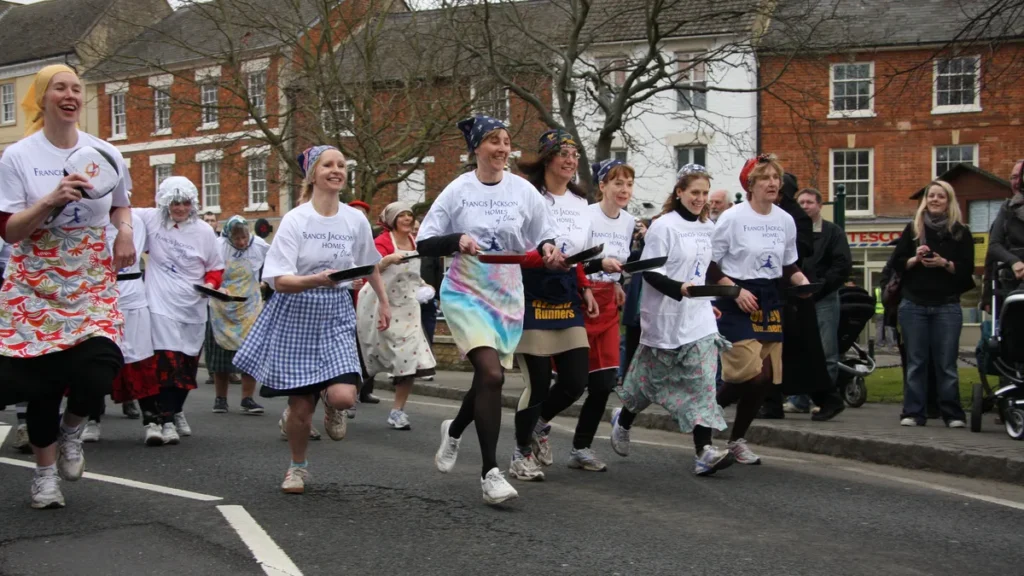
Each squad of players lines up at the start of a marked track holding a frying pan with a soft toy pancake inside. On the whistle, the first runner walks quickly to the turning cone, flips the pancake in the air, catches it in the pan, and runs back to hand the pan to the next runner. If the pancake falls, the runner picks it up, returns to the spot where it fell, and flips again before moving on. No throwing the pancake forward is allowed, and the pan must stay in one hand the whole way.
The fun of this game is that almost anyone can do it, yet almost nobody does it cleanly on the first try. Fast runners gain time on the track, while careful players gain time by flipping once and catching cleanly. Score the team by its fastest clean squad time, with a five-second penalty added for every dropped pancake that was not flipped again at the right spot.
2. Giant Coconut Shy Challenge
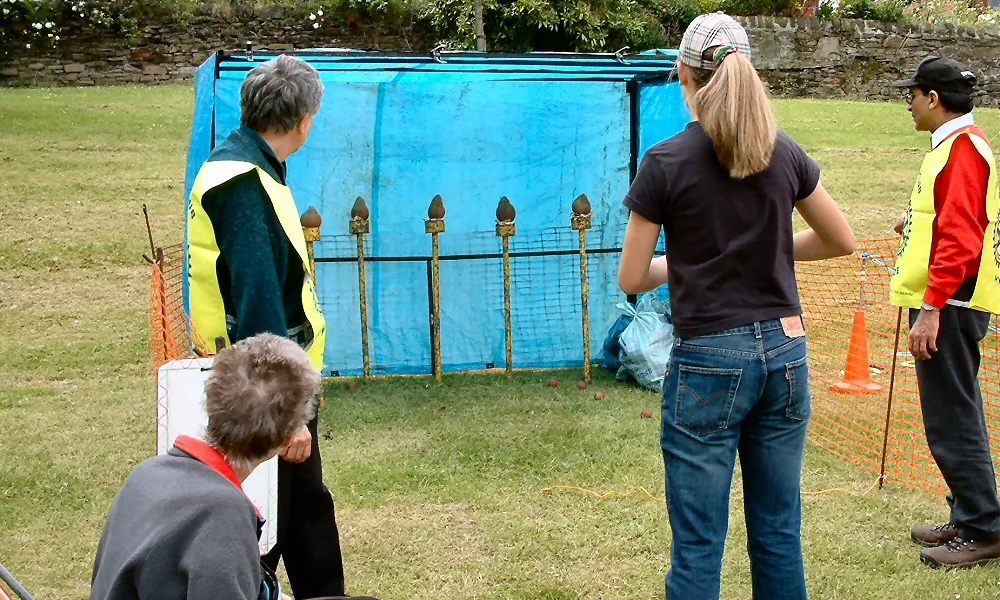
Set up a row of posts with a coconut balanced on each one, behind a low fence and a throwing line about three metres away. Each player gets three soft balls and tries to knock a coconut clean off its post. A coconut that wobbles but stays on the post scores nothing, and a ball that bounces off the fence does not count. Players throw one at a time, in squad order, while the rest of the squad watches from behind the line and calls out encouragement.
This is a calm station, and every big day needs one. It gives tired legs a rest, it gives shy players a game where nobody is watching them run, and it is easy to score, because the scorekeeper simply counts the coconuts on the ground. Bring plenty of spare coconuts and soft balls, and set the throwing line a little closer for younger players so everyone has a fair chance of a hit.
3. Mega Clay Modelling Sprint
Cover a long table with clay, modelling tools, and a printed picture of the subject for the round, such as a duck, a cup, or a small house. Each squad gets fifteen minutes to model the subject as a team, with every player adding at least one part to the shared model. One player shapes the body, another adds the head, another rolls the legs, and the rest smooth, shape, and tidy. Talking is allowed, and planning together is half the game.
At the end of the time, the station leader photographs each model next to its team colour card, and three judges score it for likeness, teamwork, and finish. This station suits players who would rather make something than run, Keep the clay soft by covering it between squads,
4. Giant Lighthouse Beam Relay
Mark a long line across an open lawn with nine small posts, one for each squad member in the relay chain. The first player holds a torch and a simple signal card showing three short flashes for one letter and three long flashes for another. On the whistle, the first player flashes the signal, the next player reads it and passes it on with their own torch, and the signal travels down the line until the last player calls out the word it spells. If the word is wrong, the chain starts again from the beginning.
This game works because it turns waiting into playing. Every player in the chain matters, and a single rushed flash can spoil the whole message, so teams learn to slow down and watch carefully. Score the team by the number of correct words in twenty minutes, with a bonus point for the fastest correct chain.
5. Mega Brick Laying Relay
Lay out a straight chalk line on flat ground and stack a pile of light foam bricks beside it. Each squad sends players forward one at a time to carry a single brick to the line and lay it in place, building a low wall one brick high. The next player may not start until the last brick is down and the carrier is back behind the line. The wall must stay straight and level, and any brick that sticks out past the chalk line costs the team a point.
Speed matters, but neatness matters more, and that balance is what makes the game fair for teams of different ages. Score the team by the length of straight wall finished in twenty minutes, minus one point for every brick out of line. Use foam bricks only, and keep the wall no higher than knee height, so a collapse is funny rather than painful.
6. Giant Flower Crown Weaving Relay
Cover a table with fresh flowers, green stems, ribbon, and wire frames in the team colour. Each squad works together to weave flower crowns, with one player cutting stems, one threading flowers, one tying ribbon, and the rest trimming and checking the fit. Every crown must fit on a head without falling apart when the wearer walks ten steps, and the team must finish at least one crown for every five players before the time runs out.
This is a gentle, crafty station that suits players who like making things with their hands. Score the team by the number of finished crowns that pass the walking test, with bonus points for the neatest crown at the station.
7. Mega Code Breaking Relay
Set out a row of locked boxes, each one holding a clue card for the next box, and give the first squad a simple cipher key that turns letters into numbers. Players work in small groups to decode the first clue, find the matching box, open it, and read the next clue. The chain ends with a final box holding the team colour card, which the squad carries back to the station leader to stop the clock. No box may be forced open, and every clue must be read aloud to the group before the squad moves on.
This station rewards clear thinking under time pressure, and it gives quiet players a real chance to lead. A good reader, a careful counter, and a calm organiser are worth more here than fast legs. Score the team by the time taken to reach the final box, with a two-minute penalty for every clue read out of order.
8. Giant Foam Javelin Throw Rally
Mark a throwing line on an open field with a long, clear landing zone and a safety rope that nobody crosses while throwing is in progress. Each player gets three foam javelins and throws them one at a time down the lane, aiming for distance inside the marked zone. A throw that lands outside the zone scores nothing, and a thrower must wait behind the line until the lane is clear before stepping forward again. The scorekeeper stands to the side with a long tape and calls out each distance.
Foam javelins make this game safe for a crowd, because they are light, soft, and easy to see in flight. Run the squads in turn and add up the best throw from each player,
9. Giant Cupcake Decorating Dash
Cover a long table with plain cupcakes, bowls of icing in the team colours, sprinkles, and small flags. Each squad gets twenty minutes to decorate as many cupcakes as it can to a set theme, such as a garden, a beach, or a party. Every player must decorate at least one cupcake, and the squad must agree on the theme before anyone picks up an icing bag. Talking and planning together is part of the game, and a tidy table counts toward the final score.
This station ends the day on a sweet note, and the decorated cupcakes can be shared at the closing ceremony, Score the team by the number of finished cupcakes that match the theme, with bonus points for the neatest cupcake at the station.
Party Day Checklist
Run through this list on the morning of the party, before the first team arrives.
- Print six rotation cards, one per team, with the nine stations in order and the start time for each round.
- Mark every station with a coloured flag, a sign with the rules, and a clear walking lane to the next station.
- Count the equipment for every game, including spare toy pancakes, coconuts, foam bricks, foam javelins, and icing bags.
- Brief every station leader, timer, and scorekeeper together, and hand out a whistle or a horn to each station.
- Set up water stations along the walking lanes and a shaded rest area near the central meeting point.
- Charge the torches, print the cipher keys and signal cards, and test every locked box before the first squad starts.
Frequently Asked Questions
How do you split 498 players into fair teams?
Divide the group into six teams of 83, and mix ages and abilities in every team rather than grouping friends together. Give each team a captain, a colour, and a printed rotation card, and let the captain count heads at every changeover so nobody gets lost between stations.
How long does a 498-player party day take?
Plan for about four hours and forty-five minutes. Nine stations at twenty minutes each give three hours of play, five-minute changeovers add forty-five minutes, and welcome and closing take about an hour together. If you want a shorter day, cut each round to fifteen minutes and drop the closing ceremony to a quick prize moment.
What if it rains on the day?
Move the clay modelling, flower crown weaving, code breaking, and cupcake decorating stations under cover first, because they need dry tables.
Do younger players get a fair chance?
Yes, if you set the throwing lines closer for the coconut shy and the foam javelin stations, and let younger squads use a shorter track for the pancake flip relay. For more ideas, see the party games for 492 players guide for a slightly smaller crowd.
How much equipment do we need?
Count one full set per station, plus spares for the items that break or run out, such as toy pancakes, coconuts, foam bricks, foam javelins, and icing bags.
Can we run this plan with fewer volunteers?
You need at least one leader per station, plus a small team at the central meeting point to keep time and add up scores. If you are short of people, pair two quiet stations under one leader, such as the clay modelling and flower crown stations,
The Bottom Line
A party for 498 players works when the day is built around teams, stations, and short rounds, rather than one big game that leaves most people watching. Split the crowd into six teams of 83, give every team a captain and a colour, and let nine simple games do the work. Mix running, throwing, building, and craft, score every station the same way, and finish with one clear winner and plenty of small prizes. Do that, and the crowd will remember the day as a festival, not a queue.