Five hundred and five players in one room sounds impossible until you see it done well. The trick is not to shout louder or to run one giant game for everyone at once. The trick is to split the crowd into small teams, give every team the same nine rounds, and keep the whole evening moving on a strict clock. When that happens, a room of 505 players feels less like a crowd and more like a hundred small groups all enjoying the same night together.
This guide shows you exactly how to run trivia games for 505 players, from the first welcome to the final scores. You will find nine fresh rounds, each built around a single theme, plus a scoring plan that stays fair when more than a hundred teams are playing, a night-of checklist, and answers to the questions every organiser asks before an event this size. Everything here has been planned for a crowd of this scale, so you can lift the whole plan and use it as it stands.
The nine rounds below cover clarinet players, trombone players, net makers, wood turners, sign writers, slaters, meadows, headlands and moorlands. Each round has three questions with answers, so you have 27 questions ready to read out. Mix in your own picture round or music round if you like, but the nine rounds here are enough for a full evening on their own.
Key takeaways
- Split 505 players into 101 teams of five, and give every team the same nine rounds on the same clock.
- Use nine single-theme rounds, each with three questions, so the night stays varied and easy to follow.
- Score each round out of ten and announce running totals after every third round to keep the room engaged.
- Appoint one host, two scorers and one runner per zone so questions, sheets and scores never pile up.
- Plan a tiebreaker in advance, because a crowd this size almost always produces a tie at the top.

How 505 players actually play together
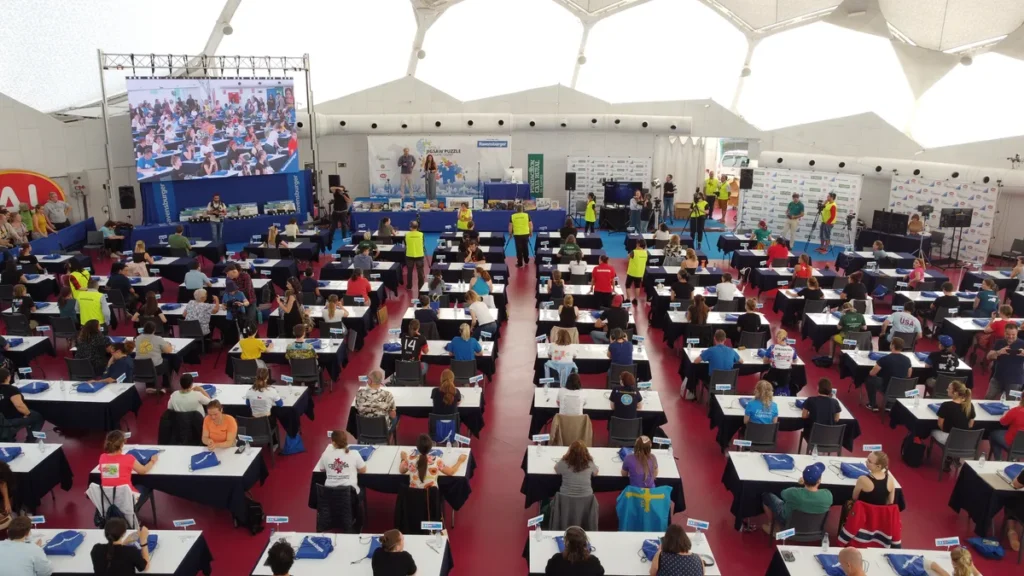
The simplest shape for 505 players is 101 teams of five. Five is the sweet spot for a quiz team: small enough that everyone gets a say, large enough that every team has a mix of strengths. Ask players to form their own teams of five as they arrive, and keep a few spare seats at a welcome table so that anyone who arrives alone can be placed with a team that has a gap. If a team ends up with four players, let them play as they are; if a team ends up with six, split them kindly and explain that five is the limit for fairness.
Divide the room into zones of about ten teams each, and give every zone a letter and a colour. Each zone gets its own runner, who hands out answer sheets, collects them at the end of each round, and carries the marked sheets back to the scorers. This is the detail that makes a 505-player night work. Without runners, the host spends half the evening waiting for sheets to travel across a crowded room. With runners, every round starts and ends on time, and no team is left wondering whether their sheet was counted.
Run the evening on a visible timer. Give teams two minutes per question, and show the time remaining on a large screen so the whole room can see it. Read each question twice, clearly, and then move on. Our guide to trivia games for 503 players uses the same zone and runner system, and it works just as well at this slightly larger size. The host should be the only voice on the microphone during questions, while the runners and scorers work quietly in the background.
The nine rounds at a glance
Every round below follows the same shape: a short introduction, three questions, and the answers. The table gives you the whole evening in one view, so you can plan your running order and your breaks before the night begins.
| Round | Category | Format | Questions |
|---|---|---|---|
| 1 | Famous Clarinettists | Spoken questions | 3 |
| 2 | Famous Trombonists | Spoken questions | 3 |
| 3 | Famous Net Makers | Spoken questions | 3 |
| 4 | Famous Wood Turners | Spoken questions | 3 |
| 5 | Famous Sign Writers | Spoken questions | 3 |
| 6 | Famous Slaters | Spoken questions | 3 |
| 7 | Famous Meadows | Spoken questions | 3 |
| 8 | Famous Headlands | Spoken questions | 3 |
| 9 | Famous Moorlands | Spoken questions | 3 |
The nine rounds
Round 1: Famous Clarinettists
The clarinet has produced some of the most recognisable sounds in popular music, from the swing era to the grand stage. This round celebrates the players who made the instrument famous, and it works well as an opener because most teams will know at least one of the answers straight away. That early success settles the room and gets everyone writing.
Keep the pace gentle in this first round. Read each question twice, give teams a full two minutes, and remind them that they can leave an answer blank and come back to it. The goal in round one is confidence, not elimination.
- Which clarinettist was known as the King of Swing? Answer: Benny Goodman.
- Which clarinettist led the band that recorded Begin the Beguine in 1938? Answer: Artie Shaw.
- Mozart wrote his Clarinet Concerto for which clarinettist? Answer: Anton Stadler.
Round 2: Famous Trombonists
The trombone is the warmest voice in the brass section, and its great players shaped the sound of swing. This round follows naturally from the clarinet round, because the two instruments shared the same dance bands and the same era. Teams that did well in round one will feel at home here, and teams that struggled will get a second chance with a familiar style of question.
- Which trombonist led the band behind In the Mood? Answer: Glenn Miller.
- Which trombonist was known as the Sentimental Gentleman of Swing? Answer: Tommy Dorsey.
- Which trombonist recorded I am Getting Sentimental Over You as his theme? Answer: Tommy Dorsey.
Round 3: Famous Net Makers
Nets are everywhere in sport, yet few people stop to think about them. This round turns that everyday object into a quiz topic, with questions about the nets used in tennis, volleyball and table tennis. It is a good change of pace after two music rounds, because it rewards players who notice the details of the games they watch.
Read the numbers in these questions slowly and clearly. A height given in feet and a height given in metres sound very different when read aloud, so pause after each number and let the teams write it down before you move on.
- In tennis, how high is the net at the centre? Answer: Three feet.
- In volleyball, how high is the top of the net for the men’s game? Answer: 2.43 metres.
- In table tennis, how high is the net across the table? Answer: 15.25 centimetres.
Round 4: Famous Wood Turners
Wood turning is one of the oldest crafts, and it still fills workshops with the smell of fresh shavings and the hum of a spinning lathe. This round asks about the tools and the terms of the craft, so it suits players who enjoy making things as much as players who enjoy music or sport. It also gives the evening a hands-on, practical feel in the middle of the night.
- What is the name of the machine a wood turner uses to spin the wood? Answer: A lathe.
- Which part of the lathe holds the cutting tool steady while the wood spins? Answer: The tool rest.
- What do turners call the piece of wood fixed between the centres of the lathe before turning begins? Answer: A blank.
Round 5: Famous Sign Writers
Before printed signs and glowing screens, every shop front was lettered by hand. Sign writers painted letters with long-haired brushes, laid gold leaf with great care, and turned a plain wooden board into a work of art. This round honours that craft, and it is a lovely round to read aloud because the answers have a satisfying, old-fashioned ring to them.
Give teams a moment on the gold leaf question, because many players will know the answer but struggle to put it into words. Accept any answer that clearly means thin sheets of beaten gold, and move on without a long debate.
- What is gold leaf made from? Answer: Gold beaten into thin sheets.
- What is the name of the long-haired brush sign writers use for lettering? Answer: A quill.
- What did old-time sign writers most often letter on before modern boards? Answer: Wooden fascia boards.

Round 6: Famous Slaters
Slaters covered roof after roof with thin sheets of split stone, working high above the ground with a hammer in one hand and a slate in the other. This round takes you to the quarries of Wales and to the tools of the trade, and it is a strong round for the second half of the evening because the questions are short, clear and very answerable.
- Which country is famous for blue-grey roofing slate from Blaenau Ffestiniog? Answer: Wales.
- What is the name of the tool a slater uses to cut slate and punch holes in it? Answer: A zax.
- Which natural stone is split into thin sheets for roofing? Answer: Slate.
Round 7: Famous Meadows
A meadow in late spring is one of the happiest sights in the year: yellow buttercups, tall grasses, and skylarks singing high above the ground. This round is about the plants and birds of open grassland, and it gives the evening a gentle, summery feel just when the players need a lift.
Read the bird question last in this round, because the skylark is the answer most teams will reach by talking it through together. One player remembers the song, another remembers the ground nest, and together they get there. That kind of teamwork is exactly what a good quiz night is for.
- Which yellow flower carpets many meadows in spring? Answer: Buttercup.
- Which bird, known for its bubbling song over open grassland, nests on the ground in meadows? Answer: Skylark.
- In which month do most hay meadows get their single annual cut? Answer: July.
Round 8: Famous Headlands
A headland is where the land meets the sea in its boldest form, a high point of rock that has stood against the waves for thousands of years. This round visits three well-known headlands, and it rewards players who have walked a coastal path or studied a map of the shore. It also pairs well with the meadow round, because both rounds are about open landscapes.
- Which headland marks the south-western tip of mainland Britain? Answer: Land’s End.
- Which headland marks the southern tip of the Isle of Wight? Answer: St Catherine’s Point.
- Which headland separates the Bristol Channel from the Atlantic on the Devon coast? Answer: Hartland Point.
Round 9: Famous Moorlands
Save the moorland round for last, because it has the strongest atmosphere of all nine rounds: purple heather, wide open skies, wild ponies and the call of the grouse. It is a fitting finish to the evening, and the questions are gentle enough that every team can score in the final round. A close finish keeps the room buzzing right up to the last answer.
When the final round is over, collect the sheets quickly and thank the runners by name. The last few minutes of a quiz night set the mood for the whole evening, so end on a warm note and promise the results within ten minutes.
- Which purple-flowering plant carpets moorland in late summer? Answer: Heather.
- Which open upland in south-west England is famous for its wild ponies and tors? Answer: Dartmoor.
- Which bird of the moors is known for its red eyebrows and bubbling call? Answer: Red grouse.
Scoring that stays fair at this scale
Score every round out of ten, even though each round has only three questions. Give three points for a fully correct answer, and keep one bonus point in reserve for the best team answer to a tiebreaker question in each round if you want to add a little extra drama. Simpler is better at this scale, so most organisers give three points per correct answer and one point for a partially correct answer, which makes nine points per round and 81 points for the whole night. Announce the running totals after rounds three, six and nine so that every team knows where it stands.
Marking 101 sheets per round is a big job, so use a marking team of at least six people and give each marker a fixed set of zones. Markers should work in pairs: one reads the answers aloud from the sheet, and the other checks them against the answer key. Swap the pairs between rounds so that no marker gets tired and starts making mistakes. Our guide to trivia games for 502 players uses the same paired-marking system, and it keeps the scores accurate even when the room is noisy and the clock is tight.
Ties are almost certain with 101 teams, so plan your tiebreaker before the night begins. Prepare three extra questions that get harder each time, and ask the tied teams to write their answers on a single sheet. The first team to answer one correctly takes the higher place. If the tie is still unbroken after three questions, use a closest-number question, such as guessing the height of a famous landmark, and the closest guess wins.
Night-of checklist
- Set out 101 answer sheets per round, plus spares, and label each zone with a letter and a colour.
- Test the microphone, the screen and the timer before the first team arrives.
- Brief the host, the two scorers and one runner per zone at least half an hour before the start.
- Place the welcome table near the door so late arrivals can join a team without crossing the room.
- Keep the answer keys with the marking team only, and collect every sheet at the end of each round.
- Prepare three tiebreaker questions and a closest-number question before the first round begins.
Frequently asked questions
How long does a trivia night for 505 players take?
Allow about two and a half hours for the nine rounds, including two short breaks and the final scoring. Each round takes around twelve minutes when you include reading time, writing time and sheet collection. Add thirty minutes before the start for seating and team forming, and ten minutes at the end for the results.
How many teams should 505 players form?
Form 101 teams of five. Teams of five work best because everyone gets a voice and every team has a mix of knowledge. If a few players arrive alone, place them with teams that have a gap, and let any team of four play as it is rather than turning people away.
Do we need special equipment for a crowd this size?
You need a good microphone, a large screen for the timer and the running scores, and enough printed answer sheets for every team in every round. A second microphone for the host’s helper is useful, and a simple spreadsheet for the scores will save the marking team a lot of time. You can find more ideas for large-group play in our guide to trivia games for 501 players, which covers the same kind of setup.
How do we stop teams from cheating?
Ask every team to put phones away in a bag or a pocket before the first question, and have the runners walk the zones during each round. Mixing the seating so that friends sit in different teams also helps, and reading the questions only twice keeps the pace too quick for anyone to look things up.
What happens if teams tie at the top?
Use the tiebreaker questions you prepared before the night began. Ask the tied teams to write their answers on a single sheet, and the first team to answer one correctly takes the higher place. If the tie survives three tiebreaker questions, use a closest-number question and the closest guess wins.
Can children play in a 505-player trivia night?
Yes, children can play, and they often do very well in the music and landscape rounds. Seat younger players with adults who can help them read the questions, and consider a small prize for the highest-scoring team with a player under twelve. Keep the evening to two and a half hours so that younger players do not get tired.
The Bottom Line
A trivia night for 505 players works when the plan is simple, the teams are small, and the clock is strict. Nine single-theme rounds, 101 teams of five, runners in every zone and paired markers will carry an evening of this size without fuss. The rounds in this guide give you 27 ready questions, and the scoring plan and checklist give you everything else you need.
Gather your teams, brief your helpers, and enjoy the moment when a whole room of 505 players leans in together to hear the next question. That shared hush, followed by the buzz of a hundred teams talking at once, is what makes a big quiz night worth running.