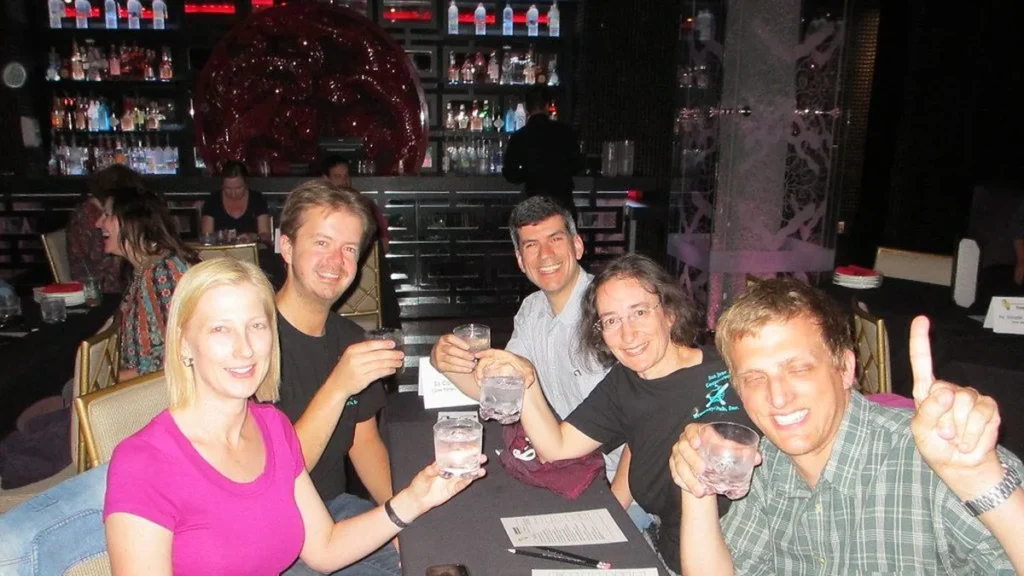
Five hundred and two players in one room sounds like chaos until you see it done well. The moment the first question lands, the noise settles into a hum: pens scratching, team captains leaning in, and five hundred people all trying to remember the same half-forgotten fact at the same time. That shared strain is exactly why giant trivia nights work. Nobody is watching a show. Everybody is playing.
The trick is structure, not volume. A night this size fails when it is run like a small pub quiz with more chairs. It succeeds when the evening is broken into clear rounds, teams are kept small enough to argue properly, and the scoring is so simple that nobody has to ask how it works twice. Give people a shape they can follow and the crowd stops being a crowd. It becomes seventy-odd teams with a common purpose.
This guide lays out a full format for 502 players: nine rounds, each built around a single famous subject, plus the practical detail that keeps a room that size moving. The 501-player edition shows how the same nine-round shape scales, and the format below adds one more table without adding any fuss.
Key takeaways
- Split 502 players into teams of six to eight, so every team has enough voices to argue and few enough to agree.
- Run nine rounds of ten questions each, with a short pause between rounds for scoring and fresh air.
- Pick one famous subject per round, so teams always know what kind of thinking the next ten questions need.
- Score one point per correct answer, with a single tie-break question ready before the night begins.
- Keep the questions spoken slowly, shown on screen, and repeated once, so the back rows never feel left out.

The Nine Rounds at a Glance
Each round below follows the same pattern: a famous subject, ten questions, and a mix of easy openers and harder closers. Teams that want a warm-up first can borrow the pacing from the 500-player night, which runs the same nine-round shape with the same pause between rounds.
| Round | Category | The Hook |
|---|---|---|
| 1 | Famous Yodelers | Alpine voices and country legends |
| 2 | Famous Tap Dancers | Rhythm you can hear in the answers |
| 3 | Famous Origami Artists | Paper folded into impossible shapes |
| 4 | Famous Beatboxers | Drum kits built from one voice |
| 5 | Famous Sundial Makers | Timekeeping carved in stone and brass |
| 6 | Famous Bonsai Masters | Tiny trees shaped over decades |
| 7 | Famous Olive Groves | Ancient trees and golden oil |
| 8 | Famous Rice Terraces | Hillsides carved into steps |
| 9 | Famous Tulip Fields | Stripes of colour across flat land |
The Rounds in Detail
Round 1: Famous Yodelers
Yodelling is one of those skills everybody recognises and almost nobody can explain, which makes it perfect trivia material. The round opens with the easy names and then moves toward the specialists, so teams feel clever early and stretched late. Start with the sound itself: the quick flip between chest voice and head voice that gives yodelling its unmistakable break.
The American story belongs to Jimmie Rodgers, the country pioneer whose Blue Yodel songs carried the style across the United States in the late 1920s. The Alpine story belongs to Franzl Lang, the Bavarian singer known as the King of the Yodelers, whose records set the standard for the German style. Between them sits Slim Whitman, whose soaring yodel in Indian Love Call turned a stage song into a chart hit. Ask teams which American country pioneer recorded Blue Yodel No. 1 (T for Texas) in 1928, which Bavarian singer was known as the King of the Yodelers, and which country star’s yodel featured in Indian Love Call.
Round 2: Famous Tap Dancers
Tap is rhythm made visible, and a round on its great dancers gives teams something to picture as they think. Open with the image of a dancer alone on a staircase, because that is the scene most people carry in their heads. Bill Bojangles Robinson made the stair dance famous, and his film partnership with Shirley Temple put tap in front of audiences who had never seen a stage show.
From there the round widens. Fred Astaire brought tap into elegant film routines, Gene Kelly gave it athletic power in Singin’ in the Rain, and Gregory Hines carried the tradition into a new generation on stage and screen. The modern chapter belongs to Savion Glover, whose Broadway show Bring in ‘da Noise, Bring in ‘da Funk rebuilt tap for a younger crowd. Ask teams which tap dancer was famous for his stair dance and films with Shirley Temple, which dancer starred in Singin’ in the Rain, and which tap star headlined Bring in ‘da Noise, Bring in ‘da Funk.
Round 3: Famous Origami Artists
Origami looks simple until you try it, and that gap between looking and doing is what makes this round fun. Everybody has folded a paper crane. Very few people know the names behind the art, which means the round rewards the teams who read beyond the obvious. Keep the questions concrete: names, books, and famous folds.
Akira Yoshizawa is the anchor. The Japanese artist is known as the father of modern origami, and the diagram symbols he devised are still used by folders everywhere. Robert J. Lang, an American artist with a background in physics, wrote Origami Design Secrets and folds insects and animals of startling realism. Satoshi Kamiya, also from Japan, is known for the Ancient Dragon, a single-sheet fold so complex it takes experienced folders many hours. Ask teams who is known as the father of modern origami, which origami artist also works as a physicist and wrote Origami Design Secrets, and which Japanese artist folded the famously complex Ancient Dragon.
Round 4: Famous Beatboxers
Beatboxing turns one voice into a whole band, and a round on its pioneers is a gift to any host who likes playing clips. If your sound system allows it, play five seconds of each artist before the question. Teams will recognise the sound long before they recall the name, and that delay is where the fun lives.
Doug E. Fresh is the starting point. The hip-hop pioneer was known as The Human Beat Box, and his routines set the template for everything that followed. Rahzel earned the nickname Godfather of Noyze for his ability to sing and beatbox at the same time, a trick that still leaves audiences staring. Tom Thum, from Australia, built a career on one-man routines that move from drums to bass to full songs without a single instrument. Ask teams which hip-hop pioneer was known as The Human Beat Box, which beatboxer earned the nickname Godfather of Noyze, and which Australian beatboxer is known for his one-man orchestra routines.
Round 5: Famous Sundial Makers
Sundials are the oldest timekeepers most people have ever seen, and a round on the people who made them takes teams somewhere genuinely unfamiliar. The trick is to keep the questions about people and places, not about angles and shadows. Nobody wants a geometry lesson in the middle of a quiz night.
William Oughtred is the best-known name. The English mathematician, inventor of the slide rule, also designed sundials in the seventeenth century. Giovanni Francesco Zarbula worked at the other end of the scale: an Italian artist who painted dozens of sundials on walls across Piedmont in the 1830s, each one a small work of art as well as a working timepiece. The grandest example of all stands in Jaipur, where Maharaja Jai Singh II built the giant sundial at Jantar Mantar. Ask teams which English mathematician and slide-rule inventor also designed sundials, which Italian artist painted dozens of sundials on walls in Piedmont in the 1830s, and which Indian ruler built the giant sundial at Jantar Mantar in Jaipur.

Round 6: Famous Bonsai Masters
Bonsai rewards patience more than any other art in this quiz, and the masters behind it are worth knowing. A round on bonsai gives teams a breather after the noise of beatboxing and sundials: slow, quiet, careful work. The questions should feel the same way, with clear names and one striking detail each.
Masahiko Kimura is the name most teams will chase. The Japanese master, nicknamed the Magician, is known for bold deadwood work and trees that look far older than they are. John Naka brought the art to American audiences, writing the classic Bonsai Techniques books and teaching a generation of growers in California. Kunio Kobayashi runs the Shunkaen nursery in Tokyo, one of the most respected collections in the world. Ask teams which Japanese bonsai master is nicknamed the Magician, which American master wrote the classic Bonsai Techniques books, and which bonsai master runs the Shunkaen nursery in Tokyo.
Round 7: Famous Olive Groves
Olive groves carry history in a way few other landscapes do. Some of the trees in this round were already old when the questions in the earlier rounds were being written, and that sense of age gives the round its weight. Keep the geography simple: one grove, one place, one fact.
The oldest famous tree stands on Crete. The Olive Tree of Vouves, in the village of Ano Vouves, is thought to be more than three thousand years old and still bears fruit. Spain holds the largest groves: the province of Jaen is covered in olive trees and is known as the world’s olive oil capital. In Jerusalem, the ancient olive trees of Gethsemane still stand, tended for centuries. Ask teams on which Greek island the ancient Olive Tree of Vouves grows, which Spanish province is known as the world’s olive oil capital, and in which city the ancient olive trees of Gethsemane still stand.
Round 8: Famous Rice Terraces
Rice terraces turn steep hillsides into staircases of green, and they make a wonderful visual round. Show a photograph with each question if you can, because teams will answer faster when they can see the steps. The round works best when the questions move from one country to the next, so teams feel the journey.
The Banaue terraces in the Philippines open the round. Carved by the Ifugao people over two thousand years ago, they are often called the eighth wonder of the world. In China, the Yuanyang terraces in Yunnan were built by the Hani people and are now a UNESCO site, their flooded steps mirroring the sky. In Bali, the Tegallalang terraces near Ubud draw visitors for their valley views and neat green lines. Ask teams which rice terraces in the Philippines were carved by the Ifugao people over two thousand years ago, which terraces in Yunnan were built by the Hani people, and which Balinese terraces near Ubud are famous for their valley views.
Round 9: Famous Tulip Fields
Save the brightest round for last. Tulip fields are pure colour, and a closing round on them sends teams home with a vivid image in their heads. The questions stay simple on purpose: by round nine, tired teams deserve questions they can actually answer, with one harder closer for the leaders.
Keukenhof leads the round. The Dutch flower display near Lisse plants around seven million bulbs each spring, and its striped beds are among the most photographed sights in the Netherlands. The Bollenstreek, the bulb region around Lisse, is where the great striped fields stretch to the horizon. In the Noordoostpolder, tulip fields run beside reclaimed land in the north-east of the country, a reminder that much of the Dutch landscape was built by hand. Ask teams which Dutch flower display near Lisse plants around seven million bulbs each spring, which region of the Netherlands is known as the bulb region, and in which country the Noordoostpolder tulip fields stretch beside reclaimed land.
How to Run 502 Players Without Losing the Room
Teams of six to eight give you roughly seventy teams, and seventy teams need clear lanes. Split the room into named areas, one per block of tables, and give each area a colour or a letter so runners know where to go. Print the team numbers large on the answer sheets, and collect sheets by area rather than by table, which saves minutes at the end of every round.
Sound matters more than anything else once the room passes five hundred people. Use a proper speaker system, speak slowly, and show every question on screen as you read it. Repeat each question once, then move on. The back rows will forgive a hard question, but they will not forgive a question they never heard. For a second opinion on scoring ties, the 499-player guide walks through the same tie-break routine, including the single sudden-death question that settles a dead heat.
Your 502-Player Checklist
- Book a room that fits seventy teams with space between tables, plus a clear stage area for the host.
- Print answer sheets in advance, one per team per round, with the team number already filled in.
- Recruit at least eight helpers: two on scoring, two collecting sheets, and four guiding teams to their seats.
- Test the sound and the screen from the back row before a single player arrives.
- Prepare ninety questions, ten per round, plus three spare tie-break questions in a sealed envelope.
- Plan the pause: ten minutes after round five for scoring, drinks, and a stretch.
Questions People Ask About a 502-Player Trivia Night
How long does a trivia night for 502 players take?
Plan for three hours, including the pause. Nine rounds of ten questions take about two hours when each question gets thirty seconds of thinking time, and scoring plus the break fills the rest. Add half an hour at the start for seating, and you have a comfortable evening.
How many teams should 502 players form?
Between sixty-five and eighty teams, with six to eight players each. Teams smaller than six struggle on the broad rounds, and teams larger than eight leave people with nothing to do. Eighty teams is the practical ceiling for one host and a small scoring crew.
Do we need special equipment for a crowd this size?
You need a proper speaker system, a screen large enough to read from the back row, and a microphone for the host. A simple spreadsheet handles the scoring, and printed answer sheets beat any app when seventy teams are writing at once.
How do we stop teams from cheating?
Keep the lights low enough that phones stand out, ask teams to place phones face down on the table, and use runners who watch their own area. Most teams police themselves once the tone is set, and a friendly reminder at the start does more than any rule sheet.
What happens if teams tie at the top?
Use a single sudden-death question, written down before the night begins. The tied teams write their answers in secret, and the closest answer wins. Pick a question with a number for an answer, such as a year or a distance, so there is no argument about who was nearer.
Can children play in a 502-player trivia night?
Yes, if the rounds suit them. The tulip, rice terrace, and origami rounds work well for younger players, while the sundial and beatboxing rounds suit older children. Seat children with adults, keep the evening to three hours, and consider a small prize for the best young team.
The Bottom Line
A 502-player trivia night works when the format does the heavy lifting: nine clear rounds, small teams, simple scoring, and questions that mix the familiar with the surprising. Pick your nine subjects, print your sheets, test your sound, and let the room do the rest. The best nights end the same way every time, with seventy teams arguing happily about the answers they almost knew.