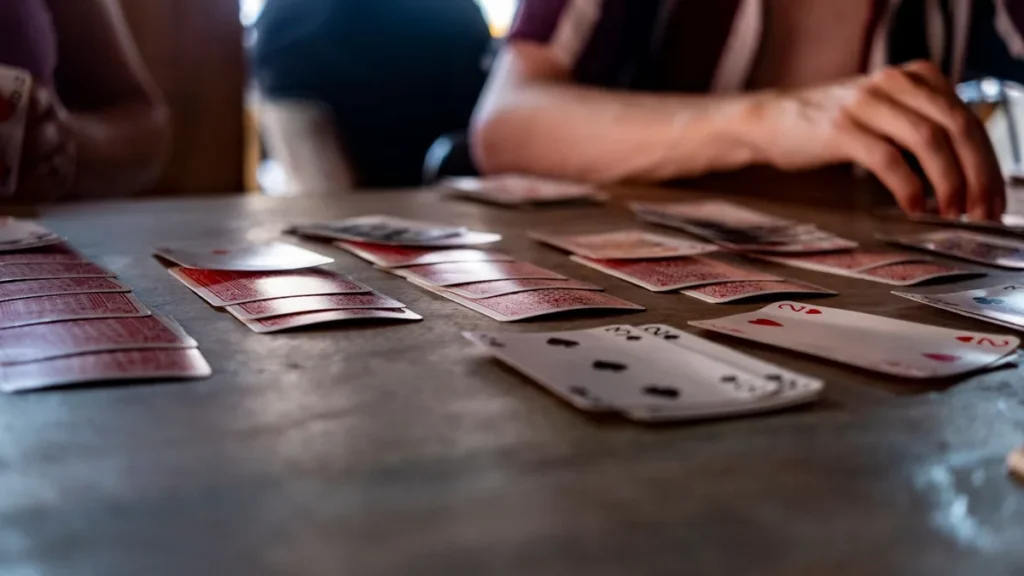
A hall holding 502 people sounds impossible for card games, until you stop picturing one table. Picture a hall full of tables instead, each running a short, lively card game, with teams rotating and scores adding up across the room. That is how a 502-player card night works, and it is far more fun than one long game that leaves most people watching.
The trick is picking games that teach in two minutes, finish inside an hour, and still feel fair when strangers sit down together. Every game below does that, and every one runs well as a station with several copies going at once. If you are planning a school fair, a company social, or a community hall night, the best card games for kids can help with the younger tables, while the nine games below carry the main hall.
You do not need 502 copies of anything. You need nine strong stations, clear hosts, a simple scoring sheet, and a rotation that keeps nobody waiting long. This guide gives you the nine games, the format that holds them together, a checklist for the night, and answers to the questions hosts ask most.
Key Takeaways
- A 502-player night means stations, not one table: nine games, many copies, and teams that rotate.
- Pick games that teach in two minutes and finish inside an hour.
- Mix loud, fast games with quiet ones so every guest finds a home.
- Give each station a host, a timer, and a simple scoring sheet.
- Run two or three rounds, add up the team totals, and finish with one clear winner.

The Nine Games at a Glance
Short games suit busy stations, while longer co-operative games suit teams that want to sit together for a full hour.
| Game | Players at one table | Round length | Best huge-group role |
|---|---|---|---|
| Archaeology: The New Expedition | 2–5 | About 20 minutes | Trading station |
| Circle the Wagons | 2 | About 15 minutes | Two-player station |
| Dead Man’s Draw | 2–4 | About 20 minutes | Push-your-luck station |
| The Lost Expedition | 1–5 | About 45 minutes | Expedition station |
| Aeon’s End | 1–4 | About 60 minutes | Co-operative boss station |
| The Lord of the Rings: The Card Game | 1–4 | About 60 minutes | Quest station |
| Pictomania | 3–6 | About 30 minutes | Drawing station |
| Sprawlopolis | 1–4 | About 15 minutes | City-building station |
| Onirim | 1–2 | About 15 minutes | Quiet co-operative corner |
How a 502-Player Card Night Works
Divide the hall into nine stations, one for each game below, and give every station at least two copies of its game. Split your guests into teams of four to six, hand each team a scoring sheet, and let them visit three stations, spending about half an hour at each one. A host at every station teaches the rules and writes down the team total before the next rotation.
Scoring stays simple on purpose. Each station awards points for a win, for a strong finish, and for good play, and the team with the highest total across its three stations wins the night. Keep the points visible on a large board near the door, so teams can watch the totals move. For a grown-up evening, the best card games for adults give you more ideas for the late tables.
Leave one station free as a practice table, with a host who teaches anyone who arrives early or wants a second try. That table stops queues, gives nervous guests a gentle start, and lets late arrivals join in without holding up a team. End the night with a short final round at the two most popular stations, then read out the totals and hand over a small prize while the energy is still high.
The 9 Best Card Games for 502 Players
1. Archaeology: The New Expedition
Players at one table: 2–5 · Round: about 20 minutes
Archaeology: The New Expedition is a bright trading game from Phil Walker-Harding, published by Z-Man Games. Players dig through a shared pile of artefact cards, gather matching pieces, and sell complete groups at the market for points. A thief card can steal from the player with the most unprotected treasure, which keeps everyone watching each other.
It works well as a station because the rules fit on one small card and a round ends before anyone gets bored. New players grasp the idea in a single turn: take a card, keep what matches, sell what is complete. The market gives every table a talking point, and the thief adds a laugh without ever feeling cruel.
Run it with three copies at one station and let two teams play side by side, comparing totals at the end of the round. Award station points for the highest total, and give a small bonus for a complete group of five matching artefacts sold in a single turn.
2. Circle the Wagons
Players at one table: 2 · Round: about 15 minutes
Circle the Wagons is a tiny two-player game from Button Shy, designed by Steven Aramini. Eighteen cards form a ring on the table, and the two players take turns picking cards from the ring to build a small frontier town. Each card shows icons for buildings, animals, and land, and points come from matching icons and the shape of the town you build.
It earns its place here as the perfect two-player station. Couples, friends, and colleagues can sit down for a quick, thoughtful duel while their team-mates play louder games nearby. The whole game fits in a wallet-sized case, so a host can carry six copies in one pocket.
Run it as a ladder: winners stay at the table and face the next challenger, while the host records every win on the team sheet. Fifteen minutes is enough for a full game, so a team can fit two or three duels into one rotation.
3. Dead Man’s Draw
Players at one table: 2–4 · Round: about 20 minutes
Dead Man’s Draw is a pirate push-your-luck game from Stonemaier Games, and one of the easiest games here to teach. On your turn you flip cards from the deck one at a time, keeping the treasure you reveal. Flip a card that matches a suit already in front of you, and your turn ends with nothing kept, so every flip is a small gamble.
Each suit brings its own trick, from cannons that let you steal to mermaids that let you look ahead, which means a lucky flip can turn a losing table around in seconds. That swing keeps spectators leaning in around a table where someone is deciding whether to flip one more card. It is the loudest station in the hall, and the one hosts love most.
Run it with a visible score sheet and a bell for the table, so the whole room hears when a big gamble pays off. Let each team play two short games in a rotation and add the totals, so one unlucky flip never decides the evening.
4. The Lost Expedition
Players at one table: 1–5 · Round: about 45 minutes
The Lost Expedition, from Osprey Games and designed by Peer Sylvester, sends a small team into the jungle to find a lost city. Players share a group of explorers, play cards to move through jungle, desert, and mountains, and manage food, ammunition, and health as the journey grows harder. The group either reaches the lost city together or loses its explorers along the way.
It suits a huge-group night because the shared journey needs no competitive edge. Guests who have never played a card game before can still follow the story while the host explains the rest. The co-operative shape also means a shy guest can ask for help without ever feeling exposed.
Run one session per rotation, with a host who manages the encounter cards and keeps the pace moving. Award station points for reaching the lost city, with a bonus if the group finishes with explorers to spare.
5. Aeon’s End
Players at one table: 1–4 · Round: about 60 minutes
Aeon’s End, from Indie Boards and Cards, is a co-operative game about breach mages defending a city called Gravehold from a powerful nemesis. Players cast spells through breaches, buy new spells and relics, and work together to bring the nemesis down before the city falls. Used cards go back on top of your pile in the order you chose, so careful players can plan their next turns with real confidence.
It is the deepest game in this list, and it belongs at the station for guests who want a proper challenge. The shared enemy gives the table a single focus, and a win against a tough nemesis feels like a genuine team achievement. Hosts should pick an easier nemesis for a public night, so most tables finish with a win.
Run it as the hall’s headline station, with one table, one host, and a sign-up sheet for teams who want the full hour. Keep a second copy ready for the next team.

6. The Lord of the Rings: The Card Game
Players at one table: 1–4 · Round: about 60 minutes
The Lord of the Rings: The Card Game, from Fantasy Flight Games, sends a small company of heroes on a quest through Middle-earth. Each player controls heroes and allies, faces the dangers in the encounter deck, and works with the table to complete the quest before the threat grows too high. It is fully co-operative, so the table either succeeds together or falls together.
It works as a quest station because the story carries the evening. Guests who know the books and films will smile at familiar names and places, while newcomers can follow the quest cards one stage at a time. A good host reads the quest text aloud, which turns a card game into a small piece of theatre that onlookers enjoy as much as the players.
Run it with a pre-built hero group for each table, so nobody builds a hand before playing. Let teams attempt the opening quest, award station points for each stage completed, and keep a spare copy of the quest cards for the next team.
7. Pictomania
Players at one table: 3–6 · Round: about 30 minutes
Pictomania, designed by Vlaada Chvátil, is a drawing game where everybody draws at the same time. Each player gets a secret word, draws it as fast as they can, and then tries to guess what everyone else drew. Points go to quick guessers and to clear drawers.
It is the noisiest station in the hall, and that is exactly why it belongs here. There is no waiting for a turn, no quiet thinking while others watch, and no way to hide at the back of the table. Even guests who say they cannot draw will laugh at their own sketches, and the guesses are usually funnier than the drawings.
Run it on a large table with plenty of paper and thick pens, and let the host call time loudly so every round ends together. Two rounds fit neatly into one rotation, and the team with the best combined total takes the station points.
8. Sprawlopolis
Players at one table: 1–4 · Round: about 15 minutes
Sprawlopolis, from Button Shy, builds a whole city from just eighteen cards. Players lay cards side by side to form roads, parks, homes, and factories, then score the finished city against three scoring cards drawn at the start. Every placement matters, because a road that helps one scoring card can hurt another.
It earns a station as the quiet, clever game of the night. Teams who want a break from the noise can sit down, talk through each placement, and enjoy a puzzle that rewards care over haste. The tiny box also means a host can keep four copies on one small table.
Run it as a score-chasing station: each team plays twice in a rotation and keeps its better total. Write the best totals on a small board beside the table, and watch teams come back later in the evening to beat the number they left behind.
9. Onirim
Players at one table: 1–2 · Round: about 15 minutes
Onirim, designed by Shadi Torbey and published by Z-Man Games, is a gentle co-operative game about escaping a dream maze. Players search a deck of dream cards for eight doors, using matching symbols to open each one, while nightmare cards threaten to close doors and undo their progress. The art is calm and strange, and the whole game feels like a quiet puzzle shared between two people.
It belongs here as the calm corner of a loud hall. Some guests arrive tired, some want a slow start, and some simply prefer a quiet game with one other person. Onirim gives them all a home, and a win feels satisfying even though nobody else in the room noticed it.
Run it with soft lighting and a small table away from the drawing station, and let guests play as many times as they like inside one rotation. Award station points for each door opened, so even a team that does not finish the maze still leaves with something to show for its effort.
Your 502-Player Card Night Checklist
- Book a hall with at least nine tables, plus one practice table near the door.
- Buy or borrow two copies of every game, and check every box is complete before the night.
- Recruit one host per station, and give each host a one-page rules summary and a timer.
- Print a scoring sheet for every team, with space for three stations and a final total.
- Put water, paper, and pens on every table, and keep spare cards and sleeves in a box at the front.
- Plan the final round early, so the prize-giving happens while the room is still full and lively.
Frequently Asked Questions
Can one card game really work for 502 players?
No single table can hold 502 players, and no game in this list tries to. The hall is divided into stations, each running the same short game for a small group, and teams rotate between stations while a shared scoreboard keeps the whole night together.
How many copies of each game do I need?
Two copies per station is the safe minimum, and three is better for the busiest games. With two copies, one table can play while the next team watches and learns, which keeps the rotation moving without long waits.
What if some guests have never played a card game before?
Start them at the practice table, then send them to Archaeology: The New Expedition or Sprawlopolis. Every station has a host whose job is to teach, not just to watch, so nobody has to learn the rules from a booklet alone.
How long should the whole evening last?
Plan for about three hours: arrival, three rotations of half an hour, and a short final round. Shorter evenings feel rushed with this many guests, while longer ones leave the last teams tired and the hall half empty.
Do teams need to stay together all evening?
Teams of four to six work best, and keeping them together helps the scoring. If a guest wants to leave a team and try a quiet game alone, let them play Onirim or Sprawlopolis at the calm corner and rejoin their team for the next rotation.
What makes a good prize for the winning team?
Keep it small and shared: a box of chocolates, a pack of new card sleeves, or a voucher for the next game night. The prize matters far less than the scoreboard, the laughter, and the feeling that the whole hall played together.
The Bottom Line
A 502-player card night is built from small pieces: nine good games, nine kind hosts, and a rotation that keeps every guest playing instead of watching. Pick games that teach fast, finish on time, and welcome strangers, and the hall will look after itself. For more ideas in the same spirit, the huge-group card games in our earlier guide use the same station format with nine different games.
Start with the checklist, book your hall, and invite your 502 players. By the end of the night, the exact number matters far less than the tables full of people who stayed, played, and asked when the next one will be.


