Five hundred and two players is not a party. It is a small town arriving at once, of all ages and energy levels. A single game for everyone at the same time would leave most people standing around, watching a few confident players take over. The trick is to stop thinking of the day as one big game and start thinking of it as a festival with nine clear stations, each built to keep a large group moving and laughing.
The plan in this guide splits 502 players into ten teams of 50, with two extra players acting as roving scorers who float between stations, settle close calls, and keep the scoreboard honest. Each team has a captain, a colour, and a simple scorecard, and the teams move from station to station in a fixed order. Nobody waits long, because every station runs in short heats and every game splits its team into smaller squads.
What makes these nine games work at this size is that each one has a job for everyone. Some players throw, bounce, or balance, while others spot, count, or keep time. A quiet player can be the best spotter or counter on the team, and a loud player can be the best starter or cheerleader. If your guest list shifts by a couple of people, our guide to party games for 500 players shows how a slightly smaller gathering runs on the same station system, and the timetable there transfers directly to this plan.
Key takeaways
- Split 502 players into ten teams of 50, with two roving scorers.
- Run nine stations in short heats so every squad plays often and nobody queues for long.
- Pick games that give every player a job, from throwing and balancing to spotting and cheering.
- Score every station the same way, with points for taking part as well as for winning.
- Finish with one clear winner, small prizes, and a group photo before everyone heads home.
How to Run a 502-Player Party Day
Start with the field, not the games. You need one large open space divided into nine marked zones, each about the size of a tennis court, with a walkway between them and a central meeting point for the scoreboard. Mark every zone with flags in the team colours, with a water point and a shaded rest area at each end of the field. If your guest list is two people smaller, our guide to party games for 498 players runs on the same station system, and its timetable transfers directly to this plan.
Give every team a captain before the day begins, and brief the captains together the evening before. A captain keeps their team together, reads out the rules at each station, and hands in the scorecard at the end of every heat. Pick captains who are organised rather than loud, because the loudest person is often the worst at counting. The two roving scorers are your safety net: they watch the busiest stations and settle arguments quickly.
Run the day in five rounds of about forty minutes, with a ten-minute break between rounds. In each round, every team plays one station, so after five rounds each team has tried five games, and a short final round lets teams revisit a favourite station. Keep every heat to ten minutes or less. Short heats are the whole secret at this size: they keep energy high, they let shy players take a turn without a long audience, and they stop one strong team from dominating a station all morning.
Score simply and visibly. Give ten points to the winning squad at each station, seven to the runners-up, five to everyone else who finishes, and two bonus points for the best team spirit, judged by the station leader. Write the scores on a big board at the central meeting point after every round. A visible scoreboard does more for the mood than any speech: teams that are behind push harder, and teams that are ahead guard their lead.
Plan for the weather and for tired legs. Book a covered area for sudden rain, keep a first-aid kit and a phone at the central meeting point, and build a quiet corner with chairs and water for anyone who needs a rest. The games below are all low-impact enough for mixed ages, but five hundred people in the sun still need shade and water.
Party Games for 502 Players at a Glance
| Game | Players per heat | Space needed | Kit needed |
|---|---|---|---|
| Mega Boomerang Catch Rally | 20 throwers, 20 catchers | Wide open field | Foam boomerangs, cones |
| Giant Pogo Stick Bounce Rally | 10 riders per squad | Flat marked lane | Pogo sticks, helmets |
| Mega Trust Fall Catch Circle | 12 per circle | Soft grass patch | Mats, blindfolds |
| Giant Snail Racing Showdown | 10 snails per heat | Long low table | Snails, lettuce, lanes |
| Mega Paper Plate Spin Challenge | 15 spinners per squad | Small flat circle | Paper plates, sticks |
| Giant Unicycle Balance Rally | 8 riders per squad | Flat paved area | Unicycles, helmets |
| Mega Improv Scene Jam | 12 performers per squad | Shaded open area | Prompt cards, timer |
| Giant Air Hockey Showdown | 4 players per table | Covered tables area | Air hockey tables, pucks |
| Mega Rock Paper Scissors Tournament | 2 per bout, squads of 10 | Open standing area | Scorecards, whistle |
The 9 Games
Each game below runs at its own station with its own leader, kit, and scoring rule. Read the two paragraphs for each game, then hand the kit list to your station leader.
1. Mega Boomerang Catch Rally
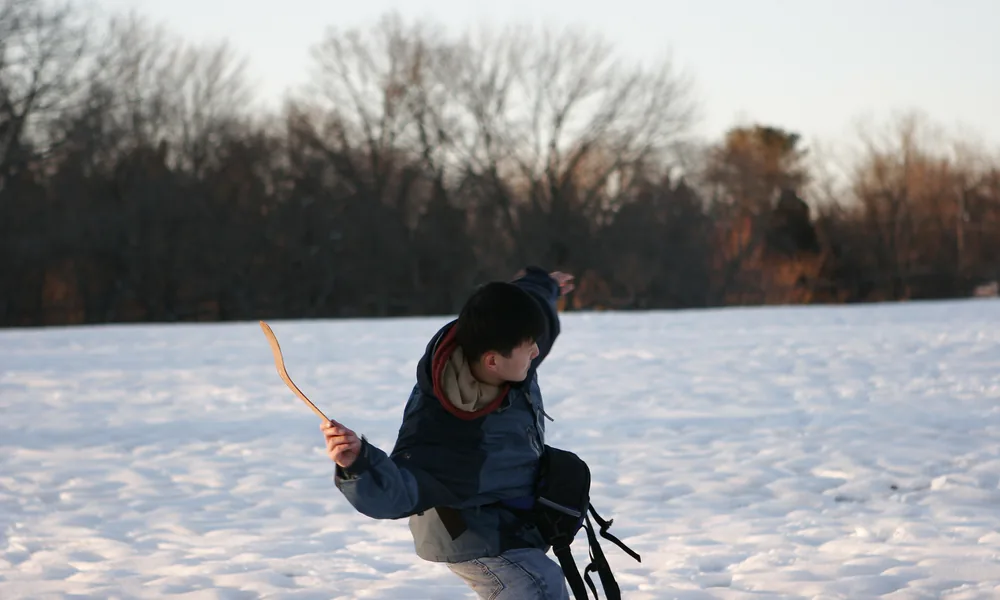
Boomerangs are the friendliest throwing game ever made, because a good throw comes back to you. Each squad gets soft foam boomerangs and a marked throwing lane on the open field. One player throws, the boomerang loops out and returns, and a team-mate tries to catch it cleanly with both hands. Every clean catch scores a point, and every throw that returns inside the lane scores too.
At 502 players this works because throwing and catching are separate jobs. While one squad throws, the next squad stands behind the line as catchers and spotters, calling out the wind and warning the thrower when the lane is clear. Rotate throwers every five minutes so arms stay fresh, and keep spare boomerangs ready.
2. Giant Pogo Stick Bounce Rally
Pogo sticks turn a simple bounce into a proper contest, and they are far easier to learn than they look. Each rider gets a helmet and a pogo stick, and the squad must bounce along a marked lane, round a cone, and bounce back without stepping off. Every completed trip scores a point, and a rider who falls off simply walks back to the start and tries again.
With ten riders per squad, the station hums along: one rider bounces, one waits at the turn cone as a spotter, and the rest cheer from the side and count the trips out loud. The squad score is the total number of completed trips in ten minutes. Swap riders every two minutes so legs stay fresh.
3. Mega Trust Fall Catch Circle
Trust falls are the quietest game on the list and often the one people remember most. Twelve players form a tight circle, shoulder to shoulder, and one player stands in the middle, arms folded, and falls backwards into the waiting hands of the circle. The circle catches gently and steadies the faller upright again. Then the next player takes the middle, until everyone has fallen and everyone has caught.
For 502 players, trust falls work because they need no speed and no skill, only attention. Each squad runs its own circle on a soft grass patch with mats underneath, and a station leader checks every circle before the first fall: feet planted, hands ready, no gaps. A circle earns a point for every clean fall and catch, and a bonus point when every member has taken a turn in the middle.
4. Giant Snail Racing Showdown
Snail racing is the slowest contest on the planet and the funniest to watch, which is exactly why it belongs at a huge party. Each heat lines up ten snails in painted lanes on a long low table, with a lettuce leaf at the far end. The crowd leans in and cheers, and the first snail to reach the lettuce wins the heat.
Scaling this to 502 players is easy because watching is half the game. Each squad picks a snail, names it, and sends two handlers to the table while the rest crowds around the edge and cheers it on. Handlers may not touch their snail once the heat starts. The winning snail of each heat goes through to a grand final, and the squad whose snail wins the final takes the station.
5. Mega Paper Plate Spin Challenge
Spinning a paper plate on a stick looks easy until you try it, and that gap is what makes it such a good party game. Each player gets a thin stick and a light paper plate, and the aim is to keep the plate spinning on the tip for as long as possible. A good spin lasts a minute or more, a wobbly one lasts three seconds.
Fifteen spinners per squad stand in a small flat circle with plenty of elbow room, and the station leader times each spin with a stopwatch. The squad score is the total spinning time across all fifteen players in a ten-minute heat, so a steady player who keeps a plate turning for a full minute is worth more than a flashy player who spins fast and drops it. Keep a big box of spare plates under the table.
6. Giant Unicycle Balance Rally
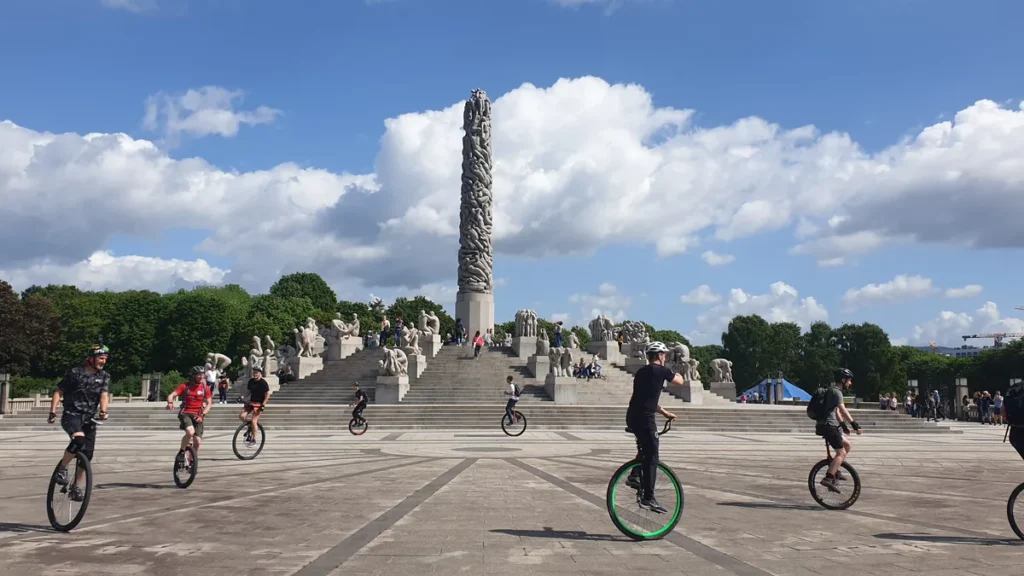
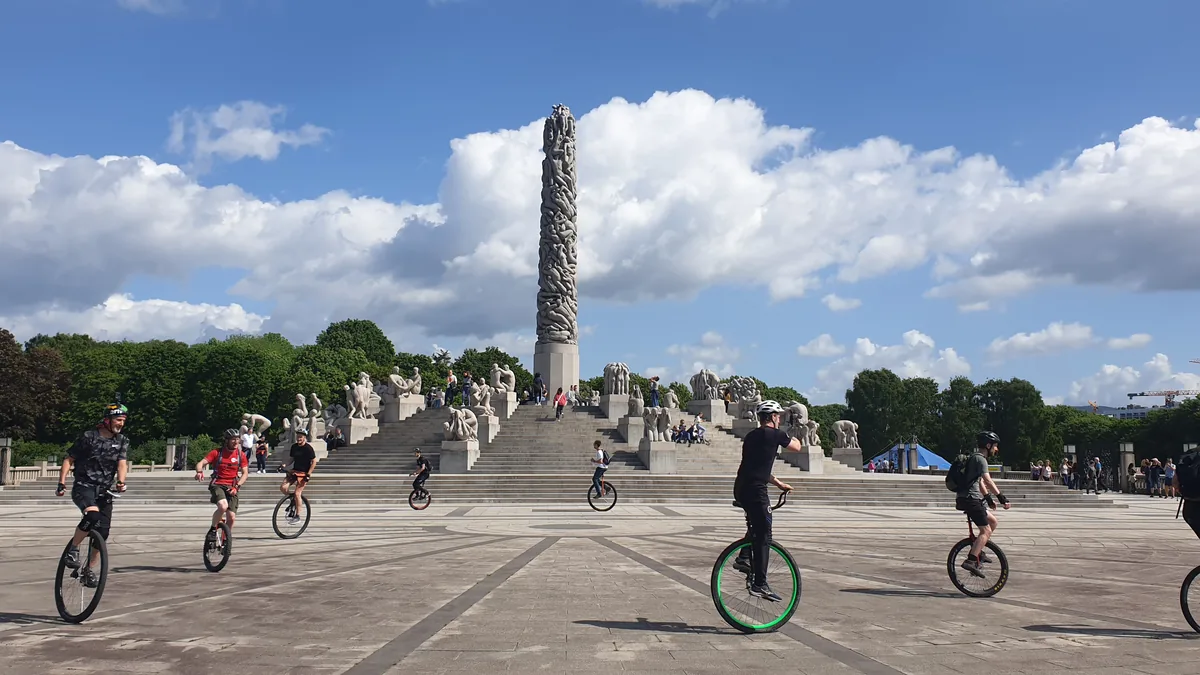
Unicycles look impossible and feel wobbly for the first minute, and then something clicks and the rider is gliding. Each squad gets two unicycles and a flat paved area with a marked course. Riders take it in turns to ride the course, with a helper walking beside them for the first few metres, and every completed lap scores a point. Helmets are compulsory.
Eight riders per squad means the station never queues for long: one rider rides, one waits at the start with the next unicycle, and the rest stands along the course as spotters and cheerleaders. The squad score is the total number of completed laps in ten minutes, and a rider who finishes a lap without touching the ground earns a bonus point. It is the most watched station on the field.
7. Mega Improv Scene Jam
Improv is making up a short scene on the spot, and it is the funniest game on this list by a wide margin. Each squad of twelve gets a prompt card with a place, a job, and a silly problem, and has two minutes to act out a scene for the station leader and the next squad. There are no scripts and no right answers: the points go to the squad that commits hardest and keeps the scene moving.
For a crowd of 502, improv works because it needs nothing but people and a prompt. The station sits in a shaded open area with a low platform and chairs for the audience, and every squad performs once per round while the next squad waits in the wings. The station leader scores each scene out of ten for energy, teamwork, and laughs.
8. Giant Air Hockey Showdown
Air hockey is fast, loud, and gloriously simple: two players, two strikers, one puck, and a cushion of air that lets the puck fly. Each table runs two-minute bouts, first to five goals, and the winner stays on while the next challenger steps up. The tables sit under cover in a row, with a queue lane marked on the ground.
Four players per table per bout sounds small for 502 players, but the queue is part of the game: squads send their players in pairs, and while one pair plays, the rest watches, studies the angles, and works out how to beat the table champion. Each squad earns a point for every bout its players win. Keep spare pucks and strikers in a box under each table.
9. Mega Rock Paper Scissors Tournament
Rock paper scissors is the oldest game on this list and the easiest to run for a huge crowd, because everyone already knows the rules. Two players face each other, count to three, and throw. Rock beats scissors, scissors beats paper, paper beats rock, and a draw means throw again. Squads of ten line up opposite each other, and each pair plays the best of three throws.
The tournament runs as a ladder: winners stay in, losers join the cheering line, and the last player standing from each squad goes through to a grand final at the central meeting point. It needs no kit beyond scorecards and a whistle, and it works for every age. The final itself is the loudest five minutes of the whole day, with five hundred people counting to three at once.
Party Day Checklist
Work through this list the day before the party, and again on the morning of the event. It follows the same station order as our guide to party games for 496 players, so a crew that has run that day will already know the rhythm.
- Confirm the ten captains, hand each one a colour, a scorecard, and a printed timetable, and brief them together the evening before.
- Mark the nine zones with flags, put a water point and shade at each end of the field, and place the scoreboard at the central meeting point.
- Check every station kit against the table above, including helmets, mats, and spare snails, plates, pucks, and boomerangs.
- Set up the first-aid kit, a phone, and a quiet corner with chairs and water at the central meeting point.
- Brief the two roving scorers on the scoring rules, give them whistles, and agree on how they settle a close call without stopping the game.
- Buy small prizes for every station winner, plus one big prize for the overall winning team.
Frequently Asked Questions
Can 502 players really play the same nine games?
Yes, because nobody plays all at once. The crowd splits into ten teams of 50, each team splits into smaller squads at each station, and every station runs in short heats. At any moment about a tenth of the crowd is playing, a tenth is watching and cheering, and the rest are moving between stations or resting.
What is the best team size for 502 players?
Ten teams of 50 is the sweet spot, with two extra players as roving scorers. Teams of 50 are big enough to fill every station squad and small enough for a captain to know every face. If a team drops to 48 or rises to 52 on the day, the plan still works.
How much space do we need for 502 players?
Plan on a field roughly the size of two football pitches, divided into nine zones each about the size of a tennis court, with a walkway between them. The boomerang lane needs the widest open space, the unicycle course needs flat paving, and the air hockey tables need cover, so map those three first.
How long does a full day of nine games take?
About five hours of play plus breaks. Five rounds of forty minutes, with ten-minute breaks between rounds, covers five stations per team, and a short final round lets teams revisit a favourite station for bonus points. Add an hour at the start for arrival and the captain briefing, and half an hour at the end for the grand finals and prizes.
What equipment should we buy first?
Buy the safety kit first: helmets and knee pads for the pogo sticks and unicycles, and mats for the trust falls. Then buy the kit that is hardest to borrow: foam boomerangs, pogo sticks, unicycles, and air hockey tables. Paper plates, sticks, prompt cards, and scorecards are cheap, so leave those until last.
What if our guest list is smaller than 502 players?
The plan scales down cleanly. With 400 players, run eight teams of 50 and keep the same nine stations. With 250 players, run five teams of 50 and shorten each round to thirty minutes. The games, the scoring, and the timetable all stay the same, so you can confirm the final headcount a week before the day.
The Bottom Line
A party for 502 players works when the day is built around teams, stations, and short heats, rather than one big game that leaves most people watching. Split the crowd into ten teams of 50, give every team a captain and a colour, and let nine simple games do the work. Mix throwing, bouncing, balancing, catching, spinning, acting, and the oldest hand game in the world, score every station the same way, and finish with one clear winner and plenty of small prizes. Do that, and the crowd will remember the day as a festival.