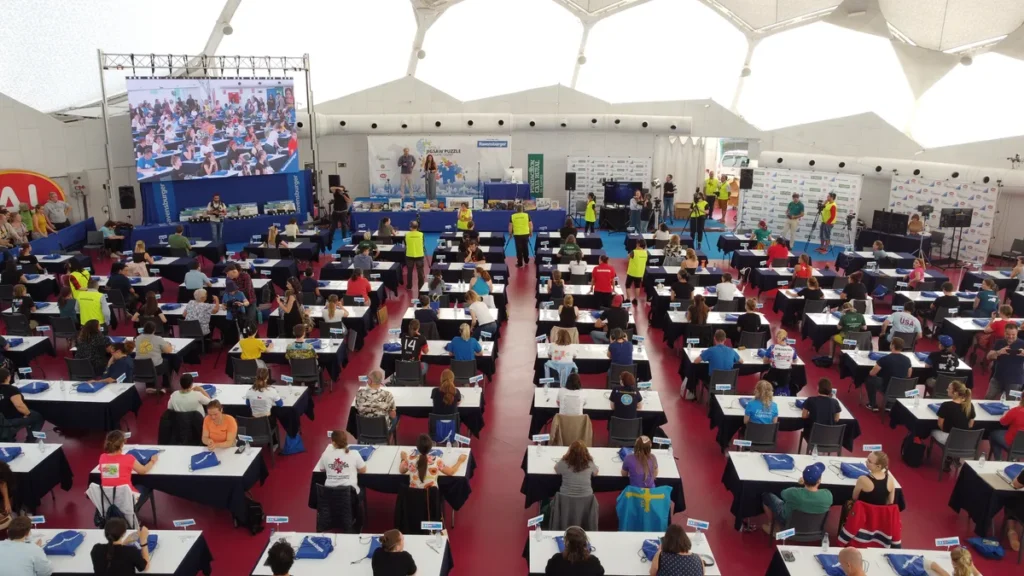
Five hundred and four players is not a party. It is a small town arriving at once, of all ages and energy levels, and a single game for everyone at the same time would leave most people standing and watching. The day has to be built the other way round: small squads, short heats, nine stations, and a scoreboard everyone can see from anywhere on the field.
The nine games below were picked for a crowd this size. Every one of them works with squads of ten to twenty, needs kit you can buy or borrow in bulk, and can be learned in two minutes by people who have never played it before. Music, movement, quick thinking, and teamwork are all in the mix, and no single game asks for speed, strength, or skill alone, so every squad has a fair shot at winning points.
Split the crowd into twelve teams of 42, give each team a colour and a captain, and run the stations in rotation so every team visits every station once. If you are still settling the format, the party games for 502 players show how a crowd only slightly smaller can be split into stations and kept moving all day.
Key takeaways
- Split 504 players into twelve teams of 42, each with a captain and a colour.
- Run nine stations in short heats so every squad plays often and nobody queues for long.
- Give every station one leader, one printed scorecard, and one clear scoring rule.
- Keep each heat to ten minutes or less, with a horn or whistle to rotate.
- End the day with a short final round where the top four teams meet head to head.

How to Run a 504-Player Party Day
Start with the field, not the games. You need one large open space divided into nine marked zones, each about the size of a tennis court, with a walkway between them wide enough for a whole team to pass without blocking the next game. Put the loudest stations, the music and the bell, at opposite ends of the field so their sound does not clash, and put the quiet station, the guessing game, in the middle where it is sheltered.
Brief your captains the evening before, not on the morning of the party. Hand each captain a colour, a printed scorecard, and the rotation schedule, and walk them around the nine zones so they know where their team starts and where it goes next. On the day itself, one person runs the horn, one person runs the scoreboard, and nobody else gives orders, because a crowd this size follows one voice far better than twelve.
Party Games for 504 Players at a Glance
| Game | Players per heat | Space needed | Kit needed |
|---|---|---|---|
| Mega Kazoo Band Parade | 12 marchers | A marked loop | Kazoos, sashes, whistle |
| Giant Xylophone Note Race | 10 runners | A flat lane | Floor bars, mallets, tune cards |
| Mega Line Dance Step Rally | 20 dancers | A flat dance floor | Speaker, playlist, floor lines |
| Mega Vine Swing Relay | 10 swingers | A swing lane with mats | Ropes, frame, mats, helmets |
| Mega Strongman Bell Ring Rally | 12 strikers | A clear striking zone | High striker, mallets, cones |
| Mega Clown Shoe Shuffle Race | 12 shufflers | Two marked lanes | Oversized soft shoes, cones |
| Mega Wink Murder Rally | 20 players in a circle | A shaded circle | Role cards, a hat |
| Mega Backpack Pack-and-Go Race | 10 packers | A packing table and lane | Backpacks, kit lists, gear |
| Mega Silent Line-Up Rally | 20 players in a line | An open line | Month cards, a marked line |
The 9 Games
Each game below runs at its own station with its own leader, kit, and scoring rule. Read the two paragraphs for each game, then hand the kit list to your station leader and let them run it.
1. Mega Kazoo Band Parade
Kazoos turn a crowd into a marching band in about thirty seconds, because nobody needs to read music and nobody can play a wrong note badly enough to matter. Each squad of twelve gets a kazoo, a sash in the team colour, and a simple tune with four notes, and then they march a marked loop while a leader keeps the pace with a whistle. Judges score timing, volume, and spirit, so the loudest squad does not always win.
The fun is in the march, not the music. Squads add a silly step, a wave to the crowd, or a sudden stop and start, and the crowd cheers the ones who commit to it. Keep each turn to one loop of the course, swap the tune for the next squad, and hand out bonus points for the best team chant at the finish line.
2. Giant Xylophone Note Race
A floor xylophone is a row of wide coloured bars laid out on the ground, and the race is simple: play the tune in order, one note per player, as fast as you can. Each squad of ten gets a tune card with eight notes on it, and the players run to the bars in turn, strike their note with a soft mallet, and run back to tag the next player. A wrong note costs five seconds, so steady feet beat wild sprinting.
Start with tunes everyone knows, a nursery rhyme or a simple folk song, and save the tricky tunes for the final round. The bars are big enough that even a player who has never held a mallet can hit the right one, and the sound carries across the whole field, so the crowd always knows when a squad is close to finishing. The 500-player line-up uses the same station model, and the party games for 500 players show how the rotation works when the crowd is nearly this big.
3. Mega Line Dance Step Rally
Line dancing works for a huge crowd because everyone faces the same way, follows the same steps, and nobody needs a partner. A caller teaches a short routine of about thirty-two steps, the squad practises it twice in rows, and then performs it to music while two judges watch for timing and togetherness. The steps are simple on purpose: step, tap, turn, clap, and repeat.
Split each squad into two rows so the judges can see every dancer, and let the front row swap with the back row halfway through so nobody hides at the back all day. Give bonus points for the sharpest turn and the loudest clap, and finish with all the squads on the floor at once for one big shared routine that brings the whole field together.
4. Mega Vine Swing Relay
Vine swinging is the closest thing to flying that a party game can offer, and it looks far harder than it is. A row of ropes hangs from a sturdy frame above a marked lane, and each player swings from one rope to the next without touching the ground in the middle, then drops onto a mat and tags the next player in line. Helmets are worn by every swinger, and a leader stands beside the lane the whole time.
Short swings beat long ones, because a player who grabs the next rope early keeps moving while a player who reaches too far stalls and drops. Let nervous players take a shorter lane with closer ropes, and give the same points for a clean short swing as for a long one, so the game rewards control rather than daring. The crowd loves this station, so put a rope barrier around it and keep the viewing line well back from the mats.
5. Mega Strongman Bell Ring Rally
The high striker is the classic fairground test of strength: swing the mallet, send the puck up the tower, and ring the bell at the top. Each squad of twelve takes one swing each, and the squad scores for every bell rung plus a bonus for the highest puck that falls short. The mallet is light enough for anyone to lift, and the safety zone is marked with cones so nobody stands in the swing arc.
Technique beats muscle here, which is why the game is fair across ages. A smooth swing with a straight follow-through sends the puck higher than a wild heave, and the station leader shows the grip and the stance before the first player steps up. Keep the queue moving with one striker at a time, and let the crowd count down each swing so the whole field hears when a bell rings.

6. Mega Clown Shoe Shuffle Race
Oversized soft shoes turn a simple walk into a proper event, because every step has to be planned. Each player pulls on a pair of huge soft shoes, shuffles down a marked lane, rounds a cone, and shuffles back to tag the next player in line. The shoes are soft and light, so nobody trips badly, and the lane is flat and clear of stones.
The trick is to take short, flat steps and keep the shoes pointing forward, which is much harder than it sounds when the shoes are twice the size of your feet. Squads soon work out that a steady shuffle beats a frantic waddle, and the funniest moments come when a player tries to hurry and ends up doing a slow-motion slide instead. Give each squad two pairs of shoes so the next player can be ready while the current one is still on the lane.
7. Mega Wink Murder Rally
Wink murder is a quiet game with a loud payoff, and it needs nothing more than a circle of chairs and a hat full of role cards. One player draws the winker, one draws the detective, and everyone else is an ordinary guest. The winker catches the eye of other players and winks, and each winked player waits a few seconds and then falls over in a dramatic faint, while the detective watches the circle and tries to spot the winker.
The detective gets three guesses, and the game ends when the winker is caught or when only the detective is left standing. Good winkers are patient, winking only when the detective is looking the other way, and good detectives watch for the tiny smile that gives a winker away. Run it in heats of twenty so the circle stays tight, and keep the rounds short so every squad gets a turn at being the winker.
8. Mega Backpack Pack-and-Go Race
Packing a bag properly is a skill, and this race turns it into a timed event. Each squad gets a pile of gear, a kit list, and an empty backpack, and the first player packs the listed items in the right order, closes the bag, puts it on, and runs a short lane to the finish line. The next player unpacks, checks the list, and packs again, so every player in the squad gets a turn.
The list is the heart of the game: a water bottle at the bottom, a jacket in the middle, a map and a snack at the top, and nothing left behind on the table. A missing item costs ten seconds, and a bag that will not close costs twenty, so careful packers beat fast packers every time. Use the same kit for every squad, print the list in large type, and let the station leader check each bag before the runner sets off.
9. Mega Silent Line-Up Rally
Silence is the hardest rule in party games, and this one is built on it. A squad of twenty must line up in order of birthday, month first and then day, without speaking a single word, using only hands, fingers, and nods. The station leader starts the clock, and the squad scores for speed and for accuracy, with a penalty for every player in the wrong place.
The first minute is always chaos, with players waving numbers in the air and pointing at each other, and then a system appears: someone holds up fingers for the month, someone else points along the line, and the order settles itself. Run a second round where the squad lines up by height instead, and watch how much faster they are once they have learned to work without words. It is a calm, clever finish to a loud day, and it rewards the squads who listen with their eyes.
Party Day Checklist
Work through this list the day before the party, and again on the morning of the event. It follows the same station order as our guide to party games for 498 players, so captains who have run that day will find it familiar.
- Confirm the twelve captains, hand each one a colour, a scorecard, and a printed schedule, and brief them together the evening before.
- Mark the nine zones with flags and cones, and walk the route between them to check that a full team can pass without blocking a game.
- Test the sound system, the rotation horn, and the whistle, and keep spare batteries in the kit box at the scoreboard.
- Lay out water points and a shaded rest area, and put the first aid post where every station leader can see it.
- Print the scorecards, the rotation schedule, and the kit lists, and pack one set for each station leader.
- Check every rope, mat, helmet, and mallet before the first heat, and replace anything worn before the crowd arrives.
Frequently Asked Questions
Can 504 players really play the same nine games?
Yes, because nobody plays all at once. The crowd splits into twelve teams of 42, each team splits into smaller squads at each station, and every station runs in short heats of ten minutes or less. With nine stations running at the same time, more than a hundred players are playing in any given minute, and the rest are watching, resting, or walking to their next station.
What is the best team size for 504 players?
Twelve teams of 42 is the sweet spot, with two extra players as roving scorers if your guest list runs slightly over. Teams of 42 are big enough to fill every station squad and small enough for a captain to know every face. If a team drops below 40 on the day, merge two small squads at the quiet station rather than re-drawing all the teams.
How much space do we need for 504 players?
Plan on a field roughly the size of two football pitches, divided into nine zones each about the size of a tennis court, with a walkway between them. The swing lane and the bell station need the most room, so put them at the edges, and keep the guessing game in the middle where it is sheltered from wind and noise.
How long does a full day of nine games take?
About five hours of play plus breaks. Five rounds of forty minutes, with ten-minute breaks between rounds, covers five stations per team, and a short final round for the top four teams takes about forty minutes more. Add an hour at the start for arrival, team photos, and the captains briefing, and the whole day fits comfortably into seven hours.
What equipment should we buy first?
Buy the safety kit first: helmets and mats for the swing lane, and cones to mark every safety zone. Then buy the kit that is hardest to borrow: the high striker, the floor bars, and the oversized shoes. Kazoos, sashes, role cards, and kit lists are cheap in bulk and can be ordered last, but order them early enough that a late delivery cannot cancel a station.
What if our guest list is smaller than 504 players?
The plan scales down cleanly. With 420 players, run ten teams of 42 and keep the same nine stations. With 250 players, run six teams of 42 and shorten each heat to eight minutes. The stations, the scoring, and the rotation all stay the same, so you can set the team count once the final numbers come in.
The Bottom Line
A party for 504 players works when the day is built around teams, stations, and short heats, rather than one big game that leaves most people watching. Split the crowd into twelve teams of 42, give every station a leader and a clear scoring rule, and let the nine games do the work. Pick the kit early, brief the captains the evening before, and keep the horn loud and the scoreboard visible, and the day will run itself from the first heat to the final round.