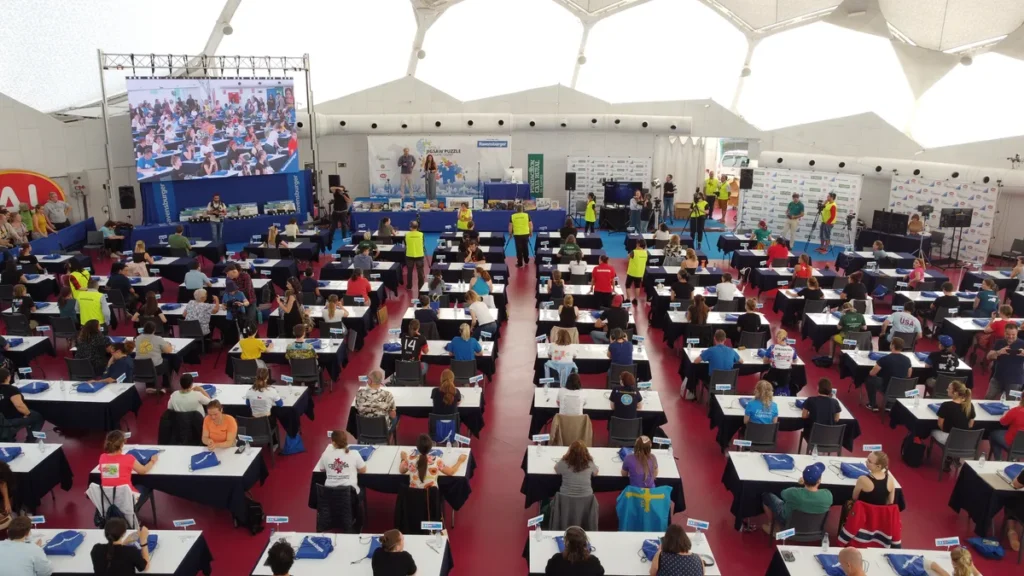
Four hundred and ninety-four players is not a party. It is a small town arriving at once, with different ages, different energy levels, and different ideas about what counts as fun. A single game for everyone at the same time would leave most people standing around, watching a few confident players take over. The trick is to stop thinking of the day as one big game and start thinking of it as a festival with nine clear stations, each one built to keep a large group moving, laughing, and taking part.
The plan in this guide splits 494 players into nineteen teams of twenty-six. Each team has a captain, a colour, and a simple scorecard, and the teams move from station to station in a fixed order. Nobody waits long, and every game can run with several teams at the same time. The games below use ordinary equipment, clear scoring, and short rounds, so the day feels busy rather than chaotic.
What makes these nine games work at this size is that each one has a job for everyone. Some players lift, carry, or run, while others sort, count, call out, or keep time. A quiet player can be the best sorter or caller on the team, and a loud player can be the best cheerleader or starter. If your guest list shifts by a couple of people, the party games for 492 players use the same station plan and the same team sizes, so the two guides work well side by side.
Key Takeaways
- Split 494 players into nineteen teams of twenty-six, each with a captain, a colour, and a scorecard.
- Run nine stations in parallel so no team waits long and every player has a clear job.
- Keep every round short, with simple rules that a new player can learn in under a minute.
- Mix lifting, running, sorting, counting, and calling games so different strengths all matter.
- Score every station the same way, and finish with one clear winner and plenty of small prizes.

Party Games for 494 Players at a Glance
Use this table to plan your space, your timetable, and your shopping list before the day begins. Every game below fits the same rotation, so you can swap the order without breaking the plan.
| Game | Team size | Space needed | Time per round | Energy level |
|---|---|---|---|---|
| Hot Air Balloon Basket Hoist Rally | 26 players | Open field | 15 minutes | High |
| Windmill Sail Turning Challenge | 26 players | Open field | 15 minutes | Medium |
| Library Book Sorting Sprint | 26 players | Covered tables | 12 minutes | Low |
| Clock Tower Chime Sequence Rally | 26 players | Open lawn | 12 minutes | Medium |
| Castle Moat Plank Crossing Race | 26 players | Long flat lane | 15 minutes | High |
| Train Ticket Punch Relay | 26 players | Marked track | 12 minutes | High |
| Market Stall Trading Challenge | 26 players | Covered tables | 15 minutes | Low |
| Firefly Jar Catch at Dusk | 26 players | Open lawn | 15 minutes | Medium |
| Circus Tent Pole Raising Rally | 26 players | Open field | 15 minutes | High |
The 9 Games
Each game below explains how to set it up, how a round works, and why it suits a group of 494 players. Read the set-up notes first, then mark out your nine stations on the morning of the party, before the first team arrives.
1. Hot Air Balloon Basket Hoist Rally
In this rally, each team works together to hoist a weighted basket up a tall frame using ropes and pulleys. The basket starts on the ground, and the team pulls in rhythm until the basket reaches a marked line near the top. A judge watches the line, calls the time, and checks that every rope stays in its guide. The team with the fastest clean lift wins the station.
The lift works because it needs timing more than strength. One strong puller cannot win alone, and a team that pulls in short, even bursts will beat a team that pulls hard and then stops. Give each team two practice pulls before the timed round, and let the captain count the rhythm out loud.
For a group of 494 players, this game is a strong opener because it is easy to watch and easy to understand. Spectators can see the basket rise, and they can cheer without getting in the way. Keep the lifting area roped off and let younger players hold the guide ropes. Safety comes first, and a slow, steady lift always beats a rushed one.
2. Windmill Sail Turning Challenge
In this challenge, each team turns a large sail frame by pulling ropes in turn, moving a marker along a track each time the sail makes a full turn. The frame is fixed to a sturdy post, and the sails are light enough for a team to move but heavy enough to need real effort. A judge counts the turns and records the time taken to move the marker from start to finish.
The challenge suits a mixed group because the work can be shared in short bursts. Four players pull for thirty seconds, then step back while the next four take over. The captain watches the marker, calls the change, and keeps the rope clear of feet. Teams that plan their changes in advance finish faster than teams that swap players at random.
At this scale, the windmill station gives tired legs a rest while still keeping arms and voices busy. It also photographs well, with the sails turning against the sky and the whole team lined up along the rope. Place this station near the centre of the field, with a shaded rest area beside it.
3. Library Book Sorting Sprint
In this sprint, each team sorts a mixed pile of books into the right order as fast as they can. The books are marked with simple coloured labels and numbers, and the team must place them on shelves in the correct sequence. A judge checks the finished shelf, counts any books in the wrong place, and adds a time penalty for each mistake.
The sprint works because it rewards calm, careful work rather than speed alone. One player reads the labels aloud, two players carry books to the shelf, and the rest check the order before the team calls time.
For 494 players, this quiet station matters more than it first seems. It gives older guests, younger children, and players who prefer thinking games a place to shine. Set the tables under cover and use large, clear labels. A steady team can win this station without running a single step.
4. Clock Tower Chime Sequence Rally
In this rally, a caller plays a short sequence of chimes on bells, drums, or metal bars, and the team must repeat the sequence in the right order. Each round adds one more note, and the team keeps going until it makes a mistake. The team that repeats the longest correct sequence wins the station.
The rally is simple to learn and hard to master, which is exactly what a party game should be. The caller stands where everyone can hear, and the players take turns striking the next note in the sequence. A good team listens together, repeats the notes softly under its breath, and lets one player keep the count on their fingers.
With nineteen teams moving through the day, this station is easy to run again and again because each team hears a fresh sequence. It needs little equipment, it works on a small patch of lawn, and it keeps a crowd quiet and focused for a few minutes.
5. Castle Moat Plank Crossing Race
In this race, each team crosses a marked moat lane using only two long planks. Players lay one plank down, step onto it, then move the second plank ahead, over and over, until the whole team reaches the far side. If a player steps off a plank, the team must send that player back to the start of the lane.
The crossing rewards planning and balance rather than speed. The tallest players can place the planks, the steadiest players can lead the line, and the captain can call out each move so nobody rushes ahead.
This station is a favourite at large parties because it looks dramatic and feels like a real adventure. The party games for 490 players use the same lane markings and plank sizes, so the same field set-up works here too. Keep the lane flat and dry, keep a helper at each end, and let every player wear flat shoes for a firm grip.
6. Train Ticket Punch Relay
In this relay, each team runs a short track between four small station posts, punching a ticket at every stop. The first runner carries the ticket to the first post, punches it, and runs back to hand it to the next runner. The team finishes when the ticket has been punched at all four posts and returned to the start.
The relay works because every runner has a short, clear job. Nobody runs far, nobody gets lost, and the handover is the part that decides the race. Practice the handover twice before the timed round, and make sure the ticket stays in one piece. A dropped ticket costs more time than a slow run.

For a group of 494 players, this game keeps the energy high in the middle of the day. The track is short, the posts are easy to see, and the crowd can cheer each handover. Mark the track with cones and keep the punches tied to their posts.
7. Market Stall Trading Challenge
In this challenge, each team runs a small market stall and trades tokens for goods. The team starts with a set of tokens and a mixed box of play goods, and it must trade with the stall keeper to end up with the highest value set. A judge checks the final set, counts the value, and records the score.
The challenge suits players who like talking, counting, and making quick decisions. One player keeps the tokens, one player checks the prices, and the rest suggest trades. The best teams trade early, keep a note of every deal, and save a few tokens for a final bargain at the end of the round.
At this size, the market station gives the day a friendly, chatty heart. It needs only tables, tokens, and play goods, and it can run under cover if the weather turns. Keep the price list large and clear, and use the same starting tokens for every team.
8. Firefly Jar Catch at Dusk
In this game, teams search a marked lawn at dusk for small glowing markers hidden in grass, behind posts, and under low branches. Each player carries a clear jar, and the team must collect as many glowing markers as it can before the time runs out. A judge counts the jars at the end and checks that every marker is real.
The catch works because it slows the day down at just the right time. After hours of lifting, running, and shouting, players walk quietly, look carefully, and work in pairs. One player spots a glow, the other checks it, and the pair moves on together.
For 494 players, this station is best run in the early evening, when the light is low enough for the markers to glow but bright enough for everyone to see where they are walking. Keep the search area flat and clear, and count the jars in the open.
9. Circus Tent Pole Raising Rally
In this rally, each team raises a set of tent poles together and holds them upright while a judge checks the line. The poles start flat on the ground, and the team lifts them in order, with the tallest pole last. A judge watches for straight poles, steady hands, and a clear call from the captain before the time stops.
The rally needs teamwork from the first second. If one side lifts too fast, the pole leans, and the team must lower it and start again. The captain calls the lift, the players on the ropes pull together, and the players at the base guide each pole into its socket. A slow, even lift always beats a fast, uneven one.
As the final station, this game brings the whole day together. It is visual, it is loud, and it ends with every team standing under its own raised poles. Keep the ground flat and let the winning team keep its poles up for a group photo. It is a fitting finish to a day built on working together.
How to Run the Day
Start with a short welcome, explain the nine stations, and send the nineteen teams out in waves. Each station runs for twelve to fifteen minutes, with three minutes to move to the next station.
Give every captain a printed map, a scorecard, and a whistle. The map stops teams from getting lost, the scorecard stops arguments about points, and the whistle helps the captain gather a scattered team. Keep a central tent with water, first aid, and spare equipment, and keep one roaming helper for every three stations.
Party Day Checklist
Work through this list the day before the party, and tick each item off as you pack it. The party games for 488 players follow the same packing plan, so you can reuse this list if your numbers change.
- Mark out nine stations, with clear signs, cones, and a safe path between each one.
- Pack ropes, planks, poles, books, bells, tickets, tokens, jars, and glowing markers, plus spares for each station.
- Print nineteen scorecards, nineteen maps, and one master score sheet for the central tent.
- Brief every captain on the rules, the rotation order, and the safety rules for their station.
- Set up water, shade, first aid, and a rest area near the centre of the field.
- Plan the prize ceremony, with one main prize and small prizes for every team that finishes.
Frequently Asked Questions
Can 494 players really play the same nine games?
Yes, because no game asks all 494 players to play at once. The players are split into nineteen teams of twenty-six, and the teams move through nine stations in turn. Each station is built for one team at a time, with jobs for every player, so everyone plays the same nine games without crowding a single space.
What is the best team size for 494 players?
Nineteen teams of twenty-six works well because 494 divides neatly into that split, and twenty-six is large enough to share the work but small enough for a captain to manage. Each team can split into smaller groups of four or five inside a station, so nobody stands idle while others play.
How much space do we need for 494 players?
You need a large field, park, or school ground with room for nine stations, paths between them, and a central rest area. A full-size sports field with space around the edges is a good guide. Keep the loud, active stations at the edges and the quiet stations, like sorting and trading, near the centre under cover.
How long does a full day of nine games take?
A full rotation takes about three hours, with twelve to fifteen minutes at each station and three minutes to move between stations. Add an hour for the welcome, a break, and the prize ceremony, and the whole day runs to about four hours.
What equipment should we buy first?
Buy the safety and marking equipment first: ropes, cones, signs, whistles, scorecards, and first aid supplies. Then buy the station equipment that is hardest to borrow, such as planks, poles, bells, and the pulley frame for the basket hoist.
Can younger children and older guests play all nine games?
Yes, with small adjustments at each station. Younger children can hold guide ropes, sort books, or punch tickets, while older guests can call sequences, keep score, or manage trades. Every game in this guide has a quiet job and an active job, so each player can choose the role that suits them best.
The Bottom Line
Party games for 494 players work when the day is built around teams, stations, and short rounds. Nineteen teams of twenty-six, nine clear games, and one simple scorecard turn a huge crowd into a festival where everyone has a part to play. The lifting games build trust, the sorting and trading games reward calm thinking, and the evening catch gives the day a quiet, memorable finish.
Keep the rules simple, keep the equipment ready, and keep the captains briefed, and the size of the group stops being a problem. Plan the space, pack the spares, and let the teams do the rest. With these nine games, 494 players can spend a full day playing together, and every player can go home with a story to tell.