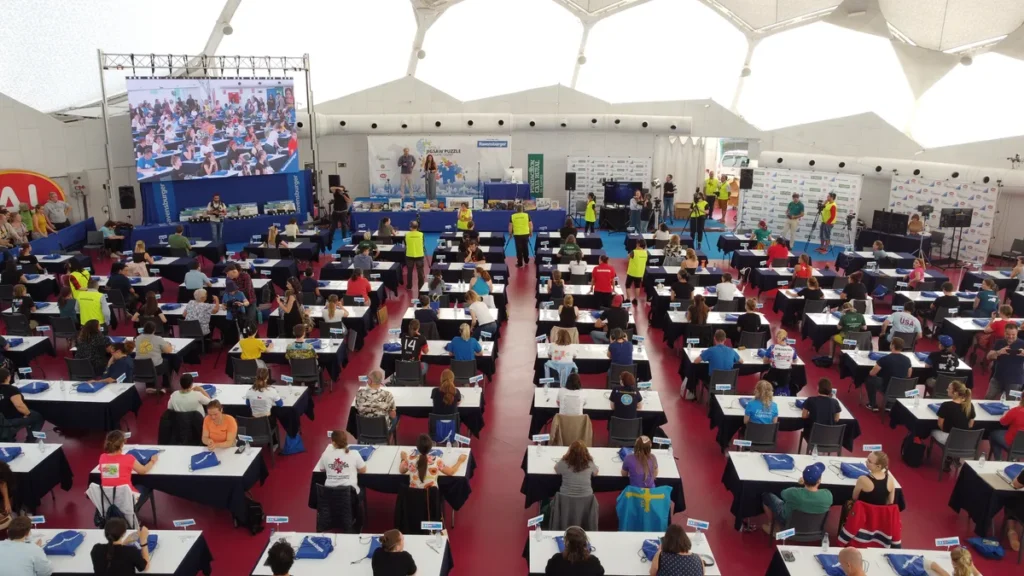
Five hundred and five players sounds like a crowd no dice game could hold together, yet a simple system turns that crowd into the best part of the night: small tables, identical kits, short rounds, and a shared theme that gives every table the same story. When each table feels like its own little workshop, nobody waits around and nobody gets lost.
This guide builds the whole evening around a toy workshop. Tables become workbenches, dice become tools, and every game borrows its spirit from the toys on a maker’s shelf: a jack-in-the-box that pops, a rocking horse that sways, a dollhouse with rooms to fill, and a spinning top that will not sit still. The theme is warm and easy to explain in one sentence, which matters when you are briefing five hundred people at once.
Below you will find a running plan, a table that maps every game to its timing and kit, nine complete games, a setup checklist, and answers to the questions every large-group host asks. Everything here was designed for huge groups, so the games scale by adding tables rather than by changing rules. If you can run one table, you can run fifty.
Key takeaways
- Split 505 players into tables of 8 to 12, and give every table the same dice kit so rounds stay in step.
- Run nine short games in rotation so every table plays every game and nobody sits out a round.
- Keep each game to one page of rules, one clear scoring move, and a single winner per table.
- Use a toy workshop theme to make instructions memorable: workbenches, tools, and toys do the explaining for you.
- Appoint one floor captain per ten tables and one scorekeeper per table, and the night runs itself.

How to Run a Toy Workshop Dice Night for 505 Players
Start by counting tables, not players. With 505 players, tables of ten give you 50 tables and five spare seats, while tables of nine give you 56 tables and one spare seat. Either layout works, so pick the one that fits your room. Set the tables in rows of ten with a wide centre aisle, and put a number card on every table so players can find their workbench without asking. A printed map at the door saves more time than any speech.
Every table needs the same kit: six standard dice, one twenty-sided die, a cup to shake in, a score pad, two pencils, and a one-page rules sheet for the game in play. Pack the kits in advance and stack them at a supply table near the door. When a round ends, scorekeepers swap the rules sheet for the next game while the floor captain calls the change, and the whole room turns over in under two minutes.
Timing is what keeps a huge night friendly. Give each game twelve minutes: two minutes to read the rules aloud, eight minutes to play, and two minutes to score and reset. Nine games at twelve minutes is just under two hours, with a ten-minute break after game four. Announce the time with a bell or a whistle rather than a microphone speech, because a short sound carries further than a long explanation in a hall this size.
Scoring stays simple on purpose. Each game names one winner per table, and that winner earns three points for their table, second place earns two, and third earns one. Tables keep a running total on their score pad, and the floor captains collect the pads at the break and at the end. The team behind the hot-air balloon dice night for 503 players used the same table-points idea, and it kept their huge hall calm and fair from the first round to the last.
Brief your helpers before the doors open. One floor captain per ten tables watches the clock, answers rule questions, and settles ties with a single extra roll. One scorekeeper per table writes down the winners and guards the dice cup. Give the captains a coloured badge and the scorekeepers a different one, so players know who to ask.
The 9 Toy Workshop Dice Games at a Glance
| Game | Players per table | Dice needed | Minutes |
|---|---|---|---|
| Dice Jack-in-the-Box Pop | 8 to 12 | 3 standard dice | 12 |
| Dice Rocking Horse Ride | 8 to 12 | 2 standard dice | 12 |
| Dice Wooden Block Stack | 8 to 10 | 4 standard dice | 12 |
| Dice Dollhouse Room | 8 to 12 | 3 standard dice | 12 |
| Dice Marble Roll | 8 to 12 | 2 standard dice | 12 |
| Dice Kite Flight | 8 to 12 | 3 standard dice | 12 |
| Dice Yo-Yo Spin | 8 to 10 | 1 twenty-sided die | 12 |
| Dice Spinning Top | 8 to 12 | 2 standard dice | 12 |
| Dice Toy Soldier March | 8 to 12 | 3 standard dice | 12 |
Each game below is written so a table can start playing within two minutes of reading it. The rules fit on one page, the scoring takes one line, and the toy workshop theme carries the flavour, so nobody needs a long introduction. Read the games in order, and you will see the night build from quick warm-ups to a marching finish.
The 9 Toy Workshop Dice Games
1. Dice Jack-in-the-Box Pop
The jack-in-the-box is the perfect warm-up because everyone knows the joke: wind it up, wait for the pop, and laugh when it jumps. Each player rolls three dice and adds the total to a shared count called the winder. The count starts at zero, and the player whose roll pushes the total to 50 or beyond springs the box. That player takes the round, and the table cheers the pop.
Play passes clockwise, and every roll is called out loud so the table can track the count together. If a player rolls three of a kind, the box pops early and that player wins at once, no matter what the count says. The early pop keeps every turn tense, even for players who are far behind. Two full rounds fit inside twelve minutes, and the table winner is the player with the most pops.
2. Dice Rocking Horse Ride
The rocking horse moves forward and back, and so does this race. Each player has a horse token on a track of twenty spaces drawn on the score pad. On a turn, a player rolls two dice: the first die moves the horse forward, and the second die moves it back by the number shown, unless the second die shows a one, in which case the horse holds still. The rocking rhythm means no lead is ever safe.
The first horse to reach space twenty wins the ride. If two horses land on the same space, both rock back three spaces, which keeps the pack close and the finish exciting. The game needs no pieces beyond the pad and a pencil, so it is the easiest game of the night to reset.
3. Dice Wooden Block Stack
Wooden blocks reward a steady hand, and this game rewards a steady total. Each player rolls four dice and must set aside at least one die per roll, building a stack of kept dice across three rolls. The catch is that the stack must total exactly 30 or as close as possible without going over. A player who passes 30 watches their whole stack tumble, and scores zero for the round.
Players decide after every roll whether to stop and bank their stack or risk another roll, so the game is really about nerve. A stack of 28 feels safe until the player next to you banks 29. The fishing dice games for 502 players use a similar bank-or-risk choice, and it works just as well here: the table goes quiet, then erupts, every single round. Highest safe stack wins the table.
4. Dice Dollhouse Room
The dollhouse has nine rooms, and each player is furnishing one room at a time. Roll three dice and match the total to a room on the chart: totals of 3 to 5 furnish the kitchen, 6 to 8 the parlour, 9 to 11 the bedroom, 12 to 14 the nursery, 15 to 16 the study, and 17 to 18 the attic. A player claims a room by writing their name in it, and no room can hold two names.
Claimed rooms earn points equal to the pips on the roll that claimed them, so a bold high roll in the attic is worth more than a safe low roll in the kitchen. The twist is that a player who rolls a total matching a claimed room must give one point to its owner, like paying rent. After twelve minutes, the player with the most points across their rooms wins, and the dollhouse is full.
5. Dice Marble Roll
Marbles are all about the roll, so this game strips everything back to two dice and a straight track. Each player rolls two dice and moves a marble forward by the total, but the track has three special spaces: space ten is a dip that sends the marble back five, space twenty is a bump that sends it forward five, and space thirty is the finish. Landing exactly on the finish wins at once.
If a roll would carry a marble past the finish, the marble bounces back the extra spaces, so an exact landing takes luck as well as speed. Players may spend one turn to nudge a rival marble back two spaces, but only once per game, and the nudge must be declared before rolling. That single nudge creates more table talk than any other rule of the night. The first marble home takes the round.

6. Dice Kite Flight
A kite needs wind, height, and a steady hand on the string, and this game gives you all three in dice form. Each player rolls three dice: the highest die is the wind, the middle die is the height, and the lowest die is the string. Add wind and height together, then subtract the string, and that is your flight score for the turn. The highest flight score after five turns wins the table.
Two special rolls change the sky. Three of a kind is a gust that doubles the flight score, and a roll of 1, 2, 3 is a tangle that scores zero for that turn. The maths is simple enough for children, and the scores stay close enough for adults to care.
7. Dice Yo-Yo Spin
The yo-yo goes down and comes back, and this game does the same with a single twenty-sided die. Each player rolls the big die once per turn and records the number. The target is 20, and the player who lands closest to 20 across five turns wins. A roll of exactly 20 is a perfect return and wins the game on the spot, no matter how many turns are left.
The twist is the rewind. Once per game, a player may rewind a bad roll by rolling again and keeping the second result, good or bad. The rewind must be used before the final turn, which forces a real decision: spend it early on a low number, or save it and hope the last roll is kind. The cinema dice games for 501 players use a one-time second chance in the same way, and it always produces the loudest moment of the round. Closest to 20 takes the table.
8. Dice Spinning Top
A spinning top stays up only while it keeps moving, and this game rewards players who keep their totals moving upward. Each player rolls two dice per turn and adds the total to a running score, but the running score only counts if each new roll is higher than the last one. A roll that is equal to or lower than the previous roll stops the top, and the player banks only half of their running score, rounded down.
Players choose when to stop spinning and bank their full running score, but a stopped top cannot start again, so stopping early is safe and stopping late is rich. The highest banked score after four rounds wins, and ties are settled with a single extra roll each.
9. Dice Toy Soldier March
The toy soldiers march in step, and the final game is a parade that the whole table marches together. Each player rolls three dice and marches forward by the total, but the march has a drumbeat: every fourth space is a drum space, and landing on one earns an extra roll at once. The first soldier to reach space forty wins the parade, and the table stands to applaud the finish.
Soldiers who land on the same space form a rank and march together, sharing the next roll, which means two players can win the same turn and share the table points. If the shared roll reaches the finish, both soldiers win, and the table records a joint victory. It is a warm way to end the night, because the final game is the only one where winning together is built into the rules. After the march, collect the score pads and announce the champion table.
Your Setup Checklist
Run through this list the day before the night, and again one hour before the doors open. A calm host makes a calm hall, and a checked list is what makes the host calm.
- Count the chairs and number the tables, leaving a wide centre aisle for the floor captains.
- Pack 56 identical dice kits with six standard dice, one twenty-sided die, a cup, a score pad, and two pencils each.
- Print the nine one-page rules sheets and the table-number cards, plus a hall map for the door.
- Choose one bell or whistle for round changes and test that it carries to the back row.
- Brief the floor captains and scorekeepers, and hand out coloured badges so players can spot them.
- Set up a supply table near the door with spare dice, pencils, score pads, and the champion table prize.
Frequently Asked Questions
How do 505 players all play at once?
They play at separate tables of 8 to 12 players, all running the same game at the same time. The hall holds about 50 tables, and every table follows the same twelve-minute round, so the whole room moves together. No player ever waits for another table to finish.
How many dice do we need for the whole night?
Each table kit holds six standard dice and one twenty-sided die, so 56 tables need 336 standard dice and 56 twenty-sided dice. Buy a few spare sets as well, because dice roll off tables in a big hall. The supply table should hold at least ten spare standard dice and five spare twenty-sided dice.
Can children play these toy workshop dice games alongside adults?
Yes, the games were written for mixed ages. The rules use adding and comparing numbers, the rounds are short, and the toy theme gives children an easy way into every game. Seat younger players with an adult at first, and they will be calling their own rolls by the second game.
What if we do not have a hall with 50 tables?
Run the night in two sittings of about 250 players each, using the same nine games and the same kits. Score each sitting separately and bring the two champion tables together for a short final round. The games do not change, only the schedule does.
How long does the full rotation take?
Nine games at twelve minutes each take 108 minutes, plus a ten-minute break after game four, which comes to just under two hours. Add fifteen minutes at the start for seating and one minute per round change, and the whole evening fits comfortably inside two and a half hours.
Do players need to know about toys already?
No, the toy workshop theme is only a wrapper for simple dice rules. A player who has never seen a rocking horse or a spinning top can still play, because every game explains its own moves. The theme makes the night memorable, but the dice do the work.
The Bottom Line
A toy workshop dice night works for 505 players because it never asks the crowd to do one big thing together. It asks fifty small tables to do one small thing at the same time, nine times in a row, and the shared theme ties it all together. Small tables, identical kits, short rounds, and simple scoring are the whole method.
Pack the kits, number the tables, brief your captains, and let the dice do the rest. By the final march, your hall will sound like one big workshop: dice rattling in cups, tables cheering their winners, and five hundred people who all played every game.