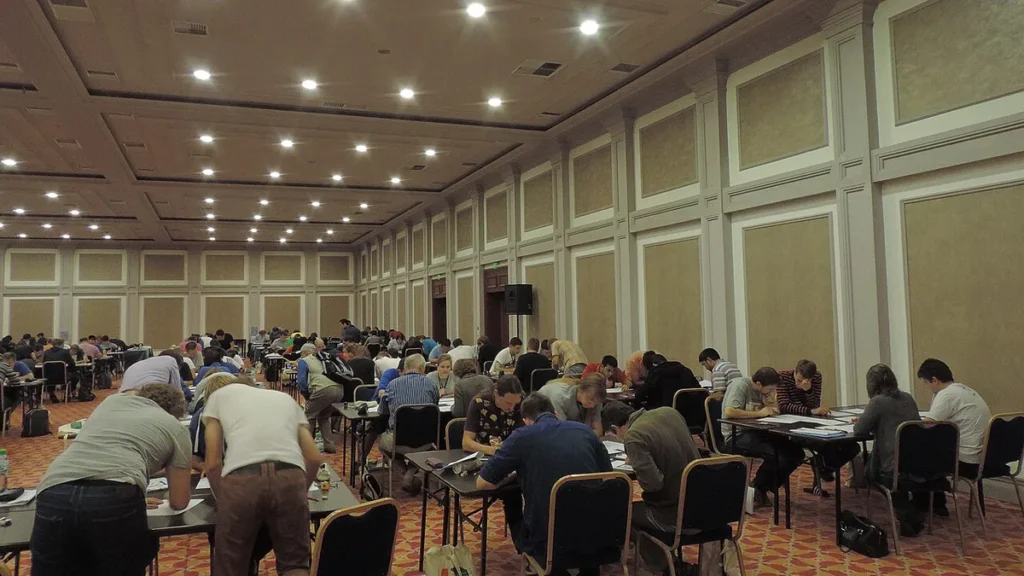
Four hundred and ninety six players in one room sounds like a recipe for noise and confusion. It can be, if everyone tries to play the same game at the same time. This plan takes a different route. It splits the crowd into 62 teams of eight players, sets up nine puzzle stations around the hall and moves every team through the same nine games on one shared timetable. Nobody waits long, and every team gets the same fair chance to win.
The games are the heart of the day. Each one is short, easy to explain in under a minute, and built for a full team of eight, so every player has a job to do. Some games reward quick thinking, some reward steady hands, and some reward a team that can agree on an answer under pressure. Points go to accuracy first, so a careful team can beat a fast team, and the leaderboard stays close all day.
This guide gives you the full plan: team sizes, station layouts, a points system, a simple tournament finish, and nine games that work for a crowd this size. If you want a second example of the same format at almost the same size, this step by step plan for 495 players shows how a similar group moves through stations. Read the plan once, print the rotation cards, and the day will largely run itself.
Key takeaways
- Split 496 players into 62 teams of eight, each with a captain and a colour band.
- Run nine stations at once, with 15 minute rounds and five minutes to move between stations.
- Award points for correct answers first, with a small bonus for finishing early.
- Give every team a printed rotation card so nobody needs to ask where to go next.
- Take the top eight teams into a short final round to decide the winners.

How 496 players fit into teams
Sixty two teams of eight is the cleanest split for 496 players, and it works because eight is a good size for a puzzle table. Everyone can reach the cards, everyone can see the board, and everyone can hear the captain. Teams of eight also make the maths simple: 62 teams and nine stations, with every team playing the same nine games in a different order.
Mix the teams on purpose. Put quick thinkers, careful checkers, builders and talkers in every team, and avoid loading one team with all the strongest players. Ask each team to pick a captain before the day starts. The captain collects the rotation card, keeps the team moving on time, and hands in the score sheet at each station. Give every team a colour band so judges can spot them across a busy hall.
Give each team a base with eight chairs and a small table, where players can rest, eat and check the leaderboard between rounds. Keep the bases around the edge of the hall and the stations in the middle, so people move in one clear direction.
How the stations work
Each station is one game, one judge and one table big enough for eight players. The judge explains the game in under a minute, starts the clock, and scores the team when time runs out. A round lasts 15 minutes, with five minutes to walk to the next station, so a full rotation takes three hours, with time for a break in the middle.
Run the stations in parallel, so all 62 teams play at the same time in different parts of the hall. A station that needs quiet, such as a listening game, goes in a far corner, while a noisy building game goes near the door. Print a large station number at every table and the same number on the rotation cards.
Keep spare kits at every station. Cards get bent, pieces go missing, and a pen runs dry at the worst moment. A judge with a spare set can restart a round in seconds. Teams that enjoy the word games in this plan will also like these word games for 493 players, which run at almost the same scale and use the same station style.
How the tournament works
Points decide the day, not speed alone. A team earns points for every correct answer, every finished model and every matched pair, and a small bonus if it finishes before the clock runs out. A team that rushes and gets half the answers wrong will score less than a team that works slowly and gets nearly everything right. That keeps the contest honest and keeps slower teams in the hunt.
Judges write the score on the team score sheet and on a master sheet at the station. At the end of each round, a runner collects the master sheets and updates a large leaderboard where every team can see it. A visible leaderboard changes the mood: teams in the middle push harder, and teams at the top feel the pressure.
After all nine rounds, the top eight teams go into a final: a short relay using quick versions of three games from the day, played in the centre of the hall while the other teams watch and cheer. The team with the most points after the final takes the trophy.
The 9 games at a glance
Use this table to plan kits, space and judges. Every game takes 15 minutes and suits a full team of eight at one table.
| Game | Players at a station | Minutes per round | Kit |
|---|---|---|---|
| Alliteration Build Race | 8 | 15 | Letter cards and paper |
| Fraction Puzzle Race | 8 | 15 | Fraction cards and shaded shapes |
| Lego Brick Model Race | 8 | 15 | Brick bins and model cards |
| Paper Fortune Teller Race | 8 | 15 | Square paper and prompt cards |
| Name That Tune Race | 8 | 15 | Speaker, playlist and answer sheets |
| Sports Logo Match Race | 8 | 15 | Logo cards and answer boards |
| Graph Plot Race | 8 | 15 | Coordinate lists and grid paper |
| Paperclip Link Race | 8 | 15 | Coloured paperclips and pattern cards |
| Idiom Match Race | 8 | 15 | Idiom cards and meaning sheets |
The 9 puzzle games
1. Alliteration Build Race
Alliteration is the art of starting words with the same sound, and this game turns it into a team chain. The judge draws a letter card, and the team must build a chain of sensible phrases, with every phrase starting with that letter. One player starts the chain, the next player adds a phrase, and the chain keeps going until the team cannot add a phrase that makes sense.
Each phrase must use at least three words, and every word in the phrase must start with the chosen letter. The judge checks each phrase as it is spoken, and a phrase that breaks the rule does not score. Teams earn two points for every valid phrase, and a bonus of five points if the chain goes all the way around the table twice without a mistake.
2. Fraction Puzzle Race
Fractions are easy to fear and easy to enjoy once they are in your hands. At this station, teams work through a set of fraction cards, each showing a shaded shape, a fraction written in numbers, or a fraction written in words. The team must match each card to its pair, so a shape shaded in quarters sits beside the card that says one quarter.
The set also asks teams to order fractions from smallest to largest and to shade a blank shape to match a given fraction. A correct pair earns two points, a correct order earns five points, and a correctly shaded shape earns three points. The judge checks the work at the end of the round, so teams that check each other as they go will score more.
3. Lego Brick Model Race
This is a building race with a clear target. The judge shows the team a photo card of a small model, such as a car, a house or a bridge, and the team must build the same model from a bin of bricks before time runs out. Four players build, two sort bricks, one studies the photo card, and one checks the model as it grows.
Points come from matching the model: five points for the right shape, three points for the right colours, and two points for the small details that make the model look finished. A model that is close but not exact still earns points, so teams should finish the main shape first and add details only if time allows.

4. Paper Fortune Teller Race
A paper fortune teller is a folded square of paper that opens to reveal hidden messages, and this game fills those messages with puzzles. Before the day, the organiser prints a prompt under every flap: a short clue, a missing word, or a simple sum. Teams fold their own fortune tellers, then take turns picking a number and a colour to open a flap and reveal a prompt.
The team must solve the prompt together before it can open another flap. A correct answer earns three points, and a team that opens all eight flaps earns a bonus of five points. The judge keeps a finished fortune teller on the table as a guide, and teams that fold slowly but neatly will do better than teams that fold fast and tear the paper.
5. Name That Tune Race
Music is a puzzle when you only hear a few seconds of it. The judge plays a short clip of a tune, and the team must write down the name of the tune on its answer sheet. Clips last about ten seconds, and the set mixes tunes that most players will know with a few harder ones, so every team has a fair chance to score.
Teams earn three points for a correct title, and one extra point if they can also name the kind of music it is, such as a folk song, a film theme or a dance tune. No singing is needed, and no player needs to know music in depth, because the team can pool what it knows. Keep the volume low so the next station cannot hear the clips, and use the same playlist for every team.
6. Sports Logo Match Race
Sports fans know far more than they think, and this game tests that knowledge with pictures alone. The judge lays out a set of logo cards, each showing a cropped badge or emblem from a sports club, and a set of name cards for the sports and the towns those clubs come from. The team must match each logo to the right sport and the right town, with no words on the logo cards to help them.
A correct sport earns one point, a correct town earns one point, and a fully correct match earns a bonus point, so a careful team can earn three points from a single card. The judge uses the same set for every team and shuffles the cards between rounds, so no team can learn the layout from watching another team.
7. Graph Plot Race
Plotting points on a grid is a quiet skill, and this game turns it into a race against the clock. The judge hands the team a list of coordinates, and the team must plot each point on grid paper and join the points in order. Joined in order, the points reveal a shape, a letter or a simple picture, and the team must name what it has drawn.
A correct plot earns two points, a correct shape earns five points, and naming the shape earns three more points. The team should split the work: two players read out coordinates, two players plot, two players check the points, and two players watch for the shape as it appears. A team that checks each point as it goes will finish with a clean shape.
8. Paperclip Link Race
Paperclips are small, cheap and surprisingly hard to link in a hurry, which makes them ideal for a timed station. The judge shows the team a pattern card, such as red, blue, red, blue, or two silver clips then one gold clip, and the team must link paperclips into a chain that follows the pattern exactly. One player reads the pattern while the others link.
Each correct link earns one point, and a chain that follows the pattern without a break earns a bonus of five points. If a clip is linked in the wrong place, the team must fix it before it can add more links, so steady hands matter more than fast hands. Keep spare clips in a tray at the side of the table, because clips drop on the floor often.
9. Idiom Match Race
An idiom is a phrase that means more than the words in it, such as a phrase about rain that has nothing to do with cats or dogs. At this station, teams match idiom cards to meaning cards, so a card with an idiom sits beside the card that explains it in plain words. The set uses idioms that most players will have heard, with a few less common ones for the best teams.
A correct pair earns two points, and the team earns three more points if it can use one of the idioms in a sensible sentence of its own. The judge listens to the sentence and checks that the idiom is used in the right way, not just dropped into any sentence. This is a good final station, because it ends the day with talk and laughter.
Setup checklist
Work through this list the day before the event and again on the morning of the event.
- Book a hall with nine tables in the middle and team bases around the edge, with room to walk between them.
- Pack a full kit for every station, plus a spare set of cards, paper and pens for each game.
- Print rotation cards for all 62 teams, with station numbers, round times and the team colour.
- Brief every judge on the rules, the scoring and the time limit, and give each judge a master score sheet.
- Set up a large leaderboard, a speaker for announcements, and a clock that every station can see.
- Arrange water, a break area and a first aid kit, and plan a midday break after the fifth round.
Frequently asked questions
How long does the whole day take?
Nine rounds of 15 minutes, with five minutes to move between stations, take three hours. Add an opening welcome, a midday break and a short final, and the day runs to about four hours from the first round to the trophy.
What if a team has fewer than eight players?
A team of six or seven can still play every game, because most games need only four or five active players at once. Let the smaller team borrow a player from a team base if it wants to, or let it play short handed and award it the same points as any other team. Do not merge two small teams on the day.
Do players need to know the games in advance?
No. Every game is explained by the judge in under a minute, and the rules are printed on a card at each station. Players who know a game already will help their team, but no game needs prior knowledge. Captains should arrive early for a short briefing.
How do you stop teams from copying each other?
Teams play the same games in a different order, so a team cannot watch the team ahead of it and learn the answers. Judges shuffle cards between rounds, change the order of the sets, and use fresh answer sheets for every team.
Can younger players join in?
Yes, with mixed teams. Younger players do well at the building, linking and matching games, and older players can help with the word and number games. Keep the teams mixed by age where you can. The games use no knowledge that only adults would have.
What happens if a puzzle set breaks during a round?
The judge pauses the clock, swaps in the spare set, and restarts the round from the point where it stopped. If a set cannot be fixed, the judge awards the team the average score for that station from the rounds already played, so no team is punished for a fault in the kit.
The Bottom Line
Four hundred and ninety six players is a big crowd, but it is not a big problem. Sixty two teams of eight, nine stations, one shared timetable and a points system that rewards accuracy will carry the day. The games are simple to run, fair to every team, and varied enough that every player will find one that suits them.
Start with the hall and the timetable, then pack the kits. If your group is smaller, the same rotation works at a smaller scale, as our guide to puzzle games for 444 players shows. Print the rotation cards, open the doors, and let the teams play.