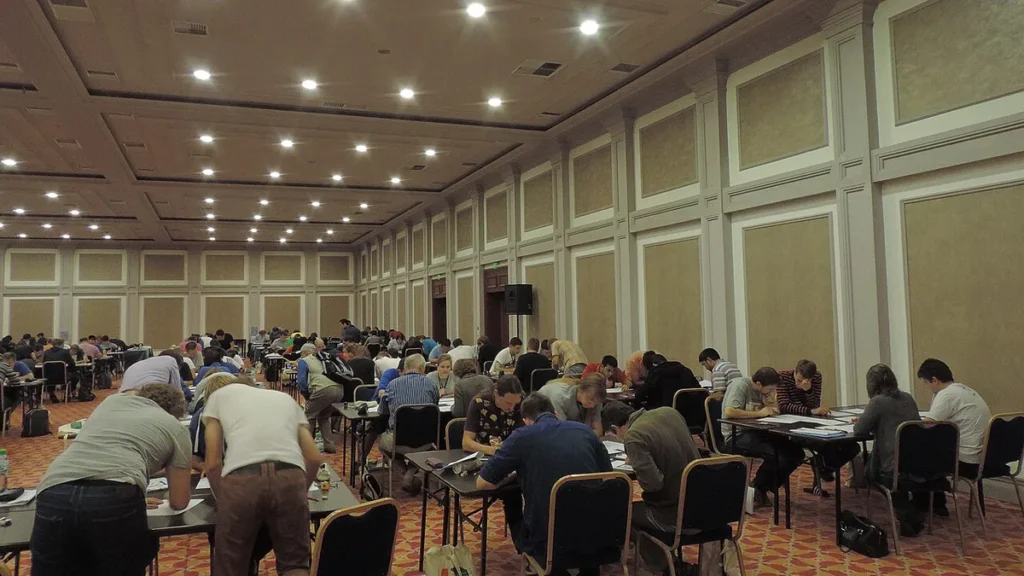
Four hundred and eighty-four players in one room sounds like a logistical nightmare. It sounds like hundreds of people waiting around, a few loud tables, and a long evening that never quite gets going. In practice, it can feel like the best game night you have ever run, as long as you stop picturing one giant board and start picturing many small ones.
The trick is scale by repetition. Nobody plays a single game with 484 people. Instead, you run dozens of tables at once, each with its own game, its own pace, and its own small drama. Players rotate, teams swap tables, and a simple scoreboard turns a scattered room into one shared event. The room feels huge, but every player only ever has to focus on the four or five people sitting opposite them.
This guide shows you how to run board games for 484 players, from the room plan to the nine games that carry the night. The approach borrows from how 480 players ran their board game night, and it works for a school hall, a community centre, a company offsite, or a festival tent. Pick the games, set the tables, and let the room do the rest.
Key Takeaways
- Split 484 players into small tables of two to eight, and run the same games in parallel across the room.
- Mix quick games with longer ones so tables finish at different times and nobody waits around.
- Use teams, stations, and a simple ladder so every table result feeds one shared scoreboard.
- Choose games with almost no setup and rules you can teach in two minutes flat.
- Keep one spare copy of every game, one spare table, and one helper for every ten tables.

The 9 Games at a Glance
| Game | Players per table | Time per round | Why it works for 484 players |
|---|---|---|---|
| Checkers | 2 | 15 minutes | Everyone knows it, and a match ends before attention drifts. |
| Mancala | 2 | 10 minutes | Tiny board, fast rounds, and a steady stream of winners. |
| Othello | 2 | 15 minutes | Simple moves with sudden reversals that keep crowds watching. |
| Sorry! | 4 | 25 minutes | Playful take-that moments that get whole tables laughing together. |
| Operation | 4 | 15 minutes | One shaky hand, one buzz, and the whole table holds its breath. |
| Trouble | 4 | 20 minutes | The pop-o-matic die keeps turns quick and nobody loses the pieces. |
| Candy Land | 4 | 15 minutes | No reading needed, so the youngest and newest players join in at once. |
| Mousetrap | 4 | 30 minutes | Building the trap together is half the fun and a great team warm-up. |
| Mahjong | 4 | 30 minutes | Rich tile play that rewards patient players and fills a long session. |
The 9 Games
Checkers
Checkers is the quiet workhorse of a huge game night. Almost every adult has played it, and almost every child can learn it in five minutes. Two players sit down, the pieces start in their rows, and the game moves at whatever pace the players choose. There is no reading, no long rulebook, and no fiddly setup, which makes it perfect for the first tables you open while the room is still filling up.
For 484 players, run Checkers as a short ladder. Winners stay and face the next challenger, while losers rotate to another table. A match takes about fifteen minutes, so one board can host four or five pairs in an hour. Keep a printed sheet of the basic rules on each table, because someone will always ask whether a king can jump backwards. A row of Checkers boards also gives nervous newcomers a calm place to start before they try the louder games across the room.
Mancala
Mancala is one of the oldest board games in the world, and it still earns its place at a modern game night. Two players share a small wooden board with rows of pits, scooping and sowing smooth stones around the board. The rules take two minutes to explain, yet the game rewards anyone who plans two moves ahead. It feels calm and thoughtful, which balances the noisier tables nearby.
With 484 players, Mancala shines as a fast rotation game. A round lasts about ten minutes, so players move on quickly and nobody guards a seat all evening. Set up a bank of Mancala boards along one wall and run them as a drop-in station. Players join a short queue, play one game, and then move on to something else. Because the board is small and the pieces are chunky, it also works well outdoors or in a corner where table space is tight.
Othello
Othello looks simple until the board flips. Two players place black and white discs on a square grid, and every disc you trap changes colour. A game that looks lost can turn around in a single move, and that sudden swing is exactly what makes it fun to watch. Spectators gather, point, and argue about the next move, which turns a quiet two-player game into a small crowd event.
For a room of 484 players, Othello works best as a head-to-head duel station. Matches run about fifteen minutes, and the clear winner makes scoring easy. Put four or six Othello boards together and you have a mini tournament that runs itself. Encourage players to count their discs out loud at the end, because the final tally often surprises both players. Keep spare discs in a labelled bag, since the small pieces are the ones most likely to roll under a table.
Sorry!
Sorry! is pure table theatre. Players race their pawns around the board, drawing cards that send them forward, slide them along, or bump a rival all the way back to the start. The moment someone draws the card that sends a leader home, the whole table erupts. It is light, silly, and forgiving, which is exactly what a big mixed group needs after a serious game.
With 484 players, Sorry! is the game that loosens the room up. Four players per table is the sweet spot, and a game takes about twenty-five minutes. Run it in the middle of the hall where the laughter carries, and let the noise advertise the event to anyone still hovering near the door. Because the cards do most of the work, new players can join a table mid-evening without a long lesson. Just warn the helpers that the loudest table is usually the Sorry! table, and that is a good sign.
Operation
Operation turns steady hands into a spectator sport. Players take turns lifting tiny plastic pieces out of a patient with tweezers, and one wrong touch sets off the buzzer and lights up his nose. The game needs no strategy and no reading, only nerve. Everyone at the table leans in for the tricky pieces, and everyone groans together when the buzzer sounds.
For 484 players, Operation is the perfect short station between longer games. A round takes about fifteen minutes with four players, and the game resets in seconds. Place it near the refreshments so people drifting between tables can stop for a quick game. Keep spare batteries in the kit box, because the buzzer will get a serious workout over the evening. If the room has younger players, let them go first, since small hands and sharp eyes are a real advantage here.

Trouble
Trouble is built for speed and for big rooms. Players press the pop-o-matic bubble, the die tumbles inside its dome, and the race around the board begins. There are no loose dice to lose, no pieces sliding off the table, and no arguments about what was rolled. Everyone can see the result, everyone moves at once in spirit, and the game keeps a brisk rhythm from start to finish.
With 484 players, Trouble is the game you hand to the tables that need to keep moving. Four players finish in about twenty minutes, and the captive die means a table can be reset in under a minute. It is also one of the easiest games for a helper to supervise, because the rules fit on a single card. Put Trouble tables near the entrance so arriving players can sit down and start playing within a minute of walking in. The popping bubble is loud enough to be heard across the room, and that sound tells everyone the night has started.
Candy Land
Candy Land is the friendliest game on this list. Players draw a colour card and move their gingerbread pawn to the next square of that colour, winding through peppermint forests and gumdrop mountains. There is no reading, no counting, and no strategy, which means a five-year-old and a grandparent can play on equal terms. The bright board and sweet theme make it the most inviting table in the room.
For 484 players, Candy Land is how you welcome families and first-timers. A game takes about fifteen minutes with four players, and the simple turns mean a helper can run two tables at once. Set these tables near the family corner with the board facing out, so passing children can see the colours and ask to join. The game also works as a gentle warm-up for players who have never been to a game night before. Nobody loses badly at Candy Land, and everyone leaves the table smiling, which is the point.
Mousetrap
Mousetrap is a game and a building project in one box. Players work together to build a wacky chain-reaction trap from plastic pieces, then race their mice around the board, trying to catch rivals in the finished contraption. The building stage gets everyone talking, pointing, and laughing at the instructions, and the first successful trap drop is the loudest cheer of the night.
With 484 players, Mousetrap needs a little more space and a little more patience than the other games here. Four players take about thirty minutes, and the building stage is best done as a team. Assign one helper to each Mousetrap table for the first round, because the trap pieces look confusing until they click together. Once the first trap is built, though, the table runs itself. Put Mousetrap tables where there is room to spread out, and keep the pieces in their tray between games so nothing goes missing.
Mahjong
Mahjong is the deep, social heart of this list. Four players build walls of tiles, draw and discard in turn, and chase matching sets while watching what everyone else is collecting. The click of the tiles, the slow reveal of a hand, and the quiet satisfaction of a completed set give the game a rhythm unlike anything else in the room. It rewards patience and memory, and it gives experienced players a game worth settling into.
For 484 players, Mahjong anchors the long-session corner. A game takes about thirty minutes, so it suits players who want one absorbing game rather than many quick ones. Run a few Mahjong tables together so players can compare hands and swap stories between rounds. Provide a simple scoring sheet, because the tile sets vary and newcomers will ask how a hand is counted. A Mahjong table also gives the evening a calm centre, a place where the noise drops and the game does the talking.
Three Formats That Scale
Three formats carry a night for 484 players, and most successful evenings use all three at once. The team format groups players into squads that travel from table to table together, which suits school groups and company teams. The station format lets players drift freely, joining any open seat and moving on when they like, which suits festivals and drop-in crowds. The tournament format runs a simple ladder or bracket, which suits competitive players who want a winner at the end of the night. The guide to board games for 478 players shows the same three formats in action at a slightly smaller scale, and the pattern holds here too.
The Team Format
Divide 484 players into teams of four, and each team becomes a small unit that plays together all evening. Teams rotate through the nine games, earning points at every table, and the team with the most points at the end wins a small prize. This format works well because nobody plays alone, shy players always have teammates beside them, and a team that loses one game can still win the night. Give each team a coloured wristband and a scorecard, and the room organises itself.
The Station Format
Set up the nine games as stations around the room, with a sign and a helper at each one. Players wander, join any station with a free seat, and leave whenever they like. This format suits open evenings where people arrive at different times, because nobody misses the start. It also lets popular games grow, since you can open a second Checkers or Mancala station when the queue gets long. The station format is the most relaxed way to run 484 players, and it needs the fewest announcements.
The Tournament Format
Run each game as its own small tournament with a simple ladder. Winners stay at their table, losers rotate, and the last players standing at each game meet in a final. A tournament gives the evening a clear shape, a schedule, and a moment at the end when the room gathers to watch the finals. Keep the brackets on a big visible board, update them loudly, and let the crowd follow the leaders. Tournaments work best for the two-player games here, Checkers, Mancala, and Othello, where a winner is never in doubt.
Your Checklist
Run through this list the day before, and the night itself will feel easy.
- Count the tables and chairs first, then the games, so every player has a seat.
- Print one rules sheet per table and one scorecard per team before anyone arrives.
- Test every Operation buzzer and every Trouble bubble the night before the event.
- Place the quiet games, Checkers and Mahjong, away from the loudest tables.
- Assign one helper for every ten tables and give each helper a coloured badge.
- Pack spare pieces, spare batteries, and one spare copy of every game.
Frequently Asked Questions
Can one board game really seat 484 players?
No single board seats 484 players, and that is the point. You run many copies of the nine games at once, with two to four players per table, and a shared scoreboard ties the room together. Every player only ever plays against the people at their own table, while the event as a whole still feels like one big night.
How many tables do 484 players need?
Plan for about 130 tables if most games seat four, and a few more if you run many two-player games like Checkers and Mancala. A school hall with long tables works well, because four players can share one end while another group uses the other. Leave wide aisles between rows so helpers and rotating players can move without bumping elbows or boards.
How many helpers do we really need?
One helper for every ten tables is a good rule, which means about thirteen helpers for 484 players. Helpers teach rules, settle friendly disputes, keep scorecards moving, and open spare games when a table finishes early. The board games night for 482 players used the same ratio, and the helpers reported that the middle hour was the busiest stretch.
Which game should we start with?
Start with Checkers or Candy Land, because both need almost no explanation and anyone can sit down and play within a minute. Opening with a simple game gets the room playing fast, which builds confidence before the longer games like Mahjong and Mousetrap. Save the tournament finals for the end, when the room is warm and the crowd is ready to watch.
What if some tables finish much faster than others?
Fast tables are a feature, not a problem. Keep a bank of quick games like Mancala and Operation ready, so finished players can drop into a short round instead of waiting around. The station format handles this naturally, since players simply move to the next open seat. Announce the next rotation every twenty minutes so nobody wonders what to do next.
How long does a night for 484 players last?
Plan for about three hours, including setup, play, and the finals. The first half hour is arrivals and warm-up games, the middle two hours are the main rotations, and the last half hour is finals and prizes. A three-hour window keeps energy high without tiring younger players, and it gives every player time to try at least four or five different games.
The Bottom Line
Running board games for 484 players is not about finding one enormous game. It is about nine good games, plenty of tables, and a simple plan that lets everyone play at once. Pick the games that fit your crowd, set the room up so people can move easily, and trust the tables to do the rest. When the last tile clicks, the last pawn reaches home, and the room applauds the final winners, you will know the night worked.