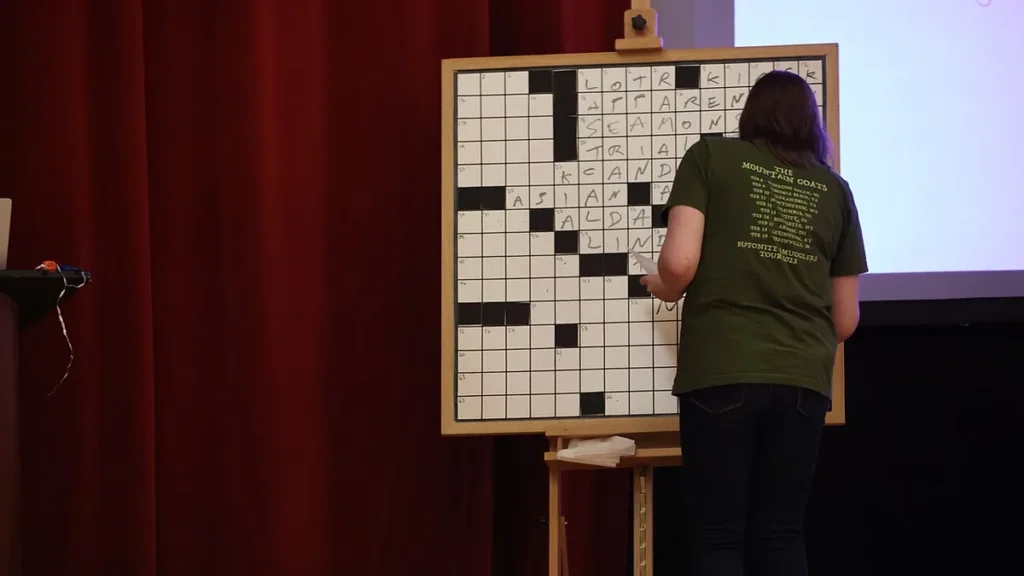
Four hundred and ninety-five players is not a game night. It is a small town that has decided, all at once, to play with words. The room will be loud, the tables will be close together, and the first ten minutes will decide whether the evening feels like a festival or a queue. The difference is not the size of the hall or the size of the prize table. It is the choice of games, and whether every player has something to do.
Most word games were built for a table of four. Stretch one of those games across a hundred tables and it breaks in the same places every time. One confident player takes over, the quiet players stop trying, and the host spends the night repeating the same rule to a different table. The nine games below were chosen to survive that stretch: short rounds, a shared task for the whole table, and scoring a captain can finish in under a minute.
You do not need a stadium, a stage crew, or a complicated app. You need ninety-nine tables of five, a clear scoring sheet, and a host who keeps the rounds moving. The same team sizes and rotation plan that worked in our guide to the best word games for 493 players scale cleanly to 495, so you can reuse the room layout and the scoring sheet with only small changes. What follows is the full plan: the nine games, the timing, the scoring, and the checklist that keeps a crowd this size playing instead of waiting.
Key takeaways
- Split 495 players into 99 teams of five, each with a captain, so every table can score itself.
- Run short rounds of eight to twelve minutes, nine rounds with two breaks.
- Choose games where the whole table works together, so no single player can take over a round.
- Score one point per valid answer, and post the top ten teams after every third round.
- Keep one spare game ready, because a crowd this size always finishes one round early.

How 495 Players Actually Play Together
The first decision is the team size, and five is the number that works. Four leaves a table short when one player is away fetching a drink, and six leaves one player with nothing to do. Five gives you ninety-nine teams, which sounds like a lot until you realise that ninety-nine is a number a host can actually manage. Each team sits at one table with a captain, who holds the score sheet and the spare pens.
Rooms matter more than rules at this scale. Put the tables in rows of nine, leave a clear aisle down the middle, and put the host where every table can see them. A single screen at the front carries the timer, the current game, and the top ten teams. If you want a full run-of-show for a night this size, our guide on how to run word games for 491 players walks through timing, hosts, and table captains in the same order used here. Print one rule card per table, and let the captain read it aloud before each round starts.
Timing is the second decision, and it is the one hosts get wrong most often. Nine rounds of ten minutes, with a fifteen-minute break after round three and another after round six, fills an evening of about two and a half hours. Short rounds keep the energy up, and the breaks give the captains time to hand in score sheets without a queue forming at the host table. Announce the next game during the break.
The Nine Games at a Glance
| Game | Teams | Round time | What you need |
|---|---|---|---|
| Rebus Relay | 99 | 10 minutes | Printed picture cards |
| Diminutive Dash | 99 | 8 minutes | Word lists and pens |
| Heterogram Hunt | 99 | 10 minutes | Letter sheets and pens |
| Double-Letter Dash | 99 | 8 minutes | Word lists and pens |
| Word Draft Pick | 99 | 12 minutes | Draft boards and cards |
| Word Trade Fair | 99 | 12 minutes | Word cards and tokens |
| Word Maze Run | 99 | 12 minutes | Printed maze sheets |
| Anaphora Round | 99 | 10 minutes | Prompt cards and pens |
| Cinquain Call | 99 | 10 minutes | Prompt cards and pens |
The Nine Games
1. Rebus Relay
A rebus is a puzzle where pictures and symbols stand for sounds and words, so a drawing of a bee next to a leaf spells a word that sounds like belief. In this relay, each table gets a pack of ten rebus cards and works through them in order. One point goes to the team for each correct answer, and a bonus point goes to the first five teams to finish the whole pack.
The huge-group trick is to use the same ten cards at every table, printed in a different order for each row, so a team cannot copy the table next to them and the host checks one answer key. Keep two volunteers walking the aisles with spare packs, so a lost card costs a table a minute, not a round.
2. Diminutive Dash
A diminutive is a small form of a word, made with endings like let, ette, and ling, so a book becomes a booklet and a duck becomes a duckling. Each table gets twenty plain words, and eight minutes to write the diminutive form of as many as they can. One point for each correct form, and a second point for any diminutive that no other table in the same row has written.
This game works for a crowd because it needs no special knowledge and no shouting across the room. Every player can suggest a word, the captain writes it down, and the table argues quietly about whether a word has a diminutive at all. Keep the list mixed, with easy words, hard words, and two words that have no tidy diminutive at all.
3. Heterogram Hunt
A heterogram is a word in which no letter appears twice, so ghost and blacksmith both count, while banana does not. Each table gets a sheet of letters, and ten minutes to build the longest list of heterograms it can from them. One point for each valid word, and three points for the longest word any table finds.
The scoring is simple enough for a captain to check with a quick look at each word, and the same letter sheet works for all ninety-nine tables. Short words keep the total moving, long words win the bonus, and the best tables usually split the work, with two players hunting short words and three chasing the long ones. Print the letter sheet large, and give each table a second sheet so a spilled drink does not end their round.
4. Double-Letter Dash
Some words carry a doubled letter in the middle, like the double o in bookkeeper or the double s in Mississippi, and this game asks teams to find as many as they can in eight minutes. Each table gets a theme, such as animals, food, or places, and writes down words from that theme with a doubled letter. One point for each correct word, and two points for any word that uses the same letter doubled twice.
The theme is what makes the game fair across a big room. A table of keen readers and a table of first-time players both know animal names, and both can spot a doubled letter once they start looking. Captains check the answers by reading each word aloud and asking the table to spell it, which takes less than a minute per table. Give each row a different theme, and swap them next round.
5. Word Draft Pick
In a draft, each team picks words from a shared pool, one pick at a time, until every team has a set of twelve words. The pool is printed on a large board at the front, and each table sends its captain to call out a pick. A picked word is crossed off the board, so no other team can take it, and the team that picks first in one round picks last in the next.
Once the draft is done, each team scores its own set. One point for each word longer than six letters, one point for each word with a doubled letter, and three points for the best set as judged by the host, who looks for the most interesting mix. The draft itself is the entertainment, and the whole room watches the board while the picks are made. Keep the pool to about two hundred words, and give the captains ten seconds per pick.

6. Word Trade Fair
A trade fair turns word collecting into a market. Each table starts with a hand of word cards, and the goal is to trade cards with other tables until the team holds a complete set, such as five words that all start with the same letter, or five words that all name something found in a kitchen. Trading happens at the aisles, two players per table at a time, and only when both sides agree.
The game needs clear rules and a firm time limit, or the trading will run on all night. Twelve minutes is enough for most teams to finish a set, and the host calls a two-minute warning so the last trades happen quickly. One point for each completed set, and a bonus point for the first team to finish. Give each table a different starting hand, and keep a spare pack at the host table.
7. Word Maze Run
A word maze is a printed grid of letters with a start square and a finish square, and the team must find a path from one to the other by stepping only on letters that spell real words. Each table gets the same maze, and the team traces the path together, writing down each word it steps through. One point for each word on the path, and five points for the first team to reach the finish.
This is the quietest game of the nine, and that is why it sits in the middle of the evening. After the noise of the draft and the trade fair, the room settles, the tables lean in, and the host can hear the murmur of teams working out a path. Print the maze on a large sheet, use a bold font, and give each table a pencil rather than a pen, because a wrong turn should be easy to rub out. The host reads the winning path aloud.
8. Anaphora Round
Anaphora is the trick of starting several lines with the same words, so a team might write four lines that all begin with we will, each line finishing the thought in a different way. Each table gets a prompt, such as the night we, and ten minutes to write the best four-line set it can. The host judges the entries: one point for each line that keeps the pattern, and three points for the set that gets the biggest cheer when read aloud.
The judging is the heart of this game, and it works because the host reads the best entries to the whole room. Teams that would never win a spelling contest can win this round with a funny line or a sharp one, and the room remembers the winning set long after the scores are forgotten. Ask the captains to write clearly, because the host has to read the entries cold. No team may use the same opening twice in its set.
9. Cinquain Call
A cinquain is a five-line poem built on a syllable pattern of two, four, six, eight, and two, so the first line has two syllables, the second has four, and the poem narrows again at the end. Each table gets a topic, such as rain, and ten minutes to write the best cinquain it can. One point for each line with the right syllable count, and three points for the poem the host judges the best.
The syllable count is the puzzle, and teams quickly learn to count on their fingers while they argue about whether a word has two syllables or three. That argument is the game, and it is why the round works in a big room: every player can join in, and nobody needs to be a poet to contribute a line. The host reads the top five poems aloud, the room votes by cheering, and the loudest cheer wins the bonus. Remind the captains that a simple poem with the right counts beats a clever poem with the wrong ones.
Scoring That Survives 495 Players
Simple scoring is the only scoring that survives a crowd of this size. One point per valid answer, a small bonus for the best entry, and a running total that the captains can add up without a calculator. The host posts the top ten teams after every third round, on the screen and on a paper board by the door, so teams can see where they stand without crowding the host table. The reason these formats hold a crowd is simple, and it is the same reason why word games for 489 players work for huge groups: every player has a job on every turn, so nobody waits long to play.
Disputes will happen, and they should be settled quickly. The captain raises a hand, a volunteer walks over, and the host makes a call within a minute. If the answer is genuinely unclear, award the point and move on, because a crowd of 495 will not wait while one table argues over a single mark. Keep a spare score sheet at every table and the answer keys in one folder at the host table. At the end of the night, the host reads the top three teams aloud, hands out the prizes, and thanks the captains by name.
Checklist for the Night
Run through this list the day before, and again an hour before the doors open. Most problems at a night this size are small things that were never checked.
- Count the tables and chairs, then count them again, and leave two spare tables at the back for late teams.
- Print ninety-nine score sheets, ninety-nine rule cards, and ten spare packs of every game.
- Test the screen, the timer, and the microphone from the back row before the first player arrives.
- Brief the table captains ten minutes early, and give each one a coloured wristband so players can find them.
- Put water, pens, and spare paper on every table, and keep the prize table visible from the door.
- Agree the dispute rule with the volunteers in advance, so every call takes less than a minute.
Frequently Asked Questions
How do you split 495 players into teams?
Make ninety-nine teams of five, and let each team choose a captain before the first round. Five is small enough that every player speaks, and large enough that a table can cover for one player who steps away. If a team arrives with four, add a volunteer rather than running a short team.
How long does the whole evening take?
Plan for about two and a half hours, including the welcome and the final scores. Nine rounds of eight to twelve minutes, with two fifteen-minute breaks, fills the evening without dragging. If the room is slow to settle, cut one round rather than rushing the last three.
What equipment do we need?
You need tables and chairs for ninety-nine teams, printed cards and sheets for each game, pens and pencils, a screen for the timer, and a microphone that reaches the back row. Everything else is optional. A single laptop runs the timer and the scoreboard, and a paper board by the door carries the top ten.
Can children play alongside adults?
Yes, and they often do well in the picture and pattern games, where a fresh eye beats a large vocabulary. Put children on mixed teams with adults rather than on their own table, and let the captain give them the first pick or the first card in each round. Keep the prompts plain, and avoid games that depend on knowledge only adults would have.
How do you stop one strong team from winning every round?
Mix the game types, so a team that is strong at spelling faces a round that rewards trading, and a team that is strong at trading faces a round that rewards writing. The bonus points for the best entry, judged by the host or by the room, also give creative teams a way to catch up. Post the top ten after every third round, so the gap never looks hopeless.
What happens if a team disputes a score?
The captain raises a hand, a volunteer comes over, and the host decides within a minute. If the answer is unclear, award the point and move on. The evening belongs to 495 players, not to one disputed mark, and a quick fair call keeps the room on your side.
The Bottom Line
A night for 495 players works when every table has a job, every round is short, and every score is simple enough to check in a minute. Start with teams of five, keep the host visible, and let the nine games do the work. The room will be loud, the scores will be close, and the best moments will come from the tables nobody expected to win.


