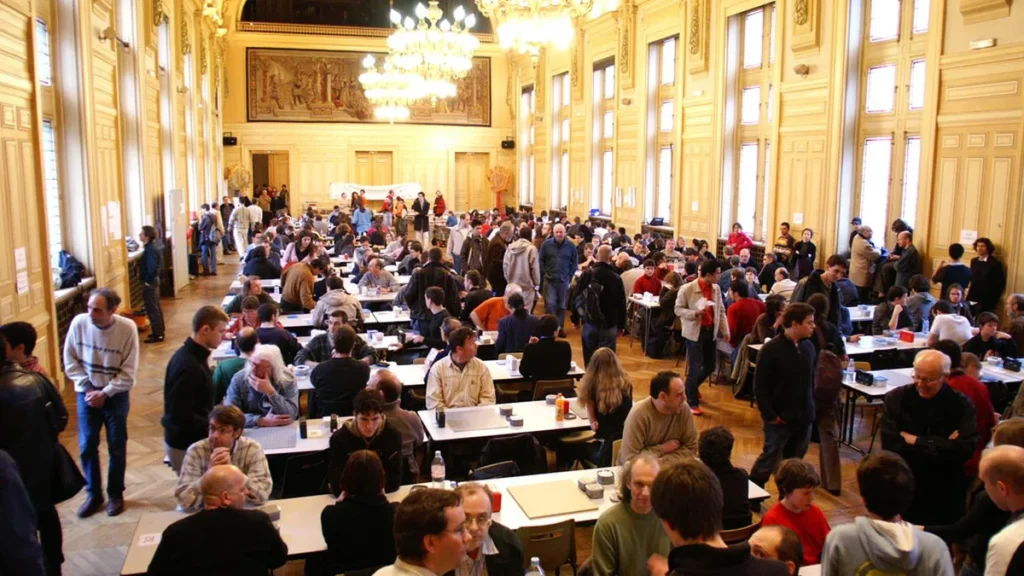
Running board games for 398 players sounds impossible until you stop picturing one enormous table and start picturing a hall full of tables. No single board game seats 398 people, and no sensible host would try to make one do it. Board games for 398 players are never really one game. They are dozens of games, played at the same time, in the same room, by teams that all feel part of one shared event. Once you make that shift, 398 becomes a planning number: tables, copies, hosts, and scores.
This guide gives you the full plan, from the first headcount to the final scores. You will meet nine board games that survive contact with a crowd of this size, learn the three formats that actually work at scale, and see exactly how many copies, tables, and helpers a night for 398 players needs.
Most large game nights fail for boring, preventable reasons. The host buys one copy of a game that takes two hours to teach, the room has nowhere for people to stand between rounds, or the scoring is so complicated that nobody trusts the result. Every section below removes one of those failure points, so your 398 players will spend their time playing instead of waiting around.
Key takeaways
- Board games for 398 players work as many small games played at once, not one huge game: plan in tables of 4 to 6 players, and scale by adding tables.
- The three scaling formats are teams, stations, and tournaments. Teams suit mixed groups, stations suit drop-in crowds, and tournaments suit competitive players.
- Choose short, simple games with fast turns. A game that takes 15 minutes to teach will eat your whole evening at this size.
- One host cannot run 398 players alone. You need one table host per 4 to 6 tables, plus a master of ceremonies, a scorer, and a floater.
- Score simply and visibly. Points per table, a shared leaderboard, and a clear finish time matter more than a clever scoring system.
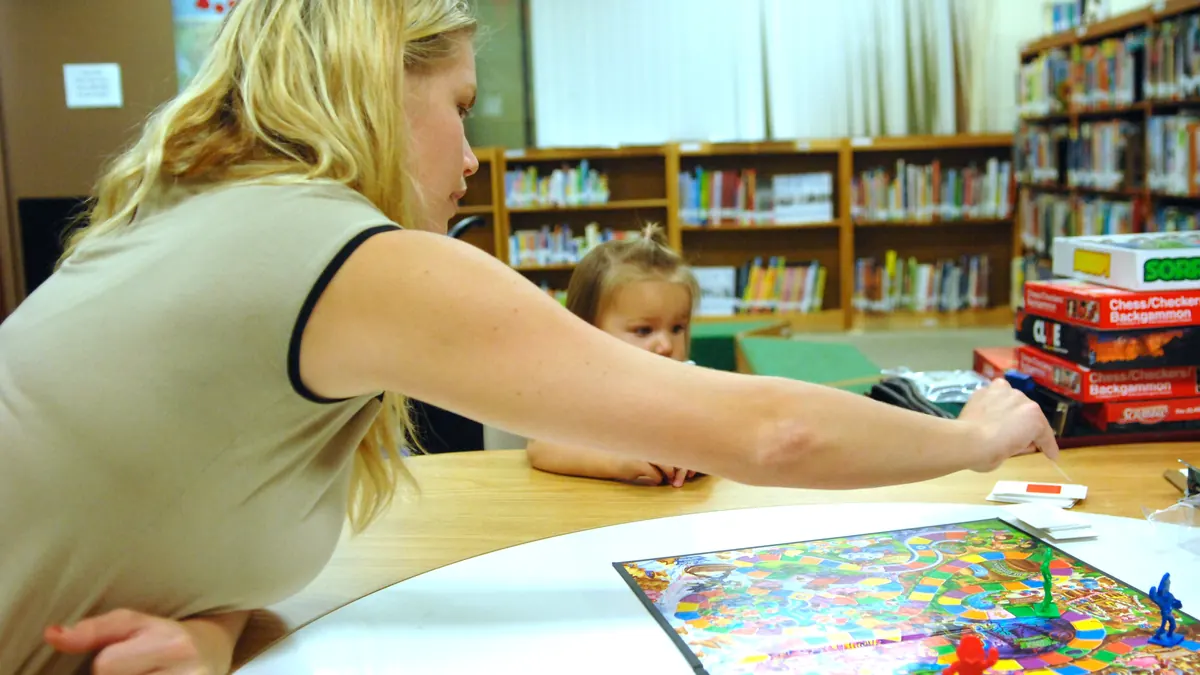
What “398 Players” Really Means
The first thing to accept is that 398 players means roughly 66 to 100 tables. At four players per table you need 100 tables; at six per table you need 66. Most events land somewhere in between, because some games play best with four and others with six. That range is your real planning unit.
Second, not everyone plays at the same speed. In a group of 398, some tables will finish a 20-minute game in 12 minutes and some will take 35. That is normal, and your schedule has to absorb it. Build in buffers between rounds, and never let the whole event depend on the slowest table finishing on time.
The 9 Best Board Games for 398 Players
Each game below is quick to teach, finishes in under 30 minutes, keeps every player involved on every turn, and works in parallel across dozens of tables. For a wider view of titles that hold up when the crowd grows, see these board games that work for very large groups.
1. Codenames
Codenames is the single best team game for a crowd of this size, and it should be the backbone of your evening. Two teams sit across a grid of 25 word cards, and each team’s spymaster gives one-word clues that link several words at once. A good clue makes the whole table gasp; a bad clue sends everyone groaning toward the assassin card. The game plays in about 15 minutes, needs almost no setup, and scales perfectly, because every table runs its own game while the room shares the same excitement. Split each table into two teams of two or three, and rotate the spymaster role so quiet players get a turn.
2. Wavelength
Wavelength is a guessing game built around one simple idea: a target sits somewhere on a scale between two opposites, such as hot and cold, and one player gives a clue to place it. The rest of the table debates, argues, and finally commits to a spot on the dial. The debates are the game. A table of six will spend ten minutes arguing about whether a sandwich is more hot or more cold, and they will love every second of it. For a huge night, Wavelength is ideal as a station game: one host can teach it in two minutes, and a round takes about 20 minutes.
3. Telestrations
Telestrations is the telephone game played with drawings, and it is the loudest game on this list. Each player writes a word, passes the sketchbook along, and the next player draws it. By the time the book comes back around, the original word has turned into something gloriously wrong, and the reveal makes the whole table laugh. No drawing skill is needed. In fact, bad drawings make the game better. With 398 players, Telestrations works beautifully because each table is its own little world of bad art and good jokes, and the sketchbooks are reusable all evening.
4. Just One
Just One is a cooperative word game that could hardly be simpler. One player tries to guess a mystery word, and everyone else writes a one-word clue on a small board. If two players write the same clue, both clues are hidden before the guesser sees them. The tension is in choosing a clue that is helpful but not obvious, and the groans when two identical clues get wiped out are half the fun. This is the gentlest game on the list, which makes it perfect for mixed groups that include children, grandparents, and people who have never played a modern board game.
5. Herd Mentality
Herd Mentality asks the whole table one question, such as what is the best pizza topping, and everyone writes down an answer. If your answer matches the majority, you score. If you are the odd one out, you collect a cow, and collecting cows is bad. The game is really about knowing your table, not knowing trivia, and that makes it a wonderful icebreaker for groups of strangers. At scale, Herd Mentality shines as a warm-up game: play one quick round while latecomers are still arriving, and the room will be laughing within five minutes.
6. Wits and Wagers
Wits and Wagers turns trivia into a betting game, and that one change makes it work for everyone. Each round asks a question with a numerical answer, such as how many calories are in a fast-food meal. Players write down their guesses, the guesses are laid out in order, and everyone bets on which answer is closest. You do not need to know the answer. You only need to judge which guess looks right. For 398 players, this is your best tournament game: every table plays the same seven questions at the same time, the answers are revealed from the stage, and the room reacts together.
7. Dixit
Dixit is a game of beautiful pictures and clever clues. Each player holds a hand of illustrated cards, and the storyteller gives a clue for one of them. The other players choose a card from their own hand that fits the clue, the cards are shuffled and laid out, and everyone guesses which one was the storyteller’s. A clue that is too obvious scores nothing, and a clue that is too strange scores nothing either. Dixit is the calm, creative heart of a big night, giving your event a quieter corner for anyone who needs a break from the noise.
8. Ticket to Ride
Ticket to Ride is the strategy anchor of this list. Players collect coloured train cards and claim railway routes across a map, trying to complete their secret destination tickets before the trains run out. The rules take five minutes to teach, the game takes 30 to 45 minutes, and every turn is a small, satisfying decision. At 398 players, Ticket to Ride belongs in the tournament section, not the drop-in area. Run it as a timed round with a hard stop, and use it for a limited number of tables rather than the whole hall, since you need one copy per table.
9. Azul
Azul is a tile-drafting game that looks like a piece of art and plays like a gentle puzzle. Players take coloured tiles from shared factory displays and place them on their own board, scoring for complete rows and patterns, and losing points for tiles they cannot place. The rules fit in a few sentences, but the decisions stay interesting for the whole game, which is a rare combination. Azul is the best closing game on this list: quiet, satisfying, and it leaves players feeling clever rather than beaten.
| Game | Players per table | Time | Best role at 398 players | Teach time |
|---|---|---|---|---|
| Codenames | 4 to 8 | 15 minutes | Team backbone | 3 minutes |
| Wavelength | 2 to 12 | 20 minutes | Station game | 2 minutes |
| Telestrations | 4 to 8 | 20 minutes | Loudest table | 2 minutes |
| Just One | 3 to 7 | 20 minutes | Calm station | 2 minutes |
| Herd Mentality | 4 to 20 | 20 minutes | Warm-up game | 2 minutes |
| Wits and Wagers | 3 to 7 | 25 minutes | Tournament game | 3 minutes |
| Dixit | 3 to 6 | 30 minutes | Creative corner | 3 minutes |
| Ticket to Ride | 2 to 5 | 30 to 45 minutes | Strategy tournament | 5 minutes |
| Azul | 2 to 4 | 30 minutes | Closing game | 3 minutes |
Teams, Stations, or Tournament: Picking Your Format
Teams are the best choice when your players already know each other, even loosely, such as a school year group, a company, or a club. Teams give people an identity, a reason to cheer, and someone to sit with during the break. They also make the maths easy: 398 players become 66 teams of six, with a couple of teams of seven. Give teams points for effort and fair play, not only for winning, so a weak team does not lose heart early.
Stations are the best choice when players arrive at different times, leave early, or bring children. Each station runs one game on a loop, and players join, play a short round, and move on. Stations need the least explaining, because each station host teaches one game all evening and gets very good at it. The trade-off is that stations can feel scattered, so add a central scoreboard and a closing ceremony to pull everyone together. The 396-player edition of this guide shows how the same team and station formats behave with a nearly identical crowd.
Tournaments are the best choice when your players are competitive and the games are simple enough that a round can be timed. A Swiss-style format works better than a straight knockout at this size, because a knockout sends half your players home after one loss, while a Swiss format keeps everyone playing every round against opponents with a similar record. Tournaments need the most discipline: fixed round times, a visible clock, and a scorer who can handle 66 results per round.
How Many Copies Do You Need?
Work it out from the tables, not from the players. If 20 tables will play Codenames in a round, you need 20 copies, plus two spares for damaged or missing pieces. Label every box with the table number and check the pieces at the end of each round. It is better to run six games with ten copies each than sixty games with one copy each.
The Room, the Tables, and the Kit
Space is the constraint most hosts underestimate. A table of six players needs roughly two metres by one metre for the table itself, plus a metre of walking space on each side. Multiply that by 66 tables and you need a hall, not a classroom. School sports halls, community centres, and hotel conference floors are the usual venues, and they work because they have the floor space, the toilets, and the fire exits for a crowd of this size. Visit the venue and sketch the layout on paper before you book anything else.
Lay the tables out in blocks of six to eight, with wide aisles between the blocks so hosts can move and players can find the toilets without climbing over chairs. Put the scoreboard and the stage at one end, where everyone can see them, and put the food and drink at the opposite end or in a separate room, so the queue does not cut through the play area. Number every table with a large, visible card, and give each block a colour or a letter.

A Run Sheet That Keeps 398 People Moving
A run sheet is a timetable with a named person responsible for each item. Print it and give a copy to every host. The example below is built for a three-hour evening, about the longest a crowd of 398 will stay sharp. Warm-up and registration run for 30 minutes, then the welcome takes 5 minutes. Round one runs for 30 minutes, then a 10-minute break. Round two runs for 30 minutes, then a 10-minute break. Round three runs for 30 minutes, then a 15-minute scoring break. The closing ceremony and prizes take 15 minutes, and pack-up takes the final 15. For the noisier, high-energy side of the evening, these party games built for big, noisy rooms pair well with the board games above.
Scoring Without Chaos
Simple scoring beats clever scoring at this size. Award points per table based on finishing position: six points for first place, four for second, three for third, two for fourth, and one for taking part. Add small bonus points for fair play or for finishing on time, and keep the bonus small so it never decides the whole event on its own. Write the points on the score sheet before the round starts. Collect scores at the end of every round, and use one scorer per block of tables, with a single head scorer who checks the totals.
Hosts, Helpers, and Keeping the Energy Up
One host cannot run 398 players alone. Plan for one table host per 4 to 6 tables, plus a master of ceremonies, a head scorer, and at least two floaters who handle problems, replace missing pieces, and cover for hosts who need a break. That is roughly 14 to 18 helpers in total. Announce the leading teams after each round, celebrate a funny moment from a table, and keep the music low enough that tables can talk.
Checklist: Your 398-Player Game Night
- Confirm the headcount, the venue, and the layout, with numbered tables in blocks of six to eight and wide aisles between them.
- Buy or borrow enough copies: one per table for the main games, plus two spares of each, with every box labelled by table number.
- Recruit 14 to 18 helpers, give each one a printed run sheet, a named block of tables, and a short briefing on the games they will host.
- Print score sheets, a visible leaderboard, and a three-hour run sheet with a named owner for every block of time.
- Test every game with a real group before the event, and time the teach as well as the play, so no game eats the evening.
- Pack the kit: extra pens, spare dice, spare markers, a first aid kit, and a box for lost pieces, then collect scores after every round.
Frequently Asked Questions
Can one board game really seat 398 players?
No, and that is the point. No single board game seats 398 people. A night for 398 players is dozens of small games running at the same time, with teams or stations tying them together into one event. Plan in tables of 4 to 6 players.
How many tables do I need for 398 players?
You need roughly 66 to 100 tables: 66 at six players per table, and 100 at four.
What is the best format for a first large game night?
Stations are the safest first format. Each station runs one game on a loop, players join and leave freely, and each host only has to teach one game all evening. Add a shared scoreboard and a closing ceremony so it still feels like one event.
How long should a 398-player board game night last?
About three hours is right for most crowds. That gives you a 30-minute warm-up, three 30-minute rounds, breaks between rounds, and a 15-minute closing ceremony. Longer evenings need a proper food break.
How many helpers do I need?
Plan for 14 to 18 helpers: one table host per 4 to 6 tables, plus a master of ceremonies, a head scorer, and two floaters. Every helper needs a printed run sheet.
What if some tables finish much faster than others?
That is normal, and your schedule should expect it. Give fast tables a short filler game such as Just One or Herd Mentality, and never let the whole event wait for the slowest table.
Bottom Line
Board games for 398 players are not about finding one magical game that seats a crowd. They are about picking nine games that are quick to teach and fun to replay, laying out enough tables, and giving the evening a simple structure that everyone can follow. Choose the games from this list, run them in teams or stations, and score simply. Do that, and 398 players will feel less like a crowd to manage and more like a room full of people having the same good night.