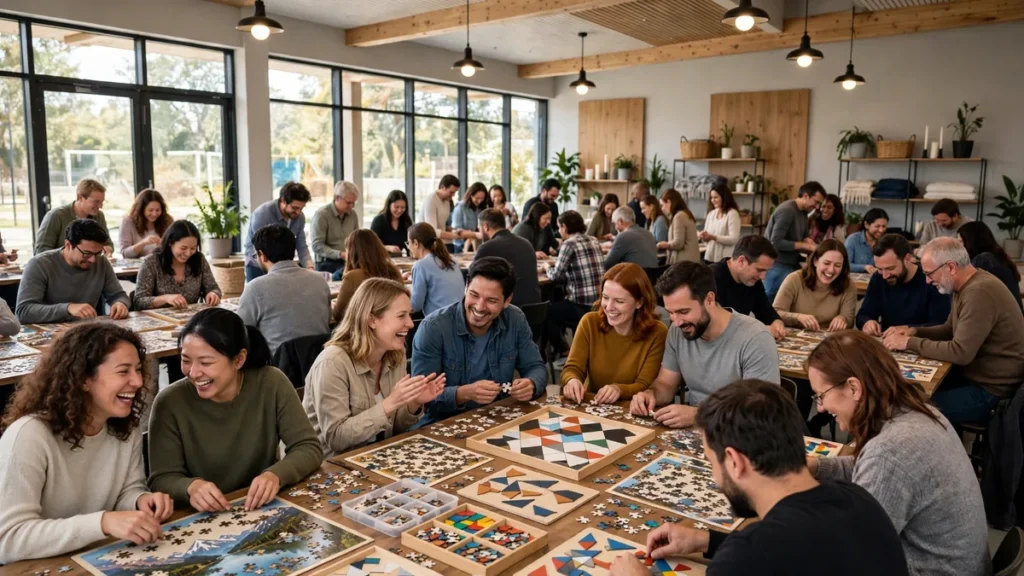
Finding the best puzzle games for 323 players sounds impossible at first. Three hundred and twenty-three people is not a living room game night; it is a school assembly, a company offsite, or a community festival. Yet puzzle games scale far better than most people expect, because the best ones do not need everyone around one table. They need a clear puzzle, a fair way to share it, and a structure that lets hundreds of minds work at once.
The best puzzle games for 323 players work in teams, in rounds, and in parallel. Instead of one giant jigsaw that only a few people can touch, a great large-group event runs dozens of identical challenges at the same time. Teams of four to eight players each tackle the same puzzles, compare answers, and feed results into a shared scoreboard. The room stays loud and competitive, and nobody is left watching from the back.
This guide covers the formats that genuinely work at this scale, from giant jigsaw relays and escape-room circuits to digital quizzes, logic hunts, and word puzzles a whole hall can play with a phone or a printed sheet. It also covers team sizes, timing, scoring, and equipment, plus a checklist and answers to the questions organisers ask most.
Key takeaways
- Split 323 players into teams of four to eight so every person has a real job to do in every round.
- Run the same puzzle set in parallel across all teams, then use a shared scoreboard to keep the whole room connected.
- Mix puzzle types: jigsaws, logic grids, word puzzles, codes, and picture rounds keep different strengths in play.
- Keep rounds short, between ten and twenty minutes, and rotate puzzle types so energy never drops.
- Test every puzzle with a small group first, and always have a spare round ready in case a puzzle proves too hard or too easy.
Why 323 Players Changes the Game
The first decision is team size. Teams of four to eight hit the sweet spot. Smaller teams mean more teams to manage, more packs to print, and more scores to track. Larger teams mean quieter players get pushed to the edge and stop contributing. With 323 players, teams of six give you about fifty-four teams, which sounds like a lot until you realise each team only needs a table, a pack, and a captain. Teams of five give you sixty-five teams, which works well if you have plenty of space. Pick a size, stick to it, and build your packs and scoreboard around it.
The Best Puzzle Games for 323 Players
1. Giant Jigsaw Relay
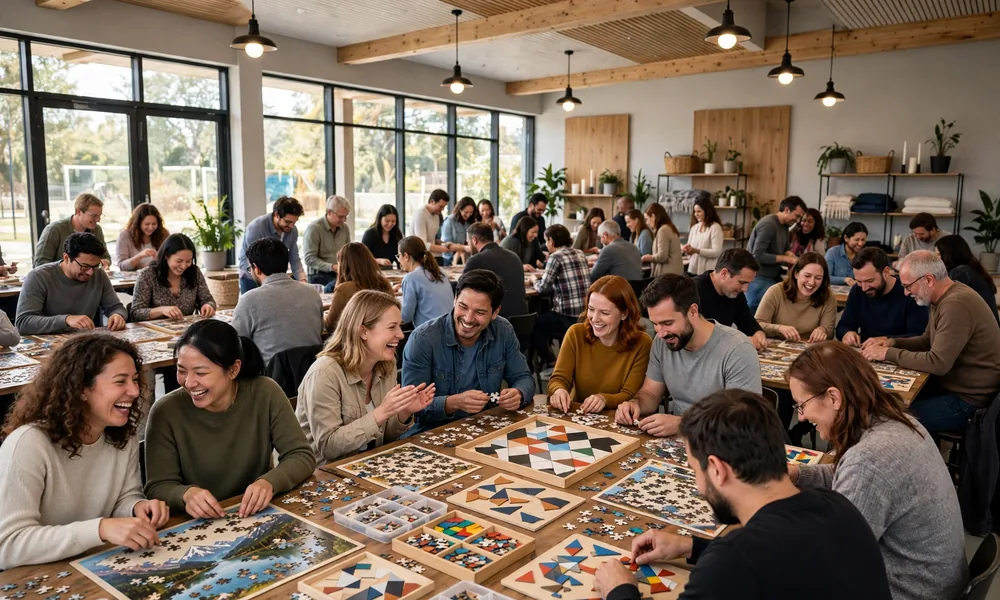
The giant jigsaw relay is the simplest large-group puzzle and often the most satisfying. Each team gets an identical jigsaw, usually between 300 and 500 pieces, and races to finish it. The twist that makes it work for 323 players is the relay element: only two team members work on the puzzle at a time, rotating every five minutes, so everyone gets hands-on time and nobody can dominate the table. A 500-piece puzzle takes most teams forty to sixty minutes, so run it as the headline event rather than a quick round.
2. Escape Room Circuit
An escape room circuit turns a hall into a series of puzzle stations. Set up eight to ten stations around the room, each with a different puzzle: a combination lock, a coded message, a tangram, a logic riddle, a pattern sequence, and a hidden-object challenge. Teams rotate from station to station, solving each puzzle to collect a code word or a digit. The first team to gather every code and unlock the final box wins.
This format shines at scale because stations run in parallel and teams never queue for long if you stagger the starting stations. Each station needs one volunteer to reset it between teams, so recruit helpers early and give each one a simple reset checklist. Keep each station puzzle solvable in five to eight minutes, and make the final code a satisfying reveal rather than a fiddly extra step. If you want inspiration for neighbouring group sizes, the ideas in our guide to the best puzzle games for 320 players adapt directly to a station circuit with almost no changes.
3. Digital Puzzle Quiz
A digital puzzle quiz uses phones and a big screen, which makes it the easiest format to run for 323 players. The host projects a puzzle, teams discuss it for sixty to ninety seconds, and everyone submits an answer through a quiz app or a simple web form. Puzzles can include anagrams, visual riddles, number sequences, spot-the-difference images, and logic questions. Because answers are submitted digitally, scoring is automatic and the leaderboard updates live on screen.
4. Logic Grid Tournament
Logic grid puzzles, where players use clues to match people, places, and objects, are perfect for large groups because they are cheap to print and genuinely fair. Every team gets the same grid and the same set of clues, and the challenge is pure reasoning. Run three rounds of increasing difficulty, with fifteen minutes per round, and award points for each correct row as well as for a fully completed grid. Teams that finish early can attempt a bonus grid for extra points.
5. Word Puzzle Relay
A word puzzle relay strings together several short word challenges into one race. Each team receives an envelope with a crossword, a word search, an anagram set, and a cryptic clue sheet. Teams must complete each puzzle to unlock the next envelope, and the final envelope contains a phrase that teams must shout out or write on their answer card. The relay structure creates natural drama, because a team stuck on one anagram can watch rivals move ahead.
Keep each word puzzle short enough to finish in five minutes, and make sure the difficulty is balanced across the set. A fiendish crossword paired with a trivial word search frustrates everyone, while four easy puzzles feel like a warm-up rather than a race. Include one puzzle that rewards teamwork directly, such as a word ladder where each player solves one rung. For a smaller-group version of the same idea, our roundup of the best puzzle games for 321 players shows how the relay scales down without losing its energy.
6. Treasure Hunt With Puzzle Clues
A treasure hunt turns puzzle solving into movement. Hide clues around the venue, in the garden, or across a campus, and give each team a starting clue that leads to the next location. Each clue is itself a puzzle: a riddle, a cipher, a rebus, or a set of coordinates. Teams photograph their finds or collect stamped cards at each stop, and the hunt ends when a team decodes the final location and claims the prize.
7. Picture Puzzle Rounds
Picture rounds ask teams to solve puzzles they can see: spot the difference, identify the cropped image, complete the sequence, or find the odd one out. Project each image large enough for the back of the hall, and give teams an answer sheet rather than asking them to shout out. Picture puzzles work brilliantly as palate cleansers between heavier logic rounds, because they use a different kind of thinking and they give the room something to laugh about.
8. Codebreaking Challenge
A codebreaking challenge gives every team the same set of encrypted messages and a limited time to crack them. Start with a simple Caesar cipher, move to a keyword cipher, and finish with a puzzle that combines a code with a logic riddle. Provide a code wheel or a printed frequency table as a prop, and award bonus points to the first team to crack each message. Codebreaking feels wonderfully spy-like, and it rewards teams that split the work: one person decodes, one checks the frequency table, and one tests guesses.
9. Puzzle Bingo
Puzzle bingo is the most relaxed format on this list and the best one for mixed-age groups. Each team gets a bingo card filled with mini puzzles instead of numbers: solve a riddle to cross off one square, complete a tiny maze for another, unscramble a word for a third. Teams work through the card in any order, and the first team to complete a line or a full house wins. Because teams choose their own order, stronger puzzlers and younger players can each contribute where they are best.
10. Team Trivia Puzzle Mix
A trivia puzzle mix blends general knowledge questions with puzzle twists. Instead of asking for a plain answer, each question hides its answer behind a puzzle: an anagram of a capital city, a riddle about a famous inventor, a sequence that reveals a year. Teams enjoy it because it rewards both knowledge and lateral thinking, and it suits a group of 323 players because the host controls the pace from the front of the room.
11. Build and Solve Challenge
A build and solve challenge asks teams to construct something and then solve a puzzle with it. Classic versions include building the tallest tower from spaghetti and tape, then using the tower height to decode a number, or assembling a tangram set and using the finished shape to reveal a clue. These games are noisy, physical, and memorable, and they give players who are less confident with word and number puzzles a different way to shine.
12. Mystery Envelope Game
The mystery envelope game is the simplest format to prepare and one of the most flexible. Each team receives a sealed envelope containing a short story with a puzzle hidden inside it: a missing word, a coded sentence, or a contradiction to spot. Teams open the envelope together, solve the mystery, and write their answer on the envelope itself. Run several envelopes in sequence, each one a little harder than the last, and the room builds to a satisfying finale.
How to Run a 323-Player Puzzle Event
Running a puzzle event for 323 players is mostly a planning exercise. The games are simple; the challenge is moving three hundred people through them without long waits, lost packs, or scoring chaos. Start planning at least three weeks ahead, and build a run sheet listing every round, its start time, its materials, and the volunteer responsible for it.
Registration is your first bottleneck. Set up a check-in desk with a printed team list and pre-made name badges or team numbers. Assign team numbers in advance and display them on the tables so players can find their seats without asking. If players are signing up on the day, keep the form to a name and a team preference, and sort late arrivals into teams that still have space. A smooth check-in sets the tone for the whole event.
Scoring needs to be visible and simple. A live leaderboard on a projector keeps the room engaged and removes arguments about who is winning. Award points per puzzle rather than per round so a team that struggles early can still climb back. Announce the scores after every round, celebrate the leaders, and give a shout-out to the most improved team as well as the top team. Keep a paper backup of all scores in case the laptop or the projector fails.
Comparing the Best Formats at a Glance
The table below summarises the twelve formats so you can pick the right mix for your audience, your venue, and your budget. Time is shown per round, and cost is a rough guide for a group of 323 players.
| Format | Time per round | Best for | Cost level | Setup effort |
|---|---|---|---|---|
| Giant jigsaw relay | 40 to 60 minutes | Headline event, all ages | Medium | Low |
| Escape room circuit | 60 to 90 minutes | Active groups, team building | Medium | High |
| Digital puzzle quiz | 30 to 45 minutes | Fast setup, live scoring | Low | Low |
| Logic grid tournament | 45 minutes | Serious puzzlers | Low | Medium |
| Word puzzle relay | 30 minutes | Word lovers, families | Low | Medium |
| Treasure hunt | 60 to 90 minutes | Outdoor venues, energetic groups | Low | High |
| Picture puzzle rounds | 15 minutes | Mixed ages, quick rounds | Low | Low |
| Codebreaking challenge | 30 to 40 minutes | Spy themes, older players | Low | Medium |
| Puzzle bingo | 30 minutes | Relaxed closing round | Low | Low |
| Team trivia puzzle mix | 40 minutes | General audiences | Low | Medium |
| Build and solve challenge | 30 minutes | Hands-on players, kids | Medium | Medium |
| Mystery envelope game | 30 minutes | Story lovers, low prep | Low | Low |
Choosing the Right Mix for Your Group
Think about your audience before you lock the mix. A corporate offsite usually enjoys competitive formats with a clear winner and a leaderboard, while a family festival needs formats that let children and grandparents play side by side. A school event needs puzzles matched to the age range and a timetable that fits around breaks. If you are unsure, ask a few likely players which formats sound most fun to them; their answers are better than any guess.
Common Mistakes to Avoid
The most common mistake is choosing puzzles that are too hard. A puzzle that takes a single expert twenty minutes will take a mixed team of six far longer, and a whole room of stuck teams goes quiet fast. Test every puzzle with people who match your audience, time them, and then make the puzzle slightly easier than the test suggests. It is far better for teams to finish with a smile than to be beaten by a puzzle nobody can solve.
The third mistake is skipping the practice run. A full rehearsal with a handful of volunteers will expose every weak point: the puzzle with two possible answers, the station that takes twice as long as planned, the scoreboard formula that breaks when a team scores zero. Fix those problems in rehearsal and your event will feel effortless on the day. For more ideas in the same series, our guide to the best puzzle games for 319 players is a useful companion when you are planning a smaller follow-up event.
Event Day Checklist
- Confirm the venue, the table layout, and the power supply for the projector and the PA system.
- Print all puzzle packs, label them by team and round, and pack one spare set for every ten teams.
- Test the quiz platform and the venue Wi-Fi with at least twenty devices connected at once.
- Brief every volunteer on their station, their reset steps, and the hint rules.
- Prepare the scoreboard, the leaderboard display, and a paper backup of all scores.
- Pack prizes, name badges, team numbers, pens, and a first aid kit before the day begins.
Frequently Asked Questions
How long should a puzzle event for 323 players last?
Two to three hours is the sweet spot for most groups. That gives you time for a warm-up round, one long headline format, and a light closing round, with short breaks in between. Shorter than two hours feels rushed at this scale, because check-in and instructions alone take twenty minutes. Longer than three hours needs a proper meal break and a change of format to keep energy up.
Do we need a professional host?
A confident volunteer can host a puzzle event well, provided they have a microphone, a run sheet, and a co-host to manage scoring while they talk. A professional host adds polish and handles surprises smoothly, which is worth considering for a corporate event or a paid festival. Either way, the host should rehearse the introductions and the scoring announcements at least once.
What if some players have never done puzzles before?
That is completely normal in a group of 323, and it is why the mix matters. Start with an easy warm-up round so everyone scores something early, and choose formats where different skills count, such as picture rounds and building challenges. Team captains should be briefed to involve every player, and the hint system should make sure no team stays stuck for long.
How do we keep scoring fair across fifty or more teams?
Use identical packs, identical time limits, and a single scoring system for every team. A digital quiz scores itself, while paper rounds need a simple points-per-puzzle system and a marking key that volunteers can apply quickly. Announce the scores after every round so any error can be spotted and fixed while the round is still fresh in memory.
Can we run a 323-player puzzle event outdoors?
Yes, provided the puzzles suit the setting. Treasure hunts, building challenges, and giant jigsaws on sturdy tables all work outdoors, but avoid small paper puzzles on a windy day and protect any electronics from rain. Have an indoor backup plan for bad weather, and make sure the outdoor area is safe, well signposted, and accessible for every player.
What prizes work best for such a large group?
Keep prizes simple and shareable: a trophy or a hamper for the winning team, small gifts for the runners-up, and a fun prize for the best team name or the most creative solution. Avoid one big individual prize, because it can make a team event feel unfair. Teams value the win itself far more than the value of the prize.
Bottom Line
The best puzzle games for 323 players are the ones that give every person a job, every team a fair chance, and the whole room a shared experience. Split into teams of four to eight, mix jigsaws, logic, word, code, and picture puzzles, keep rounds short and scoring visible, and test everything before the day. Do that, and 323 players will not feel like a crowd to manage. They will feel like the biggest, loudest, happiest puzzle team you have ever hosted.


