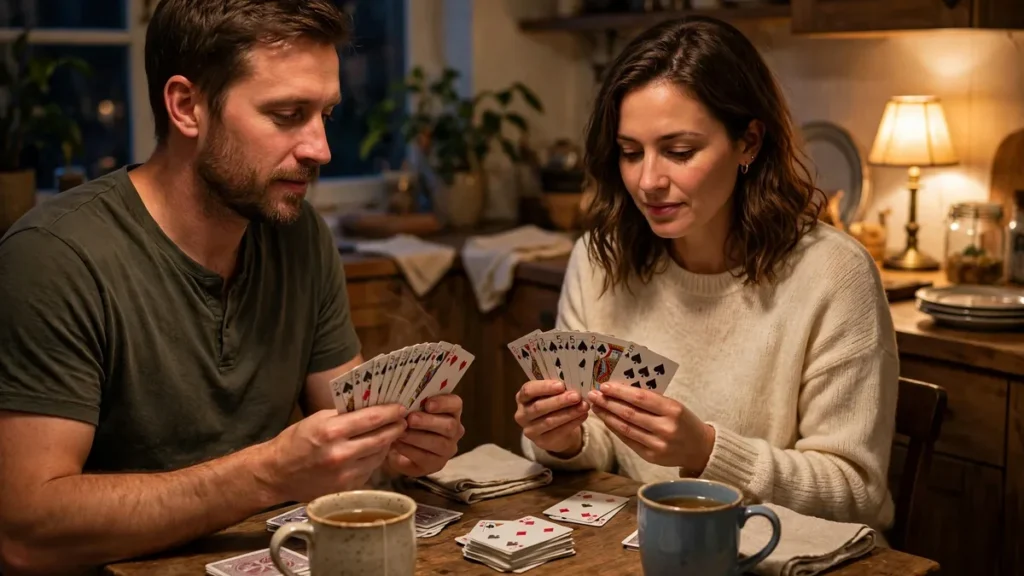
The deck turned up while we were tidying the kitchen for guests who never came. It was wedged behind the cookbooks, one card missing from the box, the corners soft from years of use. We had owned it since our first flat together and could not remember the last time either of us had touched it. That night, with the guests cancelled and the evening suddenly empty, we dealt two hands of gin rummy at the table and played until the kettle had gone cold twice. Nothing dramatic happened. We talked, we laughed at a hand so bad it felt rigged, and we went to bed later than planned and in better spirits than the day had promised. The deck went back in the drawer, but this time on top of everything else, where we could reach it. It has stayed there ever since, and most weeks it comes out at least once. That small change is the whole of my answer: yes, card games are good for couples, because a deck turns an unplanned hour at home into time the two of you actually spend together, for almost no money and no effort at all.
The short answer
Card games suit couples when three things are true: the game plays properly with two people, nothing is riding on the result, and both of you would rather be dealing cards than doing anything else that evening. When those three hold, a deck is one of the easiest pleasures a couple can keep: it costs next to nothing, it needs no booking or babysitter or clean shirt, and it leaves you both lighter than it found you. I want to be straight about the limits, too. A deck will not mend a relationship that is in trouble, and it is no replacement for a difficult conversation that keeps getting postponed. What it does, for a couple who already rub along well, is give an ordinary week a regular bright spot. If you want the same question asked about boards instead of cards, our verdict on whether board games are good for couples comes to a similar conclusion by a different route.
Why a deck suits a pair
Start with the effort involved, which is close to none. There is no board to unfold, no pieces to count, no rulebook to argue over before anyone has had any fun. You shuffle, you deal, you play. The gap between deciding to play and actually playing is about a minute, and that minute is where most game nights quietly die. We own a board game that has sat unopened for a year, because every time we look at it we remember the setup and the rules and decide to watch something instead. The deck has no such hurdle. It is the game you can start at nine on a weeknight and finish before bed, with time to spare.
Then there is the size of the thing. A deck slips into a coat pocket, a handbag, a suitcase, or the glove box. It comes to cafés, trains, park benches, and holiday cottages, and it plays just as well on a tray in bed as it does at a kitchen table. A board game stays in the house. A deck follows a couple through the small gaps in a shared life that would otherwise be filled with two phones and not much else. It also suits homes without a big dining table or a spare room. Two hands of cards and a small pile between them need barely more space than a couple of mugs, and that is the whole footprint.
Plenty of card games were made for two from the start, which matters more than people expect. Gin rummy is a quiet duel of memory and nerve, played properly by a pair and nobody else. Cribbage is the same, with its counting and its little pegboard marching along as the evening goes on. These are not party games squeezed down to fit two players. They were built for a pair sitting opposite each other, and they do not need a third person to come alive. A couple never has to recruit anyone before the fun can begin.
An evening off the screens, without a speech
Most couples know the modern evening by heart: two people on one sofa, each absorbed in a different feed, sharing a room and very little else. The usual advice is to put the phones away and talk, which rarely works, because a silent room and two irritated partners is nobody’s idea of a date. A deck gets around the problem instead of confronting it. It gives your hands work and your eyes somewhere better to look, and the phones end up face down on the table because both hands are holding cards. Nobody has to declare a screen-free evening. It happens on its own, which is the only way it ever really happens.
A hand of cards also keeps a conversation moving without anyone having to force it. Every hand throws up small moments to react to together: a lucky draw, a hopeless hand, a daring discard that pays off, a bluff that gets called. You talk about the cards, then about the day, then about something you had been meaning to mention, and the game carries you through the first ten minutes, when two tired people are still warming up. A deck is not a counselling session. It is a reason to sit facing each other and look up, and for a couple who have spent the day in separate rooms, that is often enough.
Together against the deck, or against each other
One decision shapes a card night more than any other: do you play as rivals, or as a team? A head-to-head duel suits a bright evening when you both have energy to spare. It gives you a harmless way to be competitive for an hour, to outwit each other and enjoy the teasing that follows, and the laughter is often loudest when the rivalry is at its sharpest. That only works while the contest stays light. The moment one of you starts keeping a mental tally, or treating a loss as an insult, the game has stopped doing its job.
Teaming up against the deck suits a different kind of night. In a cooperative card game, the two of you plan together, share the blame when a plan falls apart, and share the relief when a last desperate move comes off. Nobody loses, which makes it the safer choice after a hard day, or when one of you is already in a short temper. Keep one of each kind close at hand and let the mood of the evening decide. A duel for Saturday, a shared effort for a weary Wednesday: that is the whole method, and it is enough.
Picking by the mood of the night
The right game is the one that fits tonight, not the one with the best reviews. Keep one good game in each of the four types below, and the shelf will cover almost any evening. Our list of the best card games for adults names twelve that suit a grown-up table, with player counts and honest drawbacks.

| Type of game | Best for | Examples | Watch out for |
|---|---|---|---|
| Two-player classics | A calm, thoughtful evening for two | Gin rummy, cribbage | Slow pace can feel dull if you want noise and laughter |
| Quick and silly | A tired weeknight, or a warm-up game | Uno, Skip-Bo | Luck can decide the game, which frustrates a serious player |
| Cooperative | A hard day, or a pair that argues easily | Cooperative card games where you beat the deck together | One player can end up deciding everything, so share the calls |
| Conversation decks | An evening when you want to talk properly | Question and prompt decks for couples | Skip any question that feels like an interrogation, not a game |
Where it goes wrong
Luck is the first problem. A shuffled deck can hand the weaker player a win and the stronger one a hopeless hand, several nights running, and what is funny once stops being funny on the third night. The answer is to play short games in a series, so one unlucky hand cannot settle the evening, and to choose games where skill has room to show over several rounds. The second problem is a gap in ability that never closes. If one of you takes eight hands out of ten, the next hand is a formality rather than a contest. Do not fix it by letting the weaker player win on purpose, which both of you can feel. Change the game instead: try something new to you both, play cooperatively for a night, or give the stronger player a small handicap. A fair contest matters more than a familiar one.
The third problem is a game that needs a crowd. Plenty of good card games need three or more players, and with two they fall flat: the bluffing has nobody to fool and the trading has nobody to trade with. If a game felt thin the first time you played it as a pair, the evening did not fail. The player count did. Keep those games for nights with friends. The fourth problem is the slow creep of the evening itself. Card games make one more hand feel hard to refuse, and a game that starts at nine can eat the night and the next morning’s sleep. Settle the finish before you deal: a fixed number of hands, or a finishing time you both keep.
The last line is the firmest one. This piece is about family and party card games: matching, collecting sets, shedding a hand first, answering questions, beating the deck together. It is not about poker, betting, or playing for money, and those have no place at a couples table. The moment cash, or anything either of you would mind losing, enters the game, the mood changes for the worse. A good card night ends with both of you holding exactly what you started with. One more quiet failure is the rules lecture: when one of you knows a game and the other does not, it is easy to slip into correcting every move until the evening feels like a lesson. Deal the cards, let the new player learn by playing, and save the strategy talk for the third or fourth hand.
Habits that keep the deck coming out
A few small habits decide whether a deck gets played every week or goes back in the drawer. Let each of you choose the game on alternate nights, so neither becomes a guest at their own table. Settle a finishing time before you start, and keep it. Keep any score to the night itself, and let it reset with the shuffle, because a tally carried across the month turns a friendly game into a league. Drop any game that has spoiled two evenings; the shelf holds plenty of others, and no single deck deserves a third chance. Keep the deck where you will reach it, on the kitchen table or beside the sofa, because a deck in another room is a deck you will forget. For the practical side of shaping the whole evening, our guide to planning a couples game night covers timing, snacks, and winding down.
Final word
Are card games good for couples? Yes, when the game is made for two, when nothing is riding on the result, when you both chose the table over the television, and when the night counts for more than who won it. On those terms, a deck gives two busy people a cheap, portable hour away from their screens, in which they sit close, pay attention to each other, laugh at a hopeless hand, and build a small store of jokes that belongs only to them. It will not mend what is broken, and it should never stand in for a conversation that needs to happen. But for a couple who already enjoy each other, it is one of the simplest pleasures there is: a drawer, a deck, two chairs, and an hour that goes by too fast.
If you are unsure, give it a single evening. Put the phones to charge in the kitchen, deal a short game, and see how the hour feels. If it flies by and you find yourselves dealing again, the deck has earned its place on top of the drawer. If it drags, you have learned something for the price of a deck of cards, and you can try a different game next time. Either way, you will have spent the evening facing the person you chose, and that is seldom an hour wasted.