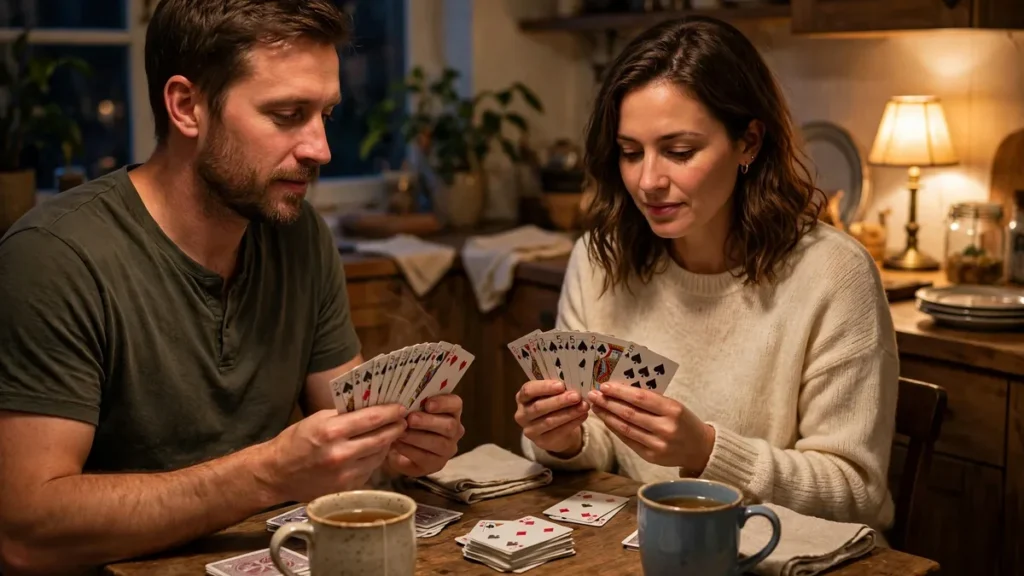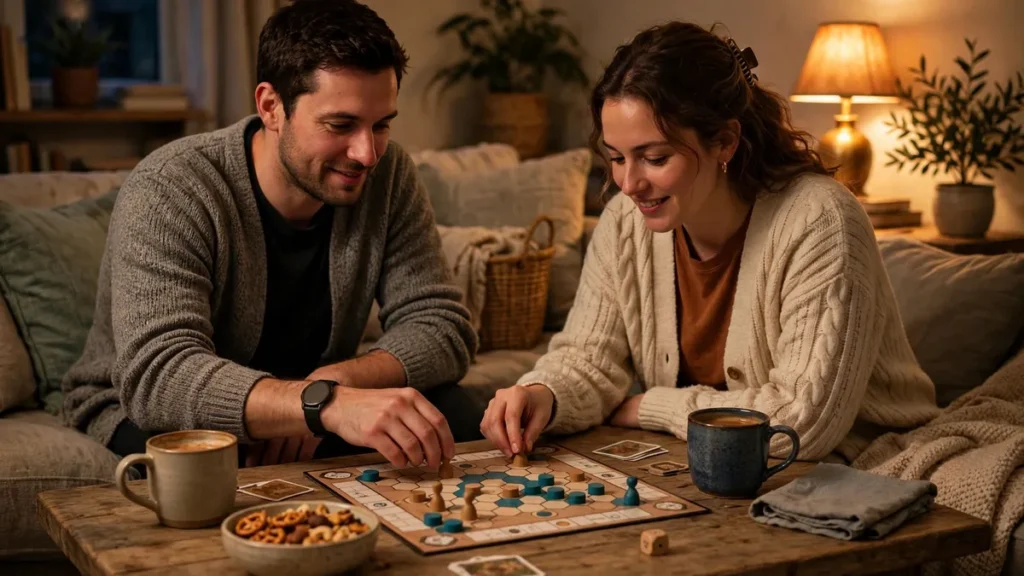
A game night for two is a different animal from a game night for a crowd. There is nobody to fill the quiet gaps, nobody to laugh at a joke that falls flat, and nobody to hide behind when a game turns out to be a dud. It is just you, your partner, a table, and whatever you chose to play. A couples game night is one of the cheapest, simplest ways to spend an evening actually paying attention to each other, and once you find a shape that suits you both, it becomes the easiest date night you will ever plan.
The mistake most couples make is treating it like a smaller version of a party. They haul out a big box and try to recreate the energy of a group evening with two people. It rarely works. Two-player evenings need their own rhythm: shorter, softer, more flexible, and built around conversation as much as competition.
Start With the Evening, Not the Game
Before you open a single box, decide when the night happens and how long it lasts. A vague plan, like sometime this weekend, is how game night quietly dies. Pick a specific evening, put it in the calendar, and treat it like any other plan you would keep. Friday works for a lot of couples because the work week is done.
Agree on a finish time as well as a start time. Ninety minutes is a good length for a first couples game night: long enough for two or three games and a proper chat, and short enough that nobody starts watching the clock. Eat first, because hungry players are impatient players. Put the phones in another room.
Match the Games to Your Mood
The best game for a couples night is the one that fits how you both feel that evening, not the one with the highest rating on the box. Some nights you want something thinky, a slow puzzle you can chew over together. Other nights you want something silly, fast, and a bit ridiculous. A shelf full of heavy strategy games is no use on a night when you are both tired.
Think in types rather than titles. Quick word games are wonderful openers: they take five minutes to learn. Two-player strategy boards suit the middle of the evening, when you are settled and ready to focus. Cooperative games, where you win or lose together against the board, are perfect for nights when neither of you feels like beating the other. Conversation games, built around questions and stories, work beautifully as a closer.
If you are building a small collection for two, aim for one good game in each of those four types rather than five games that all do the same thing. A short card game, a two-player board with a bit of depth, a cooperative puzzle game, and a deck of conversation prompts will cover almost any mood. You can find plenty of inspiration in our guide to the best board games built for two players.
Shape the Evening in Three Parts
A couples game night works best when it has a shape, even a loose one. Think of it as three short acts rather than one long session. The first act is a warm-up: something quick and light, ten or fifteen minutes at most, that gets you both laughing and talking. A fast card game or a short word round does the job.
The second act is the main event, the game you actually planned the night around. This is the one that takes thirty to forty-five minutes, the one with a bit of depth to it. Give it your full attention and stop checking the time. One solid game played properly beats three games rushed through while half your mind is elsewhere.
The third act is the wind-down, and couples often skip it, which is a shame. After the main game, switch to something gentle: a conversation game, a short round of a familiar favourite, or a last quick card game with no stakes at all. The wind-down is what turns a game session into a date.

Set the Room for Two
You do not need a special room, but a little thought about the space goes a long way. The kitchen table works fine, and so does the floor with a low coffee table, which many couples prefer because it feels more relaxed. What matters is that you can both reach the board and see each other.
Lighting does more than you might expect. A bright overhead light makes the evening feel like a meeting. A lamp or a couple of candles makes it feel like a date. You still need enough light to read cards and see small pieces, so keep a lamp near the table and let the rest of the room stay soft. Clear the table before you start, too. Leave only what the night needs: the game, the snacks, two drinks, and maybe a notepad for scores.
Snacks and Drinks That Stay Out of the Way
Food is part of the evening, but the wrong food will ruin it. Anything greasy, sticky, or dusty is a bad idea around cards and wooden pieces. Save the saucy wings and the crisps with the orange coating for dinner, and keep the game table to food you can eat with one clean hand. Popcorn is the classic for a reason: it is light, easy to share, and leaves no marks. A small bowl of nuts, some grapes, or a few squares of chocolate all work just as well.
Drinks deserve the same care. Two mugs of tea or coffee, a glass of wine each, or a jug of something cold with two glasses will do. Keep them at the corners of the table rather than beside the board, where an elbow can end the night early.
When One of You Is Not Really a Gamer
Many couples have one keen player and one reluctant one. If that is you, the night lives or dies on how the keen player behaves. The golden rule is simple: never teach like a teacher. Nobody falls in love with a hobby while being corrected, and nothing kills an evening faster than a rules lecture delivered with the patience of a saint and the tone of a referee.
Let the less keen partner choose the first game. That one choice does more for the evening than any amount of careful planning, because it means they are playing something they picked rather than something they were talked into. Start with games that have almost no rules to learn, and let them learn by playing rather than by listening. Deal the cards, play a practice round openly, and explain each rule at the moment it matters.
If you are the reluctant one, say so honestly, and say what would make the night fun for you. Maybe you would rather play a quiz, a word game, or something creative instead of a strategy board. Maybe you would like the night to be shorter, or to end with a film. A couples game night only works if both people want to be there.
Keeping Score Without Keeping Score
Competition is the trickiest part of playing games as a couple. A little rivalry is fun. It gives the evening its spark, and a close finish is one of the best feelings a game night can offer.
First, be honest with each other about how competitive you both are. Some people genuinely do not mind losing. Others mind a great deal, and pretending otherwise only makes the bad feelings worse. There is nothing wrong with caring about winning, as long as you both know where the other stands. Second, pick games that fit the gap. If one of you is much stronger at strategy games, play cooperative games, where you win or lose together, or games with a lot of luck in them.
Third, agree on stakes that are fun rather than punishing. The loser makes the tea, the winner picks the next game, the loser has to do an impression of the winner. Keep it light and keep it kind. Never keep a running score across weeks unless you both enjoy that. A tally that one person always loses is not a fun tradition, it is a slow way to make someone dread game night.
Let the Talking In
Here is the secret that separates a good couples game night from a merely good game: the games are only half the night. The other half is the conversation that happens around them. The best moments of a two-player evening rarely come from the board.
Build talking into the plan. Leave gaps between games for a proper conversation, and do not rush to open the next box the moment one game ends. Put the kettle on, refill the drinks, and let the talk happen. If conversation does not come easily, a deck of question cards can help.
If the night is a special occasion, a deck of romantic questions or a Valentine’s themed game can be a lovely touch. Our guide to the best Valentine’s Day games for couples has plenty of ideas for exactly that kind of evening, from quizzes to playful dares.
Make It a Habit, Not a One-Off
One game night is a nice evening. A regular game night is something better: a small ritual that belongs to the two of you. Couples who play together regularly say the same thing, which is that the habit matters more than any single game. It is the one evening a week when you are both in the same room, doing the same thing, with no screens and no agenda.
Pick a rhythm you can actually keep. Once a week is ideal, but once a fortnight is fine if your schedule is busy. The same night each week helps, because it removes the weekly negotiation about when to play. Take turns choosing, too. One week you pick the games, the next week your partner does. That simple rotation keeps the night fair, and it means you will both try games you would never have chosen yourself.
When the Night Goes Flat
Not every game night works, and that is normal. Sometimes the game you were excited about turns out to be dull. Sometimes one of you is too tired to concentrate. Sometimes the evening just does not click. Having a plan for that moment is what separates couples who keep playing from couples who try once and never again.
Have a standby game ready: a short, familiar favourite that you both like, something you can pull out in two minutes when the main game is not working. Give a new game fifteen minutes before you judge it, since some games start slowly and get better as the pieces fall into place. But if fifteen minutes have passed and neither of you is enjoying it, stop and put it away without guilt.
Your Couples Game Night Checklist
- Fix the night and the finish time, and put both in the calendar.
- Eat first, then put the phones in another room.
- Pick one warm-up game, one main game, and one gentle closer.
- Set the table: clear it, light a lamp, and leave room for two drinks.
- Keep snacks small, dry, and one-handed.
- Let the less keen partner choose the first game.
- Agree on light stakes before you start playing.
- Leave gaps for talking between games.
- Take turns choosing the games each week.
- Have a familiar favourite on standby if the main game flops.
Frequently Asked Questions
How long should a couples game night last?
Ninety minutes is a good length for most couples. That gives you time for a warm-up, a main game, and a gentle finish, with room for conversation. Shorter is fine on a weeknight, and longer is fine when you are both in the mood.
What if we like completely different kinds of games?
Take turns choosing, and look for games that blend your tastes. Cooperative games are a good middle ground, because you play together instead of against each other. Word and guessing games also suit mixed tastes, since they reward different kinds of cleverness.
Is it okay to play with friends sometimes?
Of course. A couples night and a friends night are different things, and both are worth having. If you ever want to host a bigger evening, our guide on how to host a board game night covers the group version, from guest lists to teaching rules to a crowd.
The Bottom Line
A game night for couples is not a smaller party. It is its own thing: an evening built for two people, at their own pace, with room for talking, laughing, and the occasional dramatic defeat. Plan the night before you plan the games, pick games that fit your mood, keep the food simple, and be kind about winning and losing. It is the hour or two you spent paying attention to each other.