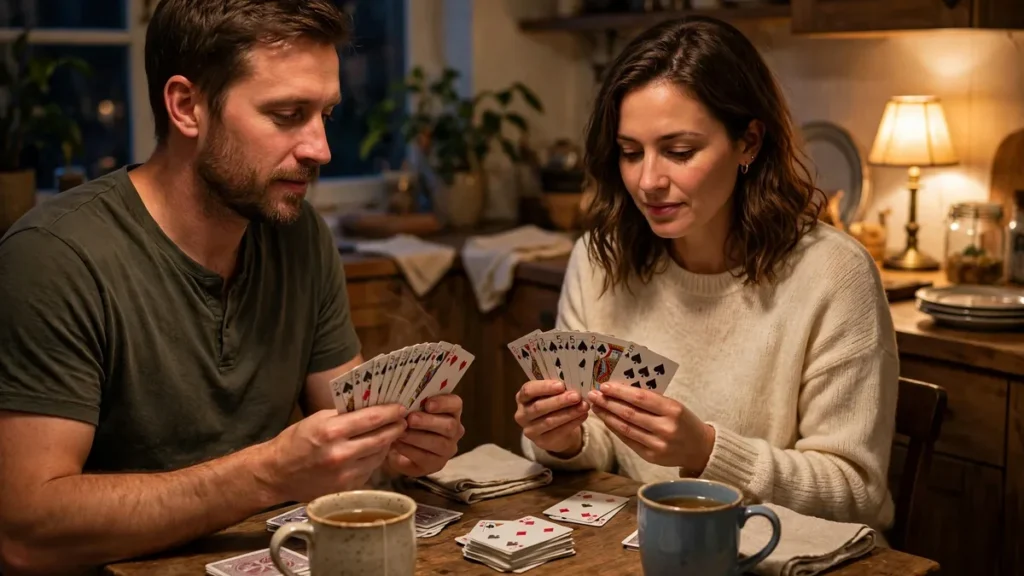
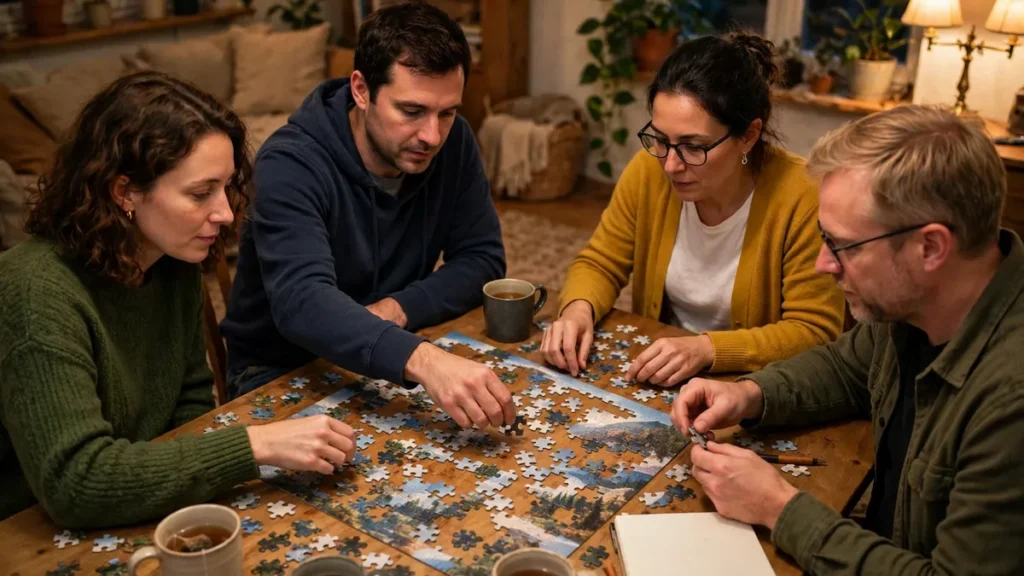
It is Tuesday, dinner is done, and the question hangs in the air the way it does most nights: what should we do now? One of you reaches for the remote. The other reaches for a phone. Two hours later you have both watched something, neither of you can quite remember what, and the evening has slipped past without either of you really being in it. That is the evening this piece is about — not a bad one, just a thin one — and a riddle is one of the cheapest ways I know to make it thicker.
Here is my answer, straight up: yes, riddles are good for couples. Not in a life-changing way, and not for every pair, but in the small, repeatable way that most of a long relationship is actually built. A riddle costs nothing, takes ten minutes, and turns an evening of parallel scrolling into twenty minutes of looking at the same thing and talking about it. It works when both of you are in on it, when the riddles fit both of you, and when nobody keeps score. What follows is how to judge whether it suits the two of you, and how to keep it sweet once it does.
Two is the right number for a riddle
Riddles behave differently depending on how many people are in the room. In a crowd, a riddle is a performance: the quickest person shouts the answer, everyone laughs, and the moment is over. With two people, there is nowhere to hide and nobody to perform for. The riddle sits on the table between you, and the only audience is the person you already live with. That is a much kinder setting than it sounds. You can take your time. You can say a wrong answer out loud and watch your partner grin instead of judging. You can admit you are stuck without feeling foolish, because the only witness is someone who has seen you stuck on far bigger things.
Two also changes the rhythm. A riddle for a pair is not a race; it is a relay. One of you reads it aloud, the other turns it over, and then you trade places. The reading matters more than people expect. Saying a riddle out loud slows it down, and the second hearing often does what the first could not. A word that sounded ordinary the first time suddenly sounds like a clue the second time. Couples who read riddles to each other often find that the answer arrives in the middle of the reading, mid-sentence, from whichever of them happens to be listening hardest at that moment. That shared arrival — both of you getting it at once — is a small pleasure, and it belongs to the pair rather than to either person alone.
What the pause teaches you
The most useful thing a riddle does for a couple is not the answer. It is the pause before the answer. For a minute or two, both of you are thinking about the same small thing, and neither of you is thinking about work, or bills, or whose turn it is to do anything. That shared pause is rare in a modern home, and it is restful in a way that scrolling never is. A feed fills your head with other people’s lives. A riddle empties it of everything except one small question. You come out of it a little calmer than you went in, and you come out of it together.
The pause also shows you things about each other that conversation alone does not. You notice whether your partner talks their way through a puzzle or goes silent and thinks. You notice whether they want a hint or would rather wrestle with it alone. You notice what makes them laugh — the groan at a pun, the delight at a clever twist, the mock outrage when the answer was obvious all along. None of this is deep psychology. It is simply paying attention to the person across the table, and attention is the currency a long relationship runs on. A riddle is a small, reliable way to spend some of it.

When the game turns sour
None of that happens on its own, and the claim has edges worth naming. Riddles can sour an evening, and the usual cause is one person turning a bit of fun into a contest. If one partner treats every riddle as a measure of cleverness, or keeps a mental tally of who solved what, the table stops being a date and starts being a test. Nobody wants to sit a test in their own kitchen, and the partner on the losing end will quietly stop playing. If you notice the tally forming, drop it. Solve everything together instead of against each other, and let the answer belong to both of you.
The second edge is speed. In most couples, one person solves riddles faster than the other. That is normal, and it is only a problem if the faster person makes it one. Blurting out every answer the moment it arrives leaves the other person with nothing to do except watch, and watching someone else be clever is a dull way to spend an evening. If you are the faster solver, hold back. Count to ten in your head. Ask your partner what they think before you say what you think. The evening is better when both of you get to do the thinking, and the riddle will still be there in ten seconds.
The third edge is the choice of riddle itself. Some riddles lean on sore subjects — money, family, old mistakes — and dressing one up as a joke does not make it playful. Some riddles are simply too hard, and an evening of riddles nobody can solve feels like homework. Both problems have the same fix: choose for the pair, not for yourself. If a riddle makes one of you go quiet, put it aside and do not bring it back. There are thousands of riddles in the world, and you do not need the one that stings or the one that stalls.
Choosing riddles that fit both of you
Most couples fail at this for a simple reason: the person who picks the riddles picks the ones they like. One partner loves wordplay and the other loves logic. One grew up on riddles and the other is meeting them for the first time. The fix is to mix the kinds on purpose. A riddle about an everyday object suits a different mind from a riddle about a word wearing two meanings, and a set that holds both kinds gives both people a turn to shine. Aim for a set where you solve most of them between you and miss a few. A night where you solve everything feels empty. A night where you solve nothing feels like a chore.
It helps to know what you are actually choosing, because plenty of things sold as riddles are really quiz questions with a costume on. A real riddle describes something ordinary in words that point somewhere else, and the fun is in catching the swerve. If you want a refresher before you build your first set, our guide to what makes a riddle grown-up level explains the difference in plain terms.
Here are three short riddles I wrote for exactly this kind of evening, to show what I mean by a riddle that fits two people at a table. Try them on each other before you read the answers.
One. I arrive on Friday and leave on Monday. I am full of plans and short on hours, and the more you spend me the faster I go. What am I? Answer: the weekend.
Two. I have no screen and no battery. I sit on the table between two people, and I can keep them talking for an hour without saying a single word. What am I? Answer: a riddle.
Three. You cannot hold me in your hands, but you can lose me in a single evening. The surest way to keep me is to laugh at the same small thing twice. What am I? Answer: a good mood.
Notice what those three share. Each one is about ordinary life, each one can be cracked in a minute or two, and each one ends with a small click rather than a long grind. That is the shape to look for. If a riddle needs a diagram, a pen, or a five-minute explanation of its own answer, save it for another night.
When riddles help, and when they do not
| Situation | What usually happens |
|---|---|
| Both of you like a small puzzle | A relaxed hour, easy talk, and a habit you will both want to repeat. |
| One of you is new to riddles | Start easy, hand out hints freely, and let the newcomer take the first few wins. |
| One of you turns everything into a race | Drop the score entirely and crack every riddle as a pair instead. |
| The riddles are far too hard | Silence, then frustration. Swap to easier ones and save the hard set. |
| Your partner truly dislikes puzzles | No riddle will change that. Pick a shared evening you both genuinely want. |
Making it a habit without making it a chore
If this sounds good but you are not sure where to start, keep it tiny. One riddle a night is enough. Read it aloud after dinner, give yourselves two minutes, and talk about it whether you crack it or not. The two minutes are the point, not the answer. After a week of that, you will know whether riddles belong in your evenings, and you will have found your own rhythm without ever having planned a thing.
If the habit sticks and you want to stretch it into a proper evening, our guide to putting together a riddle night for couples walks through the practical side — timing, rounds, keeping two players even, and prizes that suit a pair. You do not need any of that to begin, but it is there when a single riddle a night starts to feel too short.
It is worth noting that riddles sit in a different place for a settled couple than they do for people who have just met. A first date is two strangers sizing each other up, and a riddle there is an icebreaker with something riding on it. A long relationship is two people who already know each other, and a riddle there is something else entirely: a small shared project with no audience and no prize. If you want the contrast, our honest answer on whether riddles suit a first date covers the stranger side of the same question — and the contrast comes down to how well you already know the person opposite you.
The honest limits
Let me be careful about the claim, because it is easy to promise too much here. Riddles will not repair a relationship that is struggling. They will not stand in for a proper talk the two of you have been putting off, and they will not win over a partner who truly dislikes puzzles. If the two of you are barely speaking, a riddle is not a bridge. It is a distraction, and distractions do not hold weight for long.
The smaller promise is one a riddle can actually keep. For a couple whose foundations are sound, riddles offer a regular, cheap, repeatable way to pay attention to each other, to laugh at the same small thing, and to end the day on a shared note rather than on two separate screens. That is a modest promise. For a lot of couples, it is exactly enough.
So, do riddles bring couples closer?
Yes — in the way that matters. Not by teaching you something new about each other, though they will do that too. Not by making you cleverer together, though an evening of riddles is a fine workout for two minds. They bring couples closer by giving two people a reason to sit together, look at the same small thing, and laugh at it together, week after week. Closeness, in the end, is mostly made of evenings like that: small, repeated, and shared.
So try it tonight. One riddle, two mugs, phones in another room. If you crack it together, enjoy the click. If you do not, enjoy the groan when the answer lands. Either way, you will have spent twenty minutes actually with each other, and that is the whole point.