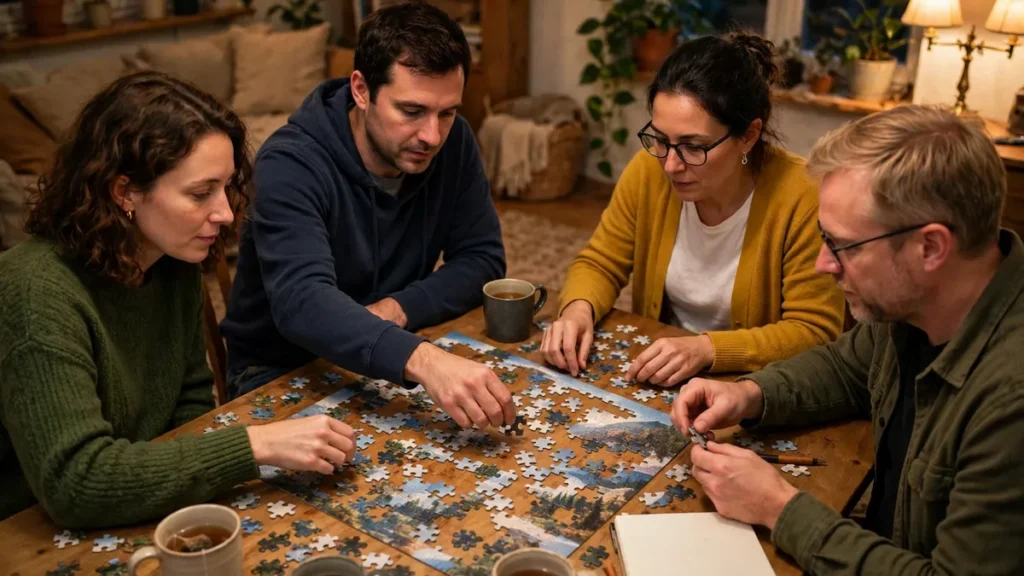
The difference between a good puzzle night for adults and a chaotic one is rarely the puzzles. It is the notebook. Somebody wrote down the date, the names, the money, and the shopping list weeks ahead, so that on the night itself nobody had to make a decision while guests were standing in the hallway with their coats still on. This guide is about that notebook: the planning half of the evening. The other half — reading the room, keeping the rounds moving, knowing when to change a puzzle — belongs to the host, and the hosting half is covered in our hosting guide for adult puzzle nights. Start here about three weeks out, and work through the decisions in the order below.
Settle the Shape of the Night First
Before you invite anyone, decide in one sentence what this night is. A quiet evening for six close friends around a single table, a livelier night for twelve with teams rotating between stations, or a monthly fixture you hope will still be running in a year — each of those needs a different guest list, a different budget, and different puzzles. Trying to plan for all three at once is how evenings end up pleasing nobody, so pick one and write it at the top of your notebook.
Let the guests decide the shape, not the other way round. Friends who already know each other well will happily share one table and one long conversation. A mixed crowd — workmates, neighbours, a couple of friends of friends — needs more structure, because people who barely know each other need something to do together before they are ready to simply sit and talk. A night you want to repeat needs a shape simple enough to run again without fresh effort every time. Choose for the people you actually have, not the people you wish you had.
| Your group | Shape that fits | Why it works |
|---|---|---|
| Six to eight close friends | One table, one main puzzle | Conversation carries the evening; nobody needs a timetable |
| Ten to fourteen, mixed circles | Stations with teams of three or four | Guests meet through the puzzles instead of standing around |
| Regular monthly night | Same small group, same simple format | Low effort each time, so the habit survives busy months |
| Workmates or neighbours | Teams with a clear finish and a small prize | A shared goal gives near-strangers a reason to talk |
Choose a Date and Then Stop Negotiating
An adult diary is a crowded thing: work deadlines, partners’ plans, children’s activities, and small commitments that only surface the week before. That is why the date needs three weeks’ lead and a firm decision rather than a vague suggestion. Offer two or three evenings to a vote in the group chat, take the one that suits the most people, and then stop discussing it. A date that stays open for negotiation will drift until half the group has booked something else.
Send the invitation the same day you fix the date, in writing, with everything in one message: the date, the start and finish times, the address, what to bring, and a plain description of the evening in a single line. A table, some puzzles, food and drinks, home by ten. When guests know exactly what they are coming to, they arrive in the right frame of mind. Ask for replies by a date a week before the night, and mean it: a list you cannot count on is not a list at all.
Build a Guest List That Mixes Well
Six to ten guests is the range to aim for. Below six, a big jigsaw feels thin, with too few hands for the work and too little talk to fill the gaps. Above ten, you need a second table, a second set of puzzles, and a louder voice, which is a different night altogether. Aim for eight on a first attempt: plenty of hands for the jigsaw, enough people for two teams, and a table everyone can talk across.
Settle the awkward questions in advance, because they always come up. Partners and plus-ones: state clearly in the invitation whether partners are invited, and do not leave it to guesswork. A guest who brings someone unannounced throws your numbers, your teams, and your puzzle buying off at once. If the night is adults-only, say so kindly and early, so nobody has to find a babysitter at the last minute. Sort the teams at home a few days beforehand and tell nobody until the evening; deciding teams in front of guests wastes ten minutes and embarrasses whoever is chosen last.
Set the Budget and Agree Who Pays
| What you are paying for | Plan it this way | Keep the cost down |
|---|---|---|
| Puzzles | One main jigsaw, two smaller puzzles, one printed round | Borrow from friends, buy secondhand, reuse next time |
| Food and drink | Finger food, one proper drink each, coffee to finish | Ask guests to bring a bottle or a dish |
| Printing and supplies | Answer sheets, score sheet, spare pens, a timer | Print at home, keep spares for the next night |
| Prize | Something small and slightly silly | A box of chocolates beats anything expensive |
Agree who pays before you buy, and say so plainly. The simplest arrangement for a first night is that the host covers the puzzles and the guests bring food or drink, because the puzzles stay with the host and get used again. For a regular night, a small kitty works better: everyone puts in the same few pounds or dollars at the start, and the kitty buys the puzzles, the printing, and the snacks. What matters is that the arrangement is settled in advance and feels fair. Nothing sours a friendly evening faster than a guest discovering at the door that they owe money they did not expect to pay, or a host quietly resenting a bill nobody offered to share. Keep the receipts in your notebook; a repeat night is far easier to cost once you know what the first one spent.
Buy the Puzzles for the Least Experienced Guest
It is tempting to buy a shelf of puzzles the moment you decide to host, and it is the easiest way to waste money. Plan the buying around the shape you chose and the guests you invited, not around what looks good in the shop. One main puzzle the whole room can work on, two smaller puzzles of different kinds, and one printed round of riddles or word puzzles is enough for a first night. Four kinds give every guest a format they enjoy; eight kinds leave nobody finishing anything. If you need help choosing the main puzzle, our list of the best jigsaw puzzles for adults will help you pick one.
Judge difficulty for the least experienced guest, not the keenest. The keenest puzzler in your group would happily spend three hours on a thousand-piece landscape; the beginner beside them will give up after twenty minutes on the same puzzle and spend the rest of the night watching. Aim the main puzzle a half-step above comfortable: a five-hundred-piece jigsaw with a busy, colourful picture suits most adult groups across a whole evening, while anything mostly one colour — a wide sky, a green forest, a plain sea — will stall a mixed group no matter how good they are.
Spread the Work Over Three Weeks
| When | Decide and do |
|---|---|
| Three weeks out | Fix the shape, the date, and the guest list; send invitations with start and finish times |
| Two weeks out | Set the budget and the payment arrangement; buy or borrow the main puzzle; ask about food allergies and dietary needs |
| One week out | Confirm numbers and chase replies; sketch the teams; test one puzzle; buy the smaller puzzles and the non-perishable snacks |
| The day before | Print the sheets and the answers; lay the room out; pack a small kit of spare pens, extra sheets, the score sheet, and the prize |
| On the day | Buy fresh food in the morning, give the room a last tidy, and read aloud anything you plan to say — then stop working |
Sketch the Room Before You Move a Chair
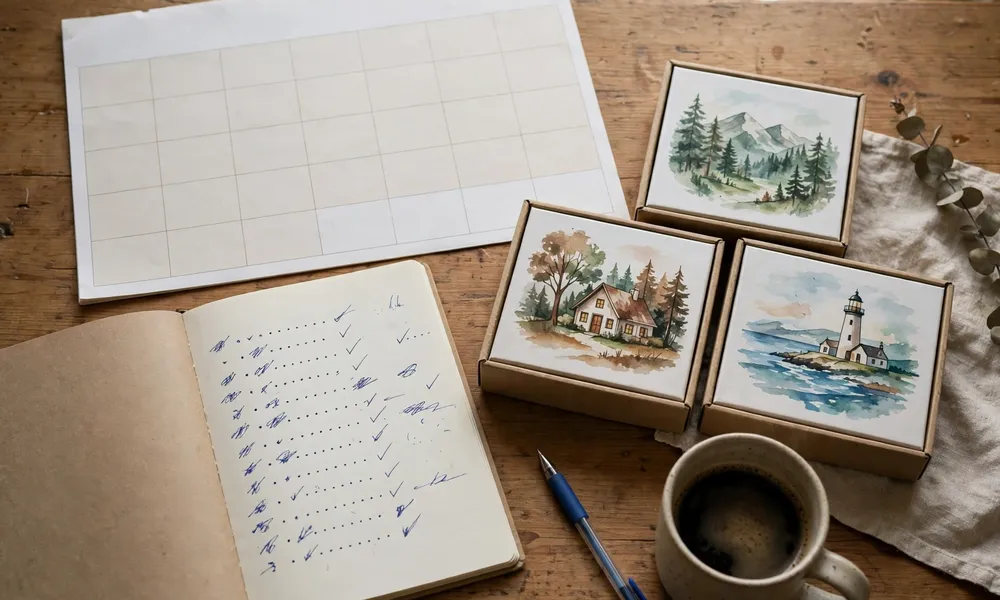
Look at the room a week early with fresh eyes, then draw it on a scrap of paper: where the tables go, where the light is strongest, and where the drinks sit so a spilled glass cannot reach the puzzles. Ten minutes with a pencil saves an hour of moving furniture on the night. Each guest needs elbow room and a clear view of the puzzle, which means a dining table holds about eight people comfortably and a kitchen table about six. Grown-ups need chairs with backs and a table at the right height — the floor and a low coffee table leave everyone leaning, and leaning guests leave early. For how the room, the stations, and the evening’s order fit together once guests arrive, our broad guide to hosting puzzle nights covers the parts that work whatever the age of the guests.
Food, Drink, and the Alcohol Question
When it comes to food, one rule matters more than the rest: nothing sticky, greasy, or crumbly belongs near the puzzles. Sticky fingers and cardboard pieces are a bad combination, and one spilled drink can ruin an hour of careful work. Keep drinks on a side table, clear of the puzzles, choose food that needs only one hand so the other stays free for a piece or a pen, and keep the eating to a proper break in the middle rather than a constant trickle across the table. That much is simple. The part that needs planning is everything around it.
Ask about food allergies and dietary needs alongside the invitations, and write the answers in your notebook. A guest with nothing safe to eat will not enjoy the evening, however good the puzzles are, and a few clearly labelled options cost very little. Offer a non-alcoholic drink that is genuinely good, because some of your guests will not be drinking and they should not have to announce why. Decide the alcohol policy in advance rather than discovering it on the night: one or two drinks across the evening keeps the room sharp and the pieces safe. If you are asking guests to bring a bottle, say so in the invitation, and have enough of your own in reserve for the guest who forgets.
Have a Plan for the Night Going Sideways
Sooner or later in any puzzle night, something stalls, and the difference between a small wobble and a spoiled evening is what you set aside beforehand. Keep a reserve pile on your side table before the night: one easy spare puzzle for a fast success, a sealed envelope of hints for the harder puzzles, a short guessing game that needs no equipment for the gap while you reset a table, and a job — scorekeeper, timekeeper — for any guest who needs a breather from solving. Reserves you never use have still done their job, because knowing they are there lets you relax.
Settle beforehand how long a team gets before you intervene: ten minutes is fair for most puzzles, and then it is time to change something: bring out the spare puzzle, open the hint envelope, or move the team to a different round. Nobody objects to a puzzle being put to one side; what wears people down is sitting with no way forward. The same thinking applies to people problems. A guest who cares too much about winning needs a job that uses their energy, like timekeeping, given early and lightly. A guest who has had too much to drink needs water, food, and a quiet word, not a scene. A guest who arrives an hour late needs a warm welcome and a puzzle they can join straight away, not a recap of everything they missed. Work these responses out now, while the room is empty, and you will not have to invent them while eight people watch.
Make the Second Night Easier Than the First
A single puzzle night is a pleasant evening; a regular one is a small institution. The habit matters more than any single puzzle, and the planning for the second night should start before the first one ends. Book the next date before anyone stands up, while the evening is still fresh in everyone’s minds. A night that ends with a plan comes back; a night that ends with a vague promise usually does not.
The planner’s job ends when the doorbell rings. From there, the host takes over, the puzzles take over from the host, and the evening looks after itself. Do the deciding early — the shape, the date, the guests, the money, the puzzles, and the backup plan — and the question at the door will be when the next one is.