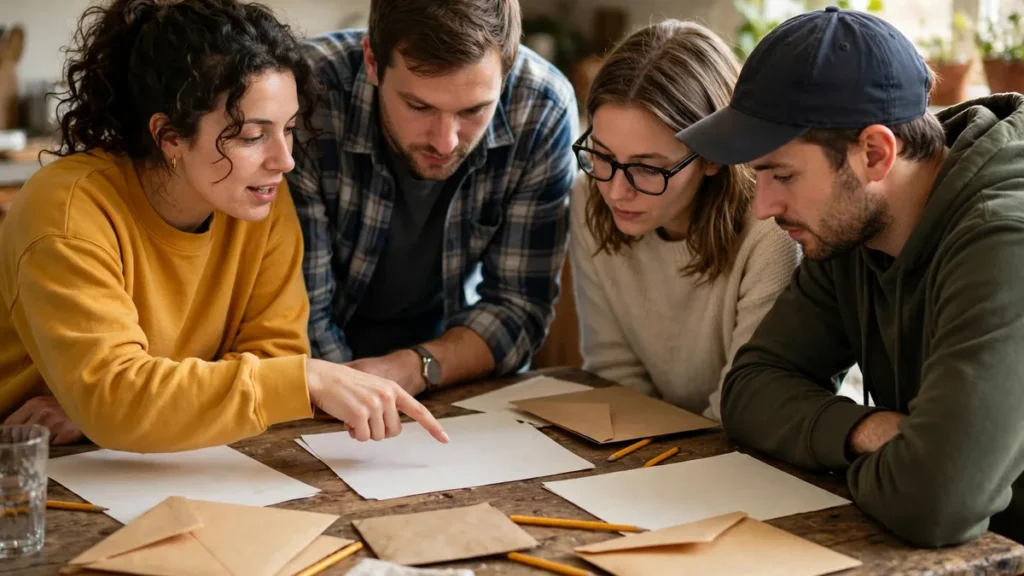
Four people are bent over a table covered in paper. One of them has just said something nobody else understands yet. Another is counting letters on her fingers. A third has turned the clue sheet upside down, as if the answer might be hiding on the other side of the page. Then somebody laughs, a pen moves, and a word nobody expected lands in the middle of the table — and suddenly the whole group is on its feet, because that word is also an instruction about where to go next. That moment, repeated a dozen times over an afternoon, is a puzzle hunt.
A puzzle hunt is a team game made of linked puzzles. You solve one, and what you get back is not just a point: it is the way into the next puzzle, or a piece of the final answer. The puzzles are deliberately mixed — words, pictures, codes, counting, spotting things in the world around you — so no single skill carries a team from start to finish. Hunts happen at kitchen tables, in pubs, across whole towns, and online, and they can last an evening or an entire weekend.
The Short Answer
A puzzle hunt is an event in which a team works through a set of puzzles that connect to each other. Each puzzle has an answer — usually a word, a short phrase, or a number — and that answer does something: it names the next place to visit, unlocks the next puzzle, or contributes one fragment toward a closing puzzle that gathers everything together. The chain matters more than any single puzzle. A crossword on its own is a puzzle; a crossword whose answer tells you which park bench holds the next envelope is a step in a hunt.
Most hunts are team games played in small groups, because the variety of puzzles rewards a mix of minds. One person may be quick with anagrams while another notices the detail in a photograph that everyone else walked past. Hunts are written for curious all-rounders rather than experts in one thing, so you do not need a shelf of puzzle books or a degree in anything to take part. Curiosity, patience, and a willingness to say a half-formed idea out loud count for far more.
How a Hunt Is Put Together
Every hunt, whatever its size, is built from the same three parts. First comes a puzzle, presented as a sheet of paper, a card, a photograph, or something found in a place. The puzzle rarely tells you how to solve it. It might be a grid of letters with a pattern to spot, a picture with one detail out of place, a message in a simple code, or a row of figures that stays meaningless until you notice what they are counting. Working out what kind of puzzle you are looking at is often the first puzzle of all.
Second comes the answer, and the answer is the currency of the game. A solved puzzle pays out in a word or a number, and that payment is spent immediately. It might spell the name of a street, give the number of a locker, or point at a particular statue in a square. In hunts played at tables, the answer is written on an answer sheet and checked with the organisers, who hand over the next puzzle in return. In hunts played across a town, the answer sends the team walking to a real location, where the next puzzle is waiting — pinned to a noticeboard, tucked under a bench, or handed over by a steward.

Third comes the closing puzzle, known among enthusiasts as the metapuzzle. As the hunt goes on, teams collect their answers, and the final stage asks them to do something with the whole set: take one letter from each answer, read the answers in a certain order, or fit them together like pieces of a larger picture. A hunt without a proper ending simply stops when the clues run out. A hunt with a good metapuzzle ends with a second click, when the team realises that answers they collected hours ago were quietly spelling out the finish all along.
The Kinds of Hunt You Will Meet
Hunts come in several shapes, and the shape changes the experience more than the puzzles themselves do. The table below sets out the main kinds.
| Kind of hunt | Where it happens | Typical length | Best for |
|---|---|---|---|
| Tabletop or pub hunt | Teams at tables in a hall, pub, or living room | Two to three hours | First-timers and sociable evenings |
| City or park hunt | Streets, statues, shop signs, and landmarks | Half a day | Teams who like fresh air with their thinking |
| Online hunt | Video calls and shared documents, from anywhere | An evening, or open for days | Friends in different places |
| Home or party hunt | A house, a garden, or a hired room | About an hour | Birthdays and family gatherings |
| Marquee weekend hunt | A campus or a city, with dozens of puzzles | A full weekend | Keen solvers who want the full test |
Hunts also differ in structure. In a linear hunt, the puzzles arrive one at a time in a fixed order, and a team cannot move on until the current puzzle falls. That shape builds tension, but a single hard puzzle can jam the whole chain, which is why linear hunts lean heavily on hints. In an open hunt, teams receive several puzzles at once and choose which to tackle, returning to the hard ones later. Open hunts suit larger groups and longer events, because no team ever sits idle. Many big hunts mix the two: rounds of open puzzles, each round feeding its answers into a closing puzzle, and the closing puzzles feeding into one final metapuzzle at the very end.
Where Puzzle Hunts Came From
The modern puzzle hunt has a clear starting point. In January 1980, a graduate student named Brad Schaefer stood in the main lobby of the Massachusetts Institute of Technology and handed out a single sheet carrying twelve small puzzles — a cipher, a short runaround, a maths problem among them. The answers, taken together, disclosed the hiding place of a small coin on the campus. That first MIT Mystery Hunt set the pattern that every hunt since has followed: linked puzzles, answers that combine, and a hidden prize at the end of the chain. Schaefer ran the event for a few years, and then the winners took over the job of writing the next one, a tradition that still holds. The hunt now runs every January, lasts a whole weekend, and can contain well over a hundred puzzles.
For a long time the form belonged mostly to universities and puzzle clubs. The change came when the format shrank to fit an evening in a pub. Puzzled Pint began in Portland, Oregon, in July 2010, as a monthly night in a bar: teams receive a small packet of four or five puzzles, solve them over a couple of hours, and feed the answers into a final metapuzzle. There is no prize in the usual sense — the point is the solving and the company. The idea spread from city to city, and it gave thousands of people their first taste of a hunt without asking them to give up a weekend.
Five Games It Gets Mixed Up With
Part of understanding a puzzle hunt is knowing what it is not. It shares a table, a park, or an evening with several neighbouring games, and the differences are worth pinning down.
| Game | What you mostly do | How you move | What decides the winner |
|---|---|---|---|
| Puzzle hunt | Solve linked puzzles | Between tables, or around a town | Answers collected and combined |
| Scavenger hunt | Find items on a list | Searching, often in any order | Most items found, fastest |
| Treasure hunt | Follow a map or trail to a prize | Along a set route | Reaching the treasure first |
| Riddle night | Answer riddles read aloud | Seated, no route at all | Most correct answers per round |
| Escape room | Solve puzzles to get out | Inside one themed room | Escaping before the clock runs out |
| Quiz or trivia night | Recall facts you already know | Seated, no route at all | Most correct answers overall |
The scavenger hunt causes the most confusion, and the split is straightforward. A scavenger hunt hands players a list and sends them looking: sharp eyes and fast feet do the work, teams pick items off in whatever sequence suits them, and the game is over when the list is done. A puzzle hunt hands players a problem instead of a list. Nothing can be found until something has been figured out, because each answer is what points the team at the next hiding place. One game tests searching; the other tests thinking, with searching as the reward for thinking well. Our guide to scavenger hunts explains the searching game on its own terms, at what a scavenger hunt is.
A riddle night looks similar from a distance, because riddles are often the first puzzle in a hunt. But a riddle night is a seated game: a host reads riddles aloud, teams write down answers, and points are scored round by round. Nothing is hidden, nobody moves, and one riddle has nothing to do with the next. A puzzle hunt takes the riddle off the stage and turns it into a key: the answer opens the next step, and the steps add up to something larger. If the seated version appeals to you, our guide to how to host a riddle night has the format, the team sizes, and the scoring.
Who It Suits — and Who Should Skip It
A puzzle hunt suits people who enjoy a slow problem, a team to argue it over with, and the moment when scattered answers click into place. It suits crossword solvers and board-game players, and it suits people who have never called themselves puzzle people but like a challenge shared with friends. The mix of puzzle types is what lets a varied team work: the word lover, the visual thinker, the careful note-keeper, and the person who notices details on buildings all get their turn. Families often find the same thing from the other direction — a hunt gives every generation a genuine job — and our verdict on whether puzzle hunts are good for families weighs that case in detail.
It suits some people badly. If being stuck frustrates you more than it intrigues you, a hunt will wear on you, because every hunt includes puzzles that resist you. If you prefer playing alone, the team sits at the centre of the experience and will feel like a constraint. And if losing would spoil your evening, keep in mind that most teams do not win anything: only one team takes the prize, and the rest take the afternoon. The cheapest way to find out which side you fall on is a short one — a pub night or an online event, with three or four friends, and no great stakes.
Questions People Ask Before Their First Hunt
What is a metapuzzle? The closing puzzle of a hunt. It takes the answers a team has already collected and asks them to do something with the whole set — take one letter from each answer, read them in a certain order, or fit them together. It is what turns a string of separate puzzles into one finished game.
How is a puzzle hunt scored? It depends on the event. Timed hunts award points for each solved puzzle, sometimes with a bonus for finishing first, and charge a penalty when a team buys a hint or asks for an answer. Untimed hunts keep no score at all: teams simply see how far they get before the finish, and the metapuzzle is the reward.
How much does it cost to join one? It varies widely. A hunt built at home needs only envelopes, pens, and a small prize. Small community events usually ask a modest amount per person for printing and hire. Large city events charge more, and pub or online nights are often free. Whatever the ticket, check what previous players said about it before you pay.
The Bottom Line
A puzzle hunt is a chain of puzzles played by a team, where every answer earns the next step and all the answers together unlock the finish. It began as a university weekend event, shrank to fit a pub table, and spread into homes, parks, and video calls — but the shape has stayed the same for more than forty years. If you like thinking with other people, and you like the moment when a scattered set of answers suddenly clicks into place, you will probably like a puzzle hunt. The cheapest way to find out is a short one, with friends, on an ordinary evening. Bring a pen, bring patience, and say your half-formed ideas out loud.