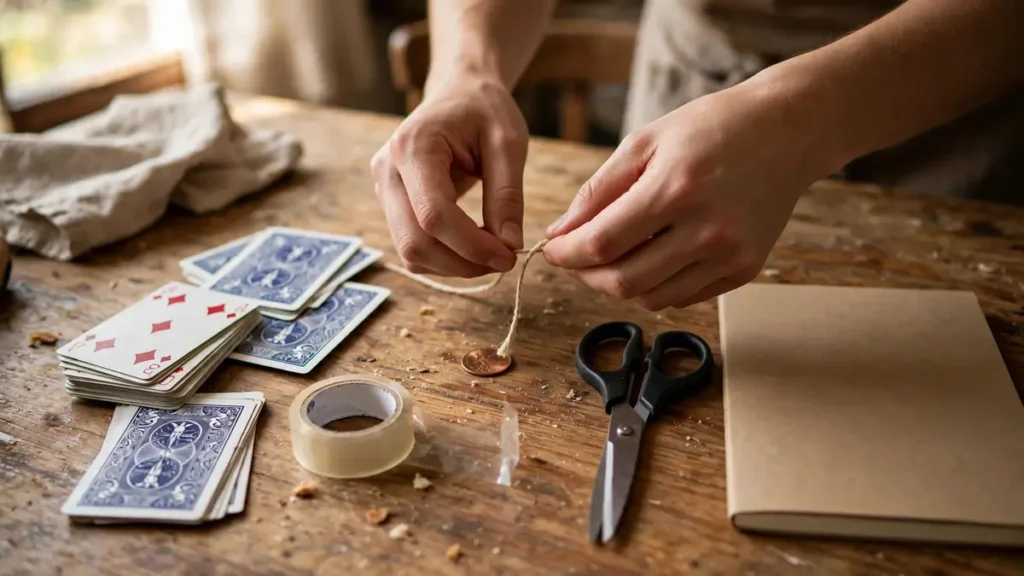
A magic show looks as if it happens on the night, while the performer stands in front of the audience. Most of it happens earlier, at a kitchen table, with a notebook and a calendar. The room, the order of the pieces, the invitations, the spare batteries, the plan for a late start: these quiet decisions decide whether the evening feels effortless or unravels in the first ten minutes.
This guide is for anyone putting a show together for adults, families, a club, a school hall, or a community event. It teaches no trick and explains no method. The performer already knows the tricks, or a hired magician brings them. Your job is everything around them: the occasion, the room, the people, the timing, and the backup plans.
Key takeaways
- Fix the occasion first: who the show is for, why it is happening, and whether you hire a performer or perform it yourself.
- Match the shape of the show to the room: stage, parlour, close-up, and outdoor sets all need different space, light, and time.
- Give every guest a clear view of the performer’s hands, and test it from the worst seat in the house.
- Plan a running order with a fast start, a change of pace in the middle, and the strongest piece saved for last.
- Rehearse the whole evening, including the welcome, the music, and the bow, not only the tricks.
Begin with the occasion, not the tricks
Start with three questions, and let the answers shape everything else. Who is the show for? What is the occasion? How long should the evening run? A forty-minute set at a wedding reception is a different job from a ninety-minute show in a village hall, and both differ from a lunchtime set at a school fair. Write the answers down before you look at a venue or a price.
Then decide who performs. A professional magician is the simplest route for a larger event: they arrive with props, music, and years of practice at reading a room. Performing yourself suits a smaller gathering, a family party, or a fundraiser where the charm is a familiar face on stage. Be honest about your level. A confident amateur with six well-practised pieces gives a better evening than a nervous performer with twelve half-ready ones. If you are building your own material, read our guide to building a trick of your own before choosing what goes into the set.
Choose the shape of the show
Magic comes in several shapes, and each one asks for a different room. Choosing the shape early stops you booking a hall that does not fit the act, or an act that does not fit the hall. The main kinds of magic show all work, but they work in different places.
| Shape | Audience | Room it needs | Typical length |
|---|---|---|---|
| Stage show | 80 to 300 people | Raised stage, lighting, sound system | 60 to 90 minutes |
| Parlour set | 20 to 60 people | A room with chairs facing the performer | 45 to 60 minutes |
| Close-up, table to table | Small groups, in turn | Tables, good light, no stage needed | 5 to 10 minutes per table |
| Street or outdoor set | A passing crowd | A clear patch of ground | 15 to 25 minutes per crowd |
Book the room and lay it out
Visit the venue before you book it. Walk in, sit in the back row, and look at the performance area. Can you see a playing card held at chest height? Can you hear a normal speaking voice from the farthest chair? Is there a bright window behind the performer that will turn them into a silhouette? None of these questions can be answered from a photograph on a booking page.
Check the practical details while you are there. Where does the performer wait before the show, and can they reach the stage without walking through the audience? Is there a table for props, out of sight, with a cloth that reaches the floor? Are there enough power sockets for the sound and the lights? Is there parking, step-free access, and a toilet near the hall? A lovely room with no parking and a long walk in the rain will lose you guests before the show begins.
Size the show to the people coming
An audience is not one thing. It is a mix of ages, moods, and expectations, and the plan should fit the mix you actually have. Ask the host or the ticket list who is coming, and how many. A show for thirty people needs a different pace from a show for two hundred, and a room with ten children in it needs different volunteer moments from a room of adults only.
Arrange the chairs in a broad curve facing the performer, with the shortest guests at the front and the tallest at the back, and leave a clear aisle down the middle so volunteers can reach the stage without climbing over chairs. Keep the front row near enough that the audience can see the performer’s hands, because that is where the wonder lives. If children are in the audience, our kids’ hosting guide covers young volunteers and short attention spans.

A good audience is the other half of the show. In this 1938 photograph by Russell Lee, a fairground crowd stands close, watches hard, and gives the performer its full attention. Photo: Russell Lee, public domain, via Wikimedia Commons.
Choose volunteers with care. One willing adult, picked kindly and thanked by name, will lift the whole room. A guest who clearly does not want to be on stage will drag it down, and the audience will feel it. Never pick a volunteer as a joke, never make them the butt of the trick, and always have a second person in mind in case the first declines.
Set the running order
The running order is the skeleton of the evening, and it is the part most planners leave until the last minute, which is why so many shows sag in the middle. Sit down with the performer, or with your own list of pieces, and lay the evening out in blocks. A sixty-minute show usually holds seven or eight pieces, and the order matters more than any single trick.
Open fast. The first piece should be visual, easy to follow, and over within two minutes, so the room knows at once that something worth watching is happening. A slow, talky opening is the most common mistake in a planned show, and it is the hardest to recover from. Put a piece with a volunteer second or third, once the room is warm, and save the quietest, most thoughtful piece for the middle, where it can reset the energy before the finish. Close with the strongest piece you have, and let nothing follow it except a bow and applause.
| Time | Block | What it does |
|---|---|---|
| 0 to 5 minutes | Welcome and opener | A quick, bright piece that proves the evening is worth watching |
| 5 to 20 minutes | Two audience pieces | Volunteers join in, the room warms up, and the pace stays high |
| 20 to 30 minutes | The quiet piece | A slower, closer piece that lets the room breathe |
| 30 to 40 minutes | Interval | Drinks, raffle, and a chance to reset the props |
| 40 to 52 minutes | Second half | Two strong pieces, one with a volunteer, one without |
| 52 to 60 minutes | Finale and bow | The biggest visual piece, then thanks and applause |
Invites, tickets and the money
An invitation should answer four questions in the first three lines: what it is, when it is, where it is, and how much it costs. Put the start time ten minutes before the show actually begins, so latecomers are seated during the welcome music rather than during the opener. Say plainly whether children are welcome, whether there is an interval, and whether tickets are needed at all.
If you are selling tickets, price them before you print anything, and keep the pricing simple: one adult price, one child or concession price, and a family ticket if the audience is mixed. A show that charges a small amount often draws a better audience than a free one, because people who have paid tend to turn up. Set the price to cover the hall, the performer, and the printing, with a little left over, and write down who covers the shortfall if fewer tickets sell than expected. Decide that now, not on the night.
Keep the budget on one page. The usual costs are the hall hire, the performer’s fee, printing, music or sound hire, and refreshments. Get the performer’s fee and terms in writing: the fee, the deposit, the travel costs, the arrival time, and what happens if the show is cancelled. A professional will expect a deposit, and that is normal. Pay it, and keep the receipt.
Rehearse the whole evening, not just the tricks
A performer can know every trick perfectly and still be unprepared for the evening, because the evening is more than the tricks. Rehearsal should cover the walk to the stage, the welcome, the first words, the music cues, the interval, and the bow. Run the show start to finish, out loud, in the room if you can, and time every block with a stopwatch.
Write a cue sheet, even for a small show. One page, listing the blocks in order, the music for each, the props needed, and who does what during the interval. The cue sheet is what keeps the evening on track when nerves take over, and it is what your helpers follow when you are on stage and cannot answer questions. Pack a spares box beside the prop table, with tape, scissors, a spare tablecloth, a torch, and the printed running order.
Have a plan for the night going sideways
Something will go wrong. It always does, in every show, and the plan is what decides whether the audience notices. A trick will fail, a prop will break, a guest will arrive late, or the sound will cut out halfway through a piece. The audience does not mind a wobble. They mind a performer who freezes, apologises again and again, and lets the evening stall.
Agree two recovery lines with the performer in advance: one for a piece that nearly worked, and one for a piece that clearly failed. A smile, a short joke, and a quick step into the next piece will carry the room with you. Give a failed piece one second attempt, and no more. After that, thank the volunteer, move on with energy, and never explain how the trick was supposed to work. The secret stays secret, even when the piece fails.
Plan for the bigger failures too. If the hired performer falls ill, who do you call, and what do you tell the audience? If the turnout is half what you expected, do you still run the show, and do you move the audience closer to the stage? If the show is outdoors and it rains, where does it go? Write the answers on the cue sheet, so the decision is already made when the moment arrives. A cancelled show with a clear refund message is better than a show that limps on in a half-empty hall with no plan.
A show-day timeline
- Three hours before: gather the props, the spares box, and the printed running orders.
- Two hours before: arrive at the hall, lay out the prop table, test the sound and the lights, and walk the room from the back row.
- One hour before: the performer runs the opening and the finale once, quietly, while the helpers set out the chairs.
- Thirty minutes before: doors open, music plays, and the host greets guests at the door.
- Show time: the host welcomes the room in one minute, introduces the performer, and steps back.
- After the bow: the performer thanks the volunteers by name, the host takes over, and the props are packed away before anyone leaves.
Frequently asked questions
How far ahead should I start planning a magic show?
Four weeks is enough for a hall show with a hired performer, and two weeks is enough for a small gathering at home. The venue and the performer book up first, so fix the date, the room, and the performer before you worry about posters or refreshments.
The bottom line
A magic show is won before the curtain, in the notebook and the rehearsal room. Fix the occasion, pick a shape that fits the room, give the audience a clear view, build a running order that starts fast and ends on the strongest piece, rehearse the whole evening, and have a plan for the night going sideways. Do those things, and the performer can walk on stage, do their work, and take the applause that the planning earned.