
Yes — with one condition. A riddle can be the best thing you bring to a first date, and it can also be the thing that quietly sinks it. The difference is not the riddle. It is how you offer it, when you offer it, and what you do when the person across the table does not get it. A first date is two strangers trying to find out whether they enjoy each other, and a riddle is one of the smallest, cheapest tools ever invented for exactly that job.
The reason it works starts with the shape of a first date. You meet, you sit down, and for the first ten minutes the conversation runs on rails: how was your day, how did you get here, have you been to this place before. Those questions are polite and necessary, and they run out fast. After them comes the part nobody plans for — the stretch where you have covered the basics and have not yet found the thing you both actually want to talk about. Most dates fill that stretch with more questions, fired faster, until it starts to feel like an interview. A riddle fills it differently. It gives you both a third thing to look at together, something that is neither you nor them, for about a minute. That minute takes the pressure off the person and puts it onto a puzzle. Nobody is being judged. A little question is being turned over between you, and the two of you are on the same side of it.
What a riddle actually does across a table
A riddle does four plain things on a first date, all of them useful. First, it changes the subject without changing the mood. You are not abandoning the conversation; you are giving it a new thread, one that arrives as a game rather than a question. Second, it lets the other person show you how they think, in miniature. You are watching them chew on a small problem, and that tells you something real: whether they enjoy a puzzle, whether they get flustered, whether they laugh at themselves. Third, it creates a shared memory within minutes. Couples remember the first thing they laughed at together far longer than they remember the first thing they ordered. And fourth, it gives you both a graceful way out of a dead end when a topic goes flat.
None of that requires the riddle to be clever. In fact, cleverness is the enemy here. The best first-date riddle is one the other person can solve — or almost solve — within a minute. The pleasure is in the near-miss, the groan, the moment the answer clicks. Keep it short, keep it about something ordinary, and keep the answer somewhere the other person can reach. The riddle is not there to prove you are smart. It is there to make the two of you feel smart together. If you love riddles generally, you will recognise the feeling — why we love a good riddle is mostly about that small shared click when an answer lands — and on a first date, that click is doing social work as well as puzzle work.
The minute it works best
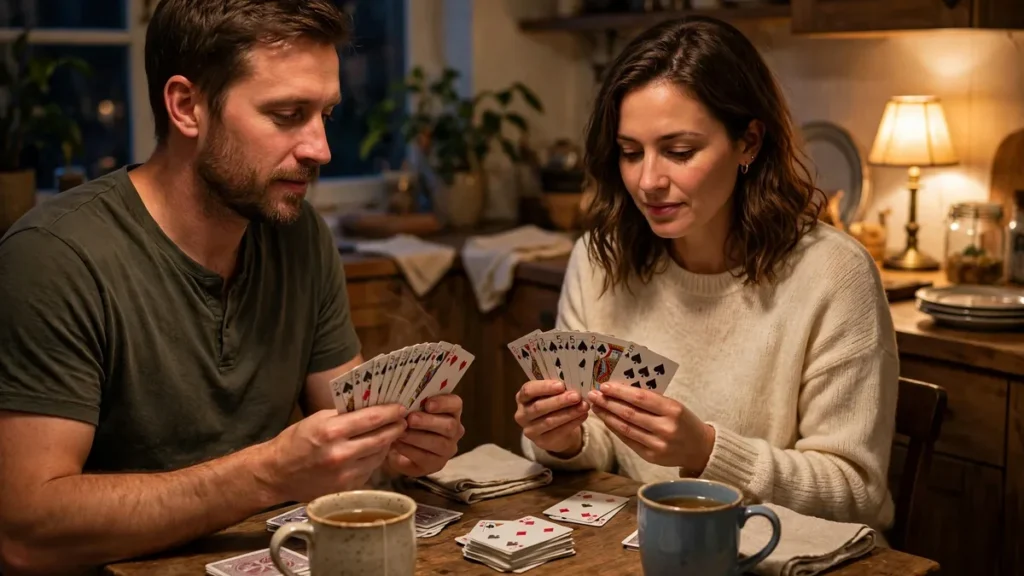
Timing is half the trick. A riddle asked in the first two minutes feels like a party trick, because you have not even settled into your chairs yet and somebody is already performing. A riddle asked after an hour of good conversation is unnecessary, because the conversation is already doing the job. The sweet spot is the first lull — the moment after the opening questions have run their course and before you have found your rhythm. You can feel it when it arrives. The coffees are in front of you, the easy topics are used up, and there is a pause that is not yet awkward but could become one. That is the moment. Offer the riddle lightly, as an aside rather than an announcement. No drumroll, no warning that this one is really hard, no promise that nobody ever gets it. Just the riddle, spoken the way you would mention anything else.
Reading the person across the table
Here is the part nobody tells you: the riddle is not really about the answer. It is about what happens while the other person is working on it. That is where a first date riddle earns its keep, because it shows you things that direct questions never will. Watch how they handle not knowing. Some people lean in, grin, and start guessing wildly, and those guesses are often funnier than the riddle itself. Some people go quiet and think hard, and then light up when the answer clicks. Both are good signs. They show someone who can sit with a small uncertainty without panicking, and that is a useful thing to know about a person you have just met.
Watch what they do with a wrong guess, too. The best response is a laugh and another guess. The worst is embarrassment, or a sudden need to argue that the riddle was unfair. Nobody should be judged on one puzzle, and a person who treats a missed riddle as a personal failure is telling you something about how they handle being wrong in general. The same goes for you. If they solve your riddle in five seconds, do not reach for a harder one to restore your pride. Congratulate them, laugh, and move on. The riddle was a gift, not a contest. There is one more thing a riddle reveals, and it is the most useful of all: generosity. A good riddle partner offers a hint before being asked and never makes the other person feel slow. You are not looking for a genius. You are looking for someone who enjoys thinking with you rather than against you, and a riddle shows you that in about a minute.
When it falls flat
Now for the honest limits. Riddles fall flat on first dates in a handful of specific ways, and every one of them is avoidable. The most common is difficulty. A riddle that is too hard does not make you look clever. It makes the other person feel foolish in front of a stranger, and that is a terrible way to start anything. If you have to explain the answer for more than a sentence, the riddle was too hard for the moment. Start easy. You can always go slightly harder later, once you know the other person enjoys the game.
The second way it fails is volume. One riddle is a charming aside. Three in a row is a performance. Five is a quiz show nobody bought a ticket for. The riddle is a spice, not the meal, and the meal is the conversation itself. Ask one, enjoy it, and then let the conversation go where it wants. The third failure is the show-off riddle — the one with an answer so out of reach that nobody could reasonably find it, told mainly so the teller can enjoy the reveal. A riddle should feel fair once the answer is out. Then there is the phone. If your date pulls out a phone to search for the answer, the riddle is already dead. Set it as something to chew on together, and if the answer does not come, give it freely and laugh about it. The answer is the least interesting part. The minute of thinking together is the point. And finally, some people simply do not like wordplay. If your date smiles politely and changes the subject, take the hint gracefully. You have learned something useful — that this particular game is not theirs — and the date is better for knowing it early.

Five gentle openers that are safe to try
If you want to try this, here are five short riddles I wrote for exactly this situation. They are all about the world of the date itself — coffee, time, the table, the room — so they feel like they belong to the evening. Each one is easy enough to solve in under a minute. Read them slowly, give the other person time, and offer a hint if they stall. The hint is part of the game, not a failure of it.
1. I have a lid but I never sleep, a handle but I never wave, and I get lighter every time you lift me. What am I? A takeaway coffee cup.
2. I have two hands but I never clap, I tick but I never talk, and on a first date I am the only guest nobody invited. What am I? A watch — the time on your wrist.
3. I am written nowhere, I am remembered by everyone who hears me, and I am the shortest story two strangers can share. What am I? A riddle.
4. I show you the whole street but I never leave the room, and the longer you look through me, the less you notice me. What am I? A cafe window.
5. I arrive the moment someone stops trying to impress you, I leave the moment someone starts again, and everyone at the table knows when I am here. What am I? Feeling at ease.
Notice what these five have in common. None of them needs knowledge the other person might not have. None of them is a trick with an unfair twist. And each answer is a small pleasure rather than a gotcha — the cup in your hand, the window beside you, the ease you are both feeling. That is the standard to hold. If your riddle’s answer makes the other person smile and nod, it was the right riddle.
Riddles beside the other first-date fillers
The closest cousin is a trivia question, and the two are easy to confuse, but they do different jobs on a date. Trivia rewards what you already know, which means it can quietly turn into a contest between two people’s general knowledge — and trivia nights as dates work best when that contest is softened by a host, a team, and a whole evening to spread it across. A riddle needs none of that. It has no score, no host, and no right answer hidden in a fact you either know or do not. It rewards how you think, not what you remember, and it fits in a single minute between sips of coffee.
A few ground rules, learned the awkward way
If you take one riddle to your next first date, take these rules with it. One at a time, always. Let the first one breathe before you even think about a second. Easy first, and only harder if the other person asks for another — their appetite is the only measure that counts. Offer the answer yourself if they stall for more than a minute; waiting longer turns a game into a standoff. Never correct their guesses with a sigh or a raised eyebrow; a wrong guess is the fun part. And never, ever use a riddle to test someone. The moment it becomes a test, it stops being a game, and the person across the table can feel the difference instantly. It is also worth choosing your riddle before you leave the house. Pick one from the five above, or write one of your own about something you can see from the table. The best first-date riddles arrive as if they just occurred to you, in a pause that needed filling, and disappear just as lightly. If the evening goes well and the riddles become a running joke between you, you have the makings of a second date already — and planning a riddle night for couples is a fine way to spend it, once the two of you are past the first meeting and the game belongs to both of you.
So, should you try it?
My answer is yes — one riddle, offered lightly, in the first lull, to someone who looks like they enjoy a puzzle. It will not fix a date that has nothing in common behind it, and it will not rescue an evening where your date plainly wishes they were somewhere else. No game can do that. What it can do is give two strangers a minute of thinking together, a laugh they share rather than one they watch, and a small, honest glimpse of how the other person handles not knowing. Bring a riddle. Offer it gently. And if the person across the table lights up and starts guessing — you have already learned the most useful thing a first date can teach you.
Frequently asked questions
Is one riddle enough for a whole first date? Yes. One good riddle, enjoyed properly, does more than five rushed ones. The date is the conversation; the riddle is a spark inside it, not a replacement for it.