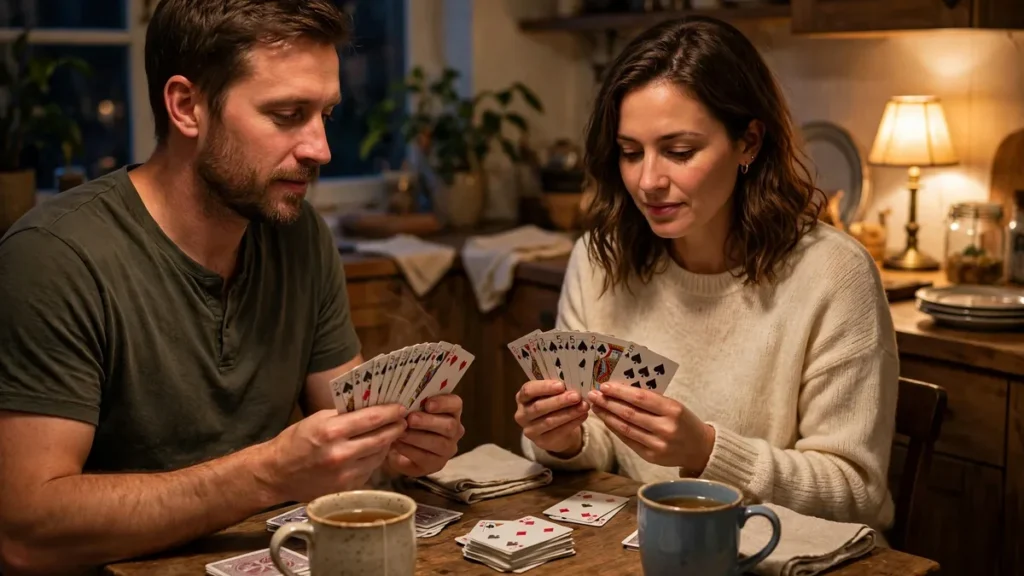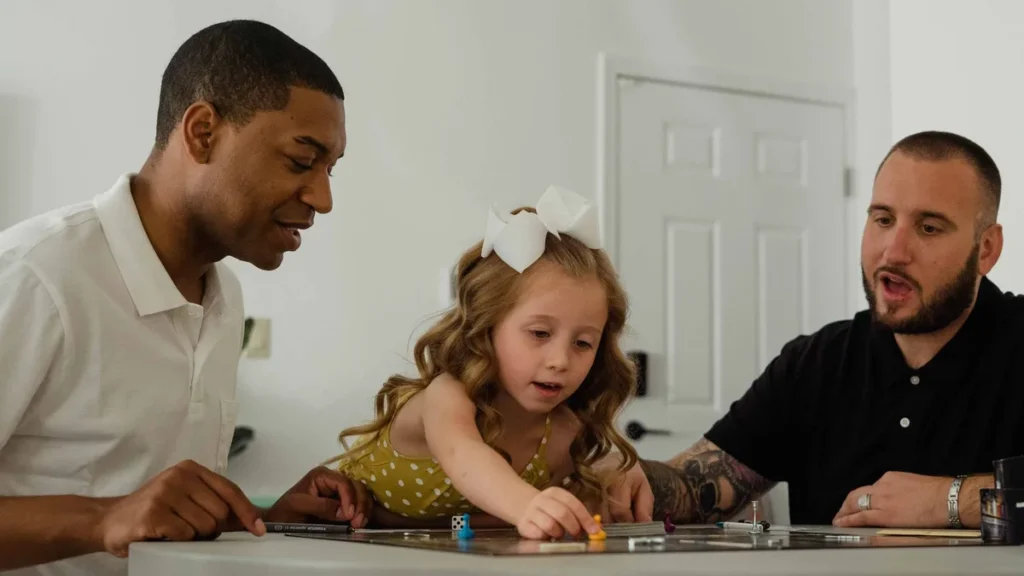
The best sound on family game night is the groan that goes round the table when a riddle clicks. One person sees it, everyone else wishes they had, and for a second the whole family is thinking about the same thing. Riddles do that better than most games because they do not reward age, vocabulary, or luck. They reward the sideways look and the second guess. A sharp eight-year-old can beat a grown-up at that game, and when it happens, the table erupts.
This guide collects ten riddle games for a real family night, where the players range from a small child to a grandparent and nobody should be left watching. Some cost nothing and need no pieces at all. Some come in a box. Each one lists who can play, how long it takes, and what makes it suit a mixed-age table. A weekly night like this builds more than memories, and our piece on why family game night matters looks at what children get out of the table while they are busy trying to win.
Picking games the whole table can play
Start with the smallest player. If the youngest person at the table cannot take a proper turn on their own, the game will quietly push them out, and no amount of adult enthusiasm fixes that. Look for games where reading is optional, where a wrong answer costs nothing, and where a good guess matters more than a big vocabulary. Picture cards, spoken riddles, and acting games all pass that test.
Then think about the room. Some riddle games are quiet and sit-down, and some are loud and on-your-feet. A good night usually has one of each. Keep the setup light, and play in teams, pairing a younger child with an older sibling or an adult, with a couple of hint tokens per team so nobody sits stuck in silence.
1. What Am I?
Players: 3 to 10 | Ages: 6 and up | Time: 15 to 30 minutes | Cost: free
Everyone writes the name of a person, animal, or thing on a sticky note and sticks it on another player’s forehead, face down so only everyone else can see it. Then each player takes turns asking yes-or-no questions to work out what they are. Am I an animal? Am I bigger than a dog? Twenty questions is the usual limit, and the first correct guess wins the round.
It works because the riddles are the players themselves. A child who could never write a clever riddle can still ask brilliant questions. Keep the notes easy for the youngest player: animals, foods, and familiar jobs rather than film characters or historical figures.
2. Twenty Questions
Players: 2 to 10 | Ages: 6 and up | Time: 10 to 20 minutes | Cost: free
One player thinks of something, and everyone else has twenty yes-or-no questions to work it out. Is it alive? Is it something you can hold? Would you find it in a kitchen? The questions narrow the field until someone risks a guess, and a wrong guess costs the table, which keeps everyone honest about when to ask and when to guess.
It needs no cards, no board, and no pieces, and it teaches the exact skill riddles reward: asking the question that cuts the possibilities in half. It also makes a perfect warm-up, because a round takes ten minutes and gets the whole table talking before the main game comes out.
3. Hedbanz
Players: 2 to 6 | Ages: 7 and up | Time: 20 to 30 minutes | Cost: boxed game
Hedbanz is the forehead guessing game in a box, with headbands, picture cards, and a timer, and the box is worth it if your family plays this kind of game often. Each player wears a card showing an animal, food, or object, and asks the table yes-or-no questions to work out what it is before the sand runs out. The cards are picture-based, so a child who cannot read well yet can still play, and the timer keeps turns short.
Buy the family edition rather than the adult one, because the adult cards lean on jobs, celebrities, and brand names that mean nothing to a nine-year-old. The game shines with four to six players, when the table is noisy and the questions fly fast.
4. Riddle Card Decks
Players: 2 to 8 | Ages: 7 and up | Time: 15 to 30 minutes | Cost: boxed game
A riddle card deck is a box of printed riddles, one per card, with the answer on the back. One player reads out a card, everyone calls out answers, and the first correct answer wins the card. Play to ten cards, or play in teams and keep a running score across the whole evening. Decks come in every flavour, so buy the difficulty that matches your youngest regular player, not your oldest.
Sort the deck before the night. Pull out any riddle with an answer that depends on a word a child would not know, and any riddle with more than one defensible answer, because an argument about the answer kills the round. One box lasts a family months if you only play ten or twelve cards a night.
5. Riddle Bingo
Players: 3 to 12 | Ages: 5 and up | Time: 20 to 30 minutes | Cost: free
Riddle Bingo turns an ordinary bingo night into a thinking game. Instead of calling out numbers, the caller reads a riddle, and the answer is the thing players mark on their cards. I have four legs but never walk. I am always coming but never arrive. A child who knows the answer looks for the picture or word on their card, and the first player to complete a row shouts bingo. Make the cards with pictures for younger children and words for older ones, with the same answers in a different order on every card.
It works with a big group, which most riddle games do not, because everyone plays every riddle at the same time and nobody waits for a turn. The five-year-old marks the easy answers, the teenager chases the hard ones, and both can win the same game. Give the caller a list of answers so there is never a dispute about whether a square counts.
6. Riddle Relay
Players: 4 to 12 | Ages: 7 and up | Time: 20 to 30 minutes | Cost: free
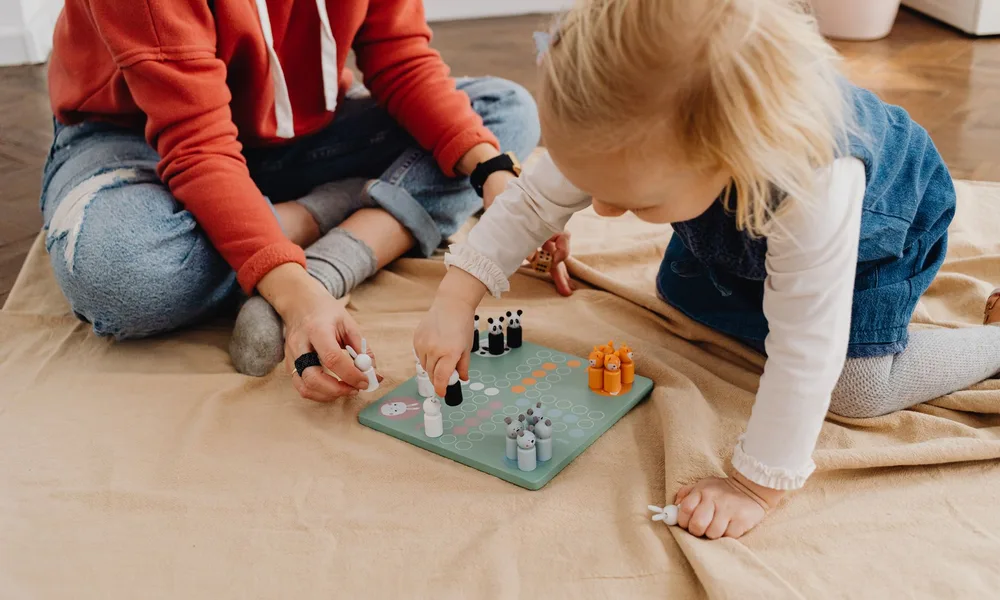
Riddle Relay is a team race, and it suits families with restless players who will not sit still for a quiet card game. Split into two teams and place a stack of riddle cards at the far end of the room. One player from each team runs to the stack, reads the top riddle, runs back, and whispers the answer to their team. If the team agrees, the runner goes back for the next card. A wrong answer means the runner must go back and try again, which costs time, so teams learn to think before they shout.
The running is the point. It burns off energy, it gives younger children a job they can do brilliantly even when the riddle is hard, and it stops one loud player from answering everything. Keep the riddles short, the running distance short, and cap the race at ten cards.
7. Riddle Scavenger Hunt
Players: 3 to 12 | Ages: 6 and up | Time: 30 to 45 minutes | Cost: free
A riddle scavenger hunt is the most memorable game on this list, because the riddles lead somewhere real. Each clue is a riddle whose answer is a place in the house: the fridge, the shoe rack, the bookshelf, the garden gate. Solve the riddle, find the place, and the next riddle is waiting there. The last clue leads to a small prize, a snack, or the next game of the night. Write eight to ten clues, keep each one to two lines, and test every riddle on someone before the night, because a clue nobody can solve stops the whole hunt.
Run it in teams, with each team following its own chain of clues so nobody follows the team in front. Mix the difficulty, with two easy clues to start and one hard clue just before the prize. Our guide on how to plan a riddle scavenger hunt covers clue chains, difficulty ladders, and hiding spots in detail.
8. I Spy Riddles
Players: 2 to 8 | Ages: 4 and up | Time: 10 to 20 minutes | Cost: free
I Spy Riddles is the game for the youngest player at the table, and it deserves a place on family night precisely because most riddle games leave small children behind. One player looks around the room and gives a riddle instead of a letter: I spy something that holds water but is never thirsty. I spy something that has teeth but never bites. Everyone else guesses from what they can see, and the first correct guesser takes the next turn. It needs no reading, no writing, and no pieces, which means a four-year-old can be the riddle-setter, not just a spectator.
It also teaches the habit every good riddle player needs: looking at ordinary things and asking what else they could be. Keep the riddles about things in the room, and let the adults give the first few riddles themselves to show how it works.
9. Riddle Charades
Players: 4 to 12 | Ages: 7 and up | Time: 20 to 30 minutes | Cost: free
Riddle Charades mixes two family favourites into one game. One player draws a card with a riddle on it, reads it silently, and then acts out the answer without speaking while their team guesses. The riddle is the clue and the acting is the proof: a riddle about a clock becomes someone ticking with their arms, and a riddle about a candle becomes someone flickering and melting. The team has one minute, and a correct guess wins the point. If the team is stuck, the actor may give one spoken hint, but only one.
It gives the shy thinkers a different way in. A child who freezes when asked to explain a riddle out loud can often show it with their hands, and the whole table ends up laughing at the acting whether the guess is right or not. Write the riddles yourself on cards the day before, and choose answers that can be acted: animals, jobs, objects, and actions, never abstract ideas.
10. Draw the Riddle
Players: 3 to 10 | Ages: 6 and up | Time: 20 to 30 minutes | Cost: free
Draw the Riddle is the quiet cousin of Riddle Charades, and it suits families with a player who would rather draw than perform. One player reads a riddle silently, then draws the answer on paper or a whiteboard while their team guesses. No letters, no numbers, no speaking, and the artist has two minutes. A riddle about a lighthouse becomes a tower with a beam of light. Bad drawing is half the fun, and the worst drawings often produce the best guesses.
Keep the riddles visual. Answers that are places, animals, and objects work; answers that are ideas do not. Give the artist a fresh sheet for each riddle, and let the team shout as many guesses as they like, because the noise is the point. It also makes a good final game of the night, when everyone is ready to sit down with a pen.
A sample riddle game night, in order
Ten games is too many for one evening, so here is a shape that works. Start with I Spy Riddles for ten minutes while everyone settles, because it needs no setup and the youngest player can lead it. Follow with What Am I? for twenty minutes, then the main game of the night: Riddle Bingo if the group is big, or a Riddle Scavenger Hunt if the house allows it. Finish with Draw the Riddle, and hand out a small prize for the best riddle of the night.
That order matters: it starts easy, peaks in the middle, and ends quietly. Rotate who chooses the games each week, and let the picker explain the rules, because children who pick the game stay with it far longer than children who are simply handed one. If you want to turn the whole evening into a themed event, our guide on how to host a riddle night covers rounds, teams, and pacing for a full two-hour night.
The bottom line
The best riddle game for your family is not the cleverest one, and it is not the most expensive one. It is the one the youngest player can genuinely play, the one that lets everyone take a turn at the same time, and the one that ends with someone solving the riddle the adults could not. Start with the free games on this list, add one boxed game a month if the night sticks, and keep a notebook of the riddles that made the table laugh.