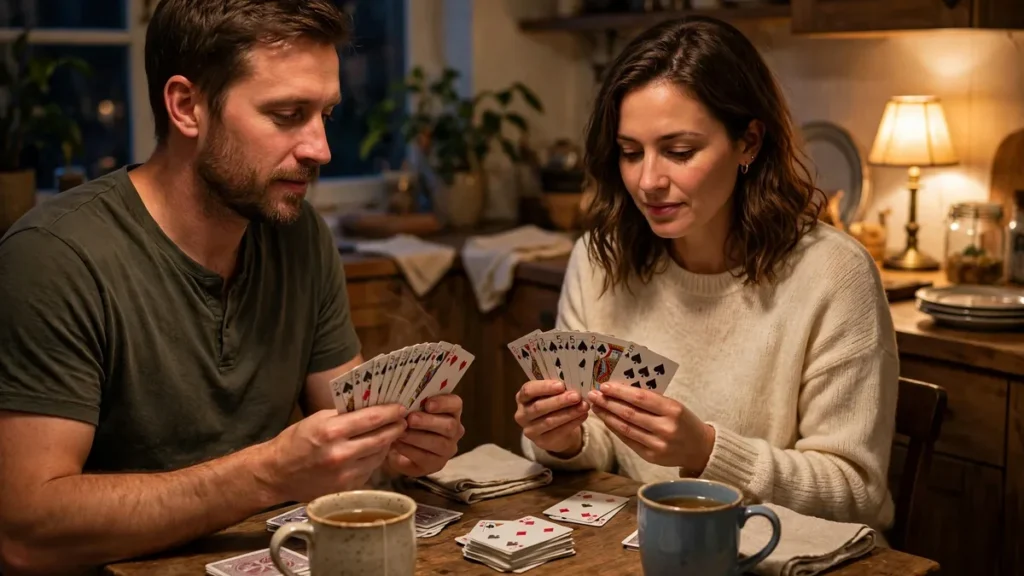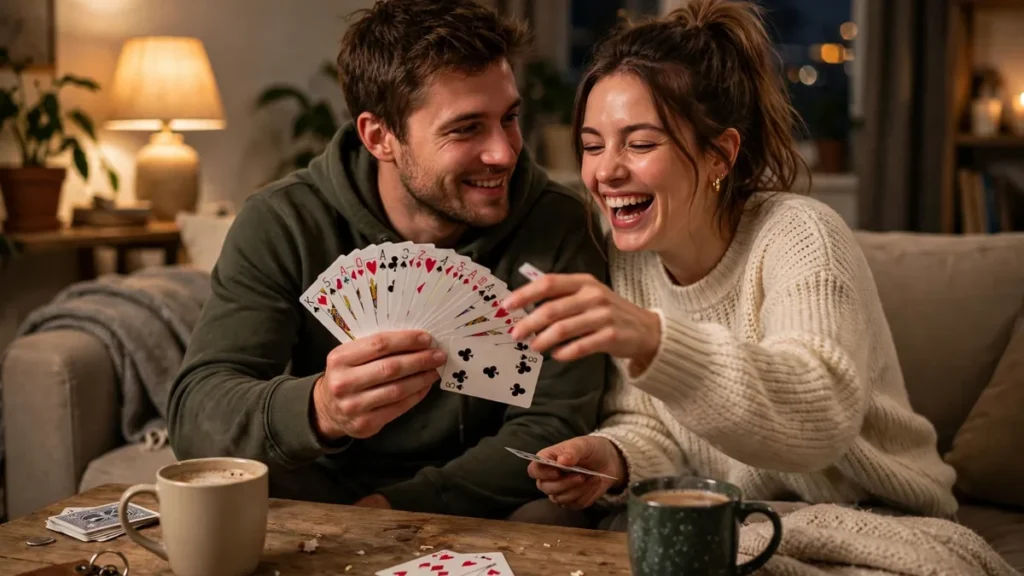
Somewhere in the second year of our relationship, my partner came home with a deck of cards and a plan. He had watched a short video, learned a trick in which a chosen card somehow ended up on top of the deck, and he wanted to show me. He fanned the cards, asked me to pick one, and then dropped half the deck on the kitchen floor. We both stared at the mess. Then we both started laughing, and we spent the next twenty minutes picking cards up off the tiles and trying to work out what had gone wrong. That evening did not make either of us a magician. It did show us something useful: a trick shared between two people who live together is a different creature from a trick performed for a room full of guests, and it deserves its own honest answer.
So, are magic tricks good for couples? My answer is yes, mostly, and the mostly matters. A trick can be a lovely shared project for two people: cheap, portable, and funny in a way that belongs only to the two of you. It can also be a surprisingly efficient way to annoy the person you love, if one of you turns it into a nightly performance and the other one into an audience that never asked to be there. The difference is not talent. It is how the two of you treat the trick, and each other, while you are learning it.
Key takeaways
- Magic suits couples best as a shared activity, not as one partner’s act and the other’s audience.
- The strongest gains are shared laughter, a low-cost thing to do together at home, and the pleasure of learning something side by side.
- The real risks are repetition, one-sided performing, teasing that lands wrong, and spending money on props neither of you needs.
- A trick that flops in front of your partner is only a problem if someone makes it one. Laugh, reset, and try again, or put the cards away.
- Choose tricks both of you can do, that neither of you minds seeing twice, and that leave the volunteer looking clever rather than caught out.
Why a couple is a different audience
A stranger watching a trick has one job: to be surprised. Your partner has a much harder job. They have to be surprised by someone they have already seen burn toast, lose their keys, and fall asleep during a film. That familiarity changes everything, and it cuts both ways. On the one hand, your partner is the kindest audience you will ever have. They already like you, they want you to succeed, and they will laugh at a flop that would silence a room. On the other hand, they are the hardest audience to fool, because they know your habits. They know when you are concentrating too hard, they know which hand you favour, and they have seen you practise the same move six times in the kitchen.
There is a second difference worth naming. Most pastimes for two people need both of you to be good at the same thing at the same time. A trick does not. One of you can be the performer tonight and the spectator tomorrow, and both roles are genuinely enjoyable. The spectator gets the surprise, the performer gets the thrill of pulling it off, and neither role is a consolation prize. That swap matters, because it stops the hobby from belonging to one person. A shared pastime that only one of you actually does is not shared at all, and couples notice that quickly, even if nobody says it out loud.
Learning tricks together, not at each other
The best version of this hobby starts with both of you learning. Sit down with one simple trick, the kind that uses ordinary objects and takes an evening to get roughly right, and learn it together. One of you reads the steps aloud while the other tries the moves. Then swap. You will both be bad at first, and that is the point: being bad at something together is far more fun than being bad at it alone. The early failures become shared jokes instead of private embarrassments, and the first time a trick works, you both feel like you earned it.
Learning together also solves the practice problem. A trick needs repeating, and repeating anything alone in a spare room feels like homework after the third night. Repeating it with your partner sitting opposite you, guessing, laughing, and occasionally spotting the move, feels like a game. Keep the sessions short. Twenty minutes is plenty, and two or three short evenings a week will take you further than one long weekend slog. Stop while it is still fun, not when one of you is tired and the other is determined to get it right.
A word about teaching each other: be gentle. The person who learns a move first will be tempted to correct the other one constantly, and constant correction is the fastest way to make a shared hobby feel like a lesson. Let your partner find their own way to hold the cards, even if it looks wrong to you. Offer one suggestion, then leave it alone. The goal is not a polished performance. The goal is an evening you both enjoyed, and a trick that mostly works is more than enough for that. If you want more ideas for things to play together at home, the best word games for couples pair well with a deck of cards on the same evening.
Performing for the person who knows you best
Performing for your partner is a strange pleasure, because the audience is also your toughest critic and your biggest fan at the same time. They will gasp at a trick that works, and they will also, lovingly, tell you exactly where they think they saw the move. That honesty is a gift, even when it stings. A guest will clap politely and say nothing. Your partner will say, “I saw you hide that card,” and then ask you to do it again, slower, so they can watch properly. That second performance, the one where the trick is examined rather than simply admired, is often the more enjoyable of the two, because it turns a show into a conversation.

When a trick falls flat between partners
Every couple who tries this will have a flop, and most will have several. The card ends up in the wrong place, the coin drops on the floor, the reveal arrives a full ten seconds before it was supposed to. In front of strangers, a flop is embarrassing. In front of your partner, it is only embarrassing if someone decides it is. The couples who enjoy magic are the ones who have agreed, without ever saying it, that a failed trick is funny rather than shameful. They laugh, they pick the cards up, and they move on to something else.
Teasing deserves a special warning, because it is the most common way a trick goes wrong between partners. A joke about a failed trick feels harmless to the person making it, and it often is, the first time. By the fifth time, it feels like a running joke at one person’s expense, and the person being teased stops wanting to perform. The same goes for the opposite habit: the performer who uses a trick to show off, or to prove they are cleverer than their partner. A trick that makes one person look foolish, even gently, is a bad trick for a couple, however impressive it looks. The audience of one you care about most should leave the moment feeling included, not outmanoeuvred.
Picking tricks that suit you both
Not every trick suits a couple, and choosing well is half the job. The best tricks for two people share a few qualities, and they are easy to test before you commit an evening to learning one. First, both of you should be able to do it. A trick that only works for someone with large hands, or long practice, will leave one partner as a permanent spectator, and that is not a shared hobby. Look for tricks built on everyday things, a pack of cards from the drawer, a coin, a ring, a serviette, and on simple moves rather than speed or nimble fingers. If a trick needs a special purchase to work, leave it on the shelf. The tricks that survive in a household are the ones you can do with whatever is already on the table.
Third, think about who the trick makes look good. The best couple tricks make the volunteer the hero: they chose the card, they named the number, they held the coin while it vanished. When the reveal lands, some of the credit should belong to them. Avoid tricks that single your partner out as the person who got it wrong, or that rely on making them look slow. A trick that leaves your partner feeling clever is one they will ask to see again. A trick that leaves them feeling caught out is one they will quietly hope you forget. And keep the cost low: a pack of cards is inexpensive, and a borrowed one is free, while a drawer full of novelty props will not make any trick better for your partner. Spend the money on a nice evening instead. If you are planning a livelier night with friends as well, the best party games for couples sit happily alongside a deck of cards.
Scorecard: magic tricks for couples
Scored out of ten, judged as a shared activity for two people at home rather than as a stage act.
| Measure | Score out of 10 | Why |
|---|---|---|
| Shared fun at home | 9 | Cheap, portable, and built around paying attention to each other. |
| Learning together | 9 | Both partners can learn side by side and swap roles freely. |
| Getting started | 9 | A pack of cards and twenty minutes is enough to begin. |
| Fits a quiet evening | 8 | Made for the sofa, the kitchen table, and a rainy night in. |
| Cost | 8 | Nearly free to start; only pricey if you chase props. |
| Pleasure as a spectator | 8 | Watching your partner perform is half the fun. |
| Survives being seen twice | 5 | A familiar watcher spots more, so rotation matters. |
| Risk of one-sidedness | 4 | Easily becomes one person’s act; needs both partners in on it. |
Our final word
Magic tricks are good for couples who treat them as something to do together, rather than something one of them does to the other. The best argument for them has nothing to do with skill and everything to do with attention: they give two people a reason to sit close, to laugh at a shared flop, to learn something side by side, and to spend an evening without a screen. The weakest version is the one where a single performer repeats the same tricks at a partner who has stopped being surprised and started being polite. That version is not a shared hobby at all, and it is the one to avoid.
Keep it mutual. Learn together, take turns, choose tricks both of you can do, and laugh when they fall apart. Keep the performances short and occasional, keep the spending low, and keep your partner looking good. Do that, and an ordinary pack of cards can turn a plain evening into a small occasion. What matters in the end is not the trick. It is the evening you spent together. If you want to turn that evening into a proper date night, the best board games for date night go nicely with a trick or two after dinner.
Questions couples keep asking
Do both partners need to learn magic, or can one of us just perform?
One performer can work for a while, but it rarely lasts. The couples who stick with magic are the ones where both people try it, even if one of them is keener. You do not both need to be good. You both need to be involved, and swapping roles keeps the hobby from becoming one person’s act.
Is it embarrassing when a trick goes wrong in front of your partner?
It can sting for a moment, but a failed trick in front of the person who knows you best is rarely remembered harshly. The awkwardness grows when the performer freezes up, argues about what happened, or tries the same trick again straight away. Own it, laugh, and move on, and your partner will move on with you.