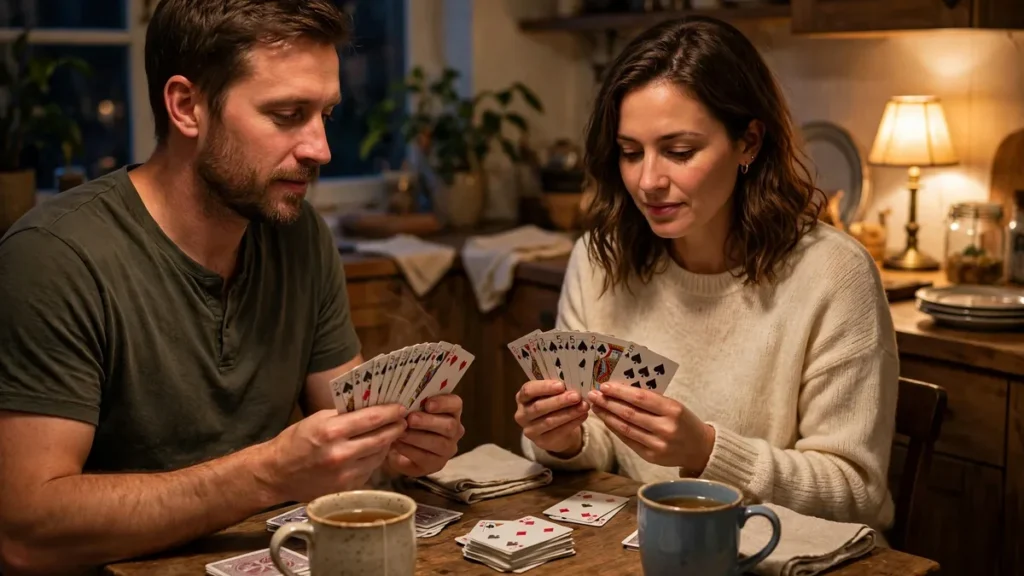
A friend once suggested a board game for a date, and my first reaction was to laugh. We were standing outside a café on a wet Thursday, trying to decide what to do with the next two hours, when she pointed at the shelf of battered boxes by the window and asked why we did not just play one of those. It sounded like a joke. An hour later we were still at the table, two cold coffees between us, arguing cheerfully over a word game neither of us could play properly, and I understood that the evening had worked in a way a meal rarely does. We had talked without once running dry, we had laughed at each other and with each other, and we had learned more in sixty minutes than a week of messaging had managed. That is my answer in short: yes, board games are good for dates, often better than the ideas people reach for first. But the yes has conditions attached, and the conditions matter, because a board game on the wrong date, in the wrong place, with the wrong game, can quietly spoil an evening that a simple walk would have saved.
What the board actually does for a date
A date has one job, and it is harder than it looks: two people who barely know each other have to find out whether they enjoy each other’s company. Most classic date ideas make that job harder. Dinner puts two strangers across a table with nothing to do but talk, which is wonderful when the talk flows and punishing when it stalls. A film gives them two hours of silence and then expects conversation to start from nothing. A board game changes the shape of the problem. It puts something between the two of you that is not the two of you, and that small shift takes the pressure off. When the talk pauses, the game fills the gap. When it flows, the game gives it somewhere to go. Every turn is a small event worth commenting on: a lucky roll, a bad draw, a move that backfires beautifully. You never have to reach for a subject, because the next one arrives in thirty seconds.
The second thing a board does is show you the other person without anyone asking a direct question. You find out whether your date can laugh at their own bad luck, whether they plan ahead or grab the first move that looks fun, whether they are generous when they win and gracious when they lose. None of that comes from a list of hobbies, and all of it matters more. A date is, at heart, a chance to see how someone behaves when things do not go their way, and a game runs that trial gently, in miniature, with nothing real at stake. There is a third benefit, quieter than the first two. A game gives a date a shape. It starts, it runs for a known length of time, and it ends, and the ending is nobody’s decision. Nobody has to decide whether ordering dessert means the night should continue, or whether standing up means it should end. If the evening has gone well, there is time for a drink afterwards. If it has not, there is a clean exit that does not feel like a rejection.
The first date is the hardest test
The setting matters too. Play somewhere public, somewhere with other people around and a clear way to leave: a board game café, a pub with a games shelf, a coffee shop with a small table. Never a first date at home, however tempting the shelf of games looks, because a home date asks for a level of trust the two of you have not built yet, and no game will fix that. Keep the first game short on purpose. A twenty-minute game leaves room for talking before and after, and the talking is the point. A game that swallows the whole evening leaves two people who have played together but barely spoken, and that is a strange way to spend a first meeting. One more trap: the person who knows the game too well. If you have played it fifty times and your date has never seen it, winning easily proves nothing except that you have had more practice. Pick a game neither of you knows, or one simple enough that experience barely matters, and teach it the way you would want to be taught: quickly, lightly, without correcting every move.
By the second or third date, the game gets better
By the second or third date, the verdict shifts, and this is where board games are at their strongest. You already know the basics about each other, you already share a few private jokes, and the game stops being a way to fill silence and starts being something you enjoy together. You can try a longer game now, or one where you team up against the board, because the evening no longer depends on the game to carry it. You also know enough to guess what your date will enjoy: the word lover will light up at a vocabulary game, the planner will relish something with a little strategy, the person who laughs easily will love anything silly. That knowledge is half the fun, and it is the part a first date cannot offer. Once the two of you are settled, the question changes, and our verdict on whether board games are good for couples takes that longer view.

Conversation or competition: the tension at the heart of it
Every board game date sits on the same fault line. A game is both a conversation and a contest, and the two pull in opposite directions. The conversation wants you relaxed, open, and paying attention to each other. The contest wants you focused, sharp, and trying to win. Most of the time those two sit happily side by side, and the teasing that comes with a close game is part of the charm. But when the contest takes over, the date suffers. The person who starts keeping a mental tally stops listening. The person who corrects every rule stops being fun to be around. The person who cannot bear to lose a round of a silly card game is showing you something real, and it is not flattering.
The way through is to choose the balance deliberately, before you start. If either of you is competitive by nature, or if it is early and you are still learning how the other person takes a loss, lean towards games where you solve something together, where a bad draw is a shared problem instead of one person’s triumph. Team games are the safest shape for a date, because the result belongs to both of you and there is nothing to keep count of. If you both enjoy a bit of spark, a gentle head-to-head game is wonderful, provided the stakes stay low and the teasing stays kind. The rule that has saved more game dates than any other is simple: play for the fun of it, and let the loser choose the next game. It turns a loss into a small privilege instead of a small defeat, and it keeps the evening moving. Losing well is a skill, and a date is a kind place to practise it, because the stakes are tiny and the audience is one person who probably wants to like you.
When it goes wrong
A board game sinks a date most often through length. A game that runs past an hour will lose one of you, and a bored person does not become charming again just because the game eventually ends. Choose short games for dates, full stop: twenty to forty minutes, with a clear end, and if the first game finishes and you both want more, play it again or pick another short one. Nobody ever complained that a date ended while they were still enjoying the game. The second way it fails is the rules lecture. A game with a thick rulebook, or a host who insists on explaining every exception before the first move, turns a date into a classroom, and nobody came out for a lesson. If the rules take longer than five minutes to explain, the game is wrong for a date, however good it is on a games night with friends.
Picking a game that fits a date, not a game night
Choosing for a date is a different skill from choosing for a games night, and the criteria are almost the opposite. A games night rewards depth, length, and complexity, because everyone there already loves games. A date rewards the opposite: something quick to teach, quick to finish, and made for exactly two players. A game designed for two keeps the pace snappy and the downtime at zero, which is what you want when the point is the company, not the contest. A game designed for six and squeezed down to two will feel thin and slow, and both of you will feel it even if neither of you can name it. Think in types rather than titles, because the type is what decides the evening. A light word game suits a first date, because it sparks talk and laughter without asking anyone to think too hard. A team game suits a date where you want to feel like a pair, or where one of you hates losing. A short, gentle duel suits a couple who already know they enjoy a little rivalry. A party game built for a crowd suits almost nobody on a date with two people. If you want named suggestions to match these types, our roundup of the best board games for date night lists ten proven picks with honest play times and prices, and it is a better place to choose a title than any single verdict can be.
| Stage of dating | Verdict | Best shape for the evening | Watch out for |
|---|---|---|---|
| First date | Good, with care | One short, light game in a public place, twenty minutes at most | Long rules, home venues, games one of you already dominates |
| Second or third date | Excellent | Two or three short games, or one team game, matched to what you now know they enjoy | Letting the game swallow the whole evening so you barely talk |
| Established couple | Very good | A planned outing with a game at its centre, phones set aside, a clear finish time | Scorekeeping across weeks, and games that end in real arguments |
The verdict
So, are board games good for dates? My answer is yes, and more often than the usual date ideas deserve. They give a date talk without pressure, a shared task without awkwardness, a natural ending without anyone having to engineer one, and a clearer picture of the other person than a meal or a film will offer. They shine brightest once you are past the first couple of dates, in a public place, with a short game made for two, played by two people who care more about the evening than the result. The exceptions are real but narrow: a game that is too long, too complicated, or too competitive for the pair playing it, a venue that does not fit the game, a first date at home, or either person treating the result as something worth arguing about. Steer clear of those and the evening largely takes care of itself. The test is simple, and it costs one evening. Suggest a short game at a café, somewhere public and easy to leave, and see what happens. If the time flies and you both want another round, you have your answer, and you have also had a good date. If it drags and you are both glad when it ends, you have your answer too, and it costs you nothing to have learned it. Whatever the result, you will have spent the evening facing the person across the table, talking, laughing, and finding out what they are like when something small is at stake. That is what a date is for, and a board game, chosen well, is one of the better ways to get there. If you are weighing the board against a quiz night instead, our honest verdict on whether trivia nights are good for dates sets out the other side of that choice.